 Arabic
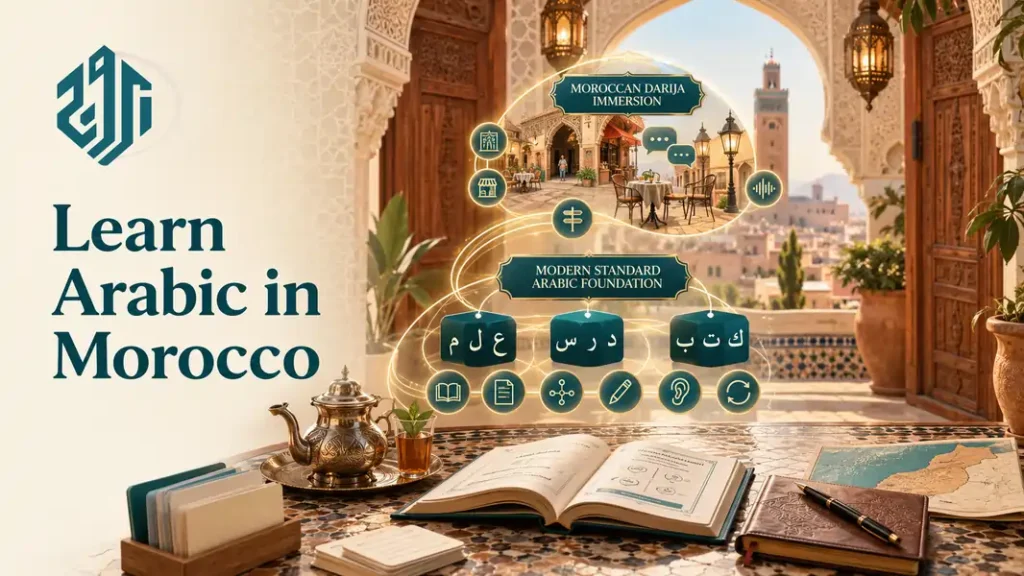
Dreaming of studying Arabic in the winding medinas of Fes or the coastal calm of Rabat? Morocco has become one of the most popular destinations for Arabic learners worldwide.
Yes, you can learn Arabic in Morocco through immersive language centers, homestays, and structured courses. Most programs teach both Modern Standard Arabic and Moroccan Darija, giving learners practical speaking skills alongside formal grammar foundations for reading and writing.
Table of Contents:
Why Do Learners Choose Morocco to Study Arabic?
Morocco combines affordable living costs, welcoming host families, and daily exposure to spoken Arabic in markets, taxis, and cafés. This mix of structured classroom time and constant real-world practice accelerates listening comprehension in ways classroom-only study rarely matches.
Beyond the language itself, students gain cultural context that textbooks cannot teach. Understanding when to use formal greetings versus casual ones, how bargaining conversations unfold, or why certain phrases carry religious weight all becomes intuitive through daily immersion.
Students who’ve already practiced live conversation before arriving adjust to the fast pace of Darija far more smoothly than complete beginners.
This is exactly why building a strong Arabic foundation before or alongside a Morocco trip matters so much.
At Buruj Academy, our Online Arabic Classes use the context-before-abstraction method, teaching Arabic through meaningful words and phrases from day one, guided by expert instructors with 12+ years of experience.
Book your FREE Arabic trial online Arabic class at Buruj

What is the offline Moroccan Center for Arabic Studies?
The Moroccan Center for Arabic Studies, known as MCAS, is a well-established language school located in the Medina of Rabat. Founded in 2010 by university academics, it has become one of Morocco’s most recognized destinations for foreign Arabic learners.
MCAS offers Modern Standard Arabic and Colloquial Moroccan Arabic courses year-round. Students typically stay with local host families, which reinforces classroom learning through daily conversation, shared meals, and cultural immersion outside formal lesson hours.
The center runs on a minimum two-week enrollment period, with new intakes starting every two weeks across all proficiency levels. This flexible structure suits both short visits and multi-month stays.
Other centers, including Qalam wa Lawh and Al Minbar Institute, offer similar immersive programs in Rabat, giving learners several reputable options to compare based on budget, schedule, and teaching style.
| Center | Location | Course Focus |
| Moroccan Center for Arabic Studies (MCAS) | Rabat Medina | MSA + Darija, homestays |
| Qalam wa Lawh | Rabat | MSA + Darija, academic credit options |
| Al Minbar Institute | Rabat city center | MSA + Darija, flexible housing |
These centers show that in-person immersion works best when paired with consistent structured study, since a two-week trip alone rarely builds lasting fluency.
Read More: The Most Common Egyptian Arabic Words and Meanings
Is It Hard to Learn Moroccan Arabic?
Moroccan Arabic, or Darija, is easier to pick up conversationally than Modern Standard Arabic because its grammar has been simplified for everyday speech. Pronunciation and vocabulary mixing remain the biggest early hurdles for new learners.
Darija blends Classical Arabic roots with Amazigh, French, and Spanish influences, which is why it sounds different from Arabic spoken in Egypt or the Gulf.
Moroccan Arabic is easier to learn than Modern Standard Arabic because the vocabulary and grammar have been greatly simplified for ease of communication.
That said, pronunciation is a major area of difficulty when learning Arabic, and Darija adds fast speech patterns and dropped vowels on top of that challenge.
Read More: Learn Arabic in Amman, Jordan
Why Does Darija Sound So Different From Standard Arabic?
Moroccan Darija shares an estimated 70-75% of its vocabulary with Modern Standard Arabic, which makes it a genuinely useful starting point for broader Arabic study. The remaining vocabulary draws from Amazigh, French, and Spanish.
This mixed vocabulary explains why someone fluent in Modern Standard Arabic can still struggle to follow a fast conversation in a Marrakech souk. Word order, verb conjugation, and everyday vocabulary all shift in Darija.
We consistently notice that students with prior MSA grammar knowledge adapt to Darija far faster than complete beginners, since they already recognize root letters even when the surface pronunciation changes.
Building that MSA foundation first is where a structured Arabic for Beginners course becomes valuable — it gives learners the grammatical scaffolding that makes any dialect, including Darija, easier to decode later.
Begin learning Arabic at Buruj with a FREE trial lesson
Discover the Buruj Academy Difference
Step into our virtual classrooms and see how our expert instructors make learning Quran and Arabic intuitive and clear. We focus on overcoming the specific hurdles non-native speakers face, building your confidence and connection with the Quran.
Master the Arabic Language
Join our expert-led courses and build a strong foundation in Classical and Modern Arabic.
Get Your Free TrialHow Do You Say Hi in Moroccan Arabic?
The most common way to say hello in Moroccan Arabic is “Salam” (سلام), short for the fuller Islamic greeting “Salam alaykum.” Moroccans use “Labas?” immediately afterward to casually ask how someone is doing.
The most common greeting in Moroccan Arabic (Darija) is “Salam” (سلام), short for “As-Salamu Alaykum”, which means “peace be upon you”. You can respond with “Wa Alaykum Salam” to return the greeting politely.
“Labas?” literally means “Are you well?” but it functions as a casual “hello, how are you?” and is frequently used between friends, family members, or colleagues.
Read also: Modern Standard Arabic vs Egyptian Arabic
Common Moroccan Arabic Greetings Table
| Darija Phrase | Meaning | When to Use |
| Salam / Salam alaykum | Hello / Peace be upon you | Anytime, formal or casual |
| Labas? | How are you? | Casual, with friends or acquaintances |
| Sbah lkhir | Good morning | Until midday |
| Bslama | Goodbye | Ending any conversation |
| Choukran | Thank you | Any polite exchange |
Practicing these five phrases before arriving in Morocco (or before any Arabic-speaking encounter) builds immediate confidence and signals genuine effort to native speakers.
Practice Exercise: Cover the “Meaning” column above and quiz yourself on each Darija phrase. Then reverse it — say the English meaning aloud and try recalling the Darija phrase from memory.
Read More: Learn Arabic in Lebanon
Can I Speak Arabic in Morocco?
Yes, Arabic speakers can absolutely communicate in Morocco, though the everyday spoken language is Darija rather than formal Modern Standard Arabic. Most Moroccans can understand Modern Standard Arabic, but Moroccan Arabic is more commonly used in daily life.
If you speak Modern Standard Arabic (Fusha), Moroccans will generally understand you in formal settings — universities, government offices, and media contexts. Street conversations, however, default to Darija almost immediately.
A common mistake when learning Moroccan Arabic is starting with classical Arabic, since street conversations in Morocco sound like a completely different language from what most Arabic textbooks teach.
In our sessions, we advise students planning a Morocco trip to build strong MSA fundamentals first, then layer Darija vocabulary on top — this order prevents the confusion of learning two systems simultaneously from scratch.
French also plays a major role in Moroccan daily life, particularly in cities like Casablanca and Rabat, so many locals code-switch fluidly between Darija, French, and occasional Modern Standard Arabic.
Read also: Can You Learn Arabic in 5 Minutes a Day?
What Are the Most Practical Ways to Learn Arabic Before Traveling to Morocco?
Building Arabic skills before arrival means combining structured grammar study with active listening practice in Darija-specific content. This dual approach prevents the common shock of understanding textbook Arabic but not street conversation.
Master the Alphabet and Core Grammar First
Every successful Morocco-bound learner benefits from solid alphabet recognition and basic grammar before layering dialect vocabulary on top. Skipping this step often leads to memorizing phrases without understanding their structure.
Resources like our guide on the Arabic alphabet with pictures for kids and how to learn the Arabic alphabet build this foundation for learners of any age.
Understanding Arabic sentence structure and core grammar patterns also makes it far easier to recognize familiar roots inside unfamiliar Darija words later on.
Practice Arabic Speaking Daily With Real Feedback
Reading about Darija greetings is useful, but speaking them aloud with correction is what builds lasting fluency. Self-study alone often reinforces small pronunciation errors that become harder to fix over time.
Through Buruj Academy’s Arabic Speaking Course, students get structured conversation practice that eliminates hesitation and builds natural fluency through real-time instructor feedback — the same skill that makes Morocco travel far less intimidating.
Book your free trial to start speaking Arabic fluently

Practice Exercise: Record yourself saying “Salam, labas?” and the reply “Labas, lhamdullah” three times daily for one week. Compare your week-one and week-seven recordings to track pronunciation progress.
Build Your Arabic Foundation With Buruj Academy Before Your Morocco Journey
Preparing for Morocco starts with real Arabic skills, not just memorized phrases. Buruj Academy helps learners build that foundation with structure and confidence.
Our online Arabic classes are taught by instructors with 12+ years of experience teaching non-Arabic speakers worldwide. We use the Buruj Method’s context-before-abstraction approach, personalized learning plans, and flexible 1-on-1 scheduling across time zones.
Whether you’re a complete beginner or refreshing rusty grammar before travel, our online Arabic classes for beginners provide real-time pronunciation correction from day one.
Book a free trial lesson today and start speaking with genuine confidence before you ever set foot in Morocco.
Begin your transformation today by choosing the path that fits your goals:
- Online Arabic Classes (General & Comprehensive)
- Arabic Course for Beginners
- Arabic Alphabet Learning Course
- Online Arabic Classes for Kids
- Arabic Classes for Adults
- Arabic Grammar Course (Nahw & Sarf)
- Intermediate Arabic Course (B1/B2)
- Arabic Speaking Course (Conversational Fluency)
- Arabic Reading Course (Literary Excellence)
- Learn Arabic Writing Course (Calligraphy & Composition)
Ready to speak with confidence? Join the global community at Buruj Academy and book your free placement interview today!
Master the Arabic Language
Join our expert-led courses and build a strong foundation in Classical and Modern Arabic.
Get Your Free TrialConclusion
Learning Arabic in Morocco works best as a partnership between structured study and real immersion, not immersion alone. Whether through a Rabat-based center or online instruction beforehand, the fastest path to confidence combines Modern Standard Arabic fundamentals with practical Darija phrases.
Morocco rewards learners who arrive prepared rather than starting from zero. A few weeks of grammar basics and greeting practice transform a two-week homestay from overwhelming into genuinely enjoyable.
Whatever stage you’re at, consistent daily practice — even just fifteen minutes — builds the foundation every successful Morocco-bound Arabic learner eventually relies on.
Frequently Asked Questions About Learning Arabic in Morocco
Is It Hard to Learn Moroccan Arabic?
Moroccan Arabic is more approachable conversationally than Modern Standard Arabic since its grammar is simplified for daily speech. The main challenges are fast pronunciation, dropped vowels, and vocabulary borrowed from French, Spanish, and Amazigh languages.
How Do You Say “Hi” in Moroccan?
“Salam” or the fuller “Salam alaykum” means hello in Moroccan Arabic. Moroccans typically follow it with “Labas?” (are you well?) as a casual way of asking how someone is doing.
Can I Speak Arabic in Morocco?
Yes, though most daily conversations happen in Darija rather than Modern Standard Arabic. Formal Modern Standard Arabic is understood in universities, government settings, and media, but street-level interactions default to the local dialect.
What Is the Moroccan Center for Arabic Studies?
MCAS is a Rabat-based language school offering Modern Standard Arabic and Darija courses with homestay accommodations. It welcomes learners at every proficiency level with flexible two-week minimum enrollment periods.
Should I Learn Modern Standard Arabic or Darija First?
Building Modern Standard Arabic grammar fundamentals first generally makes Darija easier to absorb later, since roughly 70–75% of Darija vocabulary shares roots with MSA. Layering dialect phrases onto existing grammar knowledge prevents early confusion.