 Arabic
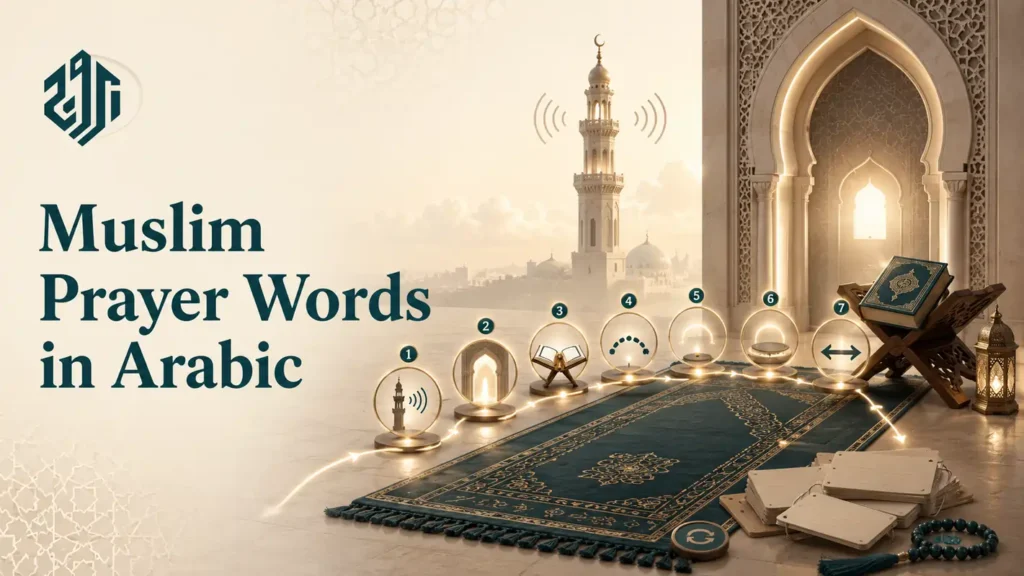
Learning the exact Arabic words spoken during Salah often feels overwhelming for new Muslims, especially when transliterations vary across websites and books. Getting the pronunciation right matters, because these words form the actual content of worship five times a day.
Muslim prayer words in Arabic include Takbir (“Allahu Akbar”), Al-Fatihah, Tasbih phrases during bowing and prostration, and Tashahhud during the seated position. Each phrase has a fixed Arabic text, a specific place in the prayer, and a precise meaning rooted in Quranic and Hadith tradition.
Table of Contents:
What Are the Call to Prayer Words in Arabic?
The Adhan, the Islamic call to prayer, consists of fifteen fixed Arabic phrases announced five times daily, beginning with four repetitions of “Allahu Akbar” and ending with the declaration of Allah’s Oneness. Each phrase is repeated twice, except the opening Takbir and closing testimony.
| Phrase | Arabic | Meaning |
| Opening Takbir | اللَّهُ أَكْبَرُ (×4) | Allah is the Greatest |
| First testimony | أَشْهَدُ أَنْ لَا إِلَٰهَ إِلَّا اللَّهُ (×2) | I testify none deserves worship but Allah |
| Second testimony | أَشْهَدُ أَنَّ مُحَمَّدًا رَسُولُ اللَّهِ (×2) | I testify Muhammad is Allah’s Messenger |
| Call to prayer | حَيَّ عَلَى الصَّلَاةِ (×2) | Hasten to the prayer |
| Call to success | حَيَّ عَلَى الْفَلَاحِ (×2) | Hasten to success |
| Closing Takbir | اللَّهُ أَكْبَرُ اللَّهُ أَكْبَرُ (×2) | Allah is the Greatest |
| Closing declaration | لَا إِلَٰهَ إِلَّا اللَّهُ (×1) | There is no god but Allah |
For the Fajr Adhan specifically, the phrase “As-Salatu Khayrun Minan-Nawm” (prayer is better than sleep) is inserted twice after the call to success — a distinction unique to the dawn prayer.
How the Response to the Adhan Differs From the Call Itself
When hearing the Adhan, listeners repeat each phrase after the muezzin, except during “Hayya ‘alas-Salah” and “Hayya ‘alal-Falah,” where the correct response is “La hawla wa la quwwata illa billah” (there is no might nor power except with Allah) rather than a direct repetition. This distinction trips up many new Muslims who repeat every line identically.
What Are the Core Muslim Prayer Words in Arabic Used in Salah?
Salah is built from a set sequence of Arabic phrases, each tied to a specific physical position: standing, bowing, prostrating, and sitting. Together these words form roughly 25 core phrases recited in every complete prayer cycle. Understanding this sequence gives structure to what can otherwise feel like memorizing disconnected sounds.
We’ve noticed that students at Buruj Academy often try to memorize Salah phrase by phrase without connecting each one to its physical position. This makes recall harder under the pressure of live prayer.
We teach the opposite approach: link every phrase to the movement it accompanies. Once a student associates “Allahu Akbar” with the physical act of raising the hands, the word becomes automatic rather than something they have to consciously recall.
This is precisely the foundation covered in our Islamic studies classes, where instructors walk students through each prayer position alongside its corresponding Arabic text.
Begin Your Islamic Knowledge Journey With a FREE Trial Lesson

The Takbir in Arabic That Opens Every Prayer
Takbir is the declaration “Allahu Akbar” (Allah is the Greatest), spoken while raising both hands to shoulder or ear level at the start of Salah. This single phrase, called Takbiratul Ihram, marks the formal entry into prayer and is repeated at nearly every transition between positions.
اللَّهُ أَكْبَرُ
Allahu Akbar
“Allah is the Greatest”
This phrase transitions the worshipper between standing, bowing, and prostrating — it is repeated more than any other phrase in Salah
Non-Arabic speakers sometimes rush this phrase, clipping the final “r” sound. In our sessions, we ask students to hold the vowel on “Akbar” slightly longer, which naturally slows the pace and improves clarity in congregational prayer.
Read More: Muslim Words Used in Daily Life
What Is Recited During Al-Fatihah in Every Rak’ah in Arabic?
Al-Fatihah, the Quran’s opening chapter, is recited in full during every single Rak’ah of every prayer, making it the most repeated passage in a practicing Muslim’s life.
Its seven verses summarize praise of Allah, a declaration of worship, and a request for guidance, and reciting it correctly is obligatory for a valid Salah.
بِسْمِ اللَّهِ الرَّحْمَٰنِ الرَّحِيمِ ﴿١﴾ الْحَمْدُ لِلَّهِ رَبِّ الْعَالَمِينَ ﴿٢﴾ الرَّحْمَٰنِ الرَّحِيمِ ﴿٣﴾ مَالِكِ يَوْمِ الدِّينِ ﴿٤﴾ إِيَّاكَ نَعْبُدُ وَإِيَّاكَ نَسْتَعِينُ ﴿٥﴾ اهْدِنَا الصِّرَاطَ الْمُسْتَقِيمَ ﴿٦﴾ صِرَاطَ الَّذِينَ أَنْعَمْتَ عَلَيْهِمْ غَيْرِ الْمَغْضُوبِ عَلَيْهِمْ وَلَا الضَّالِّينَ ﴿٧﴾
Bismi Allahi alrrahmani alrraheemi (1) Alhamdu lillahi rabbi alAAalameena (2) Alrrahmani alrraheemi (3) Maliki yawmi alddeeni (4) Iyyaka naAAbudu waiyyaka nastaAAeenu (5) Ihdina alssirata almustaqeema (6) Sirata allatheena anAAamta AAalayhim ghayri almaghdoobi AAalayhim wala alddalleena (7)
“In the name of Allah, the Entirely Merciful, the Especially Merciful. (1) [All] praise is [due] to Allah, Lord of the worlds – (2) The Entirely Merciful, the Especially Merciful, (3) Sovereign of the Day of Recompense. (4) It is You we worship and You we ask for help. (5) Guide us to the straight path – (6) The path of those upon whom You have bestowed favor, not of those who have evoked [Your] anger or of those who are astray. (7)” (Al-Fatihah 1:1–2)
Every letter of Al-Fatihah carries Tajweed rules — including madd, ghunnah, and qalqalah — that shape correct recitation
We consistently see one pattern among adult beginners: they memorize Al-Fatihah’s words accurately but recite it flat, without the natural pauses (waqf) that Arabic phrasing requires.
Correcting this rhythm typically takes three to four guided sessions before it feels natural in standing prayer.
Deepening comprehension here connects directly to broader Quranic Arabic study — a path we cover in reading the Quran for the first time.
Read More: Quranic Arabic Vocabulary and Words
How Do the Arabic Words Change During Ruku and Sujud?
During Ruku (bowing) and Sujud (prostration), the worshipper recites specific Tasbih phrases that glorify Allah’s transcendence, with different wording distinguishing each posture.
Ruku uses “Subhana Rabbiyal ‘Azim,” while Sujud uses “Subhana Rabbiyal A’la” — a deliberate distinction in the Arabic text itself.
| Position | Arabic Phrase | Transliteration | Meaning |
| Ruku (bowing) | سُبْحَانَ رَبِّيَ الْعَظِيمِ | Subhana Rabbiyal ‘Azim | Glory be to my Lord, the Magnificent |
| Sujud (prostration) | سُبْحَانَ رَبِّيَ الْأَعْلَى | Subhana Rabbiyal A’la | Glory be to my Lord, the Most High |
| Rising from Ruku | سَمِعَ اللَّهُ لِمَنْ حَمِدَهُ | Sami’Allahu liman hamidah | Allah hears the one who praises Him |
This table highlights how each posture pairs with wording that reflects its physical meaning — humility in bowing, complete submission in prostration.
Common Pronunciation Errors With Tasbih Phrases
Students frequently confuse “‘Azim” and “A’la” early on, applying the Ruku phrase during Sujud out of habit.
We address this by having students physically feel the difference: the tongue position for the letter Ain in “A’la” sits differently than in “‘Azim,” and once students isolate that makhraj, the confusion tends to disappear within a week.
Mastering these distinctions is a core focus of our Quranic Arabic Course, where Ijazah-certified instructors train the ear before introducing rule terminology — a pillar of the Buruj Method.
Begin Understanding Quranic Arabic with a FREE Lesson
Discover the Buruj Academy Difference
Step into our virtual classrooms and see how our expert instructors make learning Quran and Arabic intuitive and clear. We focus on overcoming the specific hurdles non-native speakers face, building your confidence and connection with the Quran.
Master the Arabic Language
Join our expert-led courses and build a strong foundation in Classical and Modern Arabic.
Get Your Free TrialRead also:Powerful Quran Verses About Prayer
What Is the Tashahhud Arabic Words in the Prayer?
Tashahhud, also called At-Tahiyyat, is recited while seated after the second Rak’ah in prayers of three or four units, and again in the final sitting of every prayer. It affirms the testimony of faith and greets Prophet Muhammad ﷺ, functioning as a declaration recited from memory multiple times daily.
التَّحِيَّاتُ لِلَّهِ وَالصَّلَوَاتُ وَالطَّيِّبَاتُ، السَّلَامُ عَلَيْكَ أَيُّهَا النَّبِيُّ وَرَحْمَةُ اللَّهِ وَبَرَكَاتُهُ، السَّلَامُ عَلَيْنَا وَعَلَى عِبَادِ اللَّهِ الصَّالِحِينَ، أَشْهَدُ أَنْ لَا إِلَٰهَ إِلَّا اللَّهُ وَأَشْهَدُ أَنَّ مُحَمَّدًا عَبْدُهُ وَرَسُولُهُ
At-tahiyyatu lillahi was-salawatu wat-tayyibat. As-salamu ‘alayka ayyuhan-Nabiyyu wa rahmatullahi wa barakatuh. As-salamu ‘alayna wa ‘ala ‘ibadillahis-salihin. Ash-hadu an la ilaha illallah wa ash-hadu anna Muhammadan ‘abduhu wa rasuluh
“All greetings, prayers, and good things are for Allah. Peace be upon you, O Prophet, and the mercy of Allah and His blessings. Peace be upon us and upon the righteous servants of Allah. I bear witness that none has the right to be worshipped except Allah, and I bear witness that Muhammad is His slave and Messenger”
This testimony is documented in Sahih Muslim 402, narrated on the authority of Abdullah ibn Mas’ud
We find that new Muslims often treat Tashahhud as the hardest phrase to memorize, since it’s longer than most other Salah phrases.
Breaking it into four segments — praise of Allah, greeting the Prophet, peace on the righteous, and the testimony of faith — consistently makes it easier to retain than attempting it as one continuous block.
The finger-pointing gesture during the testimony is a well-documented Sunnah, described in detail in Sahih Muslim 579, where the Prophet ﷺ is reported to have pointed with his index finger while seated in Tashahhud.
Read More: Arabic Words for Beginners
Islamic Prayer Words in Arabic for Beginning and Ending Salah
Salah opens with the Niyyah (intention, made silently in the heart) and closes with Tasleem, the turning of the head to say Salam to both sides. These two bookends frame the entire prayer and carry distinct Arabic phrasing that beginners must memorize alongside the body of Salah itself.
السَّلَامُ عَلَيْكُمْ وَرَحْمَةُ اللَّهِ
As-salamu ‘alaykum wa rahmatullah
“Peace and the mercy of Allah be upon you”
Spoken twice — once turning the head to the right, once to the left — this closes the entire prayer
We regularly remind adult students that intention (Niyyah) is a heart action, not a spoken formula, which surprises many who expect a fixed Arabic phrase to memorize for this step. Some scholars consider it acceptable to verbalize the intention, though the dominant view holds that it need not be spoken aloud.
Building this entire sequence with confidence, from opening intention to final Tasleem, is the structured focus of our Online Quran Classes, designed specifically for students building Salah fluency from the ground up.
Start Learning Quran With a FREE Trial Lesson
Master Your Salah Arabic With Buruj Academy’s Expert Instructors
Correct Salah pronunciation transforms prayer from memorized sound into meaningful worship, and that shift happens fastest with structured, personalized guidance. Buruj Academy offers exactly that pathway for non-Arabic speakers at every level.
Our Online Tajweed Classes and Online Quran Classes for Beginners are taught by Ijazah-certified instructors and Al-Azhar University graduates with 12+ years teaching non-Arabic speakers globally.
Using the Buruj Method’s sound-before-rules approach, students build accurate pronunciation before tackling terminology.
Every student receives a personalized learning plan, real-time correction, and flexible 1-on-1 scheduling.
Book a free trial lesson today and start reciting Salah with clarity and confidence, insha’Allah.
Begin your transformation today by choosing the path that fits your goals:
- Online Arabic Classes (General & Comprehensive)
- Arabic Course for Beginners
- Arabic Alphabet Learning Course
- Online Arabic Classes for Kids
- Arabic Classes for Adults
- Arabic Grammar Course (Nahw & Sarf)
- Intermediate Arabic Course (B1/B2)
- Arabic Speaking Course (Conversational Fluency)
- Arabic Reading Course (Literary Excellence)
- Learn Arabic Writing Course (Calligraphy & Composition)
Ready to speak with confidence? Join the global community at Buruj Academy and book your free placement interview today!
Master the Arabic Language
Join our expert-led courses and build a strong foundation in Classical and Modern Arabic.
Get Your Free TrialConclusion
Salah’s Arabic vocabulary follows a logical, repeatable structure once each phrase is tied to its physical position in prayer. From the opening Takbir to the closing Tasleem, every word carries both linguistic precision and spiritual weight that no shortcut transliteration fully captures.
Building fluency here isn’t about memorizing sounds in isolation. It’s about understanding why each phrase sits where it does, and practicing pronunciation until the words become second nature during worship itself.
With consistent practice and proper guidance, what feels unfamiliar today becomes the quiet, confident rhythm of daily prayer, alhamdulillah.
Frequently Asked Questions About Muslim Prayer Words in Arabic
What Is the First Word Spoken in Muslim Prayer?
The first word spoken in Salah is “Allahu Akbar” (Allah is the Greatest), known as Takbiratul Ihram. This phrase is said while raising the hands to shoulder or ear level, formally marking the start of the prayer and the worshipper’s entry into a state of focused worship.
How Many Arabic Phrases Are in the Call to Prayer?
The standard Sunni Adhan contains fifteen fixed phrases, beginning with four repetitions of “Allahu Akbar” and closing with a single declaration of “La ilaha illallah.” The Fajr Adhan adds two extra repetitions of “As-Salatu Khayrun Minan-Nawm” after the call to success.
Do I Need to Understand Arabic to Pray Correctly?
Understanding the meaning deepens focus, but valid Salah requires correct pronunciation of the fixed Arabic phrases rather than full Arabic comprehension. Many students recite accurately while gradually building vocabulary knowledge over time through structured study.
What Is the Difference Between Tashahhud and Tasleem?
Tashahhud is recited while seated mid-prayer and at the end, affirming faith through the testimony “Ash-hadu an la ilaha illallah.” Tasleem is the final act of turning the head right and left while saying “As-salamu ‘alaykum,” formally closing the prayer.