 Arabic

| Key Takeaways |
| Quranic Arabic is a classical language distinct from Modern Standard Arabic, requiring specialized instruction for genuine Quran comprehension. |
| The best Quranic Arabic courses teach grammar (nahw and sarf) through actual Quranic verses, not abstract textbook exercises. |
| Core lessons in any quality course include root word analysis, verb patterns, noun declensions, and particle recognition in Quranic context. |
| Online Quranic Arabic courses with live instructors outperform self-study apps because real-time correction prevents deeply ingrained errors. |
| Buruj Academy’s Quranic Arabic course is taught by Al-Azhar graduates specializing in classical Arabic linguistics for non-native speakers. |
The best Quranic Arabic courses close that gap systematically, teaching the exact grammatical structures, vocabulary patterns, and classical Arabic logic that the Quran uses.
When you understand why a word takes a particular form in a verse, the Quran speaks to you directly — and that changes everything.
Table of Contents:
What Is a Quranic Arabic Course?
A Quranic Arabic course is a structured program teaching classical Arabic grammar, vocabulary, and syntax specifically for understanding the language of the Quran. Unlike Modern Standard Arabic (MSA) courses, which focus on contemporary media and conversation, Quranic Arabic courses target the precise linguistic register used in the Mushaf — including classical verb patterns, Quranic particles, and the root-based word system that governs the entire text.
The distinction matters enormously. Many students spend months on MSA and still find Quranic sentences structurally unfamiliar.
That is because Quranic Arabic preserves classical grammatical forms — full case endings (i’rab), classical verb conjugations, and particles that rarely appear in modern usage.
A course built around these specifics produces far faster comprehension results than a general Arabic program.
What Is the Best Quranic Arabic Course?
The best Quranic Arabic course is one that teaches classical Arabic grammar directly through Quranic verses, covers root-word analysis, i’rab, verb patterns, and particles, and delivers live instructor correction rather than pre-recorded lessons. By every one of these measures, Buruj Academy’s Quranic Arabic course stands as the strongest option available online for non-Arabic speaking Muslims.
Buruj Academy’s Quranic Arabic course is designed and delivered by Al-Azhar University graduates specializing in classical Arabic linguistics, with 12+ years of experience teaching students whose first language is not Arabic.
Every grammar rule is taught through actual Quranic verses — not textbook inventions — so comprehension builds on the very text students are trying to understand.
The curriculum follows the Buruj Method’s context-before-abstraction principle: students encounter meaning first, then the grammar that produces it. This sequence mirrors how language acquisition works naturally, and in our instructors’ experience, it produces faster and more durable comprehension than rule-first approaches.
Students who previously struggled with abstract grammar tables find that verse-based instruction makes the same rules immediately intuitive.
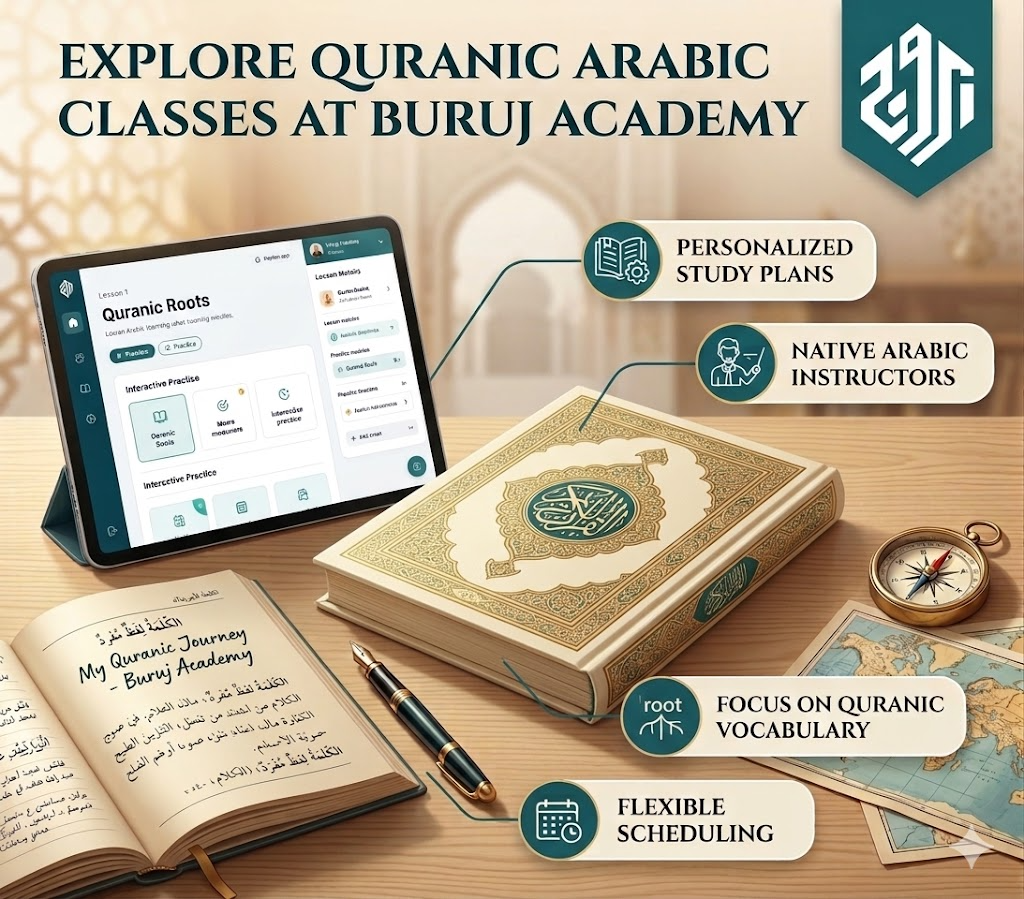
Personalized 1-on-1 sessions, flexible 24/7 scheduling, and real-time pronunciation and grammar correction ensure that no error becomes a habit.
From foundational noun structures to complex idafa constructions and particle recognition, the course takes students from zero classical Arabic knowledge to genuine, independent Quranic reading ability — with qualified instruction every step of the way.
Begin Understanding Quranic Arabic with a FREE Lesson
What Should a Learner Look for in a Quranic Arabic Course?
The single most important quality in a Quranic Arabic course is Quran-grounded instruction — every grammar rule taught through actual Quranic verses, not invented textbook sentences.
A course that teaches verb conjugation through newspaper examples trains a different muscle than one that shows you the same pattern recurring across 30 Surahs.
Beyond that foundation, look for these specific qualities before enrolling:
Does a Quranic Arabic Course Teach Root-Word Analysis?
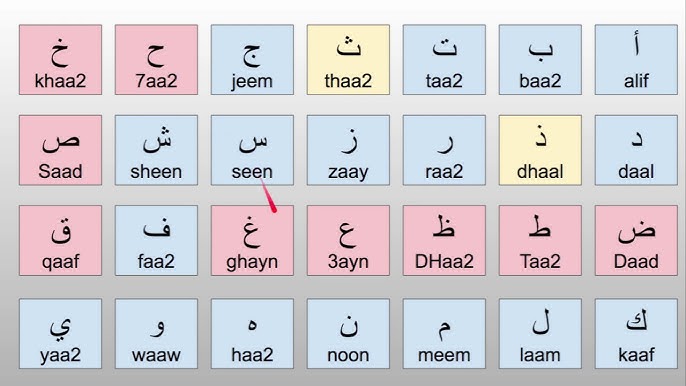
Arabic is a root-based language. Almost every word derives from a three-letter root (jidhr), and recognizing roots multiplies vocabulary acquisition dramatically.
A strong course teaches students to identify roots in unfamiliar words — so when you encounter a new word in a verse, you can often determine its meaning through its root family rather than looking it up.
Consider this verse:
إِنَّا أَنزَلْنَٰهُ قُرْءَانًا عَرَبِيًّا لَّعَلَّكُمْ تَعْقِلُونَ
Innā anzalnāhu qur’ānan ‘arabiyyan la’allakum ta’qilūn
“Indeed, We have sent it down as an Arabic Quran so that you might understand.” (Yusuf 12:2)
The word تَعْقِلُونَ derives from the root ع-ق-ل (‘aql — intellect/reason). Recognizing that root immediately connects this verse to every other Quranic reference to reason and understanding — a network of meaning no vocabulary list alone can give you.
Does a Quranic Arabic Course Cover I’rab (Case Endings)?
I’rab — the system of grammatical case endings — determines the function of every noun in a Quranic sentence. Without it, you can know every individual word yet still misread who is doing what to whom.
Quality courses teach raf’ (nominative), nasb (accusative), and jarr (genitive) not as abstract grammar but as tools for reading meaning accurately.
Is Instruction in a Quranic Arabic Course Live and Corrective?
In our years teaching at Buruj Academy, we have observed consistently that students who study Quranic Arabic through apps or pre-recorded videos plateau early. The reason is simple: classical Arabic grammar produces errors that only a trained instructor catches in real time.
Misidentifying a verbal noun (masdar) as an adjective, or misreading a construct phrase (idafa) as two separate nouns — these errors become habitual quickly.
Live, 1-on-1 instruction with real-time correction is not a luxury; it is the architecture of genuine progress.
Can a Complete Beginner Enroll in a Quranic Arabic Course?
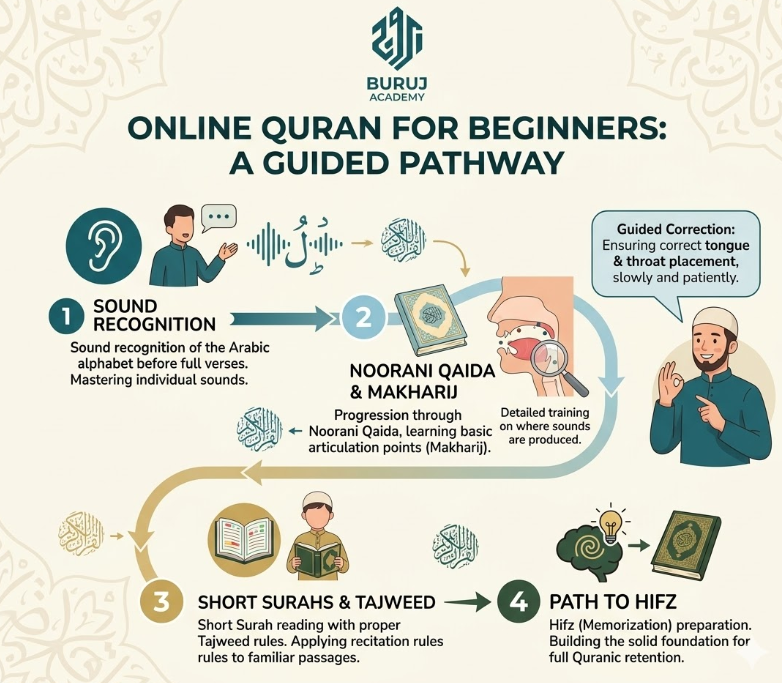
Yes — a complete beginner can enroll in a Quranic Arabic course, provided the curriculum is properly sequenced to start from Arabic script and basic nouns before advancing to syntax and verb morphology. At Buruj Academy, our Quranic Arabic for Beginners pathway starts from foundational structures. Students who cannot yet read Arabic script may benefit from completing a Quran beginner course first.
Begin Learning Quran With a FREE Trial Lesson
What Are the Recommended Features in the Best Quranic Arabic Courses?
The best online Quranic Arabic courses share a specific set of pedagogical features that separate genuine comprehension programs from basic translation classes.
These features determine whether a student moves from passive word-recognition to active grammatical understanding.
| Feature | Why It Matters | What to Avoid |
| Quran-sourced examples | Grammar becomes memorable through real verses | Textbook sentences with no Quranic connection |
| Root-system instruction | Multiplies vocabulary without rote memorization | Word-list-only approaches |
| Live instructor correction | Prevents ingrained grammatical errors | Pre-recorded-only courses |
| I’rab (case ending) training | Enables accurate sentence parsing | Courses that skip case endings entirely |
| Vocabulary in context | Words learned inside verse structures | Isolated flashcard vocabulary |
| Progressive grammar sequencing | Builds from nouns to verbs to complex sentences | Random topic-jumping |
A course carrying all six features gives students not just comprehension tools — it gives them independence as readers.
That is the goal our Quranic Arabic course works toward: students who can sit with a verse, parse it, and understand it without needing to reach for a translation.
Begin Understanding Quranic Arabic with a FREE Lesson
What Are the Main Lessons of a Quranic Arabic Course?
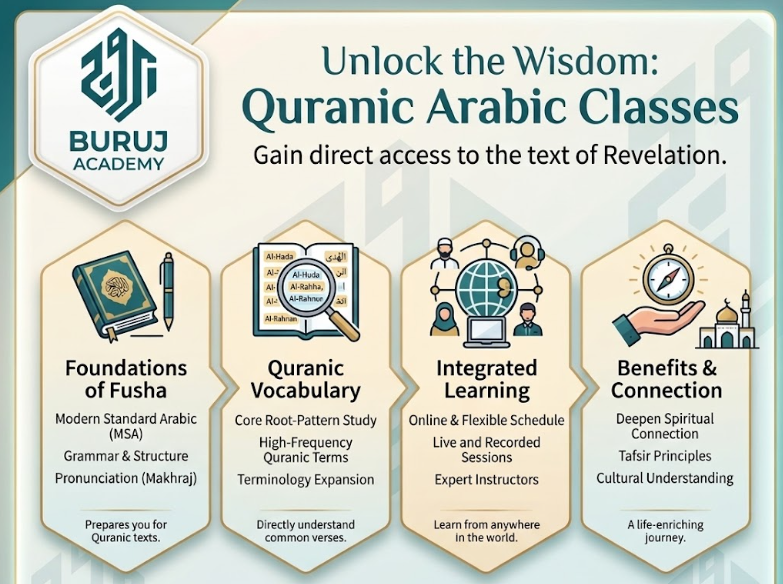
A well-structured Quranic Arabic course covers six core lesson areas, each building directly on the previous. These are the grammatical and lexical pillars the Quran’s language rests on — and every serious course must address all of them.
Lesson 1: Arabic Nouns, Gender, and Number
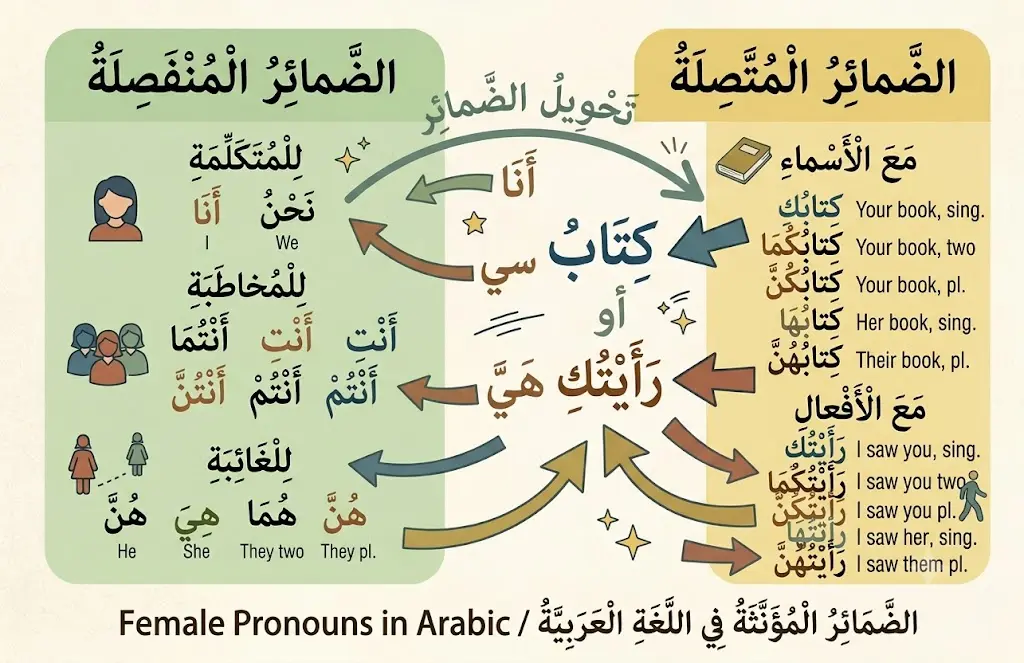
The first structural layer is noun morphology — how Arabic nouns change form based on gender (masculine/feminine), number (singular/dual/plural), and grammatical case.
Quranic Arabic uses all three number categories extensively, and plural forms are often irregular. Students who skip this layer struggle to parse even basic Quranic sentences.
Lesson 2: The Arabic Root and Pattern System (Sarf)
Sarf — morphology — teaches how three-letter roots generate entire word families through fixed patterns (awzān). The root ك-ت-ب (k-t-b, related to writing) produces كَتَبَ (he wrote), كِتَاب (book), كَاتِب (writer), مَكْتُوب (written) — and dozens more.
Teaching students to recognize these patterns accelerates Quranic vocabulary acquisition faster than any memorization method.
Lesson 3: Arabic Sentence Structure and Syntax (Nahw)
Nahw — syntax — is the grammar of how words relate to each other in a sentence. Arabic sentences follow either a verbal (fi’liyya) or nominal (ismiyya) structure. Understanding this distinction is foundational to Quranic comprehension:
وَٱللَّهُ بِكُلِّ شَىْءٍ عَلِيمٌ
Wallāhu bikulli shay’in ‘alīm
“And Allah is Knowing of all things.” (Al-Baqarah 2:282)
This is a nominal sentence: اللَّهُ is the subject (mubtada’) in the nominative case, and عَلِيمٌ is the predicate (khabar), also nominative. Recognizing this structure instantly in the Quran is a nahw skill — not a translation skill.
Read also: Benefits of Learning Quranic Arabic
Discover the Buruj Academy Difference
Step into our virtual classrooms and see how our expert instructors make learning Quran and Arabic intuitive and clear. We focus on overcoming the specific hurdles non-native speakers face, building your confidence and connection with the Quran.
Excel in Your Quranic Studies
Join Buruj Academy and master the Quran with our structured, professional curriculum.
Book Your Free TrialLesson 4: Arabic Verb Conjugations and the Ten Verb Forms
Arabic verbs change based on tense (past, present, command), gender, and number. Beyond basic conjugation, Arabic uses ten primary verb forms (awzān al-af’āl) that each carry a distinct meaning modification.
Form II adds intensity; Form III indicates reciprocal action; Form IV makes a verb causative.
These patterns appear throughout the Quran and explain meaning distinctions that translations often flatten.
Lesson 5: Particles, Prepositions, and Connectives
Quranic Arabic uses a specific set of particles (hurūf) that carry enormous grammatical and semantic weight. Words like إِنَّ (indeed/verily), لَ (truly/for emphasis), فَ (so/then), وَ (and/by oath), and مَا (that which/not) shift meaning at the sentence level.
Many translation errors trace directly to misidentifying these particles. A serious Quranic Arabic course dedicates substantial attention to them.
Read also:Top Quranic Arabic Books for Non-Arabic Speakers
Lesson 6: The Idafa (Construct Phrase) and Adjectival Agreement
Idafa — the construct phrase linking two nouns — is one of the most frequent structures in the Quran. كِتَابُ ٱللَّهِ (the Book of Allah), رَسُولُ ٱللَّهِ (the Messenger of Allah), عَذَابُ ٱلنَّارِ (the punishment of the Fire) — all are idafa structures.
Adjectives in Arabic must agree with their nouns in gender, number, case, and definiteness. Mastering these two structures alone unlocks enormous portions of Quranic text.
How Does Learning Quranic Arabic Improve Your Quran Connection?
Learning Quranic Arabic fundamentally transforms how you experience the Quran — not as a translated text you follow, but as a living message you hear directly. When you recognize grammar patterns in recitation, meaning arrives in real time. When you understand a verse’s structure, its emphasis, its repeated root — that is when the Quran begins to speak.
Students in our Quranic Arabic course for beginners regularly describe this moment — usually around the third month — as “the Quran opening up.” Before, they heard words. After, they hear meaning.
Begin Understanding Quranic Arabic with a FREE Lesson
This connection extends naturally to recitation itself. Students who understand what they are saying recite with different attention — their focus sharpens, their khushoo’ (presence) deepens.
If you have already invested in learning to recite correctly through our Tajweed classes, adding Quranic Arabic is the logical next step toward full engagement with the text.
If you are on a memorization path, reviewing our guide on how to memorize Quran faster alongside Quranic Arabic study creates a powerful combined approach.
Is There a Good Quranic Arabic Course Online Free?
Free resources for Quranic Arabic do exist, and some provide genuine value — particularly for initial orientation. However, free courses carry consistent limitations that become barriers to real progress.
| Resource Type | Strengths | Limitations |
| YouTube channels | Accessible, topic-specific | No sequential curriculum, no correction |
| Free apps (Duolingo Arabic) | Building basic vocabulary | MSA-focused, no classical grammar |
| PDF grammar books | Solid reference material | No live feedback, easy to misapply |
| Free trial classes | Real instructor interaction | Limited scope before enrollment |
The pattern we observe is clear: free resources work well for vocabulary exposure and initial motivation. They break down when students need error correction, grammar sequencing, and Quran-specific application.
A student who spends three months on free resources without live correction often needs significant unlearning before structured progress can begin.
That cost — in time and correcting ingrained errors — typically exceeds what a quality paid course costs from the start.
Buruj Academy offers a free trial class for our Quranic Arabic course — giving you real, live instructor interaction before any commitment.

Learn Quranic Arabic Online Effectively
Learning Quranic Arabic online is fully achievable with the right structure, and in many ways the online format offers advantages that classroom settings cannot — primarily the ability to match instruction pace to your individual grammar needs. The following approach reflects what works for our students:
| Stage | Focus | Approximate Duration |
| Stage 1: Foundation | Nouns, pronouns, basic sentence structure | 4–6 weeks |
| Stage 2: Verb System | Past/present conjugation, Form I patterns | 6–8 weeks |
| Stage 3: Advanced Grammar | I’rab, idafa, particles, adjective agreement | 8–10 weeks |
| Stage 4: Applied Reading | Parsing Quranic verses with full grammatical analysis | Ongoing |
The durations above reflect our instructors’ estimates for students studying 3–4 sessions per week. Individual pace varies based on prior Arabic exposure and study consistency.
Consistency matters more than session length. Three 30-minute sessions per week produce more durable grammar retention than one 90-minute session, because spaced repetition allows the pattern-recognition system to consolidate between exposures.
For students who want to build the reading foundation before addressing grammar, our Quran reading course provides the phonetic base that makes Quranic Arabic study more productive from the start.
Book your Free trial lesson and start reading the Quran
Read also: Reading Quran on Water
Start Your Quranic Arabic Studies with Buruj Academy’s Expert Instructors
Understanding the Quran’s language is one of the most rewarding investments a Muslim can make — and the right course makes the difference between years of confusion and genuine, progressive comprehension.
Buruj Academy’s Quranic Arabic course is taught by Al-Azhar University graduates specializing in classical Arabic linguistics, with 12+ years of experience teaching non-native speakers.
Our curriculum applies the Buruj Method — context-before-abstraction — teaching every grammar rule through actual Quranic verses from day one.
Every student receives personalized 1-on-1 sessions, flexible 24/7 scheduling, real-time correction, and a customized learning plan built around their starting level.
Book your free trial class today and experience the difference structured, expert instruction makes.
Begin your journey of understanding by enrolling in a specialized track today:
- Quranic Arabic Classes (General & Immersive)
- Quranic Arabic Course for Kids (Interactive & Engaging)
- Quranic Arabic Course for Beginners (Foundation Building)
- Quranic Arabic Grammar Course (Syntax & Morphology)
Are you ready to understand what you recite? Join Buruj Academy today and book your free introductory session to begin your journey of discovery!
Excel in Your Quranic Studies
Join Buruj Academy and master the Quran with our structured, professional curriculum.
Book Your Free TrialConclusion
Quranic Arabic is not simply another language skill — it is the key to the Quran’s actual voice. The best courses build this comprehension systematically, teaching root analysis, grammatical case, verb patterns, and particles through the Quran’s own verses rather than abstract exercises.
Free resources offer a starting point, but live, corrective instruction is what turns grammar knowledge into genuine reading ability.
Frequently Asked Questions About Quranic Arabic Courses
What Is the Difference Between Quranic Arabic and Modern Standard Arabic?
Quranic Arabic is a classical register of Arabic preserving full case endings (i’rab), classical verb forms, and particles that rarely appear in modern usage. Modern Standard Arabic (MSA) is a contemporary standardized form used in media and formal writing. Learners seeking Quran comprehension need Quranic Arabic specifically — MSA courses alone do not adequately prepare students for the Quran’s grammatical structures.
How Long Does It Take to Learn Quranic Arabic Online?
Most dedicated students reach functional Quranic comprehension — the ability to parse most verses with grammatical analysis — within 6 to 12 months of consistent study at 3–4 sessions per week. Basic comprehension of common Quranic structures typically develops within the first 3 months. Individual timelines depend on prior Arabic exposure, session frequency, and active Quran reading practice alongside formal study.
Does Knowing Quranic Arabic Help with Quran Memorization?
Yes — significantly. Students who understand the grammatical and semantic structure of verses retain them more reliably than students relying on phonetic repetition alone. Meaning creates memory anchors that pure sound repetition cannot provide. For more on strengthening your memorization approach, our guide on the best ways to memorize Quran addresses how comprehension supports retention directly.
What Qualifications Should a Quranic Arabic Instructor Have?
A qualified Quranic Arabic instructor should hold formal credentials in Arabic linguistics from a recognized Islamic institution — ideally an Al-Azhar University degree or equivalent — combined with proven experience teaching non-native speakers. Familiarity with classical Tajweed texts and Tafsir sources is an additional marker of genuine classical Arabic competence, ensuring the instruction stays grounded in authentic scholarly tradition rather than modern simplified Arabic pedagogy.