 Arabic
| Key Takeaways |
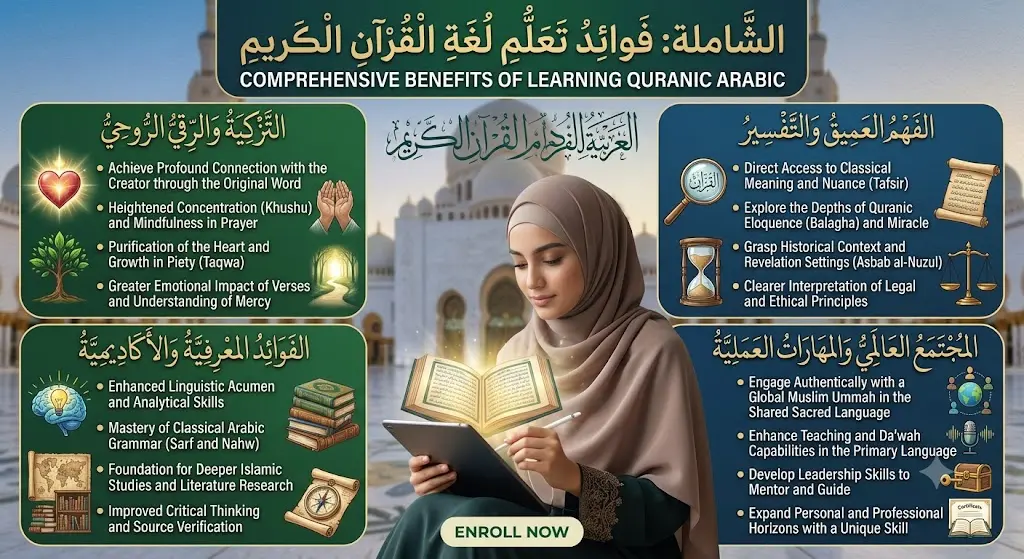
| Quranic Arabic allows Muslims to understand the Quran directly, removing dependency on translations and intermediaries. |
| Learning Quranic Arabic sharpens Tajweed accuracy because students grasp why words pause, connect, and carry specific vowel patterns. |
| Students who understand Quranic Arabic report stronger focus in Salah and a deeper emotional connection to worship. |
| Quranic Arabic builds a foundation for advanced Islamic studies, including Tafsir, Fiqh, and Hadith comprehension in classical sources. |
Every Muslim recites Arabic daily — in Salah, in du’a, in dhikr. Yet for most non-Arabic speakers, those words pass through the tongue without landing in the heart. That gap between recitation and comprehension is one of the most common struggles our students describe when they first come to us.
Learning Quranic Arabic closes that gap permanently. It does not require mastering full Modern Standard Arabic or becoming a linguist — targeted Quranic Arabic study builds the specific vocabulary, grammar patterns, and comprehension skills needed to understand Allah’s words directly, in the language He chose to reveal them.
Table of Contents:
1. You Understand the Quran Directly With Quranic Arabic
Quranic Arabic gives you direct access to Allah’s words in their original form, bypassing the inevitable limitations of translation. No translation, however skilled, fully captures the layered meanings embedded in Arabic root words, grammatical structures, and rhetorical patterns.
When you read Arabic directly, you receive what Allah revealed — not an interpreter’s best approximation.
Consider the word صَبْر (sabr), universally translated as “patience.” But sabr in classical Arabic carries a cluster of meanings: restraint, steadfastness, containment, and perseverance under difficulty simultaneously.
A single English word cannot hold all of that. When Allah says in the Quran:
يَٰٓأَيُّهَا ٱلَّذِينَ ءَامَنُوا۟ ٱسْتَعِينُوا۟ بِٱلصَّبْرِ وَٱلصَّلَوٰةِ ۚ إِنَّ ٱللَّهَ مَعَ ٱلصَّٰبِرِينَ
Ya ayyuha allatheena amanoo istaAAeenoo bialssabri waalssalati inna Allaha maAAa alssabireena
“O you who have believed, seek help through patience and prayer. Indeed, Allah is with the patient.” (Al-Baqarah 2:153)
A student of Quranic Arabic hears not just “patience” but the full weight of that endurance — the kind that holds the self firm when everything pulls it apart.
In our Quranic Arabic Course at Buruj Academy, taught by Al-Azhar University graduates, we build this depth of comprehension systematically, starting from the 300 most frequently recurring root words that cover the vast majority of Quranic vocabulary.
Begin Understanding Quranic Arabic with a FREE Lesson
2. Your Salah Becomes a Living Conversation Rather Than a Ritual Recitation
One of the most powerful transformations our students consistently describe is what happens to their Salah after they begin understanding Quranic Arabic. Salah shifts from a disciplined habit into an engaged, conscious conversation with Allah.
When you stand in prayer and recite Surah Al-Fatiha knowing exactly what each phrase means — not from memory, but from genuine understanding — every word lands differently.
ٱهْدِنَا ٱلصِّرَٰطَ ٱلْمُسْتَقِيمَ
Ihdina as-sirata al-mustaqeem
“Guide us to the straight path.” (Al-Fatiha 1:6)
The Arabic word ٱهْدِنَا (ihdina) is a first-person plural imperative of the root h-d-y — “guide us,” collectively, as a community of believers. That plural dimension is invisible in translation. A student who knows Arabic feels the weight of asking on behalf of the entire Ummah, not just themselves.
| Salah Experience | Without Quranic Arabic | With Quranic Arabic |
| Recitation of Al-Fatiha | Familiar sounds, memorized words | Conscious supplication, understood phrase by phrase |
| Listening in Tarawih | Following rhythm, uncertain of meaning | Tracking the narrative, emotionally engaged |
| Du’a after Salah | Recited from habit | Understood as personal address to Allah |
| Ruku and Sujood phrases | Memorized formulas | Understood glorifications of Allah’s attributes |
Students in our Quranic Arabic classes regularly describe this shift as among the most spiritually significant changes in their practice — Masha’Allah, a blessing that comes from effort and intention combined.
3. Quranic Arabic Dramatically Improves Your Tajweed Precision
Tajweed rules do not exist in isolation from meaning — they are built into the Arabic language itself. When students understand Quranic Arabic, their Tajweed accuracy improves because they grasp the grammatical logic behind vowel endings, pausing rules (Waqf), and word connections (Wasl).
Take Waqf (stopping) rules as a concrete example. Knowing where to stop in a verse is not arbitrary — it is tied to grammatical units of meaning.
A student who understands that مِنْ شَرِّ مَا خَلَقَ (min sharri ma khalaqa — “from the evil of what He created”) is a single grammatical phrase will never incorrectly pause in the middle of it. Grammar knowledge and Tajweed precision reinforce each other directly.
This intersection is something our Al-Azhar-trained instructors emphasize in both our Tajweed for beginners course resources and our Quranic Arabic sessions. Students who study both simultaneously progress faster and with far fewer fossilized errors than those who study Tajweed alone.
Book Your FREE Trial Lesson to Begin Your Tajweed Journey
4. Quranic Arabic Accelerates and Strengthens Quran Memorization
Memorizing words you understand is categorically different from memorizing sounds you do not. This is one of the most practically significant benefits of learning Quranic Arabic, and it is something we observe clearly across our Hifz student cohorts.
When you understand the meaning of a verse, your brain encodes it through multiple pathways simultaneously — auditory, semantic, and contextual. That multi-layered encoding dramatically improves both retention and recall.
أَفَلَا يَتَدَبَّرُونَ ٱلْقُرْءَانَ ۚ وَلَوْ كَانَ مِنْ عِندِ غَيْرِ ٱللَّهِ لَوَجَدُوا۟ فِيهِ ٱخْتِلَٰفًا كَثِيرًا
Afala yatadabbaroona al-Qurana walaw kana min indi ghayri Allahi lawajadoo feehi ikhtilafan katheera
“Then do they not reflect upon the Quran? If it had been from any other than Allah, they would have found within it much contradiction.” (An-Nisa 4:82)
The root تَدَبَّرَ (tadabbara) means deep reflection — pondering something thoroughly from beginning to end. This is precisely what Quranic Arabic enables in memorization: not mechanical repetition, but engaged understanding that makes verses genuinely stick.
| Memorization Type | Retention After 1 Month | Error Rate Under Pressure |
| Sound-only memorization | Moderate — relies on auditory repetition alone | Higher — loses anchor when audio chain breaks |
| Meaning-assisted memorization | Stronger — semantic layer reinforces audio | Lower — meaning provides a recovery anchor |
| Grammar-aware memorization | Strongest — grammatical logic predicts word order | Lowest — understands why words appear in sequence |
For students in our Online Hifz Program, we integrate basic Quranic Arabic vocabulary alongside memorization precisely because of this retention advantage. Those students consistently demonstrate stronger revision recall than students who memorize without any comprehension layer.
Start Hifz today with a FREE trial session

Read also: Reading Quran on Water
5. You Access the Quran’s Rhetorical and Linguistic Miracles Directly
The Quran’s I’jaz (inimitability) operates at the level of Arabic language — its word choices, grammatical structures, rhythm, and rhetorical patterns. This dimension is simply inaccessible without Arabic knowledge. Translations convey meaning; they cannot transmit the linguistic architecture that makes the Quran what it is.
Consider the famous opening of Surah Al-Kahf. The Quran describes itself using the word قَيِّمًا (qayyiman) — meaning perfectly straight, upright, without any deviation. The root q-w-m carries a sense of firm, vertical rectitude.
That precise word choice, placed immediately after affirming the Quran is without any crookedness, creates a rhetorical doubling that is lost entirely in translation.
Similarly, the Quran frequently employs التفاتات (iltifatat) — sudden shifts in grammatical person (from third person to first person, or from plural to singular) — as a rhetorical device that creates intimacy, urgency, or emphasis.
Students of Quranic Arabic notice these shifts and understand their effect. Students without Arabic simply read a translation that smooths them away.
This is why our Al-Azhar University graduates teaching Quranic Arabic regularly introduce students to Balaghah (Arabic rhetoric) concepts early — not to overwhelm, but to open a door to dimensions of the Quran that no translation can fully show.
Read also:The Virtues of Surah As-Saffat
Discover the Buruj Academy Difference
Step into our virtual classrooms and see how our expert instructors make learning Quran and Arabic intuitive and clear. We focus on overcoming the specific hurdles non-native speakers face, building your confidence and connection with the Quran.
Excel in Your Quranic Studies
Join Buruj Academy and master the Quran with our structured, professional curriculum.
Book Your Free Trial6. Quranic Arabic Builds the Foundation for All Advanced Islamic Sciences
Every major classical Islamic discipline — Tafsir, Fiqh, Hadith, Usul al-Fiqh, Aqeedah — is conducted in Arabic. Scholars throughout Islamic history did not merely read translated summaries; they engaged primary sources directly. Quranic Arabic is the entry point to that entire tradition.
The I’rab (grammatical analysis) of a single Quranic word can determine a ruling in Fiqh. The precise meaning of a Hadith term requires Arabic root knowledge.
| Islamic Discipline | How Quranic Arabic Helps |
| Tafsir | Understand classical commentaries (Ibn Kathir, Al-Tabari) in original Arabic |
| Fiqh | Grasp grammatical evidence behind legal rulings derived from Quranic verses |
| Hadith | Understand subtle word choices that affect meaning in prophetic narrations |
| Aqeedah | Read foundational creedal texts without dependence on secondary translations |
| Usul al-Fiqh | Follow principles of legal derivation based on Arabic linguistic analysis |
Students who come to us already holding some Quranic Arabic knowledge consistently advance faster in Islamic studies because they are reading, not just being read to.
Read also: Understanding Quranic Arabic
7. Understanding Arabic Deepens Your Emotional Connection to Quranic Recitation
Recitation is not merely a sound exercise — it is an act of worship meant to move the heart. The Prophet Muhammad ﷺ said, as recorded in Sahih Muslim 772, that he was commanded to recite the Quran with a sorrowful tone — and that those who do not feel that sorrow should try to.
The pathway to that emotional engagement, for a non-Arabic speaker, runs directly through understanding.
When you hear:
أَلَمْ يَأْنِ لِلَّذِينَ ءَامَنُوٓا۟ أَن تَخْشَعَ قُلُوبُهُمْ لِذِكْرِ ٱللَّهِ
Alam ya’ni lilladhina amanoo an takhsha’a quloobuhum lidhikri Allah
“Has the time not come for those who have believed that their hearts should become humbly submissive at the remembrance of Allah?” (Al-Hadid 57:16)
— and you understand that تَخْشَعَ (takhsha’a) means a softening of the heart in awe and humility, that قُلُوبُهُمْ is literally “their hearts” addressed as having agency, the verse speaks directly to you in a way no translation achieves.
In our sessions, we observe this regularly: students who reach even basic Quranic Arabic comprehension recite differently. Their breath changes.
Their pace naturally slows. They are no longer moving through sounds — they are reading a message addressed to them personally.
Read also:Benefits of Reading Surah An-Nur
8. Quranic Arabic Gives You Lifelong Independence in Quran Study
One of the most empowering aspects of Quranic Arabic knowledge is the independence it creates. A student who depends entirely on translations must trust the translator’s theological assumptions, linguistic choices, and level of scholarship with every single page.
A student with Quranic Arabic can evaluate, cross-reference, and develop their own grounded understanding.
This independence matters most in situations where translations diverge — and they do diverge, sometimes significantly, on theologically important verses.
A student with Quranic Arabic knowledge can go to the source, examine the root word, check classical commentary, and form an informed understanding rather than accepting one translator’s choice uncritically.
For students exploring how to read the Quran for the first time or those already reading the Quran regularly, adding Quranic Arabic study is the natural next step that transforms passive reading into active comprehension.
Read also: The Best Quranic Arabic Courses
Begin Your Quranic Arabic Journey with Buruj Academy’s Expert Instructors
Understanding the Quran in its original language is one of the most rewarding goals a Muslim can pursue — and it is more accessible than most students initially believe.
Buruj Academy’s Quranic Arabic course is taught by Al-Azhar University graduates specializing in Quranic linguistics, with 12+ years of experience guiding non-Arabic speakers from complete beginners to genuine comprehension.
Our approach: context-before-abstraction, meaning before grammar labels, Quran before textbook. Every lesson is a live, personalized 1-on-1 session with flexible scheduling built for busy adults.
Book your free trial lesson today and experience what it means to understand the words of Allah directly — no intermediary, no approximation.
Begin your journey of understanding by enrolling in a specialized track today:
- Quranic Arabic Classes (General & Immersive)
- Quranic Arabic Course for Kids (Interactive & Engaging)
- Quranic Arabic Course for Beginners (Foundation Building)
- Quranic Arabic Grammar Course (Syntax & Morphology)
Are you ready to understand what you recite? Join Buruj Academy today and book your free introductory session to begin your journey of discovery!
Excel in Your Quranic Studies
Join Buruj Academy and master the Quran with our structured, professional curriculum.
Book Your Free TrialConclusion
The benefits of learning Quranic Arabic reach every dimension of a Muslim’s relationship with the Quran — from the quality of Salah and the strength of memorization, to the depth of emotional engagement and the capacity for lifelong independent study. Arabic is not a barrier reserved for scholars; it is an invitation extended to every believer.
Even a foundational level of Quranic Arabic vocabulary and grammar restructures how you experience recitation, reflection, and worship. Insha’Allah, taking that first step with qualified guidance makes all the difference between Arabic feeling foreign and feeling, finally, like home.
Frequently Asked Questions About Learning Quranic Arabic
How Long Does It Take to Learn Basic Quranic Arabic Comprehension?
Most non-Arabic speakers with consistent daily study of 20–30 minutes reach basic Quranic Arabic comprehension — understanding common vocabulary and simple sentence structures — within six to twelve months. The timeline shortens considerably with qualified instruction, because a teacher can identify and correct grammatical misunderstandings that self-study students typically carry for years.
Can I Learn Quranic Arabic Without Any Prior Arabic Knowledge?
Yes — complete beginners learn Quranic Arabic regularly and successfully. The most effective approach starts with mastering Arabic script and basic letter sounds before introducing vocabulary and grammar. Students who attempt Quranic Arabic without first stabilizing their reading foundation typically struggle with both simultaneously. Our Quranic Arabic for Beginners course is structured specifically for students starting from zero.
Does Learning Quranic Arabic Help with Quran Memorization?
Considerably. When students understand what they are memorizing — the meaning of words, how phrases connect grammatically, why certain words appear in a given order — their retention is stronger and their recall under pressure is more reliable. Meaning provides an additional memory anchor that pure phonetic memorization lacks. For students in active Hifz, integrating even basic Quranic Arabic vocabulary accelerates both memorization and Quran revision.
What Is the Best Way to Start Learning Quranic Arabic as an Adult?
The most effective starting point for adult beginners is structured instruction focused on the most frequently recurring Quranic root words, combined with basic Arabic grammar patterns found throughout the Quran. Attempting to read grammar textbooks alone, without applying vocabulary to actual Quranic verses from the start, produces knowledge that does not transfer to real comprehension. Live instruction with an experienced teacher significantly shortens the learning curve and prevents the fossilization of early errors.