 Arabic
| Key Takeaways |
| Arabic has 12 distinct personal pronouns, each reflecting person, number, gender, and grammatical case. |
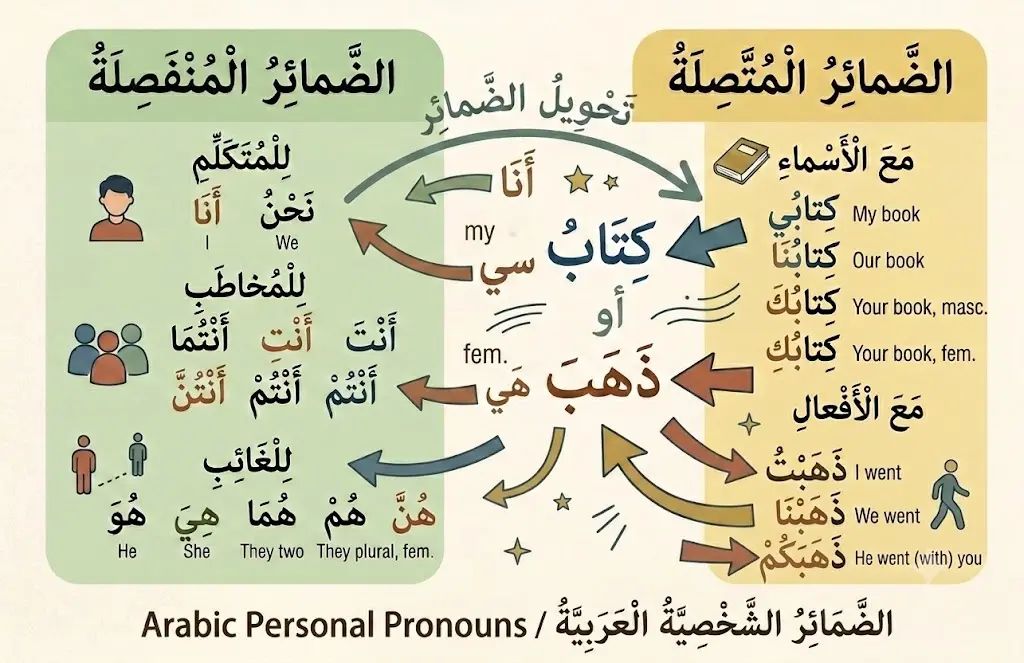
| Arabic pronouns split into two types: independent (detached) pronouns and attached (suffix) pronouns that join nouns and verbs. |
| Arabic marks gender in the second and third person — “you” has four separate forms depending on gender and number. |
In Arabic, personal pronouns encode person, number, and gender in every single form. That means a single English word like “you” expands into four separate Arabic pronouns.
Once those distinctions click, sentence-building becomes dramatically more logical. This guide gives you the full chart, attached pronoun rules, verb conjugation patterns, and structured exercises to build real fluency.
Table of Contents:
What Are Arabic Personal Pronouns?
Arabic personal pronouns (ḍamāʾir, ضمائر) are the words that stand in for a noun — “I,” “you,” “he,” “she,” “we,” and so on. Arabic has 12 independent pronouns compared to English’s 7, because Arabic grammatically marks gender in the second and third person for both singular and plural. Understanding this distinction early is the single highest-leverage move a beginner can make when learning Arabic grammar.
In our experience at Buruj Academy, students who master pronouns in the first two weeks of study consistently outperform those who skip ahead to vocabulary lists.
The reason is structural: every Arabic sentence revolves around a subject pronoun — either stated explicitly or embedded inside a verb. Without pronouns, there is no sentence.
Arabic pronouns serve two grammatical roles.
First, they appear as independent words — the way “she” appears as a standalone subject in English.
Second, they appear as attached suffixes — short sounds glued to the end of nouns, verbs, or prepositions. Both forms are essential for fluent reading and speaking.
The Complete Arabic Personal Pronouns Chart
The 12 Arabic independent pronouns cover first person (the speaker), second person (the person addressed), and third person (the person or thing spoken about).
Each second- and third-person form carries a gender marker — masculine (mudhakkar) or feminine (muʾannath).
| English | Arabic Pronoun | Transliteration | Person / Number / Gender |
| I | أنا | anā | 1st person singular |
| We | نحن | naḥnu | 1st person plural |
| You (masc. sing.) | أنتَ | anta | 2nd person masc. singular |
| You (fem. sing.) | أنتِ | anti | 2nd person fem. singular |
| You (masc. dual) | أنتما | antumā | 2nd person dual |
| You (masc. pl.) | أنتم | antum | 2nd person masc. plural |
| You (fem. pl.) | أنتن | antunna | 2nd person fem. plural |
| He | هو | huwa | 3rd person masc. singular |
| She | هي | hiya | 3rd person fem. singular |
| They (dual) | هما | humā | 3rd person dual |
| They (masc. pl.) | هم | hum | 3rd person masc. plural |
| They (fem. pl.) | هن | hunna | 3rd person fem. plural |
The dual forms (antumā and humā) often surprise English speakers — Arabic uses a dedicated grammatical number for exactly two of anything. This applies to pronouns, nouns, and verbs alike, and is covered in depth in our guide to dual nouns in Arabic.
Example Sentences Using Independent Personal Pronouns:
- أنا طالب — anā ṭālib — “I am a student.” (male speaker)
- أنا طالبة — anā ṭāliba — “I am a student.” (female speaker)
- هو مدرّس — huwa mudarris — “He is a teacher.”
- هي مديرة — hiya mudīra — “She is a director.”
- نحن في المدرسة — naḥnu fī al-madrasa — “We are in the school.”
Notice that Arabic nominal sentences (جملة اسمية) require no verb “to be” in the present tense. The pronoun functions directly as the subject, and the predicate follows immediately.
This is one of the most common structural surprises for English speakers — and once understood, it accelerates Arabic sentence construction considerably.
How Do Attached Personal Pronouns Work in Arabic?
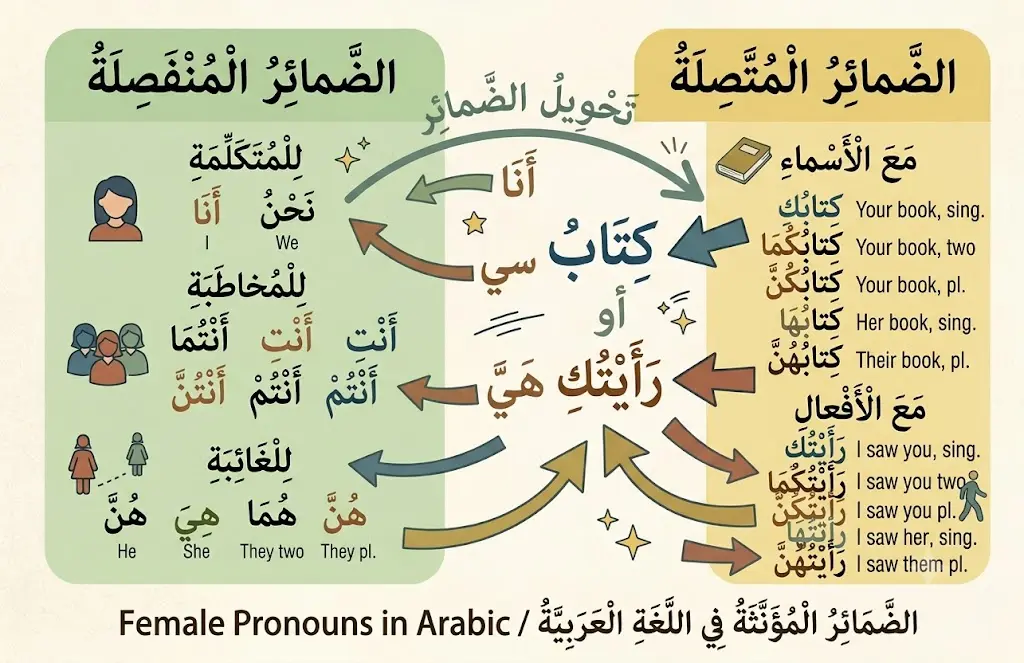
Attached pronouns (ḍamāʾir muttaṣila, ضمائر متصلة) are short suffixes that attach directly to nouns, verbs, or prepositions to indicate possession, object relationships, or pronominal reference.
They are the most frequently used pronouns in everyday Arabic — far more common than the independent forms.
The Full Table of Attached Pronouns is as Follows:
| Meaning | Suffix | Example on كتاب (kitāb, “book”) | Meaning |
| my | ـي / ـيَ | كتابي (kitābī) | my book |
| our | ـنا | كتابنا (kitābunā) | our book |
| your (m. sg.) | ـكَ | كتابك (kitābuka) | your book |
| your (f. sg.) | ـكِ | كتابك (kitābuki) | your book |
| your (dual) | ـكما | كتابكما (kitābukumā) | your book (two people) |
| your (m. pl.) | ـكم | كتابكم (kitābukum) | your book (group, m.) |
| your (f. pl.) | ـكن | كتابكن (kitābukunna) | your book (group, f.) |
| his | ـه / ـهُ | كتابه (kitābuhu) | his book |
| her | ـها | كتابها (kitābuhā) | her book |
| their (dual) | ـهما | كتابهما (kitābuhuma) | their book (two) |
| their (m. pl.) | ـهم | كتابهم (kitābuhum) | their book (group, m.) |
| their (f. pl.) | ـهن | كتابهن (kitābuhunna) | their book (group, f.) |
Attached pronouns are also used after prepositions to create prepositional phrases. For example:
- معي — maʿī — “with me”
- لكَ — laka — “for you” (masculine)
- عليها — ʿalayhā — “on her” / “on it” (referring to a feminine noun)
- منهم — minhum — “from them”
At Buruj Academy, we use attached pronouns as one of the earliest conversation tools in our Online Arabic Classes, because they allow students to express possession and relationships immediately — without waiting to learn full noun-adjective agreement rules.
Book your FREE Arabic trial online Arabic class at Buruj

How Attached Personal Pronouns Connect to Nouns
When an attached pronoun joins a noun, the noun must be in the construct state (iḍāfa, إضافة). The definite article (ال) is dropped, and the pronoun suffix carries the possessive meaning. So البيت (al-bayt, “the house”) becomes بيتي (baytī, “my house”) — the ال disappears entirely.
This rule trips up students who have been studying masculine and feminine nouns in Arabic but have not yet seen how possession works in practice.
How Do Arabic Personal Pronouns Change With Verbs?
When Arabic pronouns interact with verbs, the pronoun is encoded directly inside the verb’s conjugation. This means Arabic often drops the independent pronoun and relies on the verb ending alone to identify the subject — a feature called pro-drop.
The table below shows the present-tense verb يكتب (yaktub, “to write”) conjugated across all persons:
| Subject | Arabic Verb | Transliteration | Meaning |
| أنا | أكتبُ | aktubu | I write |
| نحن | نكتبُ | naktubu | we write |
| أنتَ | تكتبُ | taktubu | you write (m. sg.) |
| أنتِ | تكتبينَ | taktubīna | you write (f. sg.) |
| أنتم | تكتبونَ | taktubūna | you write (m. pl.) |
| أنتن | تكتبنَ | taktubna | you write (f. pl.) |
| هو | يكتبُ | yaktubu | he writes |
| هي | تكتبُ | taktubu | she writes |
| هم | يكتبونَ | yaktubūna | they write (m. pl.) |
| هن | يكتبنَ | yaktubna | they write (f. pl.) |
For a fuller breakdown of how these conjugations shift across tenses, see our guides on Arabic tenses and the Arabic present tense specifically.
Notice that هو (he) and أنتِ (you, feminine singular) both use the prefix تـ in the present tense — a common point of confusion that we address directly in our Arabic Grammar Course. Context and vowel markings (tashkīl) disambiguate the two.
Understand the Arabic Grammar with Buruj’s free trial lesson
What Are the Most Common Mistakes English Speakers Make With Arabic Personal Pronouns?
English speakers make predictable, consistent errors with Arabic pronouns — and knowing them in advance saves weeks of correction. The four most common errors we observe in our sessions at Buruj Academy are as follows.
Error 1 — Ignoring gender in the second person
English speakers use “you” without thinking about gender. In Arabic, addressing a woman as أنتَ (anta) instead of أنتِ (anti) is a grammatical error — and one that native speakers notice immediately.
Error 2 — Overusing the independent pronoun with verbs
In English, you must say “I write” — the subject is mandatory. In Arabic, أكتبُ (aktubu) already means “I write.” Adding أنا is grammatically correct but sounds emphatic or redundant in neutral statements.
Error 3 — Confusing the attached pronoun ـه (his) after long vowels
When ـه follows a long vowel, it lengthens to ـهو. Students often drop this lengthening entirely, changing both pronunciation and meaning. For example: فيه (fīhi, “in it”) — the ه here is short after a kasra, but in له (lahu, “for him”) the ه carries a ḍamma.
Read also: Demonstrative Pronouns in Arabic
Discover the Buruj Academy Difference
Step into our virtual classrooms and see how our expert instructors make learning Quran and Arabic intuitive and clear. We focus on overcoming the specific hurdles non-native speakers face, building your confidence and connection with the Quran.
Master the Arabic Language
Join our expert-led courses and build a strong foundation in Classical and Modern Arabic.
Get Your Free TrialPractical Exercises to Practice Arabic Personal Pronouns
The following exercises are structured progressively — start from Exercise 1 and move forward only when each feels automatic. We use this exact sequence in our Arabic for Beginners course at Buruj Academy before introducing any new grammar topic.
Begin learning Arabic at Buruj with a FREE trial lesson

Exercise 1 — Pronoun Identification Drill
Read each sentence and identify the subject pronoun (stated or implied):
| Arabic Sentence | Transliteration | Your Answer |
| نحن في المكتب | naḥnu fī al-maktab | ??? |
| تكتبُ رسالةً | taktubu risālatan | ??? |
| هي طبيبة | hiya ṭabība | ??? |
| يذهبون إلى المدرسة | yadh-habūna ilā al-madrasa | ??? |
| أنتِ مجتهدة | anti mujtahida | ??? |
Answers:
نحن / أنتَ (implied) / هي / هم (implied) / أنتِ
Exercise 2 — Fill in the Attached Pronoun
Complete each phrase with the correct attached pronoun:
- هذا كتاب___ (my book) → كتابي
- ذهبتُ إلى بيت___ (his house) → بيته
- هل هذا قلم___ ؟ (your pen — addressing a woman) → قلمكِ
- درسنا دروس___ (our lessons) → دروسنا
- أعطيتُها كتاب___ (their book — masculine group) → كتابهم
Read also:How Female Pronouns Work in Arabic
Exercise 3 — Pronoun Substitution
Replace the underlined noun with the correct pronoun and rewrite the sentence:
- أحمد طالب جيد. → هو طالب جيد.
- فاطمة وسارة في المكتب. → هما في المكتب.
- ذهبتُ مع أحمد وعمر. → ذهبتُ معهما.
- أنتَ وأصدقاؤك مدعوّون. → أنتم مدعوّون.
Exercise 4 — Free Production
Write three sentences in Arabic using a different pronoun in each. Use this frame as a guide:
[Subject pronoun] + [noun / adjective] + [location / object]
Example: هي معلمة في المدرسة. (hiya muʿallima fī al-madrasa — “She is a teacher in the school.”)
Try these: describe where someone is, what someone does for work, and whether a group is present or absent. This type of open production is exactly the gap-bridging technique we apply in Buruj Academy’s Arabic Speaking Course to build active fluency from passive grammar knowledge.
Book your free trial to start speaking Arabic fluently
For deeper grammar reinforcement across all these patterns, our full guide on how to learn Arabic for beginners offers a structured pathway from zero to confident reading and speaking.
Read also: Arabic Relative Pronouns
Start Building Real Arabic Fluency With Buruj Academy’s Expert Classes
Pronouns are the foundation — and now you have the complete map. What accelerates from here is structured, corrected practice with a qualified instructor.
At Buruj Academy, our Online Arabic Classes are taught by Al-Azhar University graduates with 12+ years of experience teaching non-native speakers.
We apply the Buruj Method — Context-before-abstraction — so you use pronouns in real sentences from session one, not after memorizing tables in isolation.
Every session is personalized 1-on-1, with flexible 24/7 scheduling and real-time pronunciation correction.
Book your free trial lesson today and experience the difference structured, expert instruction makes.
Begin your transformation today by choosing the path that fits your goals:
- Online Arabic Classes (General & Comprehensive)
- Arabic Course for Beginners
- Arabic Alphabet Learning Course
- Online Arabic Classes for Kids
- Arabic Classes for Adults
- Arabic Grammar Course (Nahw & Sarf)
- Intermediate Arabic Course (B1/B2)
- Arabic Speaking Course (Conversational Fluency)
- Arabic Reading Course (Literary Excellence)
- Learn Arabic Writing Course (Calligraphy & Composition)
Ready to speak with confidence? Join the global community at Buruj Academy and book your free placement interview today!
Master the Arabic Language
Join our expert-led courses and build a strong foundation in Classical and Modern Arabic.
Get Your Free TrialConclusion
Arabic personal pronouns are not just grammar vocabulary — they are the architecture of the language. Every sentence you speak or read depends on getting person, number, and gender right. The 12-pronoun system, the attached suffix forms, and the verb-embedded subject markers all work together as one coherent system — and once that system is clear, Arabic sentence-building becomes genuinely logical.
The most common barrier is not difficulty but approach. Students who study pronouns in context — through real sentences, immediate correction, and progressive exercises — internalize them in days, not months. That is what structured instruction is for, and it is why we start here with every new student at Buruj Academy.
Frequently Asked Questions About Arabic Personal Pronouns
How Many Personal Pronouns Are There in Arabic?
Arabic has 12 independent personal pronouns. Unlike English, which uses 7 pronouns (I, we, you, he, she, they, it), Arabic marks gender separately in the second and third person — giving distinct forms for “you (masculine),” “you (feminine),” and “they (masculine),” “they (feminine),” as well as dedicated dual forms for both.
What Is the Difference Between Detached and Attached Pronouns in Arabic?
Detached pronouns (ضمائر منفصلة) are independent words used as sentence subjects — like أنا or هو. Attached pronouns (ضمائر متصلة) are short suffixes joined to nouns, verbs, or prepositions to express possession or object relationships — like ـي (my) or ـه (his). Both types are essential for fluent Arabic.
Do Arabic Pronouns Change Based on Grammatical Case?
Attached pronouns can reflect grammatical case indirectly through the vowel that precedes them on the noun or verb. Independent pronouns, however, do not inflect for case the way nouns do in Arabic’s three-case system (marfūʿ, manṣūb, majrūr). Understanding Arabic grammatical cases helps clarify how pronouns interact with sentence structure.