 Arabic
| Key Takeaways |
| Arabic has two main relative pronouns: الَّذِي (alladhī) for masculine singular and الَّتِي (allatī) for feminine singular nouns. |
| Every Arabic relative pronoun must agree with its antecedent in gender and number, unlike English “who/which/that.” |
| A relative clause in Arabic requires a resumptive pronoun (ضَمِير عَائِد) when the antecedent is definite and specific. |
| Arabic has distinct relative pronoun forms for dual and plural nouns, giving six forms total across gender and number. |
| When the antecedent is indefinite, Arabic omits the relative pronoun entirely, forming a “bare” relative clause. |
Connecting ideas across sentences is where grammar truly comes alive — and Arabic relative pronouns are the connective tissue that joins a noun to its describing clause. Whether you are reading a newspaper, writing a formal letter, or holding a conversation, you will encounter these structures constantly.
Arabic relative pronouns work as a system: each form agrees with the noun it refers to in gender and number. Master this agreement system and you will read Arabic sentences with far greater precision and write with noticeably more natural flow.
Table of Contents:
What Are Arabic Relative Pronouns and Why Do They Matter?
Arabic relative pronouns are a closed set of words that introduce a relative clause describing a specific noun. The entire set is built on the root ذ and the definite article, producing forms that change according to whether the noun they refer to is masculine or feminine, singular, dual, or plural.
In English, “who,” “which,” and “that” do this work regardless of gender or number. Arabic is more precise: the pronoun itself signals the gender and number of the noun being described.
This precision is what makes Arabic relative clauses so clear — once you learn the six forms, you always know exactly what noun the clause is describing.
At Buruj Academy, we introduce relative pronouns as part of our Arabic grammar course sequence, where students learn agreement patterns — gender, number, and case — before tackling relative clauses, so the system clicks into place naturally.
Understand the Arabic Grammar with Buruj’s free trial lesson

The Complete Arabic Relative Pronouns Chart
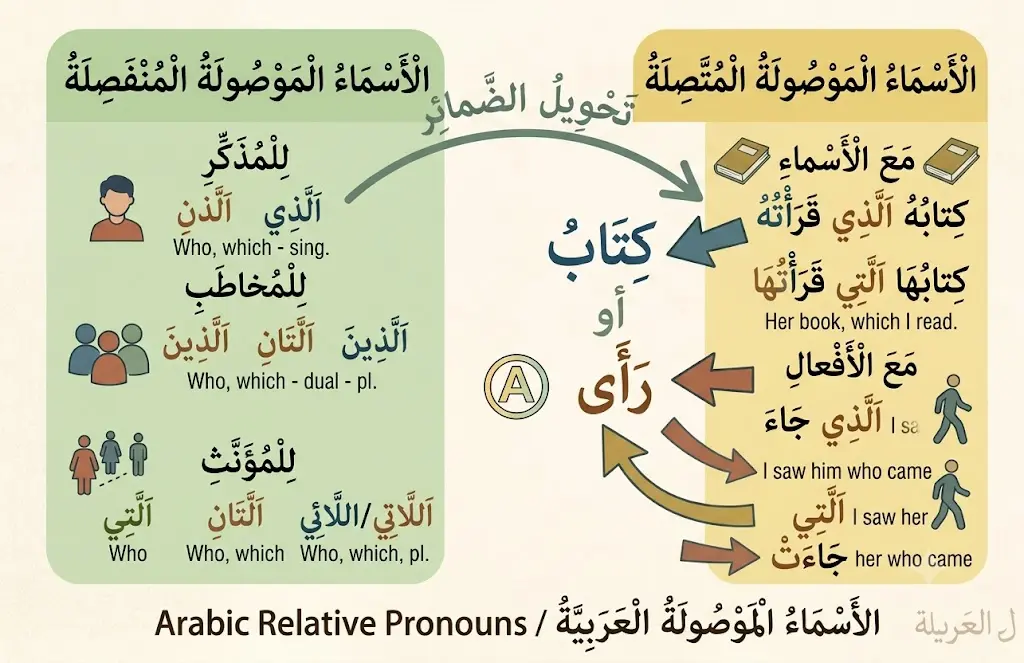
Arabic relative pronouns in Modern Standard Arabic (MSA) cover three numbers (singular, dual, plural) across two genders, giving six primary forms. The table below is your master reference.
| Form | Arabic | Gender & Number | English Equivalent |
| alladhī | الَّذِي | Masculine Singular | who / which / that |
| allatī | الَّتِي | Feminine Singular | who / which / that |
| alladhāni | اللذَانِ | Masculine Dual (nominative) | who / which (two) |
| allatāni | اللتَانِ | Feminine Dual (nominative) | who / which (two) |
| alladhīna | الَّذِينَ | Masculine Plural / Mixed | who / which |
| allawātī / allātī | اللَّاتِي | Feminine Plural | who / which |
The dual forms shift to اللذَيْنِ (alladhayni) and اللَّتَيْنِ (allataynī) in the accusative and genitive cases. This mirrors how Arabic dual nouns themselves decline — a pattern you can read more about in our guide to dual nouns in Arabic.
How to Use الَّذِي and الَّتِي Relative Pronouns in Arabic?
The two forms you will use most frequently in everyday Arabic are الَّذِي (masculine singular) and الَّتِي (feminine singular). Every time you use one, it must match the gender of the noun it describes — regardless of what follows inside the relative clause.
1. Using الَّذِي with Masculine Singular Nouns
الَّذِي refers to any masculine singular noun: people, objects, concepts, and places that carry masculine grammatical gender.
Examples with الَّذِي:
| Arabic Sentence | Transliteration | Translation |
| الطَّالِبُ الَّذِي نَجَحَ مُجْتَهِدٌ | aṭ-ṭālibu alladhī najaḥa mujtahidun | The student who passed is hardworking. |
| الكِتَابُ الَّذِي قَرَأْتُهُ مُفِيدٌ | al-kitābu alladhī qara’tuhu mufīdun | The book that I read is useful. |
| البَيْتُ الَّذِي اشْتَرَيْتُهُ كَبِيرٌ | al-baytu alladhī shtaraytuhu kabīrun | The house that I bought is big. |
Notice the pronoun هُ (him/it) attached to the verb in examples two and three. This is the resumptive pronoun — a fundamental Arabic rule we will explain in detail below.
2. Using الَّتِي with Feminine Singular Nouns
الَّتِي follows every feminine singular noun, whether the noun refers to a woman, a feminine-gendered object, or an abstract concept with feminine grammatical gender. For a solid foundation on which nouns are feminine in Arabic, see our article on masculine and feminine nouns in Arabic.
Examples with الَّتِي:
| Arabic Sentence | Transliteration | Translation |
| المَدْرَسَةُ الَّتِي أَدْرُسُ فِيهَا بَعِيدَةٌ | al-madrasatu allatī adrusu fīhā baʿīdatun | The school in which I study is far. |
| السَّيَّارَةُ الَّتِي اشْتَرَيْتُهَا جَدِيدَةٌ | as-sayyāratu allatī shtaraytuha jadīdatun | The car that I bought is new. |
| الفِكْرَةُ الَّتِي طَرَحْتَهَا جَيِّدَةٌ | al-fikratu allatī ṭaraḥtahā jayyidatun | The idea that you proposed is good. |
What Is the Resumptive Pronoun and When Is It Required?
The resumptive pronoun (الضَّمِير العَائِد) is a small pronoun inside the relative clause that refers back to the antecedent — the noun the clause is describing. It is one of the most important and most misunderstood features of Arabic relative clauses for learners of English-speaking backgrounds.
In English, we say “the book that I read” — the word “that” alone links the clause back to “book.” Arabic often requires an additional pronoun inside the clause: “the book that I read it.” This extra pronoun is the resumptive pronoun.
When Is the Resumptive Pronoun Required?
| Situation | Resumptive Pronoun? | Example |
| Antecedent is the subject of the relative clause | Not required | الرَّجُلُ الَّذِي جَاءَ (the man who came) |
| Antecedent is the object of the verb inside the clause | Required | الكِتَابُ الَّذِي قَرَأْتُهُ (the book I read it) |
| Antecedent is object of a preposition inside the clause | Required | الغُرْفَةُ الَّتِي جَلَسْتُ فِيهَا (the room I sat in it) |
In our Arabic Classes for Beginners at Buruj Academy, this is the single point where English-speaking students most frequently make errors.
They instinctively drop the resumptive pronoun because English has no equivalent — and the sentence then sounds incomplete to a native Arabic ear.
Begin learning Arabic at Buruj with a FREE trial lesson

The Plural Relative Pronouns in Arabic: الَّذِينَ and اللَّاتِي
Plural relative pronouns function exactly like the singular forms in terms of structure — the difference is purely agreement in number and gender.
1. Using الَّذِينَ in Arabic
الَّذِينَ covers masculine plural nouns and any mixed-gender group. It is far more common in formal and written Arabic than the feminine plural equivalent.
Examples with الَّذِينَ:
- الطُّلَّابُ الَّذِينَ اجْتَهَدُوا نَجَحُوا — The students who worked hard succeeded.
- المُهَنْدِسُونَ الَّذِينَ صَمَّمُوا المَبْنَى مَهَرَةٌ — The engineers who designed the building are skilled.
2. Using اللَّاتِي in Arabic
اللَّاتِي refers to feminine plural nouns — most commonly women, but also any feminine-gendered plural.
Examples with اللَّاتِي:
- المُعَلِّمَاتُ اللَّاتِي يَعْمَلْنَ هُنَا مُتَفَانِيَاتٌ — The teachers who work here are dedicated.
- الشَّرِكَاتُ اللَّاتِي شَارَكَتْ حَقَّقَتِ النَّجَاحَ — The companies that participated achieved success.
One note: broken plural nouns for non-human entities (animals, objects, concepts) typically take feminine singular agreement in Arabic, which means they use الَّتِي rather than اللَّوَاتِي. This is a consistent grammatical rule worth memorizing early.
For broader context on how Arabic tenses interact with these structures, our guide to Arabic tenses is a useful companion read.
Read also: Definite Pronouns in Arabic
Discover the Buruj Academy Difference
Step into our virtual classrooms and see how our expert instructors make learning Quran and Arabic intuitive and clear. We focus on overcoming the specific hurdles non-native speakers face, building your confidence and connection with the Quran.
Master the Arabic Language
Join our expert-led courses and build a strong foundation in Classical and Modern Arabic.
Get Your Free TrialHow Arabic Relative Clauses Work with Indefinite Nouns
When the antecedent noun is indefinite (has no الـ and no specific identity), Arabic drops the relative pronoun entirely. The relative clause attaches directly to the noun as a descriptive phrase — called a ṣifa (صِفَة) or adjectival clause.
This is a rule that catches many learners off guard because it seems like something is missing. In fact, it follows a clean Arabic logic: the relative pronoun is definite by nature (it begins with الـ), so it cannot attach to an indefinite noun.
Comparison: Definite vs. Indefinite Antecedent
| Type | Arabic | Translation |
| Definite antecedent | قَرَأْتُ الكِتَابَ الَّذِي أَوْصَيْتَ بِهِ | I read the book that you recommended. |
| Indefinite antecedent | قَرَأْتُ كِتَابًا أَوْصَيْتَ بِهِ | I read a book you recommended. |
| Definite antecedent | التَقَيْتُ بِالمَرْأَةِ الَّتِي تَعْمَلُ هُنَا | I met the woman who works here. |
| Indefinite antecedent | التَقَيْتُ بِامْرَأَةٍ تَعْمَلُ هُنَا | I met a woman who works here. |
The resumptive pronoun rule still applies inside the clause regardless of definite or indefinite status.
Practical Exercises to Master Arabic Relative Pronouns
The fastest path to internalizing the relative pronouns chart is structured, varied practice. The exercises below move from recognition to production — the same progression our instructors use in Buruj Academy’s Arabic Grammar Course.
Exercise 1: Fill in the Correct Relative Pronoun
Choose from: الَّذِي / الَّتِي / الَّذِينَ / اللَّوَاتِي
- الوَلَدُ ________ يَلْعَبُ فِي الحَدِيقَةِ أَخِي.
- السَّيَّارَةُ ________ اشْتَرَاهَا أَبِي حَمْرَاءُ.
- المُعَلِّمُونَ ________ يُدَرِّسُونَ هُنَا مُتَخَصِّصُونَ.
- الطَّالِبَاتُ ________ فُزْنَ بِالجَائِزَةِ مُجْتَهِدَاتٌ.
- البَيْتُ ________ سَكَنْتُ فِيهِ كَانَ قَدِيمًا.
Answer Key:
1. الَّذِي 2. الَّتِي 3. الَّذِينَ 4. اللَّاتِي 5. الَّذِي
Exercise 2: Add the Missing Resumptive Pronoun
Rewrite each sentence adding the correct resumptive pronoun where required.
- الكِتَابُ الَّذِي قَرَأْتُ مُفِيدٌ. (object of verb — pronoun missing)
- المَدِينَةُ الَّتِي زُرْتُ جَمِيلَةٌ. (object of verb — pronoun missing)
- الرَّجُلُ الَّذِي جَاءَ طَبِيبٌ. (subject of verb — correct as is)
Corrected:
1. قَرَأْتُهُ 2. زُرْتُهَا 3. No change needed.
Exercise 3: Translate into Arabic
- The teacher who explains well is popular.
- The company that I work for is large.
- The students who studied passed the exam.
- I met a doctor who specializes in surgery. (indefinite — no relative pronoun)
Sample Answers:
- المُعَلِّمُ الَّذِي يَشْرَحُ جَيِّدًا مَحْبُوبٌ.
- الشَّرِكَةُ الَّتِي أَعْمَلُ فِيهَا كَبِيرَةٌ.
- الطُّلَّابُ الَّذِينَ ذَاكَرُوا نَجَحُوا فِي الامْتِحَانِ.
- التَقَيْتُ بِطَبِيبٍ يَتَخَصَّصُ فِي الجِرَاحَةِ.
Common Mistakes English Speakers Make with Arabic Relative Pronouns
Understanding where errors typically occur is as valuable as learning the rules themselves. In our sessions at Buruj Academy, we notice four errors appearing consistently among English-speaking adults — regardless of their overall Arabic level.
Mistake 1: Using الَّذِي for all genders.
English uses “who/that/which” without gender, so students default to الَّذِي everywhere. Solution: always identify the antecedent’s gender before selecting the pronoun.
Mistake 2: Dropping the resumptive pronoun
As explained above, English has no equivalent. Students must consciously add it whenever the antecedent is the object of the verb or a preposition inside the clause.
Mistake 3: Using a relative pronoun with indefinite nouns
Learners write رَجُلٌ الَّذِي جَاءَ (incorrect) instead of رَجُلٌ جَاءَ (correct). The definite relative pronoun cannot attach to an indefinite noun.
Mistake 4: Ignoring dual forms
Learners skip اللذَانِ/اللَّتَانِ and use the plural instead. While understandable, this is a grammatical error in formal Arabic. The dual is active in written Arabic, news media, and formal speech — and it connects directly to the broader system of Arabic sentence structure that governs agreement throughout the language.
Read also: Demonstrative Pronouns in Arabic
Master Arabic Grammar with Buruj Academy’s Expert Instructors
Arabic relative pronouns are one chapter in a structured grammar system — and the best way to internalize that system is with a qualified instructor who can catch errors in real time, explain the why behind each rule, and build your confidence sentence by sentence.
Buruj Academy’s Arabic Grammar Course is taught by Al-Azhar University graduates with 12+ years of experience teaching non-native speakers. Our approach — context before abstraction — means you practice rules inside real sentences from day one, never in isolation.
- Ijazah-certified instructors and Al-Azhar graduates
- Personalized 1-on-1 sessions with flexible 24/7 scheduling
- The Buruj Method: context before abstraction
- Real-time correction and individualized learning plans
- Clear progression from beginner to advanced mastery
Book your free trial lesson and experience the difference structured, expert-led Arabic instruction makes.
Begin your transformation today by choosing the path that fits your goals:
- Online Arabic Classes (General & Comprehensive)
- Arabic Course for Beginners
- Arabic Alphabet Learning Course
- Online Arabic Classes for Kids
- Arabic Classes for Adults
- Arabic Grammar Course (Nahw & Sarf)
- Intermediate Arabic Course (B1/B2)
- Arabic Speaking Course (Conversational Fluency)
- Arabic Reading Course (Literary Excellence)
- Learn Arabic Writing Course (Calligraphy & Composition)
Ready to speak with confidence? Join the global community at Buruj Academy and book your free placement interview today!
Master the Arabic Language
Join our expert-led courses and build a strong foundation in Classical and Modern Arabic.
Get Your Free TrialConclusion
Arabic relative pronouns are not a minor grammatical detail — they are the framework that allows complex, nuanced sentences to hold together. Once the six-form agreement system, the resumptive pronoun rule, and the indefinite antecedent exception become second nature, your Arabic reading and writing take a measurable step forward.
The exercises above give you a practical starting point. Consistent practice with real sentences — not just memorized forms — is what converts knowledge of the relative pronouns chart into genuine grammatical instinct. Grammar studied in context always outperforms grammar memorized in tables alone.
Frequently Asked Questions About Arabic Relative Pronouns
What is the difference between الَّذِي and الَّتِي in Arabic?
الَّذِي is used for masculine singular nouns, while الَّتِي is used for feminine singular nouns. Both translate as “who,” “which,” or “that” in English. The choice between them depends entirely on the grammatical gender of the noun being described (the antecedent), not on natural gender or meaning.
Do Arabic relative pronouns change with case?
Most Arabic relative pronouns do not decline for case — الَّذِي, الَّتِي, الَّذِينَ, and اللَّاتِي remain the same in nominative, accusative, and genitive. The exception is the dual forms: اللذَانِ and اللَّتَانِ shift to اللذَيْنِ and اللَّتَيْنِ in the accusative and genitive cases.
When do you omit the relative pronoun in Arabic?
Arabic omits the relative pronoun when the antecedent noun is indefinite — that is, when it has no definite article and refers to a non-specific entity. The relative clause then attaches directly to the noun without a linking pronoun. For example: جَاءَ رَجُلٌ يَعْرِفُكَ means “A man who knows you came.”
Related Articles
Arabic