 Arabic
| Key Takeaways |
| The Arabic definite article ال (al-) is the only tool Arabic uses to make nouns definite. |
| Sun letters (الحروف الشمسية) cause the ل of ال to assimilate into the following letter, creating a doubled consonant in pronunciation. |
| Moon letters (الحروف القمرية) keep the ل of ال clearly pronounced, making them easier for beginners to master first. |
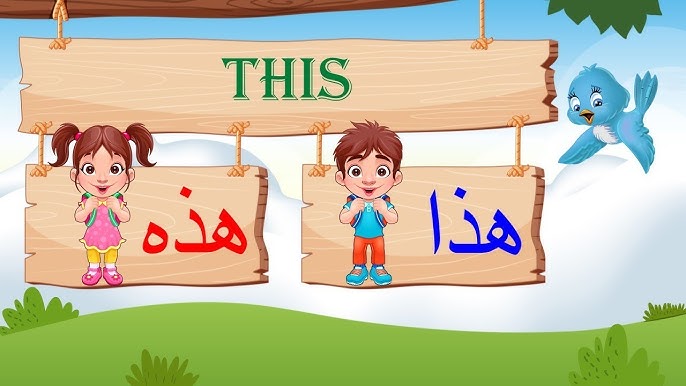
| Arabic demonstrative pronouns (هذا، هذه، ذلك) function as definite pronouns pointing to specific nouns with gender and number agreement. |
| Personal pronouns in Arabic (هو، هي، أنت) are inherently definite and never take ال, making them grammatically distinct from nouns. |
Learning Arabic grammar often feels like navigating a system that operates on entirely different logic from English. One of the first places students feel that gap is with definiteness — the way Arabic signals that a noun is the thing, not a thing.
Arabic has one definite article — ال (al-) — and it does the heavy lifting that English spreads across articles, demonstratives, and personal pronouns combined. Master how ال works alongside Arabic’s definite pronoun system, and a large portion of Arabic sentence structure clicks into place.
Table of Contents:
What Is the Definite Article in Arabic?
The Arabic definite article ال (al-) attaches directly to the beginning of a noun to make it specific and identifiable. It never changes form in writing, but its pronunciation shifts depending on the first letter of the noun it precedes — a rule governed by the sun and moon letter system.
Every Arabic noun is either indefinite (نكرة — nakira) or definite (معرفة — ma’rifa). Adding ال to an indefinite noun makes it definite. This is the foundation of Arabic nominal sentences, and understanding it is essential before tackling Arabic grammar rules for beginners.
| Arabic | Transliteration | Meaning |
| كِتَابٌ | kitābun | a book (indefinite) |
| الْكِتَابُ | al-kitābu | the book (definite) |
| بَيْتٌ | baytun | a house (indefinite) |
| الْبَيْتُ | al-baytu | the house (definite) |
| طَالِبٌ | ṭālibun | a student (indefinite) |
| الطَّالِبُ | aṭ-ṭālibu | the student (definite) |
Notice how the last example — الطَّالِبُ — sounds different. That is the sun letter rule in action.
How Do Sun Letters Change the Pronunciation of ال?
Sun letters (الحروف الشمسية) cause the ل of ال to fully assimilate into the first letter of the noun, which is then pronounced doubled (with a shadda). This happens with 14 letters that share the same front-of-mouth articulation zone as ل itself.
The sun letters are: ت، ث، د، ذ، ر، ز، س، ش، ص، ض، ط، ظ، ل، ن
In writing, ال always appears the same. In pronunciation, the ل disappears and the following letter is stressed.
| Noun | With ال (Written) | Pronunciation | Meaning |
| شَمْسٌ | الشَّمْسُ | aš-šamsu | the sun |
| نُورٌ | النُّورُ | an-nūru | the light |
| رَجُلٌ | الرَّجُلُ | ar-rajulu | the man |
| دَرْسٌ | الدَّرْسُ | ad-darsu | the lesson |
| سَيَّارَةٌ | السَّيَّارَةُ | as-sayyāratu | the car |
In our Online Arabic Classes, one of the first pronunciation exercises we use is having students read aloud a list of sun-letter nouns with ال — because hearing the doubled consonant trains the ear faster than memorizing a rule ever will.
Book your FREE Arabic trial online Arabic class at Buruj

How Do Moon Letters Keep ال Intact?
Moon letters (الحروف القمرية) do not cause assimilation. When ال precedes a moon letter, the ل is clearly and fully pronounced. These 14 letters are articulated further back in the mouth, away from ل‘s natural position.
The moon letters are: ء، ب، ج، ح، خ، ع، غ، ف، ق، ك، م، ه، و، ي
| Noun | With ال (Written) | Pronunciation | Meaning |
| قَلَمٌ | الْقَلَمُ | al-qalamu | the pen |
| كِتَابٌ | الْكِتَابُ | al-kitābu | the book |
| بَابٌ | الْبَابُ | al-bābu | the door |
| مَدْرَسَةٌ | الْمَدْرَسَةُ | al-madrasatu | the school |
| وَلَدٌ | الْوَلَدُ | al-waladu | the boy |
A reliable way to remember which letters are moon letters: the word القمر (al-qamar — the moon) itself starts with ق, a moon letter.
The ل in الْقَمَرُ is fully heard. For a deeper look at how Arabic letters function in context, our guide on moon and sun letters in Arabic breaks this system down step by step.
What Are Definite Pronouns in Arabic?
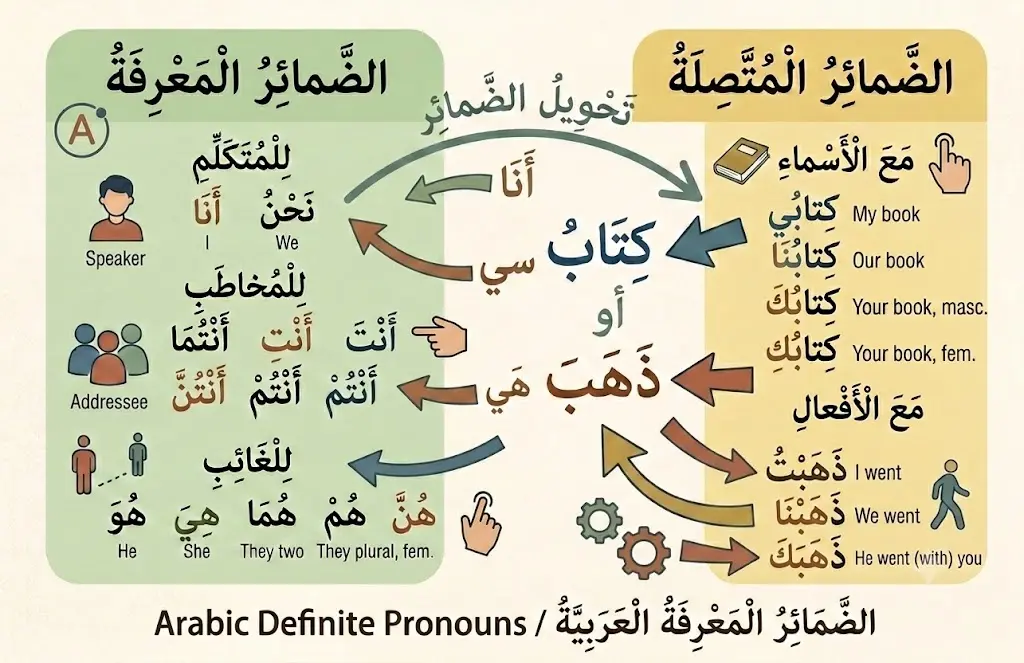
Definite pronouns in Arabic are words that refer to specific, identifiable people or things — the Arabic equivalent of “he,” “she,” “this,” “that,” and “they.” Unlike nouns, personal pronouns in Arabic are inherently definite. They never take ال and never carry tanwin (nunation).
Arabic grammar classifies definite pronouns into three main categories:
1. Personal Pronouns (الضمائر المنفصلة — al-ḍamā’ir al-munfaṣila) These stand alone as independent words.
2. Demonstrative Pronouns (أسماء الإشارة — asmā’ al-ishāra) These point to specific nouns: this, that, these, those.
3. Relative Pronouns (الأسماء الموصولة — al-asmā’ al-mawṣūla) These introduce relative clauses: who, which, that.
Each category follows its own rules of gender and number agreement — a detail that English speakers consistently find surprising, since English pronouns behave far more simply.
Read also:A Guide to Verbal Nouns in Arabic
What Are the Arabic Personal Pronouns?
Arabic personal pronouns (الضمائر) are fully definite by nature and change based on person (first, second, third), gender (masculine, feminine), and number (singular, dual, plural). This makes them more specific than English pronouns.
| Pronoun | Arabic | Transliteration | Used For |
| I | أَنَا | anā | any speaker |
| You (m. sg.) | أَنْتَ | anta | one male |
| You (f. sg.) | أَنْتِ | anti | one female |
| He | هُوَ | huwa | one male |
| She | هِيَ | hiya | one female |
| We | نَحْنُ | naḥnu | group (any gender) |
| You (m. pl.) | أَنْتُمْ | antum | multiple males |
| You (f. pl.) | أَنْتُنَّ | antunna | multiple females |
| They (m.) | هُمْ | hum | multiple males |
| They (f.) | هُنَّ | hunna | multiple females |
| You (dual) | أَنْتُمَا | antumā | exactly two people |
| They (dual m.) | هُمَا | humā | exactly two males |
Examples in sentences:
- هُوَ مُعَلِّمٌ — Huwa muʿallimun — He is a teacher.
- هِيَ طَالِبَةٌ — Hiya ṭālibatun — She is a student.
- نَحْنُ فِي الْمَدْرَسَةِ — Naḥnu fī al-madrasati — We are in the school.
- أَنْتُمْ أَصْدِقَائِي — Antum aṣdiqā’ī — You (pl.) are my friends.
Note that in Arabic nominal sentences, no verb “to be” is required in the present tense. The pronoun and the predicate sit side by side, making these structures ideal for early learners. Understanding how Arabic sentence structure handles this is key to building fluency.
Read also: Kasra in Arabic
Discover the Buruj Academy Difference
Step into our virtual classrooms and see how our expert instructors make learning Quran and Arabic intuitive and clear. We focus on overcoming the specific hurdles non-native speakers face, building your confidence and connection with the Quran.
Master the Arabic Language
Join our expert-led courses and build a strong foundation in Classical and Modern Arabic.
Get Your Free TrialHow Do Demonstrative Pronouns Work as Definite Pronouns in Arabic?
Demonstrative pronouns (أسماء الإشارة) in Arabic are definite pronouns that point to specific nouns. They must agree in gender with the noun they reference, and the noun they describe must carry ال to form a grammatically correct definite phrase.
1. Near Demonstratives (This / These)
| Arabic | Transliteration | Meaning |
| هَذَا | hādhā | this (m. sg.) |
| هَذِهِ | hādhihi | this (f. sg.) |
| هَذَانِ | hādhāni | these two (m. dual) |
| هَاتَانِ | hātāni | these two (f. dual) |
| هَؤُلَاءِ | hā’ulā’i | these (pl.) |
2. Far Demonstratives (That / Those)
| Arabic | Transliteration | Meaning |
| ذَلِكَ | dhālika | that (m. sg.) |
| تِلْكَ | tilka | that (f. sg.) |
| أُولَئِكَ | ulā’ika | those (pl.) |
Examples of Demonstrative Pronouns Work as Definite Pronouns in Arabic
Students in our Arabic grammar sessions initially mix up هَذَا and هَذِهِ because they default to English, where “this” covers both genders.
| Arabic | Translation | Note |
| هَذَا الْكِتَابُ جَمِيلٌ | This book is beautiful. | Correct: noun takes ال |
| هَذِهِ السَّيَّارَةُ سَرِيعَةٌ | This car is fast. | Correct: feminine noun, feminine demonstrative |
| ذَلِكَ الرَّجُلُ طَوِيلٌ | That man is tall. | Correct: far demonstrative, masculine |
| تِلْكَ الْمَدْرَسَةُ كَبِيرَةٌ | That school is big. | Correct: far demonstrative, feminine |
Once we connect gender agreement to the noun’s own classification — the same masculine/feminine system they learned for nouns — the confusion typically resolves within a few lessons. Our article on masculine and feminine nouns in Arabic is an excellent companion to this topic.
What Are Arabic Relative Pronouns and How Do They Create Definite Clauses?
Arabic relative pronouns (الأسماء الموصولة) introduce relative clauses and always refer back to a definite noun. They are themselves definite, and the noun they modify must also be definite.
| Pronoun | Arabic | Transliteration | Refers to |
| Who / Which (m. sg.) | الَّذِي | alladhī | one masculine noun |
| Who / Which (f. sg.) | الَّتِي | allatī | one feminine noun |
| Who / Which (m. pl.) | الَّذِينَ | alladhīna | group (masculine) |
| Who / Which (f. pl.) | اللَّاتِي | allātī | group (feminine) |
| Who / Which (dual m.) | اللَّذَانِ | alladhāni | two masculine nouns |
Examples:
- الْوَلَدُ الَّذِي يَدْرُسُ نَجَحَ — The boy who studies succeeded.
- الْمَرْأَةُ الَّتِي تُعَلِّمُ مَشْهُورَةٌ — The woman who teaches is well-known.
- الطُّلَّابُ الَّذِينَ اجْتَهَدُوا فَازُوا — The students who worked hard won.
Each relative pronoun must match the gender and number of the noun it follows. The embedded clause (called الصِّلَة — aṣ-ṣila) must contain a verb or a complete predicate that refers back to the antecedent noun.
Read also: Arabic Relative Pronouns Explained
Definite Pronouns and Indefinite Pronouns in Arabic
Definite and indefinite pronouns represent opposite ends of Arabic’s specificity system. Definite pronouns refer to specific, identifiable entities. Indefinite expressions in Arabic refer to unknown, unspecified ones.
The clearest marker of indefiniteness in Arabic is tanwin (التنوين) — the double vowel endings (-un, -an, -in) that appear on nouns without ال.
| Type | Example (Arabic) | Transliteration | Meaning |
| Indefinite noun | رَجُلٌ | rajulun | a man (unspecified) |
| Definite noun (ال) | الرَّجُلُ | ar-rajulu | the man (specific) |
| Definite (personal pronoun) | هُوَ | huwa | he (specific by nature) |
| Definite (demonstrative) | هَذَا الرَّجُلُ | hādhā ar-rajulu | this man (pointed to) |
| Definite (relative clause) | الرَّجُلُ الَّذِي | ar-rajulu alladhī | the man who… |
| Definite (proper noun) | مُحَمَّدٌ | muḥammadun | Muhammad (no ال needed) |
An important insight for learners: proper nouns and personal pronouns are intrinsically definite in Arabic — they need no ال to become specific. This is why you will never see الهو or الأنا in Arabic. The definiteness is built into the word’s identity.
Practical Exercises to Master Arabic Definite Pronouns
The rules click when you use them — not just read about them. The following exercises build real competence. For more structured daily practice, explore our Arabic Grammar Course.
Understand the Arabic Grammar with Buruj’s free trial lesson
Exercise 1: Add ال to the Following Nouns (Sun or Moon Letter?)
Add ال to each noun, then write the correct pronunciation (does the ل assimilate or stay?):
| Noun | Meaning | + ال | Sun or Moon? |
| نَافِذَةٌ | window | ____________ | ____________ |
| دُكَّانٌ | shop | ____________ | ____________ |
| طَرِيقٌ | road | ____________ | ____________ |
| غُرْفَةٌ | room | ____________ | ____________ |
| زَهْرَةٌ | flower | ____________ | ____________ |
Answer Key:
النَّافِذَةُ (sun — ن), الدُّكَّانُ (moon — د is actually sun), الطَّرِيقُ (sun — ط), الْغُرْفَةُ (moon — غ), الزَّهْرَةُ (sun — ز)
Exercise 2: Choose the Correct Demonstrative Pronoun
Fill in the blank with the correct form of هَذَا / هَذِهِ / ذَلِكَ / تِلْكَ:
- ________ الْبَيْتُ كَبِيرٌ. (near, m.) → This house is big.
- ________ الْجَامِعَةُ قَدِيمَةٌ. (far, f.) → That university is old.
- ________ الطَّالِبُ مُجْتَهِدٌ. (far, m.) → That student is hardworking.
- ________ الشَّجَرَةُ جَمِيلَةٌ. (near, f.) → This tree is beautiful.
Answers: هَذَا، تِلْكَ، ذَلِكَ، هَذِهِ
Exercise 3: Match Personal Pronouns to Their Sentences
Connect the correct personal pronoun from the box to each sentence:
Pronoun box: أَنَا / هُوَ / هِيَ / نَحْنُ / أَنْتَ
- ________ مُدَرِّسٌ فِي الْمَدْرَسَةِ. → (He) is a teacher in the school.
- ________ طَالِبَةٌ مُجْتَهِدَةٌ. → (She) is a hardworking student.
- ________ فِي الْبَيْتِ الآنَ. → (I) am at home now.
- ________ أَصْدِقَاءُ جَيِّدُونَ. → (We) are good friends.
Answers: هُوَ، هِيَ، أَنَا، نَحْنُ
Read also: Indefinite Pronouns in Arabic
Master Arabic Grammar with Buruj Academy’s Expert Instructors
Arabic definiteness — ال, personal pronouns, demonstratives, relatives — is one structural system, and mastering it changes everything.
At Buruj Academy, our Arabic Grammar Course and Arabic for Beginners course are taught by Al-Azhar University graduates with 12+ years of experience teaching non-native speakers. We use the Buruj Method — context-before-abstraction — so grammar rules always connect to real language first.
Our personalized 1-on-1 sessions, flexible scheduling, and certified instructors give you structured progression from beginner to advanced.
Book your free trial lesson today and experience the difference expert-led Arabic instruction makes.
Begin your transformation today by choosing the path that fits your goals:
- Online Arabic Classes (General & Comprehensive)
- Arabic Course for Beginners
- Arabic Alphabet Learning Course
- Online Arabic Classes for Kids
- Arabic Classes for Adults
- Arabic Grammar Course (Nahw & Sarf)
- Intermediate Arabic Course (B1/B2)
- Arabic Speaking Course (Conversational Fluency)
- Arabic Reading Course (Literary Excellence)
- Learn Arabic Writing Course (Calligraphy & Composition)
Ready to speak with confidence? Join the global community at Buruj Academy and book your free placement interview today!
Master the Arabic Language
Join our expert-led courses and build a strong foundation in Classical and Modern Arabic.
Get Your Free TrialConclusion
Arabic definiteness is an interconnected system. The ال article, sun and moon letter assimilation, personal pronouns, demonstratives, and relative pronouns all operate together to tell your listener exactly which person, object, or idea you mean.
What makes Arabic elegant is that once you understand the internal logic — that everything definite is either marked with ال or inherently specific — the entire system becomes predictable. Practice these structures daily, keep your gender agreement sharp, and the grammar becomes second nature, Insha’Allah.
Frequently Asked Questions About Definite Pronouns in Arabic
What is the definite article in Arabic and does it ever change?
The Arabic definite article is ال (al-), and its written form never changes. However, its pronunciation varies — the ل assimilates into sun letters (الحروف الشمسية) and remains clear before moon letters (الحروف القمرية). This makes ال consistent in writing but phonetically flexible, unlike English “a/an” which changes based on vowel sounds.
Can Arabic personal pronouns be used with ال?
No. Arabic personal pronouns (أَنَا، هُوَ، هِيَ، نَحْنُ, etc.) are inherently definite and never take ال. Their definiteness is grammatically built in. Attaching ال to a pronoun is a grammatical error. This is one of the key structural differences between pronouns and nouns in Arabic.
Where can I practice Arabic definite pronouns beyond this article?
Beyond the exercises above, consistent practice with real sentence patterns is the fastest path to mastery. Our Online Arabic Classes provide structured grammar drills with immediate instructor feedback. You can also explore foundational skills through our guide on how to learn Arabic for beginners before advancing to complex pronoun usage.