 Arabic
| Key Takeaways |
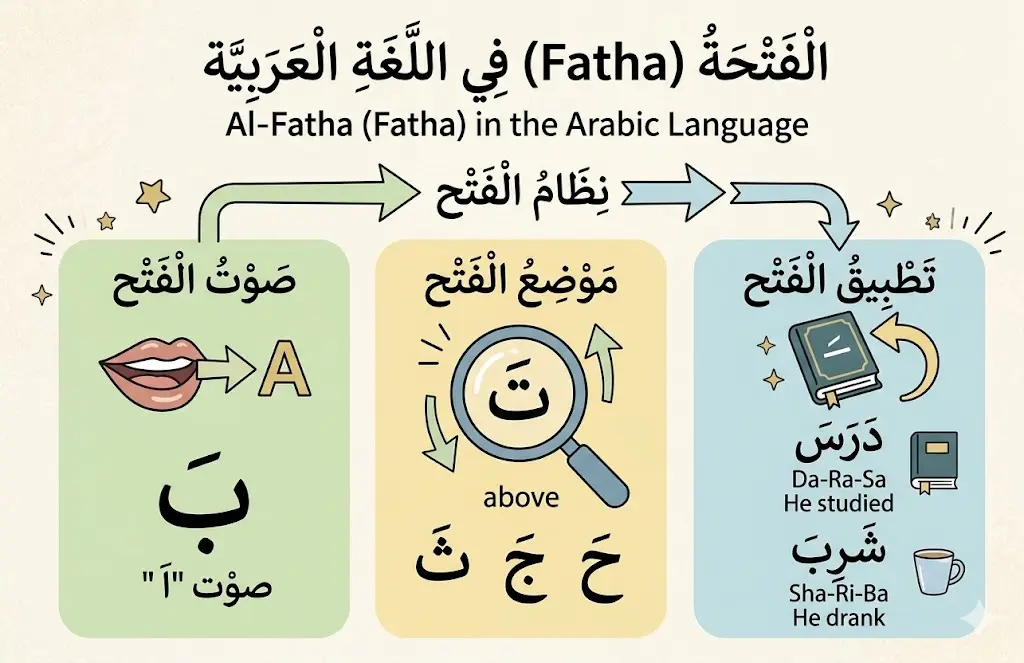
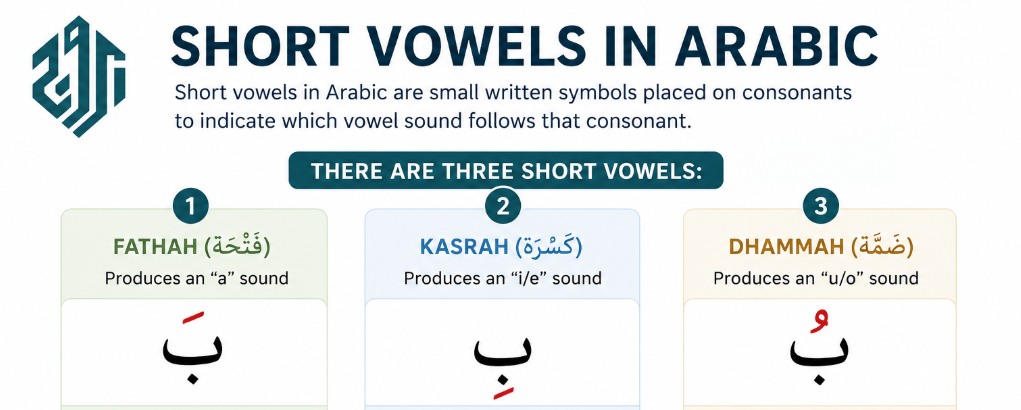
| Fatha (فَتْحَة) is a diagonal stroke written above a letter, producing the short “a” vowel sound in Arabic words. |
| Fatha changes meaning completely when added to different letters — كَتَبَ (kataba, “he wrote”) vs. كُتُب (kitāb, “books”) differ by vowels alone. |
| Tanwin al-fath (double fatha) produces the “-an” ending sound and is among the most common grammatical endings in Modern Standard Arabic. |
Every Arabic learner reaches the same wall within their first week: a string of letters that look identical but sound completely different depending on the tiny marks above and below them. Those marks are Arabic short vowels — and fatha is the one you’ll encounter most often.
Fatha in Arabic (فَتْحَة) is the small diagonal stroke placed above a consonant letter that gives it a short “a” sound. It is the most frequently occurring short vowel in Arabic, essential for reading any voweled text correctly — and the first vowel we teach at Buruj Academy to every beginner, because without it, Arabic pronunciation simply cannot begin.
Table of Contents:
What Is Fatha in Arabic and How Does It Work?
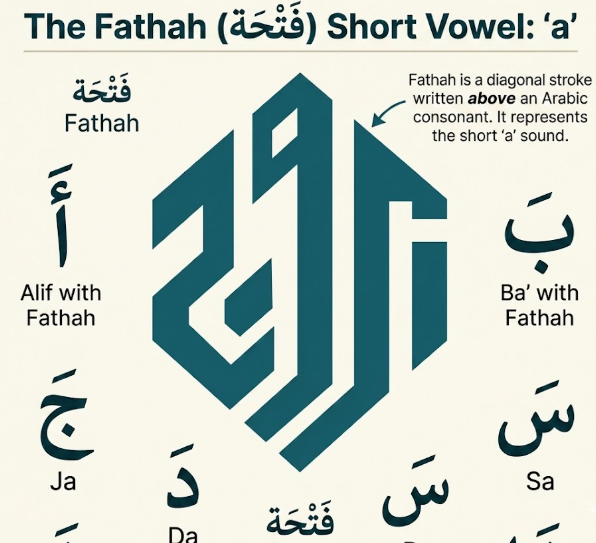
Fatha (فَتْحَة) is one of Arabic’s three foundational short vowels, written as a small diagonal line (◌َ) placed above a consonant. It produces a short “a” sound similar to the “a” in the English word “cat” or “bad.”
Fatha appears more frequently than its two counterparts — kasra (the short “i” sound) and damma (the short “u” sound) — which is why it receives focused attention at the very beginning of any serious Arabic course.
The word “fatha” itself (فَتْحَة) comes from the Arabic root ف-ت-ح, meaning “to open.” This is beautifully descriptive — when you pronounce fatha, your mouth opens slightly wider than for the other two short vowels.
Arabic grammarians named it this intentionally, as a pedagogical aid rooted in phonetic reality.
Understanding fatha also unlocks vowels in Arabic more broadly, since fatha is the gateway vowel — once learners internalize it, kasra and damma follow naturally by comparison and contrast.
How Fatha Looks on Arabic Letters
| Arabic Letter | With Fatha | Pronunciation | English Sound Equivalent |
| ب (ba) | بَ | ba | “ba” as in “bad” |
| كَ (ka) | كَ | ka | “ca” as in “cat” |
| دَ (da) | دَ | da | “da” as in “dad” |
| سَ (sa) | سَ | sa | “sa” as in “sand” |
| نَ (na) | نَ | na | “na” as in “nap” |
| مَ (ma) | مَ | ma | “ma” as in “map” |
Fatha in Arabic Letters: Sound, Position, and Consistency
Fatha’s defining strength as a vowel is its consistency — it always produces the same sound regardless of which letter it accompanies. This differs from English vowels, which shift constantly depending on surrounding letters. In Arabic, بَ (ba) always sounds like “ba,” كَ (ka) always sounds like “ka,” and so on.
At Buruj Academy, one of the first things we tell students in our Online Arabic Classes is this: “Arabic vowels are loyal.” Once you know fatha, you can read any voweled syllable containing it — there are no exceptions, no irregularities, and no surprises.
That predictability makes fatha one of the most learner-friendly elements in the entire Arabic phonetic system.
Book your FREE Arabic trial online Arabic class at Buruj

The Physical Position of Fatha
Fatha is always written above the consonant it vocalizes. It never appears below a letter (that is kasra’s position) and never curves into a circle (that is damma’s shape).
In fully voweled Arabic texts — commonly found in children’s books, beginner textbooks, and the Quran — fatha appears consistently above every applicable consonant.
The fatha mark itself does not change position — it always sits directly above the letter. What changes is only the letter’s own shape.
Fatha in Arabic Words
One of the most important lessons for Arabic learners is that short vowels in Arabic are not decorative — they are grammatically and semantically functional. Changing a fatha to a kasra or damma can change the entire meaning of a word, and sometimes its grammatical role in a sentence.
In our experience teaching students through Buruj Academy’s Arabic for Beginners course, the biggest early shock for learners is discovering that three seemingly identical words — differing only in their vowel marks — can mean three completely different things. This is not a quirk; it is a feature of Arabic’s precision.
Fatha vs. Other Vowels: Meaning Comparison Table
| Word | Vowel Pattern | Meaning |
| كَتَبَ | All fatha | Kataba — “he wrote” |
| كُتُبٌ | All damma | Kutubun — “books” (plural) |
| كِتَابٌ | Kasra + long alif | Kitābun — “a book” |
| كَاتِبٌ | Fatha + kasra | Kātibun — “a writer” |
All four words share the same three-letter root (ك-ت-ب / k-t-b). The vowels — especially fatha — are what carry the morphological information.
Begin learning Arabic at Buruj with a FREE trial lesson

More Fatha Word Examples with Explanations
Here are varied examples showing fatha in realistic Arabic words, organized by category:
Verbs (فعل — fi’l):
- ذَهَبَ (dhahaba) — “he went” — fatha on all three root letters
- فَتَحَ (fataha) — “he opened” — fatha on all three, giving the classic fa’ala verb pattern
- نَظَرَ (naẓara) — “he looked” — same pattern, consistent fatha voweling
Nouns (اسم — ism):
- وَلَدٌ (waladun) — “a boy” — fatha on the first two letters
- بَيْتٌ (baytun) — “a house” — fatha on the first letter, followed by a long vowel
- شَجَرَةٌ (shajaratun) — “a tree” — fatha across all syllables
Adjectives (صفة — sifa):
- جَمِيلٌ (jamīlun) — “beautiful” — fatha opens the word
- كَبِيرٌ (kabīrun) — “big/large” — fatha on the first root letter
- صَغِيرٌ (ṣaghīrun) — “small” — same pattern, fatha begins the root
Notice how fatha on the first letter of a word is extremely common in Arabic — this pattern recurs across verbs, nouns, and adjectives and is worth drilling early.
Read also: Dammah in Arabic
Discover the Buruj Academy Difference
Step into our virtual classrooms and see how our expert instructors make learning Quran and Arabic intuitive and clear. We focus on overcoming the specific hurdles non-native speakers face, building your confidence and connection with the Quran.
Master the Arabic Language
Join our expert-led courses and build a strong foundation in Classical and Modern Arabic.
Get Your Free TrialWhat Is Tanwin al-Fath and Why Does It Matter?
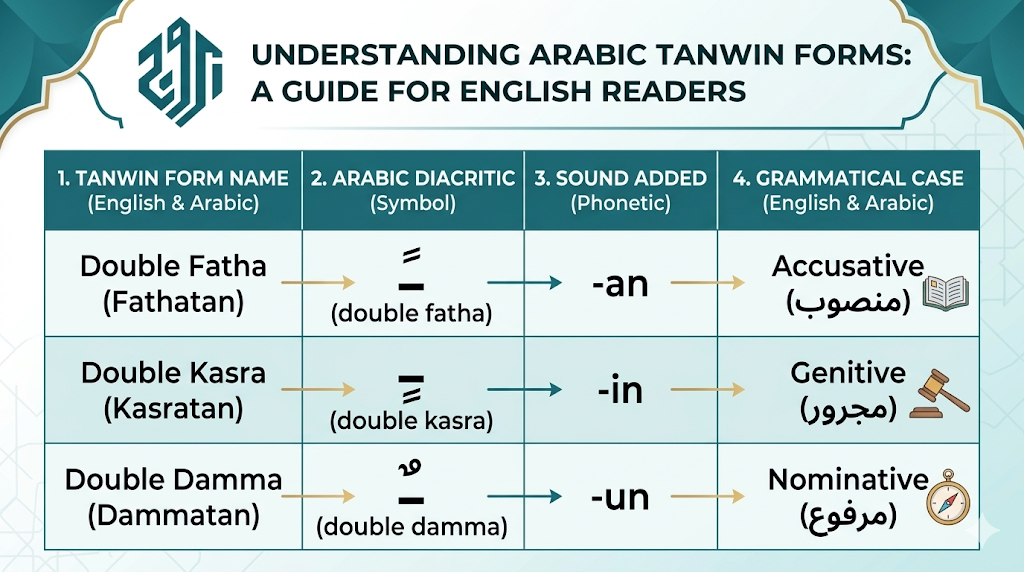
Tanwin (تنوين) is the “nunation” system in Arabic — double vowel marks that add an “n” sound to the end of a word. Tanwin al-fath (تنوين الفتح) specifically uses a double fatha (◌ً) and produces the “-an” sound. It is the most recognizable of the three tanwin forms and appears constantly in Modern Standard Arabic (MSA).
Unlike tanwin al-damm (ـٌ) and tanwin al-kasr (ـٍ), tanwin al-fath has a unique spelling rule: it is almost always written with an alif (ا) at the end of the word. The fatha sound lands on the consonant before the alif, and the alif itself is silent.
Tanwin Comparison Table
| Tanwin Type | Symbol | Sound | Example | Meaning |
| Tanwin al-Fath | ـً | “-an” | كِتَابًا (kitāban) | “a book” (accusative) |
| Tanwin al-Damm | ـٌ | “-un” | كِتَابٌ (kitābun) | “a book” (nominative) |
| Tanwin al-Kasr | ـٍ | “-in” | كِتَابٍ (kitābin) | “a book” (genitive) |
These three tanwin endings mark the Arabic case system — nominative (فاعل), accusative (مفعول), and genitive (مجرور). Tanwin al-fath indicates the accusative case in most indefinite nouns, making it essential for anyone studying Arabic grammar.
The Alif Rule for Tanwin al-Fath
Most indefinite nouns receiving tanwin al-fath are written with an added alif: شُكْرًا (shukran, “thank you”), كِتَابًا (kitāban, “a book”). Exceptions include words ending in ta’ marbuta (ة), hamza on alif (أ), or alif maqsura (ى) — these take the double fatha without an extra alif.
Knowing this rule prevents a very common spelling error we see frequently among beginner students in our Arabic Grammar course.
Fatha in Arabic Pronunciation
Fatha in Arabic produces a short “a” sound — but not every “a” sound in English is equivalent. Getting fatha’s pronunciation right from the beginning prevents fossilized errors that are much harder to correct later.
The correct fatha sound is open and front — produced with the mouth slightly open, tongue relatively flat, and jaw relaxed downward. It resembles the “a” in “hat,” “cat,” or “man” in General American English.
Fatha in Arabic does not sound like the long “a” in “cake,” the “a” in “father” (which is too deep and back), or the “a” in “about” (which is the schwa — too reduced and unstressed).
Common Pronunciation Mistakes English Speakers Make with Fatha in Arabic
From our years of teaching non-Arabic speakers, we see the same fatha errors consistently. Here is a guide to those errors and their corrections:
| Mistake | What It Sounds Like | Correction |
| Replacing fatha with a schwa | “kataba” sounds like “kuh-tuh-buh” | Keep fatha crisp and open — never reduced |
| Elongating the fatha | “kataba” sounds like “kaay-taba” | Fatha is short — never hold it longer than the beat |
| Deepening it like “father” | بَ sounds like the “ba” in “bar” | Keep it frontal, not throaty |
| Confusing with kasra | Reading بَ as “bi” | Remember: fatha is above the letter — kasra is below |
Practice these minimal pairs to train your ear on fatha’s exact sound:
- بَ (ba) vs. بِ (bi) — fatha vs. kasra on the same letter
- سَ (sa) vs. سُ (su) — fatha vs. damma on the same letter
- كَتَبَ (kataba) vs. كُتُبٌ (kutubun) — all-fatha word vs. all-damma word
For a broader perspective on Arabic vowel sound training, our article on Arabic pronunciation covers all three short vowels with audio-equivalent guidance.
Practical Exercises to Master Fatha in Arabic Words
Knowing fatha conceptually and reading it fluently are two different skills. Fluency comes from deliberate practice. Here are structured exercises we use with our students, organized by level:
Exercise 1 — Single-Letter Fatha Drill (Beginner)
Read each syllable aloud, focusing on producing a clean, short “a” sound:
| بَ | تَ | ثَ | جَ | حَ | خَ |
| دَ | ذَ | رَ | زَ | سَ | شَ |
| صَ | ضَ | طَ | ظَ | عَ | غَ |
| فَ | قَ | كَ | لَ | مَ | نَ |
Read each row left to right, then right to left. Aim for even rhythm — do not slow down on unfamiliar letters.
Exercise 2 — Complete Words with Fatha (Intermediate)
Read these real Arabic words, focusing on fatha consistency:
| Arabic Word | Transliteration | Meaning |
| فَتَحَ | fataha | he opened |
| ذَهَبَ | dhahaba | he went |
| كَتَبَ | kataba | he wrote |
| نَصَرَ | naṣara | he helped/supported |
| سَأَلَ | sa’ala | he asked |
| قَرَأَ | qara’a | he read |
| وَجَدَ | wajada | he found |
| جَلَسَ | jalasa | he sat |
Each word above follows the فَعَلَ (fa’ala) verb pattern — three root letters with fatha on each. This is the most productive verb pattern in Arabic, and mastering it with fatha unlocks Arabic past tense verbs immediately.
Exercise 3 — Fatha vs. Other Vowels (Intermediate)
Read each row across and identify how changing vowels changes the word:
| Word 1 (Fatha) | Word 2 (Kasra) | Word 3 (Damma) |
| كَتَبَ (kataba) | كِتَابٌ (kitābun) | كُتُبٌ (kutubun) |
| فَتَحَ (fataha) | فِتْنَةٌ (fitnatun) | فُتِحَ (futiha) |
| بَيْتٌ (baytun) | بِئْرٌ (bi’run) | بُيُوتٌ (buyūtun) |
This exercise builds your intuition for how the same root letters produce completely different vocabulary through vowel changes.
How Fatha Interacts with Long Vowels in Arabic
Fatha does not exist in isolation — it connects directly to Arabic’s long vowel system. When fatha is followed by an alif (ا), it lengthens into the long “ā” sound, held for approximately double the duration of a short fatha.
This fatha + alif combination is written throughout Arabic and produces some of the language’s most common words:
| Short (Fatha Only) | Long (Fatha + Alif) | Difference |
| بَ (ba) | بَا (bā) | short vs. doubled length |
| كَتَبَ (kataba) | كَاتِبٌ (kātibun) | “he wrote” vs. “a writer” |
| سَ (sa) | سَاعَةٌ (sā’atun) | syllable vs. “an hour/clock” |
| نَ (na) | نَامَ (nāma) | syllable vs. “he slept” |
Understanding this connection helps learners avoid a very common error: treating fatha + alif as two separate sounds rather than one elongated vowel. As we teach in our Arabic Reading course, the rule is simple — fatha stretches when it meets an alif, and that stretch is predictable and consistent.
Read Arabic fluently with a free Buruj trial

Read also: Long Vowels in Arabic
How Fatha Fits into Arabic Sentence Structure
Fatha’s role extends beyond single words — it functions as a grammatical marker at the sentence level. In Arabic’s case system (الإعراب — al-i’rab), the vowel on the final letter of a noun often signals its grammatical role.
Specifically, fatha (or tanwin al-fath for indefinite nouns) on the final letter typically marks the accusative case (المنصوب — al-manṣūb) — indicating the direct object, certain adverbial roles, or words following specific particles.
This is foundational knowledge for understanding Arabic sentence structure.
Fatha as a Case Marker — Examples
| Sentence (Arabic) | Role of Fatha | Translation |
| قَرَأَ الطَّالِبُ كِتَابًا | كِتَابًا = accusative object | The student read a book. |
| رَأَيْتُ وَلَدًا | وَلَدًا = accusative object | I saw a boy. |
Notice how tanwin al-fath (the double fatha with alif) marks each indefinite direct object. This grammatical function makes fatha indispensable for writing and reading grammatically accurate Arabic — not just isolated words.
Start Reading Arabic Fluently with Buruj Academy’s Expert Instructors
Mastering fatha is your entry point into reading Arabic with confidence. Once the short vowels click, entire pages of voweled Arabic text open up.
Buruj Academy’s Online Arabic Classes are taught by Al-Azhar University graduates with 12+ years of experience teaching non-Arabic speakers worldwide. Our approach — context before abstraction — means you read and hear real Arabic words from your very first lesson, not just theory.
We offer personalized 1-on-1 sessions with flexible scheduling, so learning fits around your life. From the alphabet to grammar to speaking fluency, our instructors build your skills systematically.
Book your free trial lesson today and take the first step toward reading Arabic with clarity and confidence — Insha’Allah.
Begin your transformation today by choosing the path that fits your goals:
- Online Arabic Classes (General & Comprehensive)
- Arabic Course for Beginners
- Arabic Alphabet Learning Course
- Online Arabic Classes for Kids
- Arabic Classes for Adults
- Arabic Grammar Course (Nahw & Sarf)
- Intermediate Arabic Course (B1/B2)
- Arabic Speaking Course (Conversational Fluency)
- Arabic Reading Course (Literary Excellence)
- Learn Arabic Writing Course (Calligraphy & Composition)
Ready to speak with confidence? Join the global community at Buruj Academy and book your free placement interview today!
Master the Arabic Language
Join our expert-led courses and build a strong foundation in Classical and Modern Arabic.
Get Your Free TrialConclusion
Fatha is the cornerstone of Arabic reading. It is consistent, logical, and foundational — once it settles into your reading instincts, Arabic text transforms from an intimidating series of shapes into meaningful, pronounceable language. From the classic فَعَلَ verb pattern to tanwin al-fath endings, fatha appears in virtually every Arabic sentence you will ever read or write.
The key is not just knowing what fatha is — it is drilling it until recognition becomes automatic. Use the exercises in this guide regularly, study how fatha interacts with long vowels and grammatical case endings, and always read aloud.
Frequently Asked Questions About Fatha in Arabic
What Is the Difference Between Fatha, Kasra, and Damma in Arabic?
Fatha (◌َ), kasra (◌ِ), and damma (◌ُ) are Arabic’s three short vowels. Fatha sits above a letter and produces a short “a” sound. Kasra sits below the letter and produces a short “i” sound. Damma sits above the letter (as a small curl) and produces a short “u” sound. Together, they make any Arabic text fully pronounceable.
Why Does Tanwin al-Fath Add an Alif at the End of Words?
Tanwin al-fath (double fatha, ـً) adds a silent alif (ا) in writing for most indefinite nouns in the accusative case. This is an orthographic convention — the alif does not add a sound, only the “-an” ending is pronounced. Exceptions include words ending in ta’ marbuta (ة), alif maqsura (ى), or hamza on alif (أ), which take the double fatha without the extra alif.
How Long Does It Take to Learn to Read Arabic with Short Vowels?
In our experience at Buruj Academy, students with no prior Arabic background typically read fully voweled Arabic syllables confidently within two to four weeks of consistent daily practice — roughly 20 to 30 minutes per day. Reading complete voweled words fluently usually follows within six to eight weeks. Progress depends significantly on practice regularity and the quality of phonetic instruction received early on.