 Arabic
| Key Takeaways |
| Prioritizing spoken Arabic alongside reading from day one cuts the average learning timeline by 30–40% for most adult beginners. |
| Mastering the Arabic alphabet in the first two weeks — not two months — is the single fastest structural investment you can make. |
| Consistent daily sessions of 30–45 minutes outperform weekly 3-hour blocks in both retention and pronunciation development. |
| A qualified instructor who corrects pronunciation in real time prevents months of ingrained errors that slow long-term progress. |
Most people overestimate how long Arabic takes and underestimate how fast they can start using it. Arabic has a reputation for difficulty that often paralyzes beginners before they even start — and that hesitation costs more time than the language itself.
The quickest way to learn Arabic is to sequence your study strategically: alphabet first, high-frequency vocabulary second, grammar as a support tool — not a starting point. Learners who follow this order with daily consistency regularly reach functional reading and basic speaking within 3–6 months.
Table of Contents:
1. Master the Arabic Alphabet in Your First Week — Not Two Months
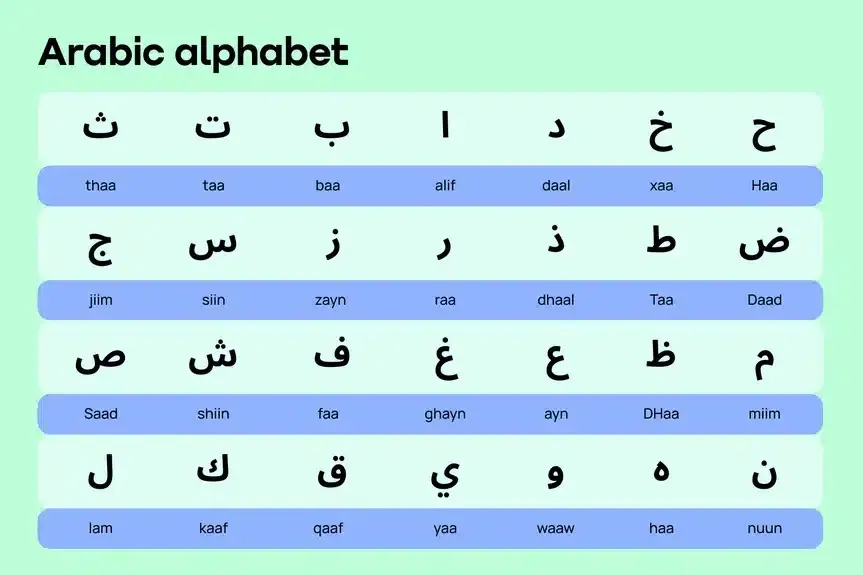
The fastest path to Arabic fluency begins with the alphabet, and it begins immediately. Many beginners delay this step or spend months on it — both mistakes. The Arabic script has 28 letters, each with up to four positional forms, and the entire system can be internalized in 7 days with focused daily practice of 20–30 minutes.
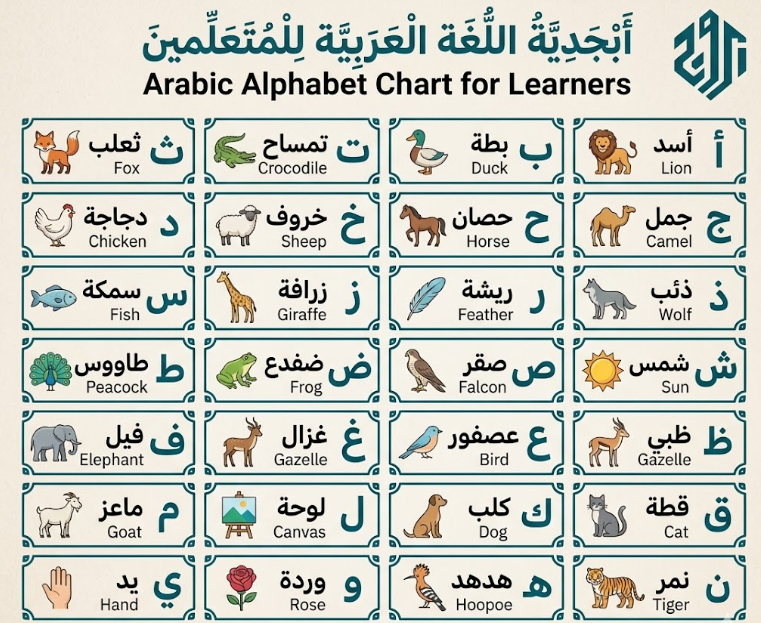
At Buruj Academy, we have seen adult beginners with zero prior exposure to Arabic script achieve confident letter recognition within 12 days using our structured alphabet sequence. The key is learning letters in phonetic groups — sounds that share articulation points — rather than in alphabetical order.
Why Letter Groups Beat Alphabetical Order
Learning ب، ت، ث together (all sharing the same base shape) builds visual pattern recognition faster than isolated memorization. This reduces confusion between similar letters and accelerates writing recognition simultaneously.
Our Arabic Alphabet Learning Course uses exactly this grouping approach with non-native speakers from day one.
| Learning Method | Avg. Time to Alphabet Mastery | Retention Rate at 30 Days |
| Alphabetical order (traditional) | 6–10 weeks | ~55% |
| Phonetic grouping method | 10–14 days | ~80% |
| Letter + sound + word context | 7–12 days | ~85% |
Understanding how to learn the Arabic alphabet with the right sequencing is the structural investment that makes every subsequent step faster.
Get a free trial now in Buruj’s Alphabet course
2. Learn High-Frequency Vocabulary Before Studying Grammar Rules
The second fastest accelerator in Arabic learning is vocabulary prioritization. Grammar gives you the structure to arrange words — but without words, grammar has nothing to arrange.
Learners who build a core vocabulary of 300–500 high-frequency Arabic words before diving deeply into grammar rules reach conversational thresholds significantly faster.
For Muslim learners specifically, this approach carries a remarkable shortcut: the 300 most frequently occurring words in the Quran cover approximately 70–80% of Quranic text.
Investing your first vocabulary sessions in these words gives you simultaneous progress in both Modern Standard Arabic and Quranic comprehension. Our guide to mastering Arabic vocabulary outlines exactly which word categories to prioritize and why.
How to Build Vocabulary Fast Without Forgetting It?
Use spaced repetition — a learning method where words are reviewed at increasing intervals as they move into long-term memory.
Pair every new word with an Arabic sentence, not an isolated translation. This activates Arabic sentence structure naturally from early stages, reducing the grammar shock many students experience later.
3. Speak Arabic from Week One — Even Imperfectly
One of the most common reasons learners take years instead of months to reach speaking ability is that they delay speaking until they feel “ready.” In our instructors’ experience, that moment of readiness rarely arrives through silent study alone — it arrives through speaking practice, with correction.
Starting spoken Arabic in week one — even at the level of basic greetings, numbers, and object names — builds neural pathways that reading alone cannot.
Pronunciation errors caught in the first month take days to correct; errors embedded over six months of self-study can take weeks to undo.
Our Arabic Speaking Course addresses this directly by making live conversation practice the core of every session from the very first class.
Book your free trial to start speaking Arabic fluently

To learn to speak Arabic fast, follow this weekly speaking schedule:
| Week | Speaking Focus | Daily Time |
| 1–2 | Greetings, numbers 1–20, self-introduction | 10 min |
| 3–4 | Daily object names, basic questions | 15 min |
| 5–8 | Simple present-tense sentences, describing surroundings | 20 min |
| 9–12 | Expressing needs, giving basic directions | 25 min |
Learning how to improve Arabic speaking skills consistently — even through short daily sessions — compounds rapidly over weeks.
Read also: The Difference Between Ikhfa, Idgham, Izhar, and Iqlab in Tajweed
4. Use a Structured Beginner Course Rather Than Scattered Free Resources
Many learners try to answer “how can I learn Arabic fast” by assembling a patchwork of YouTube videos, apps, and grammar websites. This approach feels productive but produces fragmented knowledge — gaps in pronunciation, inconsistent grammar understanding, and no clear progression pathway.
The quickest way to learn Arabic for free or affordably is not zero structure — it is structured input at low cost.
A well-designed beginner course provides sequenced content, real-time feedback, and a teacher who catches what apps cannot: subtle pronunciation errors, wrong stress patterns, and individual misconceptions before they harden.
Master the Arabic Language
Join our expert-led courses and build a strong foundation in Classical and Modern Arabic.
Get Your Free TrialBuruj Academy’s Arabic for Beginners course provides exactly this — personalized 1-on-1 instruction with Al-Azhar-trained instructors who have 12+ years of experience teaching non-native speakers, at accessible pricing with a free trial lesson.
Our beginner’s guide to Modern Standard Arabic outlines the foundational structure every new learner should understand before choosing their learning path.
Begin learning Arabic at Buruj with a FREE trial lesson

5. Introduce Arabic Grammar as a Pattern Tool — Not a Rulebook
Grammar is where most adult Arabic learners slow down — and where the quickest learners accelerate. The difference is framing. Arabic grammar (النحو, an-Nahw) is a pattern system, not a list of exceptions to memorize.
When you approach it as a set of logical patterns that explain what you already hear and read, grammar becomes fast. When you approach it as an abstract rulebook to memorize before using the language, it becomes a bottleneck.
The key patterns to prioritize in the first three months:
- Nominal sentences (الجملة الاسمية): subject + predicate, no verb required
- Verbal sentences (الجملة الفعلية): verb + subject + object order
- Definite article (ال): the distinction between sun and moon letters for pronunciation — see our guide on moon and sun letters in Arabic
- Dual and plural forms: understanding broken plurals early prevents enormous confusion later
- Basic verb conjugation in the past tense (الماضي) before present or future
Our guide to learning Arabic grammar easily walks through each of these patterns with English-speaker-specific explanations that cut through the abstraction. Buruj Academy’s Arabic Grammar Course builds these patterns progressively, ensuring grammar supports speaking and reading rather than blocking it.
Understand the Arabic Grammar with Buruj’s free trial lesson

6. Train Your Arabic Pronunciation Early with Targeted Online Practice
Pronunciation is the area where non-native Arabic speakers most frequently lose time. Arabic contains sounds that do not exist in English — the emphatic consonants (ص، ض، ط، ظ), the pharyngeal sounds (ع، ح), and the uvular consonants (غ، خ، ق) — and incorrect pronunciation habits built in the first weeks become progressively harder to correct.
The fastest approach to Arabic pronunciation is ear-first training: listen to correct production of each sound before attempting to produce it yourself.
At Buruj Academy, we use a sound-before-rules methodology — learners internalize the correct sound of each letter before any written rule explanation is given.
This dramatically shortens the gap between knowing what a letter looks like and saying it correctly.
Using Arabic pronunciation resources online as a daily supplement to live instruction accelerates correction speed significantly. Aim for 10 minutes of targeted listening and imitation daily in your first month.
7. Build a Daily Consistency Habit — 30 Minutes Beats 3 Hours Weekly
The single most decisive factor in how quickly you learn Arabic is not the method, the app, or even the teacher. It is daily consistency.
A learner who studies Arabic for 30 minutes every day for 90 days will outperform a learner who studies for 3 hours every Saturday — even if the Saturday learner accumulates more total hours.
This is not motivational advice — it is how memory consolidation works. Sleep cycles between daily sessions allow procedural memory to stabilize new Arabic sounds, vocabulary, and patterns. Without those daily cycles, even intensive sessions produce poor long-term retention.
| Study Pattern | Weekly Hours | 3-Month Retention | Recommended For |
| 30 min/day, 7 days | 3.5 hrs | High | Working adults, parents |
| 45 min/day, 5 days | 3.75 hrs | High-Moderate | Flexible schedules |
| 90 min × 3/week | 4.5 hrs | Moderate | Students with blocked time |
| 3 hrs × 1/week | 3 hrs | Low | Not recommended |
Understanding how long it realistically takes to learn Arabic based on your daily time investment helps you set expectations that keep you consistent rather than discouraged.
Read also: How to Learn Arabic for Free?
8. Use Arabic Dictation to Accelerate Reading and Writing Simultaneously
One of the fastest — and most underused — methods for accelerating Arabic literacy is dictation (الإملاء, al-Imla’). Writing what you hear forces your brain to process Arabic at three levels simultaneously: phonemic (sound recognition), orthographic (letter-to-script conversion), and semantic (meaning verification). No passive reading exercise achieves all three at once.
A structured dictation practice of 10–15 minutes, three times per week, can accelerate reading fluency by weeks compared to reading-only approaches. Start with individual words, then short phrases, then full sentences.
Our resource on improving Arabic writing with dictation outlines a progression any beginner can follow using our Learn Arabic Writing Course.
Book your free trial to start writing Arabic
Discover the Buruj Academy Difference
Step into our virtual classrooms and see how our expert instructors make learning Quran and Arabic intuitive and clear. We focus on overcoming the specific hurdles non-native speakers face, building your confidence and connection with the Quran.
Start Learning Arabic Faster with Buruj Academy’s Expert Instructors
The quickest way to learn Arabic is not about shortcuts — it is about correct sequencing with expert guidance from the start. Buruj Academy’s Online Arabic Classes provide exactly that, with:
- Al-Azhar University graduates and Ijazah-certified instructors with 12+ years teaching non-native speakers
- The Buruj Method: context-before-abstraction, sound-before-rules, consistency-before-speed
- Personalized 1-on-1 sessions with real-time pronunciation correction
- Flexible 24/7 scheduling for working adults, parents, and students globally
- Clear progression from alphabet to fluency with customized learning plans
Book your free trial lesson today — and start making real progress from your very first session, Insha’Allah.
Begin your transformation today by choosing the path that fits your goals:
- Online Arabic Classes (General & Comprehensive)
- Arabic Course for Beginners
- Arabic Alphabet Learning Course
- Online Arabic Classes for Kids
- Arabic Classes for Adults
- Arabic Grammar Course (Nahw & Sarf)
- Intermediate Arabic Course (B1/B2)
- Arabic Speaking Course (Conversational Fluency)
- Arabic Reading Course (Literary Excellence)
- Learn Arabic Writing Course (Calligraphy & Composition)
Ready to speak with confidence? Join the global community at Buruj Academy and book your free placement interview today!
Master the Arabic Language
Join our expert-led courses and build a strong foundation in Classical and Modern Arabic.
Get Your Free TrialConclusion
Learning Arabic quickly is entirely achievable when the steps are sequenced correctly — alphabet mastery first, high-frequency vocabulary second, spoken practice immediately, and grammar as a pattern tool rather than a gateway.
The learners we see progress fastest at Buruj Academy are not necessarily the most talented — they are the most consistent, and they start speaking before they feel ready.
Alhamdulillah, Arabic is one of the richest and most rewarding languages a Muslim can invest in — connecting you to the Quran, to classical scholarship, and to a global community of speakers. Follow the structure above, commit to daily practice, and do not underestimate how much a qualified instructor accelerates what self-study alone cannot achieve.
Frequently Asked Questions About Learning Arabic Fast
What Is the Quickest Way to Learn Arabic for Complete Beginners?
The quickest way to learn Arabic for beginners is to master the alphabet in the first two weeks, then immediately begin building high-frequency vocabulary alongside basic speaking practice. Pairing this with a structured course taught by a qualified instructor — rather than scattered free resources — prevents the pronunciation and grammar gaps that delay most self-taught learners by months.
How Can I Learn Arabic Faster If I Have Only 30 Minutes a Day?
Thirty minutes daily is genuinely sufficient for rapid progress if those minutes are structured: 10 minutes of vocabulary review using spaced repetition, 10 minutes of reading or writing practice, and 10 minutes of listening or speaking. Daily consistency at this level produces better retention than longer, infrequent sessions. Most of our students at Buruj Academy begin with exactly this schedule.
Is There a Quickest Way to Learn Arabic for Free?
Free resources — YouTube channels, open vocabulary lists, free apps — can supplement learning effectively, but rarely replace structured progression. The quickest way to learn Arabic for free involves using high-quality free resources for vocabulary and listening while accessing at least some structured instruction for pronunciation correction. Buruj Academy offers a free trial lesson as a starting point with zero financial commitment.
How Long Does It Realistically Take to Reach Basic Arabic Speaking Ability?
In our instructors’ experience, non-Arabic speakers who study 30–45 minutes daily with a qualified teacher typically reach basic conversational ability — greetings, simple questions, describing their surroundings — within 3–5 months. Reading basic Arabic sentences usually arrives within 6–8 weeks when the alphabet is mastered correctly from the start.