 Arabic
| Key Takeaways |
| Multisensory activities — combining sight, sound, and touch — accelerate Arabic letter recognition significantly faster than flashcard drilling alone. |
| Arabic has 28 letters, each with up to 4 positional forms; activities must address all forms to build genuine reading readiness. |
| Short daily sessions of 10–15 minutes outperform weekly long sessions for children’s Arabic alphabet retention and confidence. |
| Children aged 4–7 learn Arabic letters most effectively through play-based methods before transitioning to structured writing practice. |
Children who struggle with the Arabic alphabet are almost never struggling because the language is too hard — they are struggling because the method is too flat. Most parents hand a child a worksheet, point to a letter, and wonder why recognition does not stick.
The Arabic alphabet responds beautifully to the right activities. With 28 letters and multiple positional forms, children need variety, repetition with novelty, and above all, a sense of delight.
The activities below are drawn directly from our classroom experience at Buruj Academy, where our native Arabic instructors have guided hundreds of children from zero letter recognition to confident reading — and these are the methods that consistently produce results.
Table of Contents:
1. Sand Tracing Builds Letter Memory Through Touch
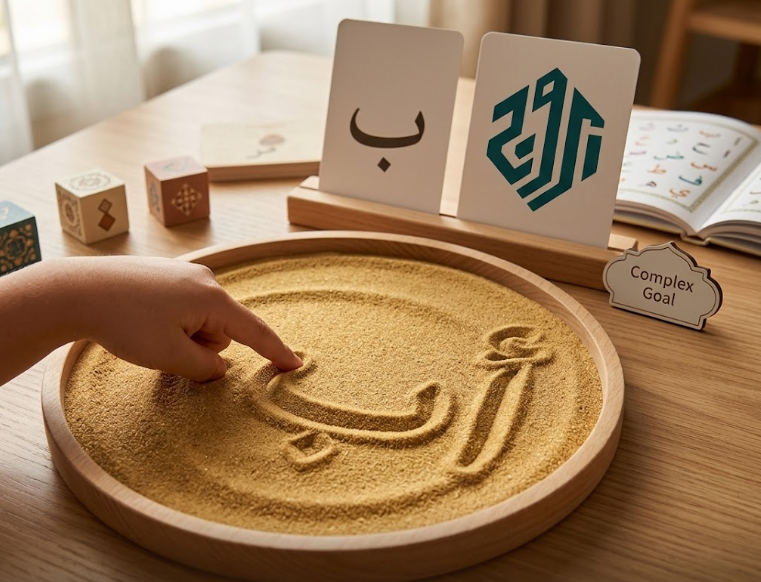
Sand tracing is one of the most powerful entry-point activities we use for children aged 3–6. Fill a shallow tray with fine sand, say the letter name aloud, then guide the child’s finger to trace its shape.
The combination of auditory input, muscle movement, and visual feedback creates a three-channel memory pathway that worksheets simply cannot replicate.
We consistently find that children who trace letters in sand remember their shapes after just three repetitions — compared to six or more repetitions with pencil-and-paper drilling. The tactile feedback is irreplaceable for young learners whose fine motor skills are still developing.
Start with letters that have distinct, easy shapes: و (waw), ر (ra), and ز (zayn) work well as entry points before moving to more complex forms like ع (ayn) or غ (ghayn).
2. Letter-of-the-Day Routines Create Daily Immersion Without Overwhelm
Introducing one Arabic letter per day — or every two days for younger children — prevents the cognitive overload that occurs when parents attempt to teach the full alphabet in a single week.
Dedicate the chosen letter to every activity that day: breakfast plate arrangement, drawing, a short song, and a bedtime story featuring that letter’s sound.
This approach mirrors how our instructors structure the early weeks of Buruj Academy’s Online Arabic Classes for Kids — consistent, focused exposure with meaningful variety rather than rushed coverage.
| Age Group | Letters Per Day | Recommended Session Length |
| 3–4 years | 1 every 3 days | 5–8 minutes |
| 5–6 years | 1 every 2 days | 10–12 minutes |
| 7–9 years | 1–2 per day | 15–20 minutes |
| 10+ years | 2–3 per day | 20–25 minutes |
Consistency matters far more than speed. A child who knows 10 letters with confidence is more prepared than one who has “covered” all 28 with shaky recognition.
Book a FREE Arabic trial for your Child

3. Arabic Alphabet Songs Help Children Internalize Letter Sequences Effortlessly
Music engages the brain’s memory centers differently from visual or verbal instruction. Singing the Arabic alphabet — with correct pronunciation of each letter name — helps children internalize the sequence, the sounds, and the rhythm of the language simultaneously.
Use recordings that pronounce letter names correctly: أَلِف (alif), بَاء (ba), تَاء (ta) — not approximated English versions. Clap on each letter, pause for children to echo, and repeat the song across different times of day to reinforce the sequence through spaced repetition.
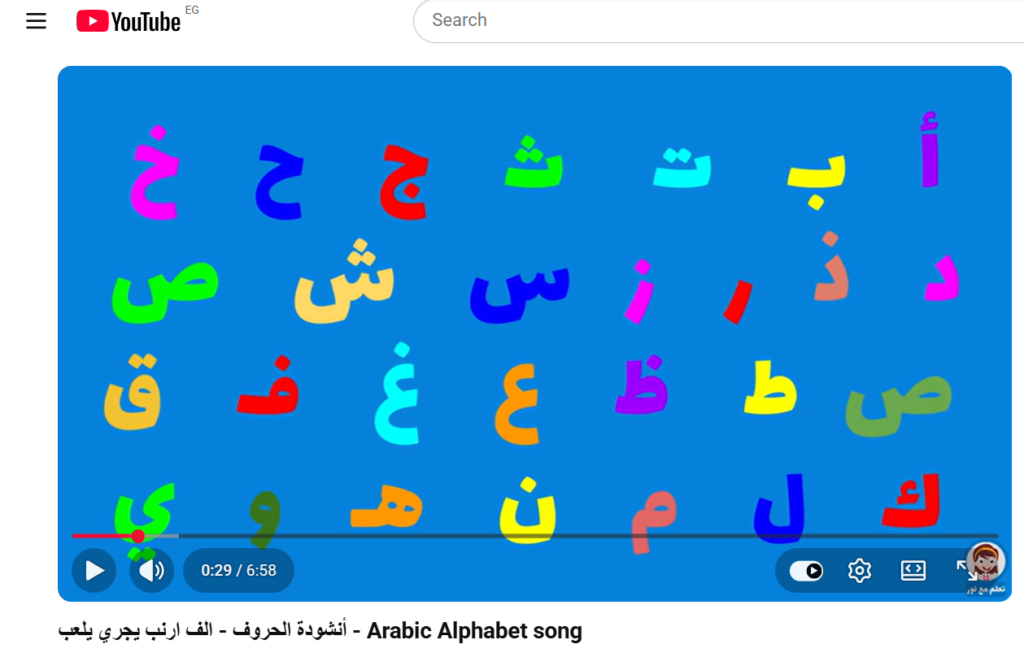
For children working through our learning Arabic alphabet for kids resources, pairing songs with visual letter cards creates a powerful recall system that accelerates readiness for reading.
4. Playdough Letter Sculpting Strengthens Fine Motor Skills Alongside Letter Recognition
Ask children to roll playdough into the shape of each Arabic letter as you call it out. This activity achieves two goals simultaneously: letter shape memorization and the fine motor development children need for writing. It also introduces the concept of letter curvature — a feature of Arabic script that children must internalize before pen-to-paper practice.
Guide children to notice which letters are “open” (like ح) and which are “closed” (like ه), building the shape-awareness that transfers directly into reading accuracy.
This kind of observation is exactly what our instructors call “pre-reading intelligence” — the visual sensitivity to letter detail that separates fast readers from slow decoders.
5. Arabic Alphabet Puzzles Train Letter Recognition Through Problem-Solving
Alphabet puzzles — where each piece represents a single Arabic letter — require children to visually discriminate between similar letter shapes, which is one of the most valuable pre-reading skills in Arabic.
Letters like ب، ت، ث or ح، ج، خ are visually related, and puzzles force children to notice the distinguishing features: dots, their position, and their number.
Choose puzzles that show the letter in isolation, not just in its initial form. Children need exposure to all positional forms — initial (أَوَّلِيّ), medial (وَسَطِيّ), final (أَخِيرِيّ), and standalone (مُنْفَرِد) — to develop full reading competence.
For a deeper foundation in how these forms work, our Arabic Alphabet Learning course addresses each positional form systematically.
Get your kid a free trial now in Buruj’s Best Alphabet course
6. Dot-Counting Games Make Letter Differentiation Genuinely Fun
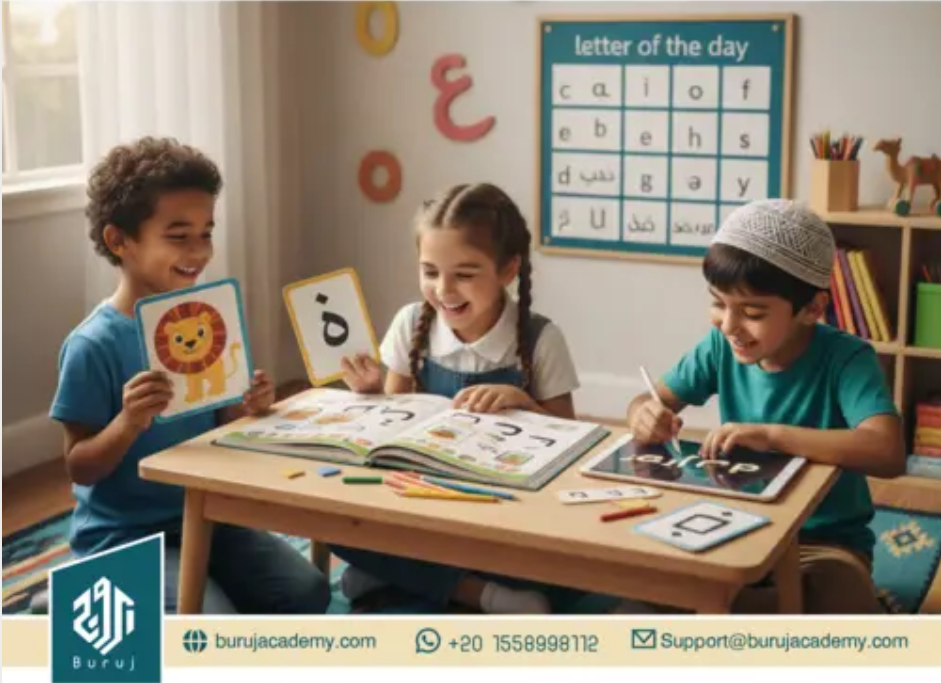
Many Arabic letters are distinguished solely by the number and position of their dots — a feature that confuses young learners and is responsible for a significant proportion of reading errors we see in new students. Turn dot-counting into a game: hold up a flashcard, and challenge children to call out the number of dots before naming the letter.
| Letter Group | Number of Dots | Position |
| ب | 1 dot | Below |
| ت | 2 dots | Above |
| ث | 3 dots | Above |
| ن | 1 dot | Above |
| ي | 2 dots | Below |
This table gives children a visual anchor. Once dot-position is internalized as a distinguishing feature, letter confusion drops dramatically — a pattern we observe consistently within the first two weeks of focused dot-awareness practice.
Read also: Learn Egyptian Arabic for Kids
7. Quranic Word Association Gives Each Letter a Sacred, Memorable Context
Linking each Arabic letter to a Quranic word the child already hears creates a meaningful anchor that pure phonics cannot provide. The letter ب (ba) becomes the letter of بِسْمِ (bismi, “in the name of”) — a word every Muslim child hears daily. The letter ر (ra) connects to رَحْمَن (Rahman, “the Most Merciful”).
This approach is central to how we build letter foundations at Buruj Academy. When a letter carries meaning from the Quran, children remember it not just as a shape but as something alive and familiar. It also begins building the Quranic vocabulary that accelerates progress later in their learning to read Arabic journey.
Try Buruj’s Quranic Arabic Course for Kids for free now

8. Magnetic Letter Boards Allow Repeated, Low-Pressure Practice
Magnetic Arabic letter sets on a refrigerator door or small whiteboard give children continuous access to the alphabet without the pressure of performance. Allow children to arrange letters freely, match them to flashcards, or simply play — unstructured contact with letter shapes is genuinely valuable at ages 3–5.
When you notice your child picking up and examining certain letters repeatedly, use that as a natural opening: name the letter together, make its sound, and find a word it belongs to.
This child-led engagement produces stronger retention than timed drills because the child’s own curiosity is doing the work.
9. Arabic Storytime With Letter Spotting Builds Reading Readiness Naturally
Read age-appropriate Arabic stories for kids aloud and assign your child a “letter detective” role: every time they hear a specific letter sound, they tap the table, raise a hand, or place a counter.
This trains phonemic awareness — the ability to distinguish individual sounds within the flow of spoken language — which is a prerequisite for decoding written Arabic.
Start with letters whose sounds are clearly distinct from English: ح (ha), خ (kha), and ع (ayn) are excellent choices because children must actively listen for sounds that do not exist in their native phonology. Our Al-Azhar-trained instructors emphasize this phonemic awareness phase before any writing instruction begins.
Master the Arabic Language
Join our expert-led courses and build a strong foundation in Classical and Modern Arabic.
Get Your Free Trial10. Letter Matching Card Games Build Speed and Accuracy Through Repetition
Create or purchase a set of matching cards where one card shows the letter in isolation and its pair shows it embedded in a simple word.
Memory-match games require children to recognize the letter across different visual contexts — which is exactly the flexibility needed for real reading.
Vary the game format weekly: sometimes play standard memory match, other times play “snap” (fastest to call the letter name wins the pair), and other times sort cards into groups by letter family (the ب، ت، ث family; the ج، ح، خ family).
This variety prevents the boredom that causes retention to plateau, a pattern we see clearly when families rely on a single activity format for too long.
11. Writing Practice in Stages Prevents the Frustration of Starting Too Early
Many parents introduce Arabic writing too early — before a child has developed sufficient fine motor control or letter recognition — and the resulting frustration sets back progress by weeks.
Our experience shows that the correct sequence is: recognize → trace → copy → write from memory. Rushing to step four before mastering steps one and two is the most common parent mistake we encounter.
When Is a Child Ready to Write Arabic?
A child is ready for independent Arabic writing when they can: identify a letter by name when shown its shape, reproduce its shape in sand or with playdough, and trace it accurately three consecutive times. These three benchmarks — not age alone — determine writing readiness.
For structured guidance on the writing progression, our Learn Arabic Writing course takes children through this exact sequence with qualified instructors who catch and correct habits early, before errors become ingrained.
Book your kid a free trial to start writing Arabic
12. Color-Coding Letter Families Makes the Arabic Alphabet’s Structure Visible
Arabic letters naturally cluster into families sharing base shapes. Color-coding these families — all ب، ت، ث letters in blue; all ج، ح، خ letters in green — gives children a visual system for organizing what would otherwise feel like 28 unrelated shapes.
| Color | Letter Family | Distinguishing Feature |
| Blue | ب ت ث | Curved base, varying dots |
| Green | ج ح خ | Hook shape, varying dots |
| Red | س ش | Teeth pattern |
| Orange | ص ض | Bowl shape |
| Purple | ع غ | Open curve |
This color system reduces the memorization load significantly. Instead of 28 isolated letters, children are learning approximately 17 base shapes — a far more manageable cognitive task.
13. Alphabet Books in Arabic Build Letter-Object Associations Early
Arabic kids’ books designed around the alphabet — where each page features a letter with a clear illustration of a familiar object — build the letter-word-image associations that accelerate early reading.
Choose books where the illustrated word is simple, common, and clearly connected to the letter sound.
Read these books daily during the letter-of-the-day routine, pointing to the letter shape, naming it together, and making its sound before discussing the picture. This sequence — shape, name, sound, word — mirrors the exact introduction order our instructors use in Buruj Academy’s foundational sessions.
Read also: Quran Memorization Test: Assess Your Hifz Level at Every Stage
14. Movement-Based Activities Anchor Letter Memory in the Body
Assign a physical movement to each letter or letter family: clap once for letters with one dot, clap twice for those with two, stamp for letters with no dots. Or act out the shape of each letter with arms — ل (lam) becomes a straight arm raised, و (waw) becomes a curled fist.
Research in educational psychology consistently supports what our instructors observe in practice: children who associate movement with learning retain information longer and recall it more accurately under the mild pressure of a reading exercise. Movement is not a distraction from learning — it is the learning.
Discover the Buruj Academy Difference
Step into our virtual classrooms and see how our expert instructors make learning Quran and Arabic intuitive and clear. We focus on overcoming the specific hurdles non-native speakers face, building your confidence and connection with the Quran.
15. Whiteboard Practice With Immediate Erasure Removes the Fear of Mistakes
Children who fear making mistakes on paper often freeze during writing practice. A whiteboard removes that pressure entirely: mistakes disappear instantly, and children feel free to attempt, erase, and try again without the permanence of ink. This psychological shift is more significant than it appears.
Use a small personal whiteboard — one the child can hold in their lap — and take turns: the instructor writes a letter, the child copies it; the child writes a letter, the instructor copies it.
This reciprocal structure makes writing feel collaborative rather than evaluative, and we find children attempt significantly more independently when evaluation pressure is reduced.
16. Arabic Alphabet Crafts Connect Letter Learning to Creative Expression
Craft activities — making a letter collage, decorating a letter cutout, or creating an alphabet book by hand — engage children’s creativity while reinforcing letter shapes. The extended time spent looking at, handling, and decorating a specific letter deepens familiarity in ways that brief drills cannot.
For the letter ش (shin), for example, children can create three small “suns” (شَمْس, shams) above the base shape — connecting the letter to a word while reinforcing its three-dot feature.
These embedded connections are what our Al-Azhar-trained instructors call “anchor associations” — memorable links that persist when isolated letter knowledge fades.
17. Arabic Alphabet Worksheets Give Kids Structured Tracing and Writing Practice
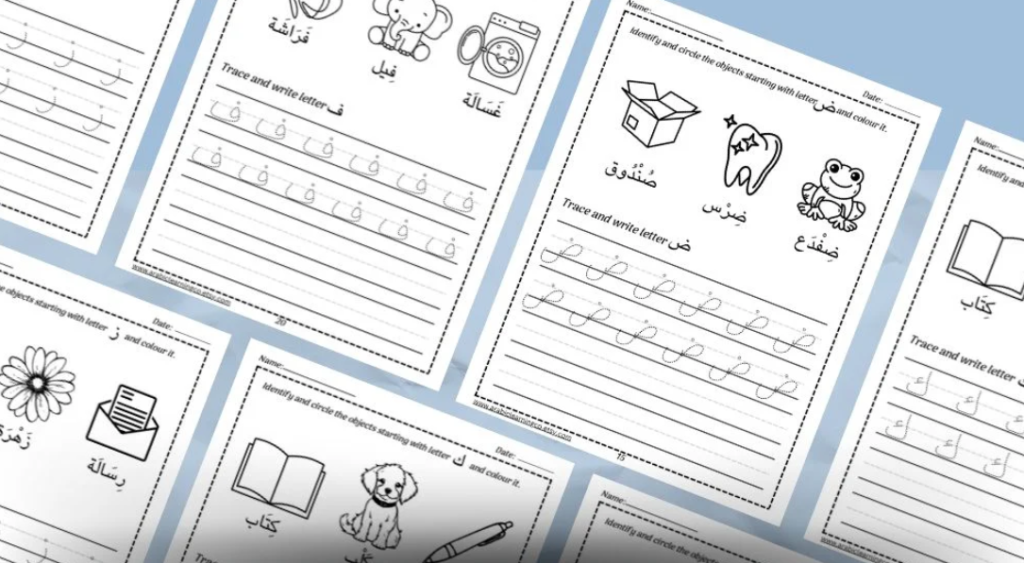
An Arabic alphabet worksheet for kids bridges the gap between freeform activity and formal writing by providing guided letter paths, dot-to-dot outlines, and copy rows that train muscle memory within a structured framework.
Worksheets are most effective when introduced after a child has already explored a letter through sand tracing and playdough — not as a first encounter.
The best worksheets for Arabic include three elements in this sequence: the isolated letter form, a tracing row with directional arrows, and a blank copy row. Directional arrows are non-negotiable — Arabic letters have specific stroke directions that, if learned incorrectly from the beginning, become very difficult to correct later.
Free Arabic Alphabet Worksheets for Kids from learnarabicworksheets.com bundles tracing, writing practice, and coloring into a single A4 PDF pack. The activities progress logically: recognition first, then tracing, then independent writing. Coloring activities are embedded throughout to maintain engagement across a full session.
18. Arabic Alphabet Quizzes for Kids Consolidate Learning Through Low-Stakes Testing
An Arabic alphabet quiz for kids does not need to be formal or anxiety-producing — the most effective versions are oral, playful, and short. Retrieval practice, the cognitive process of pulling a memory out rather than passively reviewing it, is one of the most evidence-supported methods for long-term retention in any language.
A quick quiz at the end of each session consolidates what activities have introduced.
Structure quizzes in ascending difficulty: begin with “What letter is this?” (recognition), move to “What sound does this letter make?” (phonics), then advance to “Find the letter ص in this word” (contextual recognition). Each level targets a different cognitive skill, and all three are necessary for genuine reading ability.
How to Run an Arabic Alphabet Quiz That Kids Actually Enjoy
Keep each quiz to five questions maximum for children under 7, and ten for older learners. Use a points or sticker system to mark correct answers — not to penalize errors.
We find at Buruj Academy that children who associate quizzes with reward and progress attempt answers more confidently and recover faster from mistakes than those who associate testing with judgment.
Vary the format weekly to maintain engagement:
- Flashcard flip: Hold up a card, child names the letter — 10 seconds per card
- Sound-to-letter: Say a letter sound, child points to the correct card
- Word detective: Show a simple Arabic word, child identifies the first letter
- Dot challenge: Show two similar letters, child identifies which has more dots and names both
For children working through Arabic grammar for kids content alongside alphabet study, adding simple quizzes that identify whether a letter is a sun letter (حَرْف شَمْسِيّ) or moon letter (حَرْف قَمَرِيّ) builds the grammatical awareness they will need for connected reading. Our resource on moon and sun letters in Arabic explains this distinction accessibly for young learners.
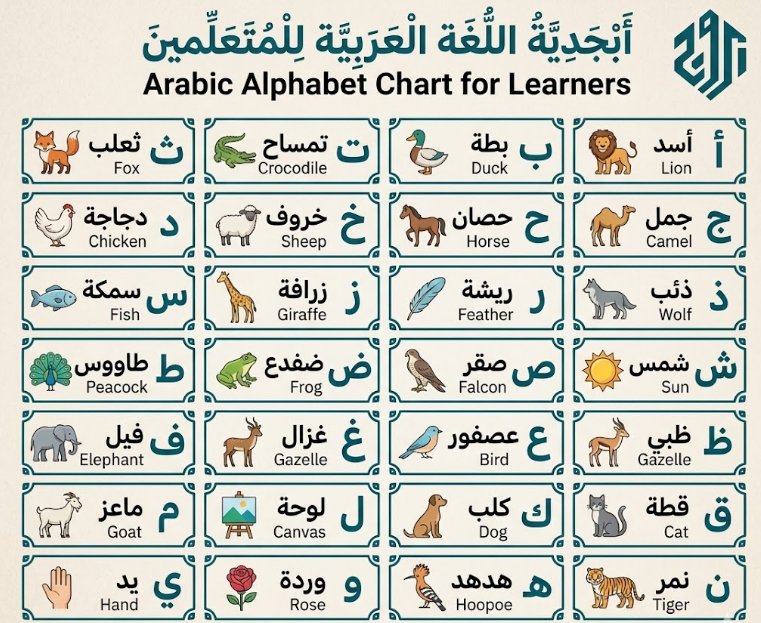
19. Arabic Alphabet Charts Give Kids a Permanent Visual Reference at Home
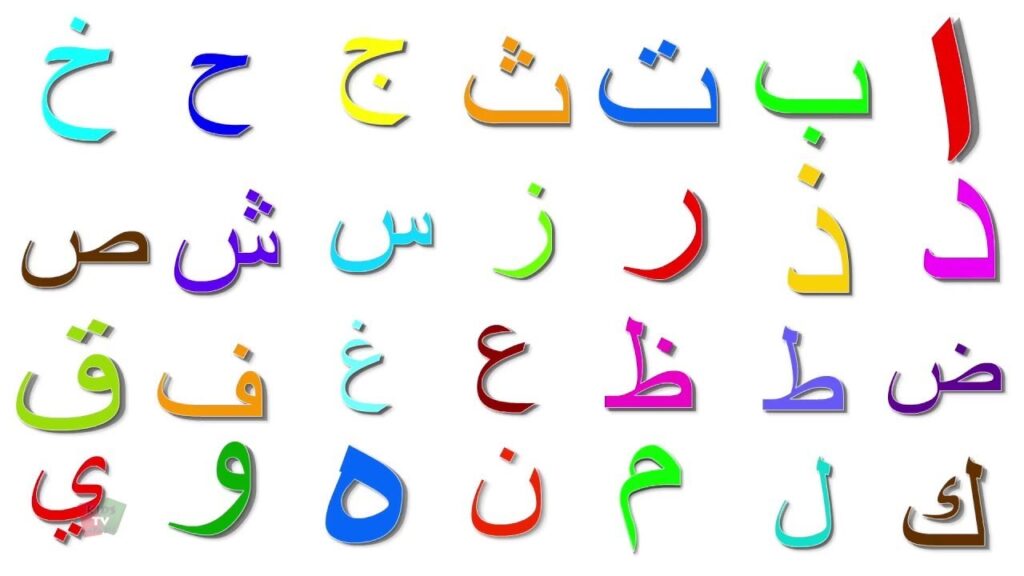
An Arabic alphabet chart for kids is not simply a decoration — it is a daily retrieval tool that keeps all 28 letters in a child’s visual field during the months it takes to achieve full recognition.
Position the chart at the child’s eye level, in a location they visit regularly: beside the breakfast table, above a desk, or next to the prayer area.
The most effective charts for young learners display each letter with three features visible simultaneously: the letter name, its isolated form, and a simple illustrated word beginning with that sound.
Charts that also show the letter’s positional forms — initial, medial, final, and isolated — serve older children who are moving from letter recognition into connected word reading.
How to Use an Arabic Alphabet Chart as an Active Learning Tool
A chart left on the wall without interaction is merely wallpaper. Turn it into a daily practice tool with these structured uses:
Point to a random letter each morning and ask the child to name it before breakfast. During Quran recitation or Arabic reading time, refer to the chart when a letter appears in text — “Where is that letter on our chart?” — to build the bridge between the chart and live reading. As letters are mastered with confidence, mark them with a small sticker directly on the chart — giving children a visible record of their own progress.
20. Online One-on-One Sessions Provide What No Activity Alone Can Replace
All the activities above are most effective when a qualified teacher is watching, correcting, and adapting in real time.
A child who has practiced the wrong pronunciation of ح or ع for three months has not spent three months learning — they have spent three months reinforcing an error. Early correction from a skilled instructor is what converts good activities into genuine progress.
Buruj Academy’s Online Arabic Classes for Kids pair children with Al-Azhar-trained instructors who specialize in teaching non-Arabic speakers. Sessions are 1-on-1, scheduled flexibly around family routines, and structured around the Buruj Method’s foundational principle: sound accuracy before written form.
Children build correct habits from the first lesson — which is what makes everything else work.
For families ready to combine home activities with expert instruction, explore our Arabic for Beginners course or book a free trial session to see the approach in practice.
Give Your Child the Best Start With Buruj Academy’s Arabic Classes for Kids
Every activity in this article produces real results — and they produce faster, more accurate results under the guidance of a qualified teacher.
At Buruj Academy, our Online Arabic Classes for Kids are taught by Al-Azhar University graduates with 12+ years of experience guiding non-Arabic-speaking children from their very first letter to confident reading.
Enroll your child in one of our specialized, kid-friendly tracks today:
- Online Quran Classes for Kids
- Tajweed Classes for Kids
- Hifz Classes for Kids
- Online Arabic Classes for Kids
- Quranic Arabic Course for Kids
- Noorani Qaida Course for Kids
- Islamic Studies Classes for Kids
Ready to watch your child grow in knowledge and character? Join the Buruj Academy family and book a free trial session for your child today!
Master the Arabic Language
Join our expert-led courses and build a strong foundation in Classical and Modern Arabic.
Get Your Free TrialOur instructors use the Buruj Method — sound-before-form, context-before-abstraction — with personalized 1-on-1 sessions tailored to each child’s age, pace, and learning style.
Flexible scheduling means classes fit around school, sports, and family life. Book your child’s free trial lesson today and give them a foundation they will carry for life, Insha’Allah.
Conclusion
Learning the Arabic alphabet does not have to be a battle of will between parent and child. When the right activities meet consistent, daily exposure, children absorb letter shapes, sounds, and forms naturally — the way language acquisition is meant to happen.
The activities above work because they respect how children actually learn: through the body, through play, through repetition that feels different each time. Pair them with qualified instruction, and the results speak for themselves.
Start with one or two activities this week, build a rhythm, and trust the process — Alhamdulillah, the foundation will come.
Frequently Asked Questions About Arabic Alphabet Activities for Kids
What Is the Best Age to Start Arabic Alphabet Activities for Kids?
Children can begin exposure to Arabic letter shapes and sounds as early as age 3 through songs, sand tracing, and picture books. Formal letter recognition activities are most effective from age 4–5, while structured writing practice is best introduced between ages 5–7, once fine motor control is sufficiently developed for Arabic script’s curves and connected forms.
How Many Arabic Letters Should a Child Learn Per Week?
For children aged 3–5, learning 4–7 letters per week is a realistic and sustainable pace when using multisensory activities daily. Rushing to complete all 28 letters quickly produces shallow recognition. Deeper mastery of fewer letters — including all positional forms — produces stronger reading readiness than rushed surface coverage of the full alphabet.
Are Arabic Alphabet Apps Enough to Teach Kids the Alphabet?
Apps are a valuable supplement but cannot replace qualified instruction or physical practice. They provide immediate audio feedback on letter sounds, which is genuinely useful. However, apps cannot correct a child’s pronunciation errors, identify developing bad habits, or adapt to a specific child’s confusion patterns. Combine apps with physical activities and teacher-led sessions for best results.
Why Does My Child Confuse Similar Arabic Letters Like ب، ت، and ث?
These letters share identical base shapes and differ only in dot number and position — a distinction that requires deliberate, focused training. Children confuse them because their visual systems are not yet calibrated to treat dots as meaning-carrying features. Dot-counting games, color-coding activities, and repeated sorting exercises specifically targeting these letter families resolve this confusion systematically within a few weeks of consistent practice.
How Can I Make Arabic Alphabet Practice Fun Without Losing Seriousness?
The distinction between fun and serious is a false one in early childhood education. Play-based methods — sand tracing, playdough sculpting, movement games, crafts — produce measurably better retention than worksheet drilling precisely because engagement sustains the repetition needed for mastery. Seriousness of purpose is maintained by choosing activities with clear learning objectives and providing consistent, loving correction when errors occur.