 Quran
Quran
| Key Takeaways |
| Starting with the Arabic alphabet and Noorani Qaida builds the phonetic foundation needed for fast Quran reading progress. |
| Consistent daily practice of 20–30 minutes accelerates reading fluency faster than longer, infrequent study sessions. |
| Learning basic Tajweed rules early prevents mispronunciation habits that slow down reading speed and require correction later. |
| A qualified teacher providing real-time correction cuts the learning timeline significantly compared to self-study alone. |
| Most adult beginners reach independent Quran reading fluency within 6–12 months with structured, consistent instruction. |
Many adults want to read the Quran properly but feel overwhelmed before they even begin. The script looks unfamiliar, the sounds feel impossible, and the rules seem endless — yet thousands of non-Arabic speakers learn to read fluently every year.
The fastest path to Quran reading is not about shortcuts. It is about sequencing correctly: mastering Arabic letters first, building sounds before rules, practicing daily in short focused sessions, and getting expert correction early. Follow the right steps in the right order, and progress comes faster than most beginners expect.
Table of Contents:
1. Master the Arabic Alphabet Before Opening the Quran
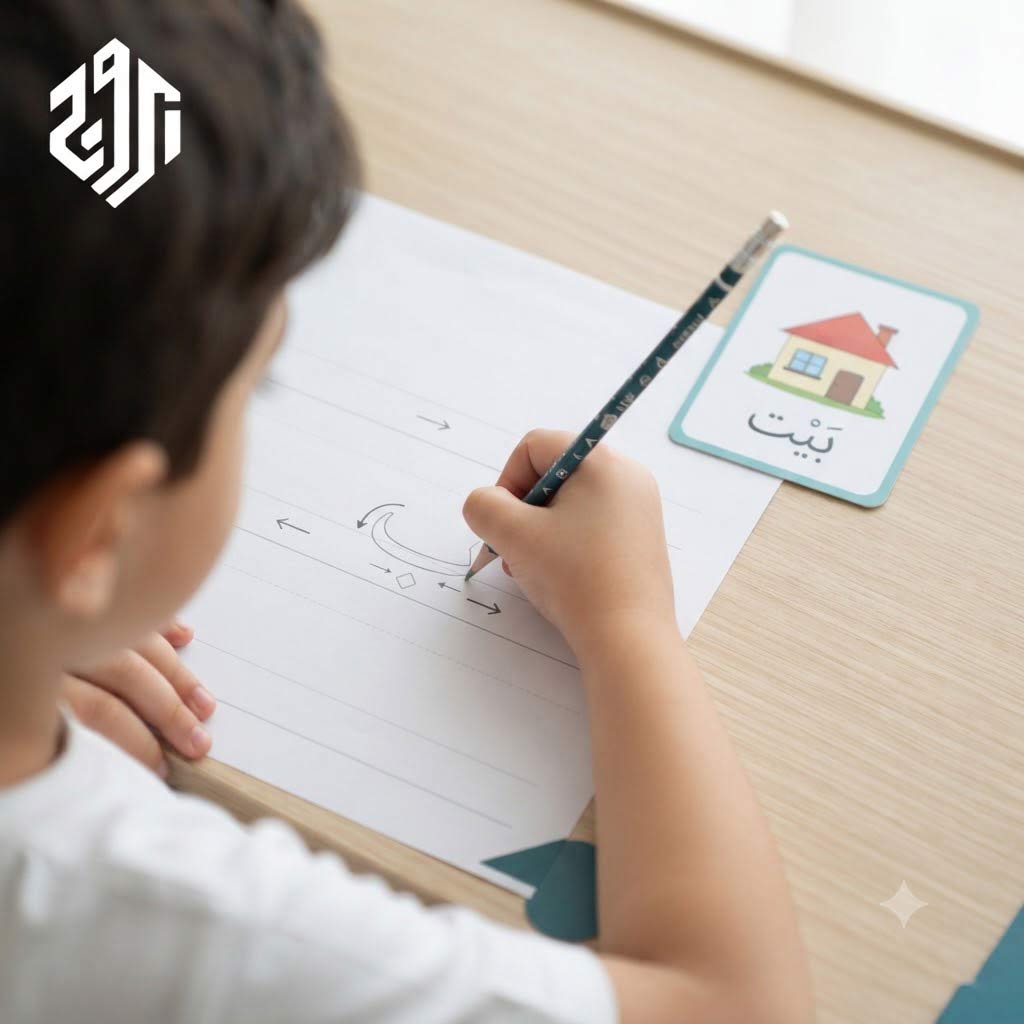
To learn to read the Quran quickly, your first task is complete Arabic letter recognition — all 28 letters, in isolation, in their joined forms, and with their vowel markers (harakat). Without this foundation, every subsequent step takes three times longer than it should.
Most beginners underestimate how foundational this stage truly is. In our sessions at Buruj Academy, students who rush past the alphabet and jump straight to Quran recitation almost always plateau within weeks.
They recognize some letters by shape but confuse similar ones — ب، ت، ث or ح، خ، ج — under the pressure of connected script.
How Long Does the Arabic Alphabet Take to Learn?
With daily 20–30 minute sessions, most adult beginners recognize all Arabic letters in isolation within 1–2 weeks. Learning them in joined (connected) form takes another 1–2 weeks. Adding the six harakat (Fathah, Kasrah, Dhammah, and their tanwin forms, plus Sukoon) brings the total foundational stage to approximately 4–8 weeks for most learners.
This is not slow — this is the fastest sustainable path.
| Learning Stage | Estimated Duration | What You Master |
| Letters in isolation | 1–2 weeks | All 28 letters, names, and basic sounds |
| Letters in joined form | 1–2 weeks | Beginning, middle, end, and isolated forms |
| Harakat (vowel markers) | 1–2 weeks | Fathah, Kasrah, Dhammah, Sukoon, Tanwin |
| Short words and syllables | 2–3 weeks | Combining letters with vowels fluently |
Buruj Academy’s Noorani Qaida Online Course guides students through every one of these stages systematically, with Al-Azhar-trained instructors who correct pronunciation at the letter level before a single Quranic word is introduced.
Book your FREE trial lesson in the Noorani Qaida course
2. Use the Noorani Qaida as Your Structured Reading Roadmap
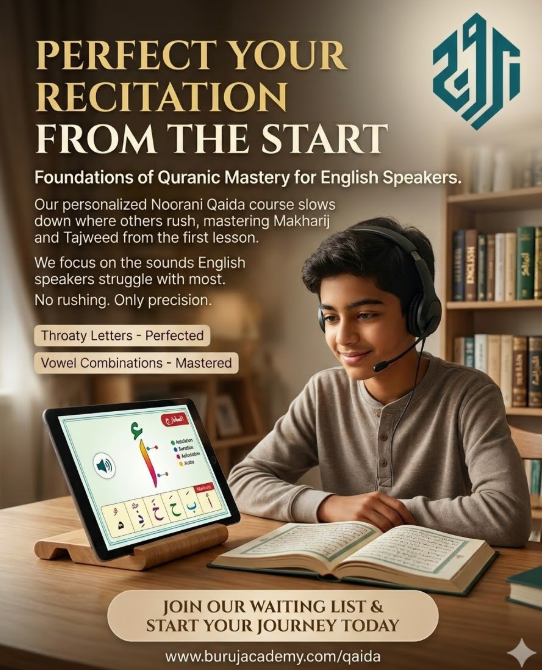
The Noorani Qaida is the single most efficient tool for learning to read the Quran quickly as a non-Arabic speaker. It is a phonics-based primer that takes you from individual letter sounds to full Quranic syllables in a logical, graduated sequence — before you ever face the connected script of a Mushaf.
The Qaida works because it separates the challenge into manageable layers: letter recognition, then vowelized syllables, then joined words, then longer phrases. Each layer builds directly on the one before.
Students who complete the Qaida properly read Quran with far less guessing and far fewer ingrained errors than those who skip it.
What Does the Noorani Qaida Cover?
The Qaida introduces:
- All 28 Arabic letters with their correct articulation points (makharij)
- Letters with all six harakat
- Madd (elongation) sounds — the long alif, waw, and ya
- Shaddah (doubled consonants) and Sukoon combinations
- Light (tarqeeq) and heavy (tafkheem) letter pronunciation
- Basic stopping rules (Waqf) used throughout the Quran
Completing the Noorani Qaida with a qualified teacher typically takes 6–10 weeks for adult beginners with daily sessions.
The Noorani Qaida with Tajweed Course at Buruj Academy integrates basic Tajweed principles directly into Qaida training — so students develop correct habits from day one rather than having to unlearn errors later.
3. Learn Core Tajweed Rules Alongside Your Reading Practice
To learn the Quran fast without developing errors that need correcting later, introduce the fundamental Tajweed rules while you are still in the early reading stages — not after.
Reciting the Quran with proper Tajweed is an obligation according to classical Tajweed scholarship, and learning rules early prevents the double work of relearning.
The good news is that you do not need to master every Tajweed rule before reading. You need the core rules that appear most frequently in the Quran. These are the ones that, if applied incorrectly, cause the most noticeable errors in recitation.
Which Tajweed Rules Should Beginners Learn First?
| Priority | Rule | Why It Matters |
| 1 | Madd Asli (Natural Elongation) | Appears in nearly every line of the Quran |
| 2 | Noon Sakinah rules (Ikhfa, Idgham, Iqlab, Izhar) | Among the most frequently occurring rules |
| 3 | Ghunnah (Nasal Sound) | Required with Meem and Noon Mushaddad |
| 4 | Qalqalah (Echo Sound) | Five letters appear constantly throughout the Quran |
| 5 | Waqf (Stopping Rules) | Needed for every pause and end of ayah |
Our Al-Azhar-trained instructors at Buruj Academy use the Buruj Method’s sound-before-rules approach: students hear and reproduce the correct sound first, then the rule name is introduced.
This prevents the common trap where students memorize rule names but cannot apply them in live recitation.
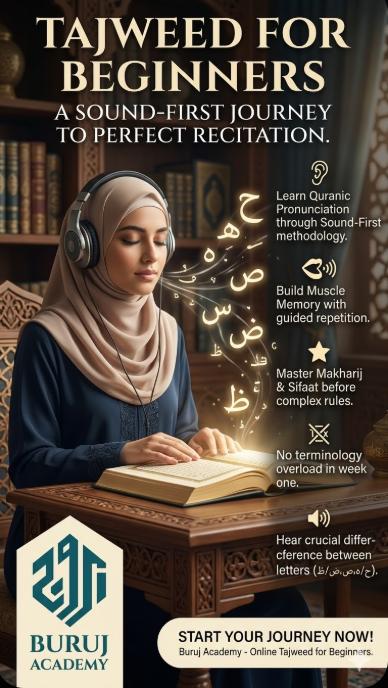
For a deeper understanding of these rules, our blog covers Tajweed for beginners,Ikhfa letters in Tajweed, and Ghunnah and its rules in detail. Buruj Academy’s Tajweed for Beginners course introduces these rules in exactly this priority sequence, ensuring fast progress without overwhelm.
Book Your FREE Trial Lesson to Begin Your Tajweed Journey
4. Practice Daily in Short, Focused Sessions Rather Than Long Irregular Ones
Consistency beats intensity when learning to read the Quran quickly. Twenty minutes of focused daily practice produces faster, more durable fluency than two-hour sessions twice a week. This is not a preference — it reflects how phonetic memory and motor patterns are built in the human brain.
In our experience at Buruj Academy, students who commit to 20–30 minutes daily progress through their reading levels roughly twice as fast as students who study for longer sessions three or four times per week.
The daily repetition keeps sounds fresh and reinforces neural pathways before forgetting can occur.
Excel in Your Quranic Studies
Join Buruj Academy and master the Quran with our structured, professional curriculum.
Book Your Free TrialWhat Should a Daily Quran Reading Practice Session Include?
Structure your daily session in three parts:
- Revision (5–7 minutes): Re-read the portion you covered in the previous session. This locks retention and exposes errors before they solidify.
- New material (10–15 minutes): Advance to new letters, syllables, or Quranic lines — only as much as you can read accurately, not quickly.
- Listening (5 minutes): Listen to a qualified reciter reading the same passage. Auditory modeling accelerates pronunciation accuracy significantly.
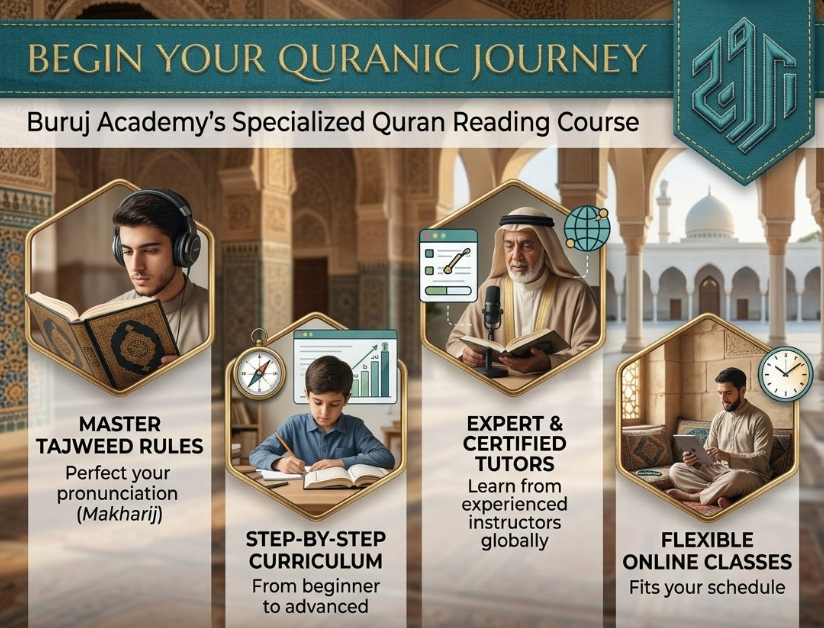
The Quran Reading Course at Buruj Academy is structured around exactly this daily session model, with Ijazah-certified instructors providing personalized correction in live 1-on-1 sessions that fit around working professionals’ schedules.
Book your Free trial lesson and start reading the Quran
5. Work with a Qualified Teacher Who Can Correct You in Real Time
The fastest way to learn to read the Quran is with a teacher — not because self-study is impossible, but because mispronunciation errors are invisible to the learner.
You cannot hear your own mistakes the way a trained ear can. And in Quran reading, uncorrected errors become deeply ingrained habits that take months to reverse.
This is one of the most consistent patterns we observe at Buruj Academy: students who attempt how to learn Quran by yourself through apps and recordings alone often reach us after six months of practice — reading confidently, but incorrectly.
Rebuilding those habits takes longer than learning correctly from the start would have.
Read also: Hadith and Quranic Prophecies Proven Right
Discover the Buruj Academy Difference
Step into our virtual classrooms and see how our expert instructors make learning Quran and Arabic intuitive and clear. We focus on overcoming the specific hurdles non-native speakers face, building your confidence and connection with the Quran.
What Should You Look for in a Quran Reading Teacher?
A qualified Quran reading teacher should hold — or teach under the supervision of someone who holds — an Ijazah in Quran recitation. This is the traditional certification confirming that the teacher’s recitation has been verified through an unbroken chain (sanad) back to the Prophet ﷺ.
Beyond credentials, your teacher should:
- Correct makharij (articulation points) at the letter level, not just the word level
- Pace sessions to your retention speed, not a fixed syllabus timeline
- Identify your specific error patterns and address them directly
- Provide encouragement without sacrificing accuracy standards
Buruj Academy’s Online Quran Recitation Course connects students with Ijazah-certified instructors and Al-Azhar University graduates with 12+ years of experience teaching non-Arabic speakers.
Book a free trial lesson to experience the difference that qualified correction makes from session one.
Book a FREE trial session with one of Buruj’s Azhari Quran tutors

6. Build Reading Speed Through Targeted Repetition of Short Passages
Once you can read Quranic text accurately, the next step toward fast and fluent reading is repetition of short passages until they flow without hesitation. Speed in Quran reading is never about rushing — it is about reducing the cognitive load of decoding letters so that your mind can focus on recitation quality.
The practical method: take three to five lines of Quran, read them accurately ten times in a single session.
By the tenth reading, most students notice a significant reduction in hesitation and a natural increase in flow. This is the same technique our instructors use to prepare students for longer recitation sessions and eventually for Hifz.
How Does Repetition Connect to Quran Memorization?
Students who read the Quran fluently before beginning memorization memorize significantly faster than those who begin Hifz while still struggling with reading mechanics. Reading fluency removes the decoding burden and allows memorization to focus entirely on retention.
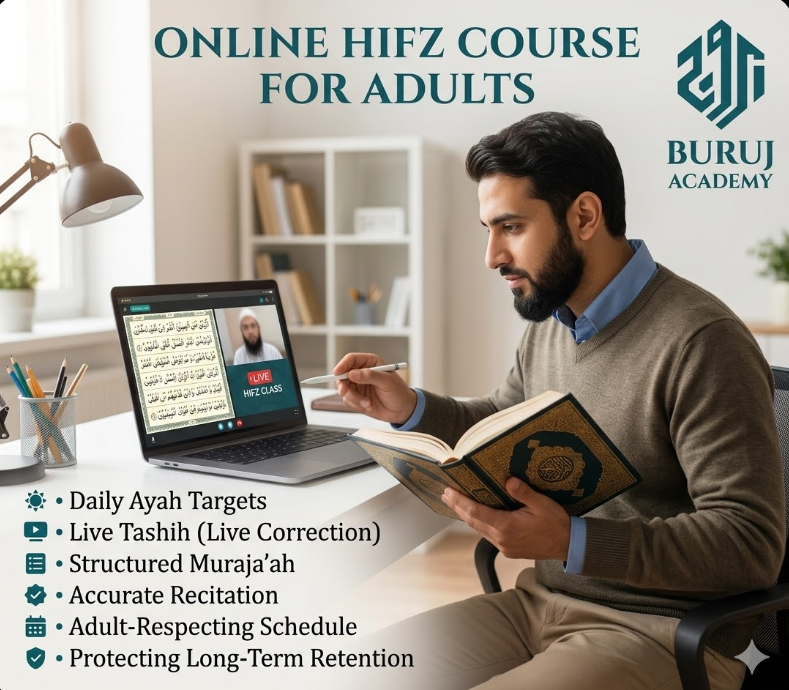
If memorization is a future goal, our blog on how to memorize Quran faster provides a detailed progression from reading fluency to full memorization readiness. Buruj Academy’s Hifz for Adults course is designed to build this bridge — ensuring students arrive at memorization with a solid reading foundation already in place.
Book Your Free Trial Lesson with Burruj’s Hifz Course for Adults
7. Track Your Progress with a Simple Weekly Reading Log
Learning to read the Quran quickly requires visible progress markers — not just the feeling that you are improving. A simple weekly log keeps you accountable, reveals which letter combinations or rules are causing consistent difficulty, and gives your teacher clear data to adjust your sessions.
Your log does not need to be elaborate. A basic table with five columns is enough:
| Week | Pages Covered | Errors Noted | Rules Practiced | Session Length |
| Week 1 | Qaida pp. 1–5 | ح vs. خ confusion | Makharij — throat letters | 20 min/day |
| Week 4 | Qaida pp. 18–24 | Madd Asli duration | Natural elongation | 25 min/day |
| Week 8 | Juz 30, Al-Fatiha | Qalqalah on ق | Echo release | 30 min/day |
Tracking also serves a motivational function that is easy to underestimate. When progress feels slow — and it will during some weeks — your log shows you exactly how far you have come from where you started.
This matters deeply for maintaining consistency, which is the single biggest predictor of how fast you learn.
Read also: Quranic Facts Proven by Science
Start Reading the Quran Confidently with Buruj Academy’s Expert Instructors
Mastering Quran reading quickly comes down to correct sequencing, daily consistency, and qualified correction. These seven steps provide the roadmap — but a qualified teacher makes every step faster and more reliable.
At Buruj Academy, our Ijazah-certified instructors and Al-Azhar University graduates have guided non-Arabic speaking students from complete beginners to confident Quran readers for over 12 years.
Our Buruj Method — Sound-before-rules, Consistency-before-speed, Patience-before-performance — ensures you build genuine fluency, not just surface familiarity.
We offer personalized 1-on-1 online sessions with flexible 24/7 scheduling, real-time pronunciation correction, and customized learning plans for every age and level.
Book your free trial lesson today and read your first lines of the Quran correctly — from session one.
Take the next step in your learning journey today by enrolling in one of our specialized programs:
- Online Quran Classes
- Online Quran Classes for Beginners
- Online Quran Classes for Adults
- Online Quran Classes for Ladies
- Online Quran Classes for Kids
- Quran Reading Course
- Quran Recitation Course
- Online Ijazah Course
- Online Qirat Course
Don’t wait to transform your relationship with the Holy Quran. Join our global community of students and book your free evaluation session now!
Excel in Your Quranic Studies
Join Buruj Academy and master the Quran with our structured, professional curriculum.
Book Your Free TrialConclusion
Learning to read the Quran is one of the most meaningful skills a Muslim can develop — and it is far more accessible than most beginners believe. The key is not finding a shortcut; it is following the right sequence from the very first day: letters before words, sounds before rules, accuracy before speed, and daily practice before occasional marathon sessions.
Every step in this guide builds directly on the one before it. Students who follow this progression consistently — with qualified guidance and honest self-tracking — typically reach independent reading fluency well within their first year. Insha’Allah, your path to confident Quran recitation begins with a single, well-taught letter.
Frequently Asked Questions About Learning to Read the Quran Quickly
How Long Does It Take to Learn to Read the Quran for a Complete Beginner?
Most adult beginners with no prior Arabic knowledge reach independent Quran reading fluency within 6–12 months of consistent daily practice with a qualified teacher. Students who practice 20–30 minutes daily and receive regular correction progress toward the faster end of this range. Individual factors — prior language experience, session frequency, and teacher quality — influence the timeline.
How to Learn the Quran Fast Without Losing Accuracy?
To learn the Quran fast without sacrificing accuracy, prioritize the Noorani Qaida before the Mushaf, introduce core Tajweed rules during early reading practice, and work with an Ijazah-certified teacher who corrects errors in real time. Short daily sessions of 20–30 minutes build phonetic memory faster than infrequent longer sessions.
How to Learn Quran by Yourself if You Cannot Access a Teacher?
Self-study is possible but significantly slower and more error-prone than guided learning. If studying independently, use a structured phonics resource like the Noorani Qaida, listen extensively to verified reciters like Sheikh Mahmoud Khalil Al-Husary, and record yourself to catch errors. Even occasional online sessions with a qualified teacher dramatically improve accuracy and speed compared to fully unsupported self-study.
What Is the Best Age to Start Learning to Read the Quran?
There is no single best age — children as young as four and adults well into their sixties learn successfully. Children typically develop pronunciation accuracy more quickly due to phonetic flexibility. Adults bring stronger discipline and motivation. Buruj Academy offers age-specific programs for children, teens, and adults precisely because effective pedagogy differs significantly across life stages.
Is It Necessary to Learn Tajweed to Read the Quran Correctly?
Yes. Classical Tajweed scholarship establishes that reciting the Quran with proper Tajweed rules is an obligation (fard) for every Muslim reciting aloud. Basic Tajweed rules — including proper elongation (Madd), Ghunnah, and correct letter articulation — must be learned alongside reading practice. You do not need to master advanced rules immediately, but core rules must be introduced from the beginning of your reading journey. For a structured approach, see our guide on how to read Quran with Tajweed.