 Arabic
| Key Takeaways |
| Children learn Arabic most effectively when instruction begins with spoken sounds before introducing written script or formal grammar rules. |
| Starting with the Arabic alphabet through phonics-based methods builds accurate letter recognition before children attempt reading full words. |
| Short daily sessions of 15–20 minutes consistently outperform longer irregular lessons for children’s Arabic language retention. |
| Vocabulary acquisition accelerates when new Arabic words are connected to objects, images, and real-life contexts children already understand. |
| Professional guided instruction with structured progression prevents foundational errors that become very difficult to correct at later stages. |
Teaching a child Arabic at home feels exciting until the first lesson — then the questions multiply fast. How can a parent teach Arabic for kids? Where do you even begin? Most parents we speak with at Buruj Academy started with the alphabet and quickly discovered that letter recognition alone does not build a reader.
Arabic requires a layered, deliberate sequence that respects how children actually absorb language: through sound, repetition, meaning, and confident use.
The most effective approach to teaching kids Arabic combines phonics-first letter instruction, systematic vocabulary building, and structured reading practice — all delivered in short, engaging daily sessions.
When these elements are sequenced correctly, children progress from complete beginners to confident readers and speakers within months, not years.
Table of Contents:
1. Build Sound Awareness Before Introducing the Arabic Alphabet
Children need to hear Arabic sounds accurately before they can reproduce or read them. Arabic contains sounds that do not exist in English — the ع (ʿayn), the غ (ghayn), the خ (kha), and emphatic consonants like ص, ض, ط, ظ — and children’s ears need exposure to these sounds as early as possible.
Begin each session with listening activities. Play short audio clips of native Arabic speakers, Quranic recitation, or simple children’s songs in Arabic. Ask children to repeat individual sounds, not full words, until their pronunciation approximates the target sound closely.
At Buruj Academy, our instructors spend the first week entirely on sound recognition before a single letter shape is introduced — and students who follow this approach make measurably fewer pronunciation mistakes later.
Why Phonemic Awareness Matters More Than Most Parents Realize
Arabic is a phonetically consistent language, meaning letters almost always produce the same sound.
This is actually an advantage — but only if the child has heard those sounds first. Without sound awareness, children read Arabic mechanically without knowing what they are saying, which collapses comprehension entirely.
2. Introduce the Arabic Alphabet Through Systematic Letter Groups
Once a child can distinguish Arabic sounds confidently, begin formal letter instruction. The Arabic alphabet has 28 letters, each with up to four positional forms (isolated, initial, medial, final).
Presenting all 28 at once overwhelms young learners — sequence matters enormously here.
Group letters by visual similarity and sound category. A proven grouping begins with letters sharing similar shapes: ب، ت، ث form one group; then ج، ح، خ; then د، ذ and so on.
This approach reduces cognitive load because children only need to learn one new shape and distinguish it by dots or minor marks.
Our detailed guide on the Arabic alphabet for kids walks through this grouping system with visual examples suited to children aged 4–12.
| Letter Group | Letters Included | Shared Visual Feature |
| Group 1 | ب ت ث | Single horizontal base, dots above or below |
| Group 2 | ج ح خ | Curved bowl shape, distinguished by dot placement |
| Group 3 | د ذ | Simple angular form, one letter adds a dot |
| Group 4 | ر ز | Descending curve, one letter adds a dot |
| Group 5 | س ش | Three-tooth shape, dot cluster distinguishes them |
Teach two to three letters per week maximum for children under eight. Older children aged 9–12 can absorb four to five letters weekly with sufficient review.
3. Teach Short Vowels (Harakat) Immediately After the First Letters
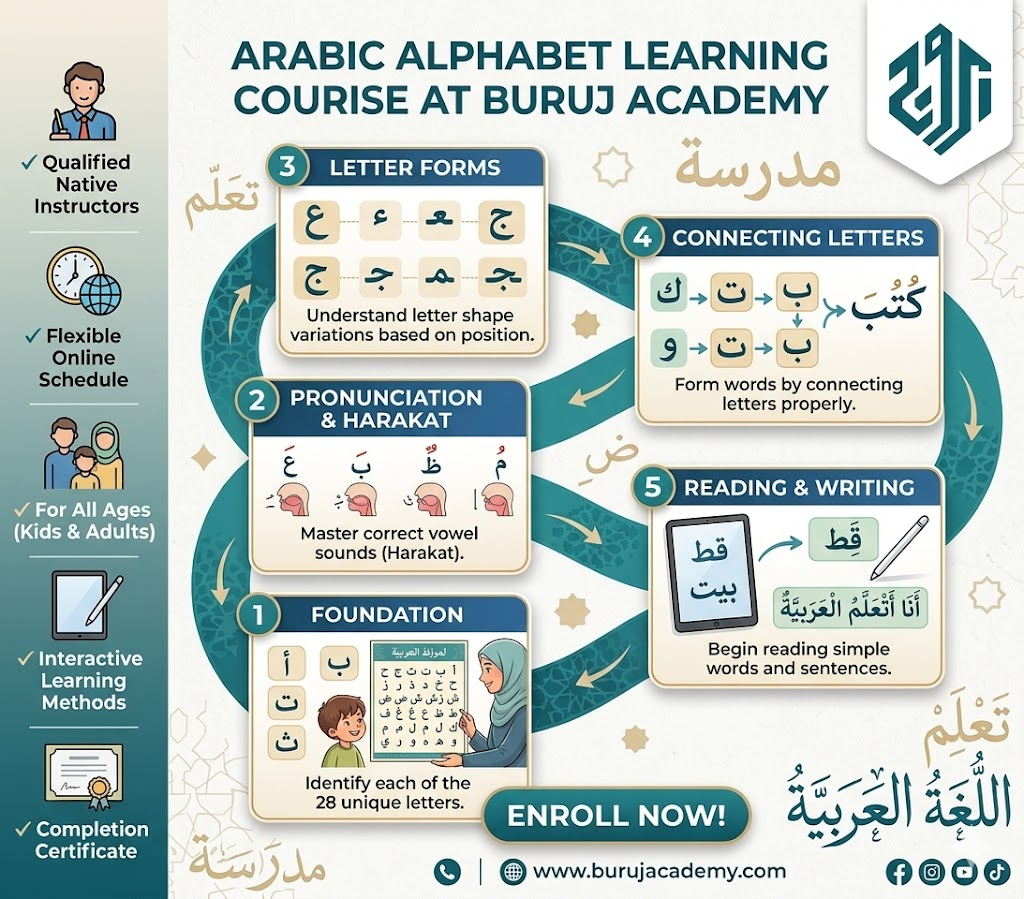
One of the most common mistakes parents and tutors make is delaying harakat — the short vowel markers (fatḥah ـَ, kasrah ـِ, ḍammah ـُ, sukoon ـْ) — until “later.” This creates a fundamental gap: children learn letter shapes but cannot read actual Arabic words without vowel markers.
Introduce harakat alongside the first letter group. The moment a child knows ب, teach them to read بَ (ba), بِ (bi), بُ (bu), and بْ (b). This transforms an isolated shape into a functional reading unit.
Buruj Academy’s Arabic Alphabet Learning Course integrates harakat from lesson one, which is why our students begin reading short words within their first month of instruction.
Get a free trial now in Buruj’s Alphabet course
How to Practice Harakat With Young Children
Use flashcards combining the letter and its vowel visually. Call out the voweled sound — “ba!” — and have the child point to the correct card.
Reverse the activity: hold up a card and ask the child to produce the sound. This two-directional practice cements the sound-symbol connection rapidly.
4. Build Core Vocabulary Through Themed Word Sets
Children acquire vocabulary most naturally when words belong to meaningful categories they already navigate daily.
After a child can read basic consonant-vowel combinations, begin introducing simple Arabic nouns through themed sets: family members, colors, numbers, animals, food, and classroom objects.
Limit each session to five to seven new words. Connect each word to a physical object, a picture, or an action — never abstract definitions. The word كِتَابٌ (kitāb, “book”) lands permanently when the child holds a book while repeating it. Our resource on learning Arabic words for kids provides themed vocabulary lists organized by age and learning stage.
| Theme | Suggested Arabic Words | Age Range |
| Family | أَبٌ (father), أُمٌّ (mother), أَخٌ (brother), أُخْتٌ (sister) | 4–7 |
| Colors | أَحْمَرُ (red), أَزْرَقُ (blue), أَصْفَرُ (yellow) | 4–8 |
| Numbers | وَاحِدٌ، اثنان، ثَلَاثَةٌ (1, 2, 3) | 5–9 |
| Animals | قِطَّةٌ (cat), كَلْبٌ (dog), أَسَدٌ (lion) | 5–10 |
| School | قَلَمٌ (pen), كُرَّاسَةٌ (notebook), مَكْتَبٌ (desk) | 6–12 |
Our guide on Arabic numbers for kids provides a structured approach to numerals — both written and spoken — which children often find easier than letters and benefit from learning early for motivational momentum.
Master the Arabic Language
Join our expert-led courses and build a strong foundation in Classical and Modern Arabic.
Get Your Free Trial5. Transition to Simple Sentence Construction Early
Parents often delay sentence practice until vocabulary feels “large enough.” In our experience at Buruj Academy, waiting too long creates passive learners who accumulate words but cannot use them.
Children as young as six can form simple Arabic sentences using structures they already know.
The simplest Arabic sentence structure is: subject + predicate with no verb required (nominal sentence / الجملة الاسمية). “البيتُ كبيرٌ” — “The house is big” — requires only two known words and teaches children that Arabic can express complete meaning without a verb. This immediate sense of accomplishment matters enormously for a child’s motivation.
Our blog on Arabic sentences for kids provides age-graded sentence templates that parents and teachers can use directly in lessons.
Read also: Fruits Mentioned in the Quran
Moving From Sentences to Short Conversations
Once a child can build simple nominal sentences, introduce basic question-and-answer exchanges. “مَا هَذَا؟” (What is this?) / “هَذَا كِتَابٌ” (This is a book) creates a real communicative loop. Practicing these exchanges — even briefly — builds the speaking confidence that formal grammar study alone never provides.
Buruj Academy’s Arabic Speaking course uses this conversation-first framework for older children and adults, but the principle applies equally to young learners from the earliest stages.
Book your kid a free trial to start speaking Arabic fluently

6. Develop Reading Fluency Through Connected Text Practice
Letter recognition and vocabulary knowledge do not automatically produce reading fluency. Children need practice reading connected text — full sentences and short paragraphs — to develop the visual scanning and decoding habits that fluent Arabic reading requires.
Begin with fully voweled (harakat-marked) texts. At this stage, children should not attempt unvoweled Arabic, which requires significant vocabulary and contextual knowledge to decode.
Use graded readers designed for non-native children — books with large print, clear fonts, and repetitive simple vocabulary.
Our list of Arabic kids’ books includes recommendations at each reading level from absolute beginner to intermediate.
Read aloud together first — the child listens to the teacher or parent model the text. Then the child reads aloud while the adult listens and gently corrects. Never correct every error simultaneously; prioritize letter sound accuracy and vowel pronunciation over speed.
Discover the Buruj Academy Difference
Step into our virtual classrooms and see how our expert instructors make learning Quran and Arabic intuitive and clear. We focus on overcoming the specific hurdles non-native speakers face, building your confidence and connection with the Quran.
7. Introduce Writing as Reinforcement, Not as a Separate Skill
Arabic writing develops fine motor coordination alongside language knowledge, so introduce it once letter recognition is established — not before. Children who write letters before they can identify them reliably confuse visual memory with motor memory, slowing both skills.
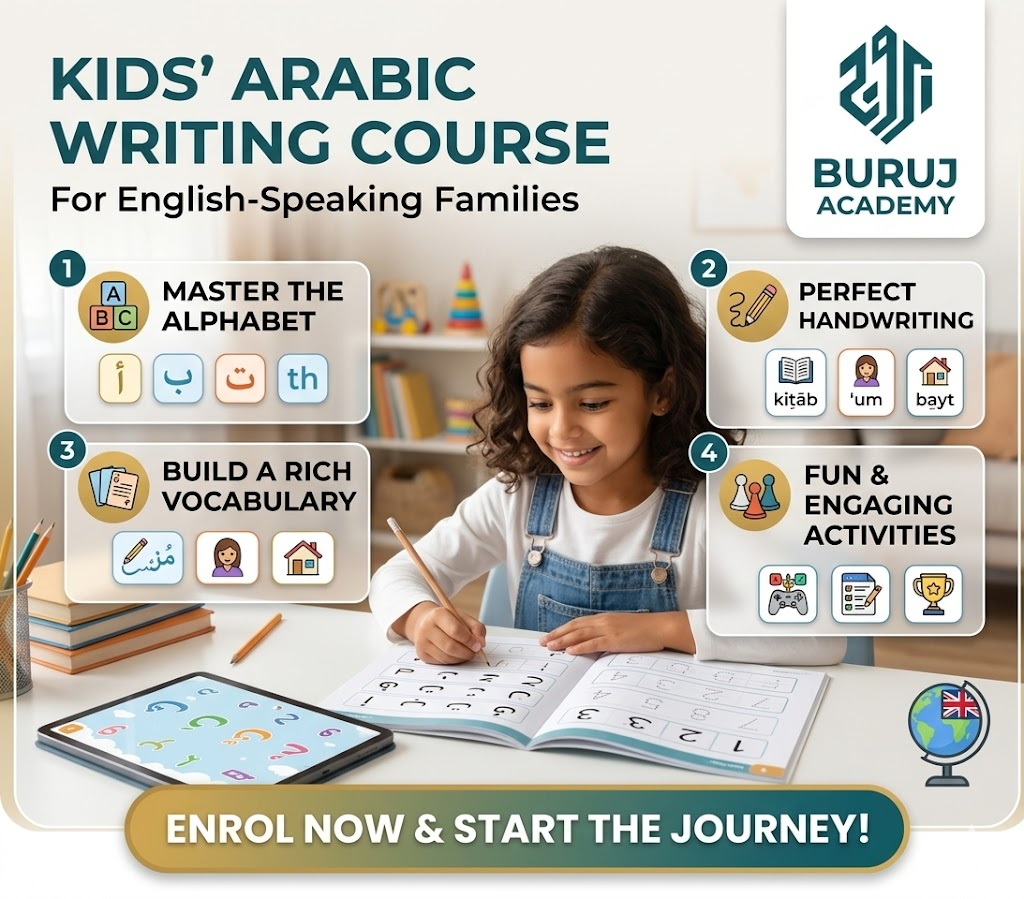
Begin with tracing exercises using dotted letter templates. Progress to independent writing one letter group at a time, mirroring the reading sequence. Dictation is one of the most powerful writing reinforcement tools available — our guide on improving Arabic writing with dictation explains how to use this technique correctly with children without creating anxiety or frustration.
Buruj Academy’s Learn Arabic Writing course teaches children the correct stroke order and letter connection rules that prevent the ingrained errors we see in students who learned writing informally without structured guidance.
Book your kid a free trial to start writing Arabic
8. Use Games and Interactive Activities to Maintain Engagement
Motivation is the most underestimated factor in children’s language learning. A child who is engaged for 15 minutes learns more than a child enduring 45 reluctant minutes. Structured games are not optional extras — they are a core pedagogical tool for sustaining learning across months and years.
Effective Arabic games for children include letter matching card games, word bingo with Arabic vocabulary, Simon Says using Arabic body part vocabulary, and simple Arabic board games.
Our collection of top Arabic games for kids provides printable and digital game formats organized by skill and age group.
Start Your Child’s Arabic Learning With Buruj Academy’s Expert Instructors
Teaching kids Arabic requires the right sequence, the right pace, and instructors who understand child psychology as well as Arabic linguistics.
At Buruj Academy, our Online Arabic Classes for Kids are taught by Al-Azhar University graduates with 12+ years of experience teaching non-native learners — instructors who know exactly where children struggle and how to prevent those struggles from becoming habits.
Every child receives a personalized learning plan, 1-on-1 online sessions with flexible scheduling, and real-time pronunciation correction from qualified teachers.
Book your child’s free trial lesson today and see the difference structured, expert instruction makes from the very first session.
Master the Arabic Language
Join our expert-led courses and build a strong foundation in Classical and Modern Arabic.
Get Your Free TrialConclusion
Teaching kids Arabic well is not about finding the perfect app or the right workbook — it is about following a deliberate sequence that respects how children learn language: through sound first, then symbols, then meaning, then use.
Each step in this guide builds directly on the one before it, and skipping ahead creates gaps that surface later as persistent errors or lost motivation.
The children who make the most consistent progress are those with structured, guided instruction from qualified teachers who understand both Arabic and child development. When those two elements combine, Arabic becomes accessible, meaningful, and genuinely enjoyable for young learners — Insha’Allah.
Read also: Stories to Learn Arabic for Kids
Frequently Asked Questions About How to Teach Kids Arabic
What Is the Best Age to Start Teaching a Child Arabic?
Children can begin phonics-based Arabic exposure as early as age four, focusing on sound recognition and simple vocabulary. Formal reading instruction with harakat is most effective from ages five to six. Starting early with listening and speaking activities creates a strong foundation before written Arabic is introduced systematically.
How Long Should Each Arabic Lesson Be for a Young Child?
For children aged four to seven, sessions of 15–20 minutes daily are optimal. Children aged eight to twelve can sustain 25–35 minute sessions effectively. Consistency matters far more than duration — five short sessions weekly produce stronger retention than one or two longer sessions spread across the week.
Should Children Learn Modern Standard Arabic or Quranic Arabic First?
For Muslim families prioritizing Quran reading, beginning with Quranic Arabic — starting with the alphabet and harakat as they appear in the Quran — provides immediate religious relevance and motivation. Modern Standard Arabic can be introduced alongside or after foundational reading is established, depending on the child’s goals and family priorities.
Can a Non-Arabic-Speaking Parent Effectively Teach Their Child Arabic?
A non-Arabic-speaking parent can support vocabulary practice, flashcard review, and reading games at home effectively. However, pronunciation accuracy — especially for sounds like ع, ح, and emphatic consonants — requires an expert instructor for correction. Professional guided sessions ensure correct habits from the beginning, which home practice alone cannot reliably achieve.
How Do I Know If My Child Is Progressing at the Right Pace?
A child progressing well can identify taught letters reliably, reproduce their sounds accurately, read simple voweled words without guessing, and use learned vocabulary in short phrases. Milestones vary by age, but most children with consistent structured instruction can read short voweled sentences within three to four months of beginning formal lessons.