 Arabic
| Key Takeaways |
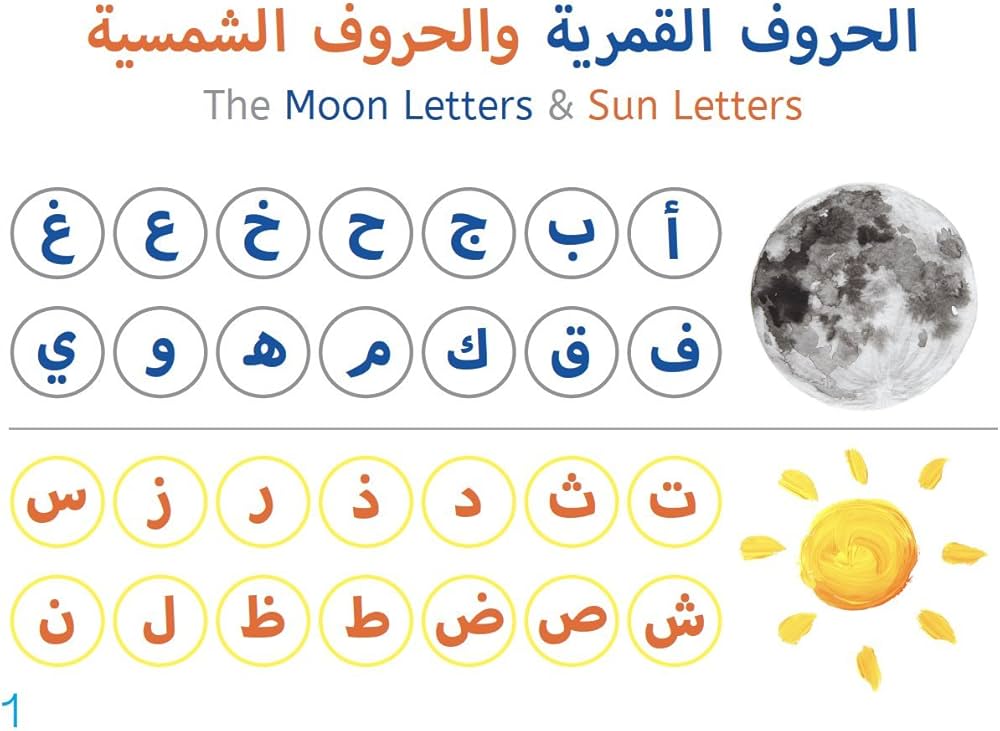
| Arabic has 28 letters divided into 14 sun letters (حروف شمسية) and 14 moon letters (حروف قمرية). |
| Sun letters cause the “ل” in “ال” to assimilate completely, doubling the following letter with a shaddah. |
| Moon letters keep the “ل” in “ال” clearly pronounced, producing a clean, distinct lam sound. |
| The word الشَّمْس (sun) begins with a sun letter; القَمَر (moon) begins with a moon letter — a built-in memory tool. |
| Mastering sun and moon letters is foundational for correct Arabic pronunciation, grammar, and Quranic recitation. |
When Arabic learners first encounter the definite article “ال” (al-), they quickly discover it doesn’t always sound the same. Sometimes the “ل” disappears into the next letter — and sometimes it rings out clearly.
Arabic has 14 sun letters (حروف شمسية) and 14 moon letters (حروف قمرية). Sun letters assimilate the lam of “ال,” doubling the first letter of the word.
Moon letters leave it unchanged. This single distinction controls how every definite noun sounds in Arabic — spoken, written, and recited.
Table of Contents:
What Are Moon and Sun Letters in Arabic?
Moon and sun letters in Arabic describe how the 28 Arabic letters interact with the definite article “ال.” The 14 moon letters (حروف قمرية) keep the lam audible. The 14 sun letters (حروف شمسية) cause the lam to assimilate silently into the following letter, which receives a shaddah (ّ). This rule governs pronunciation in every definite Arabic noun.
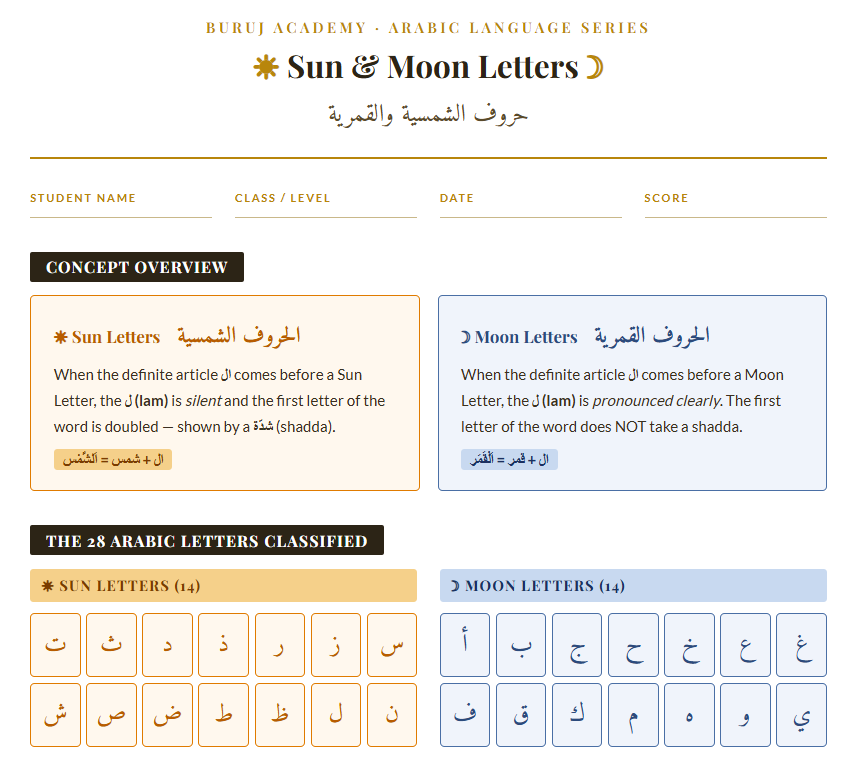
Understanding this distinction is not optional — it affects every sentence a student reads, speaks, or recites.
In our Online Arabic Classes at Buruj Academy, this is among the first rules our Al-Azhar-trained instructors introduce, because mispronouncing the definite article creates errors in every single definite phrase a student produces.
Book your FREE Arabic trial online Arabic class at Buruj

What Are the Named Moon and Sun Letters in Arabic?
The names themselves are the best memory tool available. الشَّمْس (ash-shams, the sun) begins with the letter “ش” — a sun letter, so the lam assimilates: ash-shams. القَمَر (al-qamar, the moon) begins with “ق” — a moon letter, so the lam stays: al-qamar. Classical Arabic scholars used these two words to name the entire system.
How Many Sun Letters Are There in Arabic?
There are exactly 14 sun letters in Arabic. Each one shares a point of articulation (makhraj) close to or overlapping with the lam (ل), which is why the lam naturally assimilates into them during connected speech.
| # | Sun Letter | Name | Example with ال | Pronunciation |
| 1 | ت | Ta | التِّجَارَة | at-tijārah |
| 2 | ث | Tha | الثَّوْب | ath-thawb |
| 3 | د | Dal | الدِّين | ad-dīn |
| 4 | ذ | Dhal | الذَّهَب | adh-dhahab |
| 5 | ر | Ra | الرَّحْمَة | ar-rahmah |
| 6 | ز | Zay | الزَّمَان | az-zamān |
| 7 | س | Sin | السَّلَام | as-salām |
| 8 | ش | Shin | الشَّمْس | ash-shams |
| 9 | ص | Sad | الصَّبْر | as-sabr |
| 10 | ض | Dad | الضَّوْء | ad-daw’ |
| 11 | ط | Ta | الطَّرِيق | at-tarīq |
| 12 | ظ | Dha | الظُّلْم | adh-dhulm |
| 13 | ل | Lam | اللَّيْل | al-layl |
| 14 | ن | Nun | النُّور | an-nūr |
The lam itself is a sun letter — when “ال” precedes a word beginning with lam, the two lams merge into one doubled lam. الليل (al-layl, the night) demonstrates this clearly in recitation.
What Are the 14 Moon Letters in Arabic?
The 14 moon letters are those after which the lam of “ال” remains fully pronounced. Their articulation points are distant from the lam’s, making assimilation phonetically unnecessary in classical Arabic phonology.
| # | Moon Letter | Name | Example with ال | Pronunciation |
| 1 | ا | Alif | الأَرْض | al-ard |
| 2 | ب | Ba | البَيْت | al-bayt |
| 3 | ج | Jim | الجَنَّة | al-jannah |
| 4 | ح | Ha | الحَمْد | al-hamd |
| 5 | خ | Kha | الخَيْر | al-khayr |
| 6 | ع | Ayn | العِلْم | al-‘ilm |
| 7 | غ | Ghayn | الغَيْب | al-ghayb |
| 8 | ف | Fa | الفَجْر | al-fajr |
| 9 | ق | Qaf | القَمَر | al-qamar |
| 10 | ك | Kaf | الكِتَاب | al-kitāb |
| 11 | م | Mim | المَاء | al-mā’ |
| 12 | و | Waw | الوَقْت | al-waqt |
| 13 | ه | Ha | الهُدَى | al-hudā |
| 14 | ي | Ya | اليَوْم | al-yawm |
Notice the range: letters from the throat (ع، غ، ح، خ), the lips (ب، م، و، ف), and the back of the mouth (ق، ك) are all moon letters — their distance from the lam’s articulation point explains why assimilation does not occur.
Sun Letters and Moon Letters in Arabic with Meaning
The most powerful place to observe this rule is the Quran itself, where precision of pronunciation is an act of worship. Every definite phrase follows sun and moon letter rules without exception.
Moon Letter Example from Surah Al-Fatihah
اَلْحَمْدُ لِلَّهِ رَبِّ الْعَالَمِينَ
Al-hamdu lillāhi rabbil-‘ālamīn
“All praise is due to Allah, Lord of the worlds.” (Al-Fatihah 1:2)
الحَمْد begins with ح (Ha) — a moon letter. The lam is fully audible: al-hamd. الْعَالَمِينَ begins with ع (Ayn) — also a moon letter: al-‘ālamīn. Both lams ring clearly.
Sun Letter Example from Surah Ash-Shams
وَالشَّمْسِ وَضُحَاهَا
Wash-shamsi wa duhāhā
“By the sun and its brightness.” (Ash-Shams 91:1)
الشَّمْس begins with ش (Shin) — a sun letter. The lam assimilates completely: wash-shams, not wal-shams. The shaddah on the shin is obligatory in correct recitation.
In our Tajweed sessions at Buruj Academy, we use this surah specifically because it opens with a definitive sun letter example — students hear the rule actively at work in a short, familiar surah they have often memorized.
Book Your FREE Trial Lesson to Begin Your Tajweed Journey

Sun and Moon Letters Examples with Meaning
Seeing this rule in common vocabulary reinforces it far more effectively than abstract charts alone. Below are everyday Arabic words organized to show both categories in practical use.
| Arabic Word | Meaning | Sun/Moon Letter | Pronunciation |
| الرَّجُل | The man | Sun (ر) | ar-rajul |
| الطَّالِب | The student | Sun (ط) | at-tālib |
| النَّهَار | The day | Sun (ن) | an-nahār |
| الدُّنْيَا | The world | Sun (د) | ad-dunyā |
| الكِتَاب | The book | Moon (ك) | al-kitāb |
| البَيْت | The house | Moon (ب) | al-bayt |
| الوَلَد | The boy | Moon (و) | al-walad |
| الفَجْر | The dawn | Moon (ف) | al-fajr |
Building vocabulary through this paired lens — word meaning alongside its definite article pronunciation — is a method our instructors at Buruj Academy apply consistently in our Arabic for Beginners course. Students retain the rule faster when it is attached to words they are already learning.
Begin learning Arabic at Buruj with a FREE trial lesson

How to Memorize Sun and Moon Letters Reliably?
Rote memorization of two lists is the least effective strategy. The following methods work because they tie the rule to phonetic reality and visual pattern recognition.
Method One: Group by Articulation Point
Sun letters cluster around the front of the mouth and the tip of the tongue — the same region as the lam itself. Moon letters span the throat, back of the mouth, and lips. Students who understand why assimilation happens internalize the rule, not just the list.
Method Two: Use the Built-In Mnemonic
الشَّمْس (ash-shams) assimilates — sun letter. القَمَر (al-qamar) does not — moon letter. These two words are the rule’s own self-demonstration. Every time a student says “the sun” in Arabic, they practice a sun letter. Every “the moon” is a moon letter example.
Read also: Numbers in Arabic
Method Three: Practice with High-Frequency Quranic Phrases
Short surahs and daily adhkar (remembrances) contain dense concentrations of definite nouns. الرَّحْمَن (ar-rahmān), النَّاس (an-nās), الفَلَق (al-falaq) — listening and repeating with a qualified instructor builds the phonetic pattern instinctively.
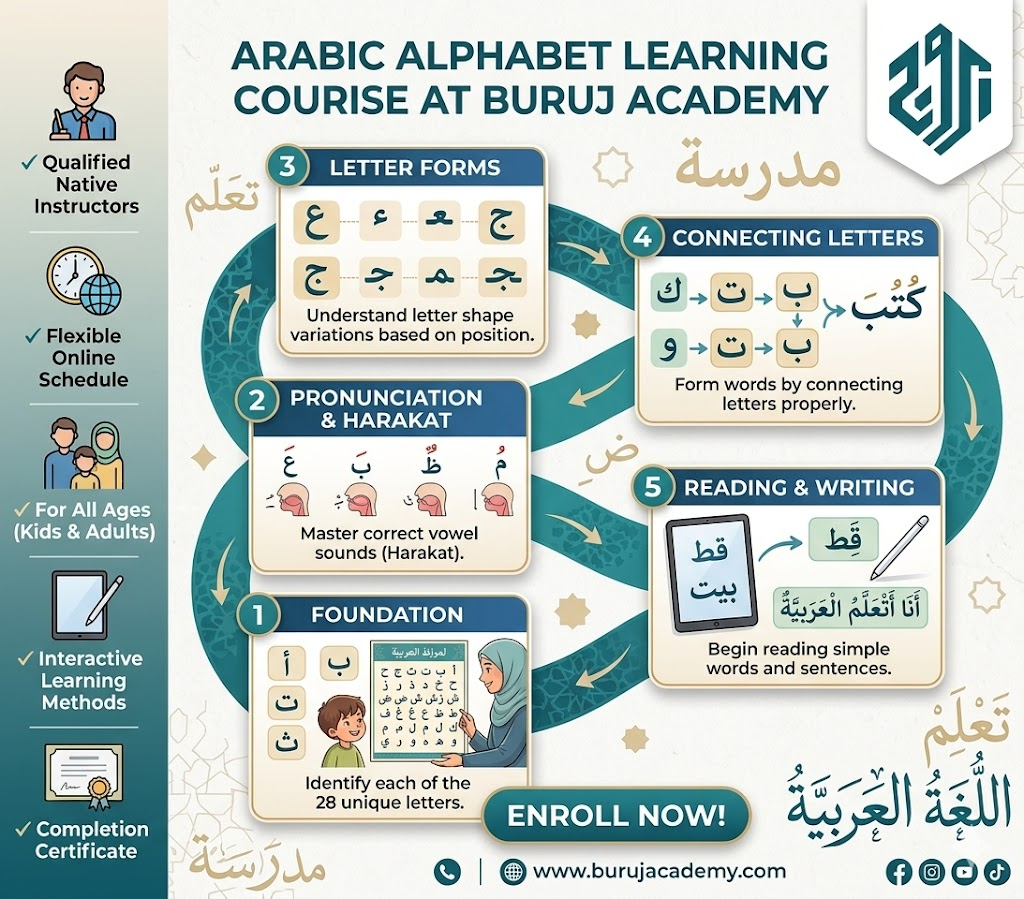
Our Arabic Alphabet Learning Course at Buruj Academy dedicates structured practice time to exactly this type of auditory reinforcement before students encounter the rule in written form.
Get a free trial now in Buruj’s Alphabet course
Master the Arabic Language
Join our expert-led courses and build a strong foundation in Classical and Modern Arabic.
Get Your Free TrialSun and Moon Letters for Kids: Age-Appropriate Learning Approaches
Children learn this rule most effectively through sound and pattern — not grammatical explanation. The assimilation is fundamentally auditory, which gives children a natural advantage when the teaching method prioritizes listening before labeling.
In our Online Arabic Classes for Kids, instructors introduce sun and moon letters through color-coded flashcards: sun letters in yellow, moon letters in blue. Children sort familiar words by color before ever naming the rule.
By the time the grammatical term is introduced, the distinction already feels natural.
For parents supporting home learning, the most effective practice is reading Surah Al-Ikhlas, Al-Falaq, and An-Nas aloud slowly together. An-Nās alone — الناس، الناس، الناس — repeats a sun letter word three times, giving young learners immediate repetition in a memorized context.
Resources like our guide on learning Arabic words for kids and our collection of Arabic games for kids offer additional reinforcement activities that make this phonological distinction stick without formal drilling.
Book a FREE Arabic trial for your Child

Discover the Buruj Academy Difference
Step into our virtual classrooms and see how our expert instructors make learning Quran and Arabic intuitive and clear. We focus on overcoming the specific hurdles non-native speakers face, building your confidence and connection with the Quran.
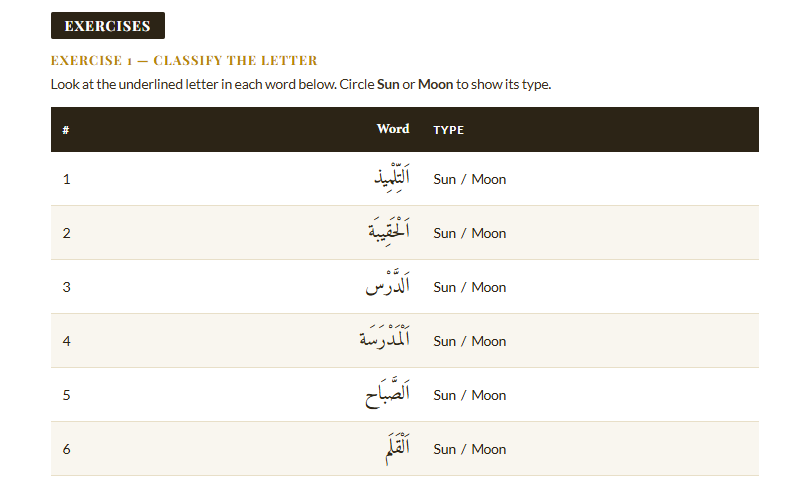
Free Downloadable PDF for Sun and Moon Letters in Arabic Worksheet
Structured practice materials — worksheets and organized PDF references — remain among the most requested resources for this topic. Effective worksheets follow a specific progression:
Level 1 — Recognition: A list of definite Arabic words; students circle whether the first letter is a sun or moon letter.
Level 2 — Pronunciation marking: Students add or remove the shaddah marker on the letter following “ال” based on correct classification.
Level 3 — Dictation: The instructor pronounces definite nouns; students write them with correct “ال” and shaddah placement.
This three-level progression — recognition, writing, then dictation — mirrors the approach we recommend in Buruj Academy’s Arabic dictation improvement guide, where building writing accuracy through sound before script is central to the method.
Buruj Academy · Sun&Moon Letters WORKSHEET.pdf
For a well-organized moon and sun letters in Arabic PDF reference, a clean two-column table of all 28 letters with their category, example word, and pronunciation is the most practical format.
Students keep it accessible during reading practice until classification becomes automatic — which, in our instructors’ experience, typically happens within three to four weeks of daily reading practice.
Read also: Can I Listen to the Quran Instead of Reading It?
Master Arabic Pronunciation with Buruj Academy’s Expert Instructors
Sun and moon letters sit at the heart of correct Arabic pronunciation. Mispronouncing the definite article affects every definite noun — and definite nouns appear in nearly every Arabic sentence and Quranic verse.
Buruj Academy’s Online Arabic Classes are taught by Al-Azhar University graduates with 12+ years of experience teaching non-Arabic speakers. Our context-before-abstraction method ensures students hear and produce correct sounds before encountering written rules — eliminating the most common pronunciation errors from the start.
- Personalized 1-on-1 sessions with flexible 24/7 scheduling
- Real-time pronunciation correction from Ijazah-certified instructors
- Proven progression from alphabet to fluent Arabic reading
Book your free trial lesson today and experience the Buruj Method firsthand.
Begin your transformation today by choosing the path that fits your goals:
- Online Arabic Classes (General & Comprehensive)
- Arabic Course for Beginners
- Arabic Alphabet Learning Course
- Online Arabic Classes for Kids
- Arabic Classes for Adults
- Arabic Grammar Course (Nahw & Sarf)
- Intermediate Arabic Course (B1/B2)
- Arabic Speaking Course (Conversational Fluency)
- Arabic Reading Course (Literary Excellence)
- Learn Arabic Writing Course (Calligraphy & Composition)
Ready to speak with confidence? Join the global community at Buruj Academy and book your free placement interview today!
Master the Arabic Language
Join our expert-led courses and build a strong foundation in Classical and Modern Arabic.
Get Your Free TrialConclusion
Sun and moon letters are not a minor detail — they shape how every definite noun sounds in Arabic and in Quranic recitation. The rule is consistent, logical, and deeply connected to Arabic phonology.
Once a student understands why assimilation happens, rather than simply memorizing which letters are which, the distinction becomes instinctive.
Approached correctly — with sound first, script second, and consistent practice in real Arabic contexts — this rule moves from confusion to confidence quickly. Insha’Allah, with the right guidance and regular practice, it becomes one of the most natural features of Arabic pronunciation.
Frequently Asked Questions About Moon and Sun Letters in Arabic
What Is the Easiest Way to Remember Which Letters Are Sun Letters?
Sun letters are those whose articulation point is close to or shared with the lam (ل) — mostly tongue-tip and front-of-mouth sounds. The word الشَّمْس (ash-shams) itself begins with a sun letter and demonstrates assimilation automatically. Grouping letters by makhraj (articulation point) is more reliable than memorizing a list alone.
Does the Sun Letter Rule Apply in Writing or Only in Speech?
The rule primarily governs pronunciation, but it is also visible in written Arabic. When a sun letter follows “ال,” a shaddah (ّ) appears over that letter in fully voweled text, signaling the doubled sound. In unvoweled Arabic, the rule must be recognized from knowledge of the letter category alone.
Do Sun and Moon Letters Affect Meaning in Arabic?
Sun and moon letters do not change a word’s meaning. الدِّين and الكِتَاب both remain grammatically definite nouns — the rule only determines how “ال” is pronounced. Meaning is carried by the root letters; assimilation is purely phonological.
Are Sun and Moon Letters Relevant for Quran Recitation and Tajweed?
Yes — this rule is directly applied in Quranic recitation. Every definite noun in the Quran follows the sun and moon letter principle. Mispronouncing the lam of “ال” before a sun letter is a Tajweed error that changes the correct recitation of the verse.
How Long Does It Take to Master Sun and Moon Letter Recognition?
In our instructors’ experience at Buruj Academy, most non-Arabic speaking adults correctly identify sun and moon letters in unfamiliar words within three to four weeks of daily reading practice. Children following structured programs with visual aids often internalize the distinction even faster through auditory repetition.
Related Articles
Arabic