 Arabic
| Key Takeaways |
| The Madinah Arabic Course (3 volumes) is the most widely used Islamic Arabic program for English speakers globally, combining grammar with Quranic vocabulary. |
| Alif Baa by Georgetown University Press is the gold standard for absolute beginners learning the Arabic script and core sounds before any grammar. |
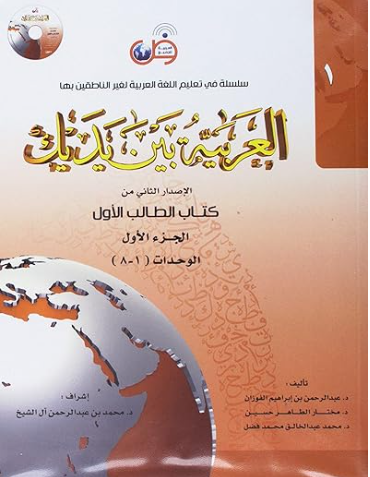
| Arabic Between Your Hands (Al-‘Arabiyya Bayna Yadayk) is a four-level series adopted by over 12 universities, covering all four language skills systematically. |
| Mastering Arabic by Jane Wightwick suits independent learners wanting a structured, self-study friendly MSA course with audio support from day one. |
| The Al-Kitaab series is the most academically rigorous MSA program, integrating formal Arabic, Egyptian, and Levantine dialects across three progressive volumes. |
Choosing the right book is often the single decision that determines whether an Arabic learner makes consistent progress or stalls within weeks.
With dozens of options on the market, many of them either too academic for independent study or too shallow for real comprehension, the choice genuinely matters.
The best books to learn Arabic for non-native speakers share three qualities: they build the Arabic script before expecting reading fluency, they integrate audio from the start, and they match your specific goal — whether that is Quranic understanding, conversational MSA, or classical grammar.
Table of Contents:
1. The Madinah Arabic Is the Most Essential Arabic Series for Muslim Learners of English
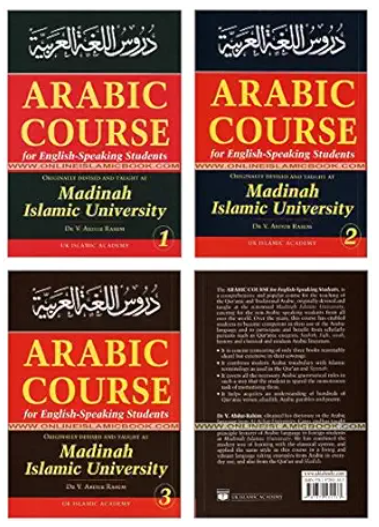
The Madinah Arabic Course (officially titled Arabic Course for English-Speaking Students by Dr. V. Abdur Rahim) is a three-volume series originally developed for the Islamic University of Madinah.
It remains the most widely used Arabic program for Muslim English speakers globally, combining formal grammar structures with Quranic and Hadith-based vocabulary from the very first lesson.
The series progresses logically:
Book 1 introduces basic grammar and sentence construction through short, clear Arabic examples.
Book 2 advances into verb patterns, root-based morphology, and I’rab (grammatical case endings).
Book 3 consolidates everything at a near-advanced level, equipping students to read classical Islamic texts with comprehension.
What Makes This Course Stand Out for Islamic Studies
The Madinah books are unique because they do not separate language learning from Islamic content. Vocabulary lists draw directly from Quranic expressions, ahadith, and classical Arabic literature.
A student finishing all three volumes will have encountered hundreds of Quranic words in their grammatical context — a feature no Western Arabic textbook replicates at this depth. We frequently recommend it to students in our Arabic Grammar course as a foundational reference alongside live instruction.
Understand the Arabic Grammar with Buruj’s free trial lesson
Who This Book Is Best For
| Learner Type | Suitability |
| Muslims wanting Quranic Arabic comprehension | Excellent — vocabulary is Islamically grounded |
| Complete beginners with no Arabic background | Moderate — requires patience; benefits greatly from a teacher |
| Students pursuing Islamic studies | Excellent — covers Fiqh and Hadith terminology |
| Learners wanting speaking practice | Limited — focus is grammar and reading, not conversation |
The Madinah books work best when paired with live instruction. In our instructors’ experience, students who attempt these books entirely alone often get stuck on Book 2 grammar explanations written entirely in Arabic.
Pairing them with Buruj Academy’s Arabic for Beginners course removes that barrier entirely.
Begin learning Arabic at Buruj with a FREE trial lesson
2. Alif Baa Is the Best Starting Point for Learning the Arabic Script and Sounds
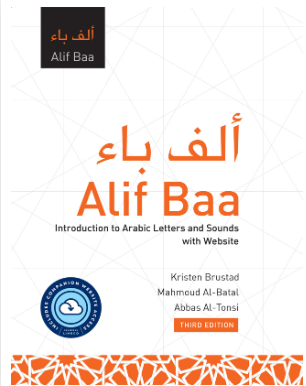
Alif Baa: Introduction to Arabic Letters and Sounds published by Georgetown University Press, is the standard entry point for anyone who has zero exposure to the Arabic alphabet. Before you learn a single grammar rule, you need to recognize letters in their initial, medial, and final forms — and this book does that better than any other resource on the market.
The third edition introduces over 200 basic vocabulary words in Modern Standard Arabic alongside Egyptian and Levantine spoken forms, color-coded throughout.
It includes streaming video dialogues filmed in Cairo and Damascus, an interactive companion website with autocorrecting exercises, and cultural capsules that give learners real-world context from the beginning.
Why Sound Recognition Comes Before Grammar
At Buruj Academy, we follow a sound-before-rules teaching philosophy — and Alif Baa aligns with that perfectly. The book trains the ear and the eye simultaneously before asking the student to process any grammatical abstraction.
This means students who complete it are not just memorizing letter shapes; they are already producing sounds correctly and connecting letters fluidly.
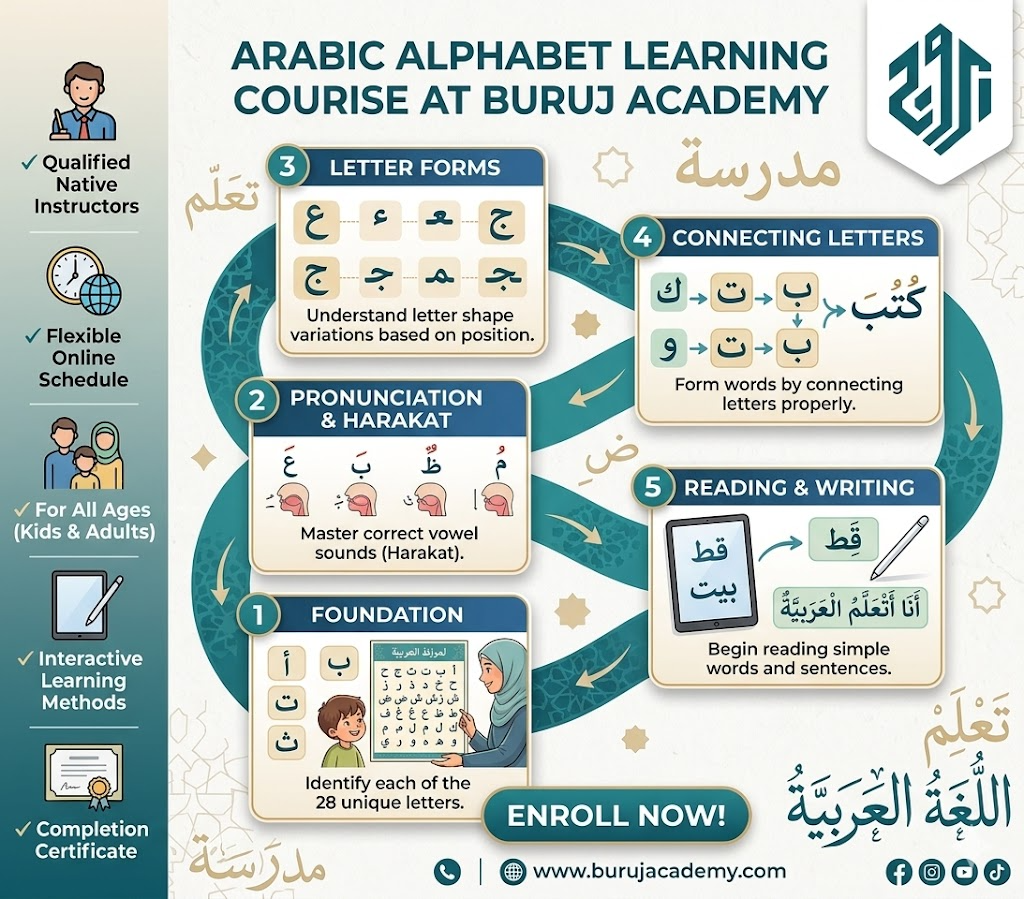
For learners pursuing our Arabic alphabet learning course, Alif Baa is the closest standalone equivalent to what our Al-Azhar-trained instructors teach in structured sessions.
Students who complete Alif Baa reach a novice-intermediate proficiency level and are ready for Al-Kitaab Part One, the logical next step in the Georgetown program.
Get a free trial now in Buruj’s Alphabet course
3. The Al-Kitaab Series Offers an Academically Rigorous MSA Program Available
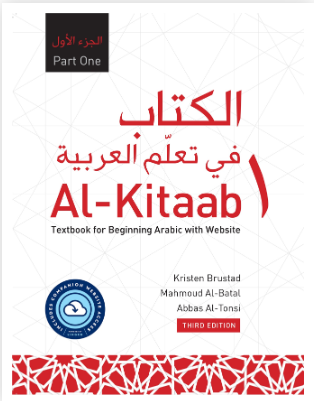
Al-Kitaab fii Ta’allum al-‘Arabiyya (Parts One, Two, and Three), published by Georgetown University Press, is the most comprehensive Modern Standard Arabic textbook program in the English-speaking academic world.
Used in over 200 universities across North America and Europe, it integrates formal MSA with Egyptian and Levantine Arabic simultaneously, using a color-coded system that shows learners how the same concept appears across varieties.
Part One covers thirteen lessons of daily-life topics with grammar explanations, reading comprehension texts, listening exercises, and speaking drills. Part Two strengthens academic reading and writing at the intermediate level. Part Three advances students into authentic Arabic prose, poetry, and contemporary texts.
Read also: The Best Apps to Learn Arabic
What Makes Al-Kitaab Challenging but Rewarding
The series is not designed for pure self-study — it shines in structured course environments with instructor feedback. The grammar explanations assume active classroom use, and the companion website provides exercises with automated feedback.
For independent learners, it can feel dense. However, the depth it provides in I’rab, verb morphology, and connected reading is unmatched. Students pursuing serious Quranic Arabic or classical text studies will find this series builds the strongest grammatical foundation.
For a structured path, our Online Arabic Classes use a curriculum aligned with this kind of progressive, skills-integrated methodology.
Book your FREE Arabic trial online Arabic class at Buruj
4. Mastering Arabic by Jane Wightwick Is the Best Self-Study Book for Independent Learners
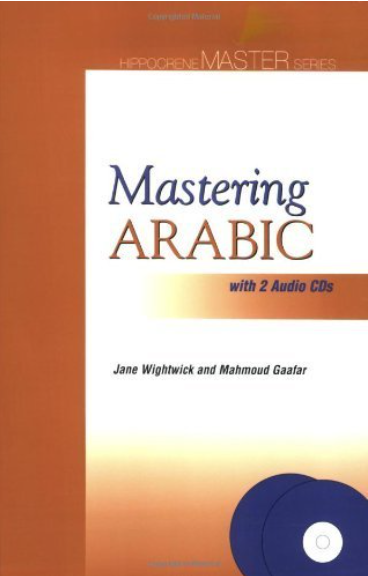
Mastering Arabic 1 by Jane Wightwick and Mahmoud Gaafar, published by Hippocrene Books, is consistently rated as one of the most accessible introductory MSA courses for self-directed learners. With 370 pages organized across twenty progressive units, it teaches the script, pronunciation, grammar, and conversational vocabulary together — without requiring a classroom environment.
The book uses cartoons, dialogues, newspaper extracts, and drawings to present Arabic in meaningful, real-world contexts. Audio recordings by native speakers are available online, allowing learners to calibrate their pronunciation independently.
An activity book is sold separately for additional practice. It genuinely works — for students who travel regularly or have irregular schedules, it provides reliable structure without a fixed timetable.
Comparing Mastering Arabic to Other Self-Study Options
| Feature | Mastering Arabic | Alif Baa | Madinah Course |
| Suitable for pure self-study | ✅ Yes | ✅ Yes | ⚠️ Partial |
| Audio support included | ✅ Yes | ✅ Yes | ⚠️ Limited |
| Islamic vocabulary emphasis | ❌ No | ❌ No | ✅ Strong |
| Formal grammar depth | Moderate | Beginner | Advanced |
| Recommended level | Absolute beginner | Absolute beginner | Beginner to Advanced |
We often recommend Mastering Arabic to students who begin with us in our Arabic Reading course as a companion resource for out-of-class review, particularly for the script recognition chapters.
Master the Arabic Language
Join our expert-led courses and build a strong foundation in Classical and Modern Arabic.
Get Your Free Trial5. Arabic Between Your Hands Is the Most Widely Adopted Institutional Arabic Series
Arabic Between Your Hands (Al-‘Arabiyya Bayna Yadayk), authored by Dr. Abdul Rahman Al-Fuzan and published by the Arabic For All project, is a four-level series adopted by over 12 universities and institutions worldwide. It targets adult non-Arabic speakers and develops all four language skills — listening, speaking, reading, and writing — from absolute zero through near-mastery.
The first level alone contains 144 basic lessons across 16 units in two volumes. Each unit introduces vocabulary with illustrated pictures, audio-supported texts on MP3 CD, and a gradual grammatical progression that respects adult learning curves.
Standard Modern Arabic is used throughout — no colloquial shortcuts — making it ideal for students who want to understand both the Quran and contemporary Arabic media.
Discover the Buruj Academy Difference
Step into our virtual classrooms and see how our expert instructors make learning Quran and Arabic intuitive and clear. We focus on overcoming the specific hurdles non-native speakers face, building your confidence and connection with the Quran.
Why Universities Choose This Series
The series stands out for its systematic phonemic approach. Unlike many textbooks that mention Arabic sounds in passing, Arabic Between Your Hands dedicates significant attention to sound recognition and production from unit one — treating the phonemic system as a priority, not an afterthought.
For our students pursuing our Arabic Speaking course, the early emphasis on correct articulation in this series aligns precisely with what our Ijazah-certified instructors reinforce in live sessions.
Students working through this series benefit most from also using dictation exercises regularly. Our blog on improving Arabic writing with dictation outlines exactly how to build that complementary practice.
Book your free trial to start speaking Arabic fluently
6. The Hans Wehr Dictionary Is the Indispensable Reference Tool for Every Arabic Learner
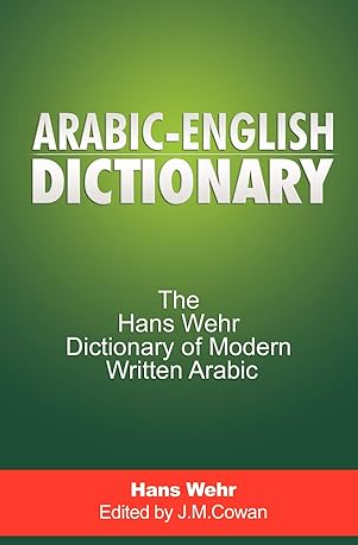
A Dictionary of Modern Written Arabic by Hans Wehr, edited by J. Milton Cowan, is not a course book — it is the definitive reference dictionary every serious Arabic student needs on their desk. Organized by Arabic root (not alphabetically by letter, which is how Arabic vocabulary actually works), it covers over 40,000 entries of Modern Standard Arabic.
Understanding the Arabic root system is the most important grammatical concept a learner can internalize.
Once a student grasps that the root ك-ت-ب (K-T-B) generates the words for “write,” “book,” “library,” and “correspondent,” vocabulary acquisition accelerates dramatically.
The Hans Wehr dictionary makes that root system accessible to English speakers in a practical, daily-use format. For a deeper explanation of how Arabic morphology works at the beginner level, our guide to Modern Standard Arabic covers this foundational concept in full.
Every student at the intermediate level and above should own this dictionary regardless of which course book they use.
7. Short Stories in Arabic for Intermediate Learners
Short Stories in Arabic for Intermediate Learners by Olly Richards, published by Teach Yourself/Hodder & Stoughton, addresses one of the most common gaps in Arabic study: the absence of graded reading material between textbook exercises and authentic Arabic texts.
Most learners complete a beginner course and then face a wall — nothing to read that is realistic yet comprehensible.
This book contains eight original stories in Modern Standard Arabic at a B1 level, each accompanied by a vocabulary list, comprehension questions, and an English translation. The stories progress in difficulty.
Because the content is narrative-driven rather than exercise-based, learners build the sustained reading habit that is essential for real fluency. For students building vocabulary systematically, our resource on mastering Arabic vocabulary pairs naturally with reading practice at this level.
At Buruj Academy, we frequently recommend this book to students completing our Arabic Grammar course who want to transition from structured exercises to meaningful reading.
Understand the Arabic Grammar with Buruj’s free trial lesson
Read also: Best YouTube Channels to Learn Arabic
Start Learning Arabic Today with Buruj Academy’s Expert Instructors
Books are powerful — but they have limits. No textbook corrects your pronunciation in real time, adjusts to your specific confusion, or keeps you accountable week after week.
Buruj Academy’s Online Arabic Classes provide exactly what books cannot:
- Al-Azhar University graduates and Ijazah-certified instructors with 12+ years teaching non-native speakers
- Personalized 1-on-1 sessions tailored to your level, goals, and schedule
- The Buruj Method: Context-before-abstraction and Consistency-before-speed
- Flexible 24/7 scheduling for students in any time zone
- A free trial lesson to experience the difference
Book your free trial lesson today and let our instructors guide you from whichever book you choose — straight to real Arabic fluency.
Begin your transformation today by choosing the path that fits your goals:
- Online Arabic Classes (General & Comprehensive)
- Arabic Course for Beginners
- Arabic Alphabet Learning Course
- Online Arabic Classes for Kids
- Arabic Classes for Adults
- Arabic Grammar Course (Nahw & Sarf)
- Intermediate Arabic Course (B1/B2)
- Arabic Speaking Course (Conversational Fluency)
- Arabic Reading Course (Literary Excellence)
- Learn Arabic Writing Course (Calligraphy & Composition)
Ready to speak with confidence? Join the global community at Buruj Academy and book your free placement interview today!
Master the Arabic Language
Join our expert-led courses and build a strong foundation in Classical and Modern Arabic.
Get Your Free TrialConclusion
The best books to learn Arabic do not replace a teacher — they amplify what a teacher makes possible. Whether you begin with Alif Baa to master the script, work through the Madinah Course for Quranic Arabic grounding, or use Arabic Between Your Hands for a structured institutional-style progression, the books above represent the most reliable, authentic resources available to English-speaking learners.
What matters most is matching the book to your goal. A Muslim learner seeking Quran comprehension and a university student studying MSA for academic purposes need different tools.
Use this list to identify your starting point — and then commit to consistent, guided practice that makes your investment in the right book actually pay off. Insha’Allah, the right combination of resources and instruction will take you further than you expect.
Frequently Asked Questions About the Best Books to Learn Arabic
What Is the Best Arabic Book for Absolute Beginners with No Prior Knowledge?
Alif Baa by Georgetown University Press is the best starting point for complete beginners. It teaches Arabic letters, sounds, and basic vocabulary before introducing any grammar, building the script-reading foundation that every subsequent study depends on. Students completing it typically reach a novice-intermediate level after 20–25 contact hours of focused study.
Can I Learn Arabic Effectively from a Book Without a Teacher?
Books like Mastering Arabic and Alif Baa are designed for independent study and include audio support. However, without a teacher to correct pronunciation and explain grammatical confusion in context, most learners plateau significantly faster. Live instruction — even one session per week — dramatically increases the speed and accuracy of progress alongside any book.
Is the Al-Kitaab Series Suitable for Self-Study?
Al-Kitaab is primarily designed for classroom use with instructor guidance. Its companion website provides automated feedback for exercises, which helps independent learners — but the dense grammar explanations and integrated dialect exposure are most effective when a teacher explains nuance in real time. It is excellent for serious self-study students who supplement it with regular tutoring sessions.
Which Arabic Book Is Best for Understanding the Quran?
The Madinah Arabic Course by Dr. V. Abdur Rahim is the top recommendation for Quranic Arabic specifically. It embeds Quranic vocabulary and Hadith expressions throughout all three volumes, building both grammatical knowledge and textual comprehension simultaneously. Paired with an understanding of Arabic pronunciation and Arabic grammar basics, it provides a strong foundation for direct Quran engagement.