 Arabic
| Key Takeaways |
| Arabic is classified by the U.S. Foreign Service Institute as a Category IV language, requiring approximately 2,200 hours for English speakers to reach professional proficiency. |
| English speakers face three core challenges: a new script, an unfamiliar sound system, and grammatical structures that work differently from any European language. |
| Spanish speakers have a measurable phonetic advantage due to shared sounds like rolled R, short vowels, and the absence of the “th” sound problem. |
| Consistent daily practice of 30–45 minutes produces faster results than infrequent long sessions, regardless of which Arabic variety a learner pursues. |
Arabic has a reputation that precedes it — one that sends many learners into hesitation before they write a single letter. That reputation is not entirely undeserved, but it is frequently misunderstood.
So how hard is it to learn Arabic for English speakers? It is genuinely challenging, but the difficulty is specific and manageable. With the right method and guidance, meaningful progress comes sooner than most learners expect.
Table of Contents:
How Hard Is It to Learn Arabic for English Speakers Specifically?
Arabic is officially classified as a Category IV language by the U.S. Foreign Service Institute — the hardest category for native English speakers, alongside Chinese, Japanese, and Korean. The FSI estimates roughly 2,200 classroom hours to reach professional working proficiency.
That number sounds intimidating, but it describes a very high bar: government-level professional fluency.
Most learners have more accessible goals — reading the Quran, understanding Friday sermons, holding basic conversations, or building a foundation in Islamic texts. These goals are achievable in far shorter timeframes with focused, structured learning.
Why Does Arabic Feel So Difficult for English Speakers?
Three features make Arabic genuinely unlike European languages:
| Challenge | What It Means for English Speakers |
| New writing script | Right-to-left, connected letters, 28 characters with positional forms |
| Unfamiliar phonemes | Sounds like ع (ayn), غ (ghayn), ح (ha), خ (kha) have no English equivalent |
| Root-based morphology | Words derive from three-letter roots — a completely different logic from English |
| Grammatical case system | Nouns change endings based on grammatical role (I’rab) — absent in English |
| Diglossia | Modern Standard Arabic (MSA) differs significantly from spoken dialects |
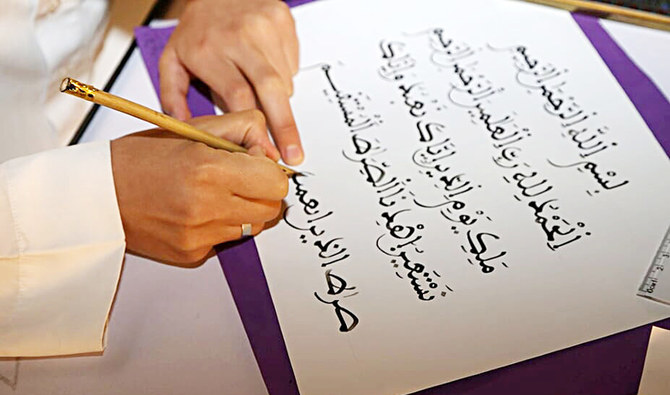
The script is typically the first barrier. In our experience at Buruj Academy, adult beginners who commit to daily 20-minute alphabet practice usually achieve confident letter recognition within three to four weeks — far faster than they anticipated.
At Buruj Academy, our Arabic for Beginners course builds from complete zero, addressing each of these challenges in a logical sequence — script first, sounds second, structure third — so no challenge overwhelms the learner before they are ready for it.
Begin learning Arabic at Buruj with a FREE trial lesson

Is It Hard to Learn Arabic Script and Pronunciation Together?
Learning the Arabic script and its sounds simultaneously is not that hard. The script is learnable in weeks; the sounds require consistent, corrected practice over months.
Arabic has 28 letters, but the phonetic challenge is not volume — it is precision. English speakers must produce sounds that originate deep in the throat (pharyngeals) and distinguish between emphatic and non-emphatic consonants that completely change word meaning.
The Pharyngeal Sounds That Challenge English Speakers Most
| Arabic Sound | Articulation Point | Common English Speaker Error |
| ع (Ayn) | Pharyngeal — constricted throat | Replaced with a glottal stop or omitted entirely |
| غ (Ghayn) | Uvular fricative — back of throat | Pronounced as a French “r” or skipped |
| ح (Ha) | Pharyngeal fricative — breathy | Confused with the regular هـ (ha) |
| خ (Kha) | Velar fricative — like Scottish “loch” | Often replaced with English “h” |
| ق (Qaf) | Uvular stop — deepest in throat | Pronounced as English “k” |
These sounds cannot be learned from written descriptions alone. They require a trained teacher who can model them correctly and catch errors in real time.
Our Al-Azhar-trained instructors in the Online Arabic Classes focus specifically on these sounds before moving into grammar — because a mispronounced foundation causes cascading errors later.
For a structured breakdown of how to master Arabic pronunciation from the beginning, our guide to Modern Standard Arabic for beginners walks through the phonetic system in plain, learner-friendly terms.
Book your FREE Arabic trial online Arabic class at Buruj

How Hard Is It to Learn Arabic Grammar for English Speakers?
Arabic grammar is sophisticated, but it is also deeply systematic. Once a learner grasps the root-pattern system, vocabulary acquisition accelerates dramatically — a feature that actually makes Arabic easier in the long run than it appears at the start.
The three-letter root (الجذر — al-jidhr) is the backbone of Arabic vocabulary. The root ك-ت-ب (k-t-b), for example, generates: كَتَبَ (he wrote), كِتَاب (book), كَاتِب (writer), مَكْتَبة (library), مَكْتُوب (written/letter). One root, dozens of words.
The Grammar Structures That Take the Most Time to Master
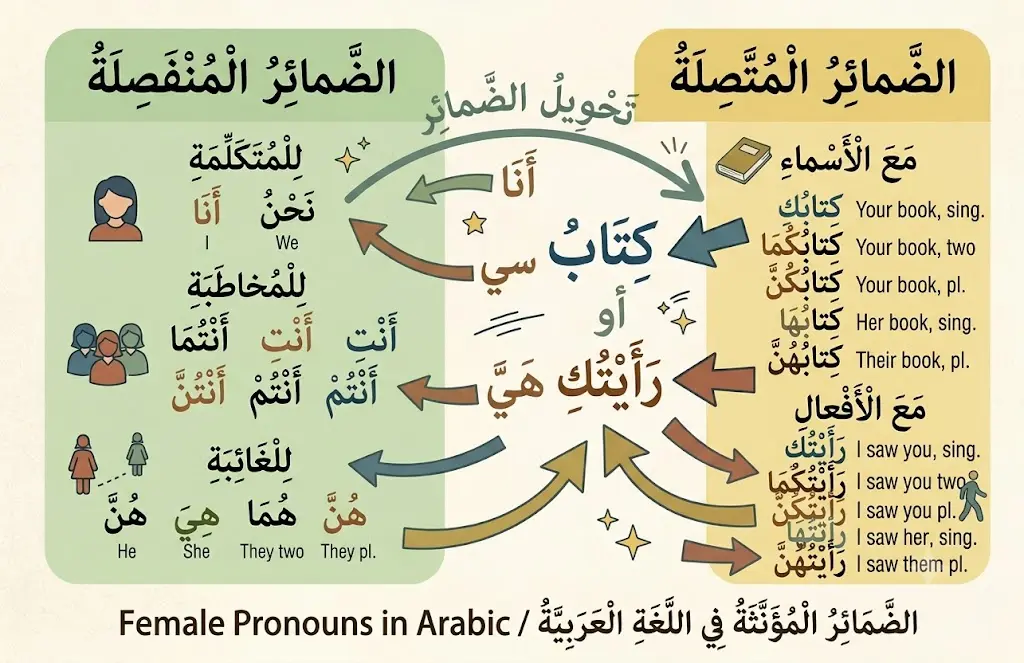
The I’rab System (Grammatical Case Endings) Arabic nouns carry case endings that indicate their grammatical role: nominative (رفع), accusative (نصب), and genitive (جر). English has no direct equivalent — this concept requires patient, repeated exposure before it feels natural.
Verb-Subject Agreement Arabic verbs agree with their subjects in gender and number. A sentence can begin with a verb before the subject appears — a word order that consistently surprises English speakers in early stages.
Dual and Plural Forms Arabic distinguishes singular, dual, and plural — and plurals are often irregular (broken plurals), requiring memorization of patterns rather than simple suffix addition.
Our detailed guide to Arabic grammar for beginners explains these structures using English-speaker-friendly comparisons that make the logic accessible without oversimplification.
For learners wanting to understand how Arabic sentences are built from the ground up, our guide to Arabic sentence structure is an essential companion resource.
Through Buruj Academy’s Arabic Grammar Course, students master MSA grammar systematically — from sentence construction to verb conjugations — with clear explanations designed specifically for English speakers who have never encountered a case system before.
Understand the Arabic Grammar with Buruj’s free trial lesson
How Hard Is It to Learn Arabic for Spanish Speakers Compared to English Speakers?
Spanish speakers have a measurable, genuine advantage when approaching Arabic — and this is not simply encouraging language-learner mythology.
The phonetic overlap between Spanish and Arabic is historically significant and practically useful.
Spanish and Arabic share or closely approximate several sounds that English entirely lacks: the rolled or trilled R, clear short vowel sounds (a, i, u) that closely mirror Arabic’s three-vowel system (فتحة، كسرة، ضمة), and the absence of the ambiguous English “th” sound that confuses Arabic phonemic categories.
Read also: Most Common Quranic Words
Where Spanish Speakers Gain Ground Faster
| Phonetic Feature | Spanish Advantage | English Disadvantage |
| Short vowels (a, i, u) | Already natural in Spanish | English has reduced/schwa vowels instead |
| Rolled R (ر) | Identical or very close in Arabic | Absent in standard English |
| Clear consonant articulation | Spanish consonants are precise | English consonants often reduced or aspirated |
| Rhythmic word stress | Similar patterns | English stress is irregular and often unstressed |
Spanish speakers still face identical challenges with the Arabic script, pharyngeal sounds, and root-based grammar. The phonetic head start saves weeks of pronunciation drilling but does not shortcut the grammatical learning curve.
English speakers should not be discouraged by this comparison. The script, which Spanish speakers also learn from scratch, is genuinely mastered faster than most expect — and the grammar, once internalized, becomes a logical, elegant system rather than an obstacle.
Master the Arabic Language
Join our expert-led courses and build a strong foundation in Classical and Modern Arabic.
Get Your Free TrialHow Easy Is It to Learn Quranic Arabic Compared to Modern Standard Arabic?
Quranic Arabic and Modern Standard Arabic (MSA) are related but distinct registers, and choosing the right goal significantly affects how hard the learning process feels. For Muslim learners whose primary motivation is Quran understanding, this distinction changes everything.
Quranic Arabic operates within a relatively fixed vocabulary. Classical studies indicate that approximately 80% of the Quran is composed of words from roughly 300–400 high-frequency roots. A learner who masters this core vocabulary and the foundational grammatical structures of classical Arabic can reach meaningful Quranic comprehension without targeting full MSA fluency.
MSA, by contrast, is used in contemporary media, literature, and formal settings — it includes modern vocabulary, evolving usage, and broader grammatical demands. It is a larger, more dynamic target.
Discover the Buruj Academy Difference
Step into our virtual classrooms and see how our expert instructors make learning Quran and Arabic intuitive and clear. We focus on overcoming the specific hurdles non-native speakers face, building your confidence and connection with the Quran.
Which Should You Learn First?
| Goal | Recommended Starting Point |
| Understand Quran during Salah | Quranic Arabic — focused vocabulary and classical grammar |
| Read Islamic texts and Tafsir | Quranic Arabic with classical grammar emphasis |
| Watch Arabic news or media | MSA — contemporary vocabulary and pronunciation |
| Travel and daily conversation | Colloquial dialect of the target region |
| Full Islamic scholarship | Both Quranic Arabic and MSA, sequenced properly |
For learners building Quranic vocabulary systematically, our guide on mastering Arabic vocabulary provides practical memorization techniques specifically suited to high-frequency Quranic words.
Buruj Academy’s Quranic Arabic Classes focus specifically on understanding Quran grammar, classical vocabulary, and comprehension skills, taught by Al-Azhar graduates specializing in Quranic linguistics — a completely different approach from general Arabic conversation courses.
Begin Understanding Quranic Arabic with a FREE Lesson
How Long Does It Realistically Take to Learn Arabic?
The honest answer depends entirely on three variables: the learner’s goal, the consistency of practice, and the quality of instruction. Vague timelines serve no one — here are realistic, goal-specific estimates based on structured learning.
| Learning Goal | Daily Practice | Realistic Timeframe |
| Read Arabic alphabet fluently | 20–30 min/day | 4–8 weeks |
| Read Quran with basic Tajweed | 30–45 min/day | 6–18 months |
| Basic Quranic vocabulary comprehension | 30 min/day | 12–24 months |
| Conversational MSA proficiency | 45–60 min/day | 2–4 years |
| Professional/academic Arabic fluency | Full-time study | 5–7+ years |
These are estimates based on our instructors’ observations across hundreds of students — not published research statistics. Individual progress varies based on prior language learning experience, consistency, and instructional quality.
In our sessions at Buruj Academy, the most consistent predictor of progress is not raw intelligence or natural aptitude — it is the learner who practices in short daily sessions rather than sporadic long ones.
A student who studies 30 minutes every day will outperform one who studies three hours once a week, consistently.
Improving Arabic writing through structured practice is another dimension often underestimated — our resource on improving Arabic writing with dictation explains a highly effective technique our instructors use with intermediate learners to accelerate script fluency.
Read also: How to Learn Arabic?
What Mistakes Do Most English Speakers Make When Learning Arabic?
Understanding the most common errors prevents learners from cementing bad habits that become exponentially harder to correct later. These are patterns we observe repeatedly — not theoretical concerns.
1. Skipping the sound system
Many self-study learners rush to vocabulary and grammar while pronouncing Arabic sounds approximately. Approximate pronunciation becomes a ceiling — it limits Quran recitation accuracy, listening comprehension, and spoken production simultaneously.
2. Mixing dialects with MSA or Quranic Arabic
Arabic dialects differ significantly from formal Arabic. Mixing them creates confusion and inconsistency. Clear goal-setting prevents this from the start.
3. Avoiding speaking practice
Reading and writing feel “safer” than speaking, but they develop different skills. Speaking practice — even in one-on-one sessions with an instructor — is irreplaceable for building active fluency.
4. Inconsistent revision of vocabulary
Arabic’s root system rewards active vocabulary building. Learners who study new words without regular revision lose them quickly — a spaced repetition system is not optional, it is foundational.
For learners working on the speaking dimension specifically, Buruj Academy’s Arabic Speaking Course addresses the confidence gap directly, providing structured conversation practice that eliminates hesitation and builds natural fluency through real-time instructor feedback.
Book your free trial to start speaking Arabic fluently

Start Learning Arabic with Buruj Academy’s Expert Instructors
Arabic is challenging — but it is also one of the most rewarding languages a Muslim can pursue, connecting learners directly to the Quran, Islamic scholarship, and the language of worship.
Buruj Academy’s Online Arabic Classes are taught by Al-Azhar University graduates with 12+ years of experience teaching non-Arabic speakers. Our Buruj Method — context-before-abstraction, sound-before-grammar — builds genuine skills from day one through personalized 1-on-1 sessions with flexible global scheduling.
Book your free trial lesson and discover exactly where to start.
Begin your transformation today by choosing the path that fits your goals:
- Online Arabic Classes (General & Comprehensive)
- Arabic Course for Beginners
- Arabic Alphabet Learning Course
- Online Arabic Classes for Kids
- Arabic Classes for Adults
- Arabic Grammar Course (Nahw & Sarf)
- Intermediate Arabic Course (B1/B2)
- Arabic Speaking Course (Conversational Fluency)
- Arabic Reading Course (Literary Excellence)
- Learn Arabic Writing Course (Calligraphy & Composition)
Ready to speak with confidence? Join the global community at Buruj Academy and book your free placement interview today!
Master the Arabic Language
Join our expert-led courses and build a strong foundation in Classical and Modern Arabic.
Get Your Free TrialRead also: How to Learn the Arabic Alphabet?
Conclusion
Arabic is genuinely difficult for English speakers — the script, the sounds, and the grammar all require real effort and time. But difficulty is not the same as impossibility, and the challenge is far more specific and addressable than the language’s reputation suggests.
The learners who succeed are not necessarily the most talented — they are the most consistent, and the most purposefully guided. Whether your goal is reading the Quran with understanding, building conversational Arabic, or deepening your connection to Islamic texts, the path is clear when you begin with the right foundation.
Frequently Asked Questions About How Hard It Is to Learn Arabic
Can an Adult English Speaker Really Become Fluent in Arabic?
Yes — adult English speakers regularly reach meaningful Arabic fluency with consistent, structured practice. The FSI estimates 2,200 hours for professional proficiency, but most learners pursue more accessible goals. Adults who practice 30–45 minutes daily under qualified instruction typically reach functional Quranic or conversational Arabic within two to four years.
Is Arabic Harder to Learn Than Chinese or Japanese for English Speakers?
The FSI places Arabic, Chinese, Japanese, and Korean in the same Category IV difficulty tier. Arabic’s challenge lies in its script, phonetics, and grammar system. Chinese and Japanese have more complex writing systems but simpler grammar in some respects. The difficulty is comparable but expressed differently across these languages.
How Hard Is It to Learn Arabic for Spanish Speakers Specifically?
Spanish speakers have a genuine phonetic advantage — short vowels, rolled R, and clear consonant articulation overlap significantly with Arabic. This advantage accelerates pronunciation learning by several weeks. However, the Arabic script, pharyngeal sounds, and root-based grammar present the same challenges for Spanish speakers as for any other Latin-script language native speaker.
What Is the Fastest Way to Make Progress in Arabic as a Beginner?
The fastest progress comes from three non-negotiable practices: daily consistency over sporadic intensity, immediate pronunciation correction from a qualified instructor, and systematic vocabulary building using Arabic’s root-pattern system. Self-study without feedback consistently produces slower progress and entrenched pronunciation errors that require correction later.