 Arabic

| Key Takeaways |
| Arabic has three main varieties — Modern Standard Arabic, Quranic Arabic, and dialects — each requiring a different learning approach. |
| Mastering the Arabic alphabet with correct pronunciation takes most adult beginners four to 3-6 weeks of consistent practice. |
| Vocabulary acquisition of 300–500 core words enables basic Arabic comprehension before grammar study begins. |
| Structured grammar study using Nahw and Sarf principles is essential for reading, writing, and understanding Arabic correctly. |
| Daily practice of 20–30 minutes consistently outperforms occasional long study sessions for long-term Arabic retention. |
Arabic is one of the most studied languages among Muslims worldwide — yet most learners hit the same wall: they study for months without gaining real confidence. The reason is almost always a missing structure in how they approach the language from the start.
Learning Arabic effectively means following a deliberate sequence — alphabet first, then sounds, then vocabulary, then grammar, then active skills like speaking and writing.
When this sequence is followed correctly, non-native speakers make measurable, lasting progress at every stage.
Table of Contents:
1. Decide Which Type of Arabic You Need to Learn
The most important decision before starting Arabic is identifying which Arabic you are actually learning. Arabic is not one uniform language — it exists in three distinct forms, each with different uses and learning paths.
| Arabic Variety | Primary Use | Recommended For |
| Modern Standard Arabic (MSA) | Reading, writing, formal speech, media | General education, literacy, professional use |
| Quranic Arabic (Classical) | Quran comprehension, Islamic texts | Muslims seeking Quran understanding |
| Spoken Dialects (Egyptian, Levantine, etc.) | Daily conversation in specific regions | Travel, regional communication |
Most non-native Muslim learners benefit most from either MSA or Quranic Arabic. These two share significant overlap in vocabulary and structure, making them the most efficient starting point.
Our beginner’s guide to Modern Standard Arabic walks through exactly what MSA covers and why it builds the strongest foundation.
At Buruj Academy, our Online Arabic Classes are structured around this exact decision — we identify each student’s purpose in the first session and tailor their learning path accordingly, guided by Al-Azhar University graduates with 12+ years teaching non-native speakers.
Book your FREE Arabic trial online Arabic class at Buruj

2. Master the Arabic Alphabet Before Anything Else
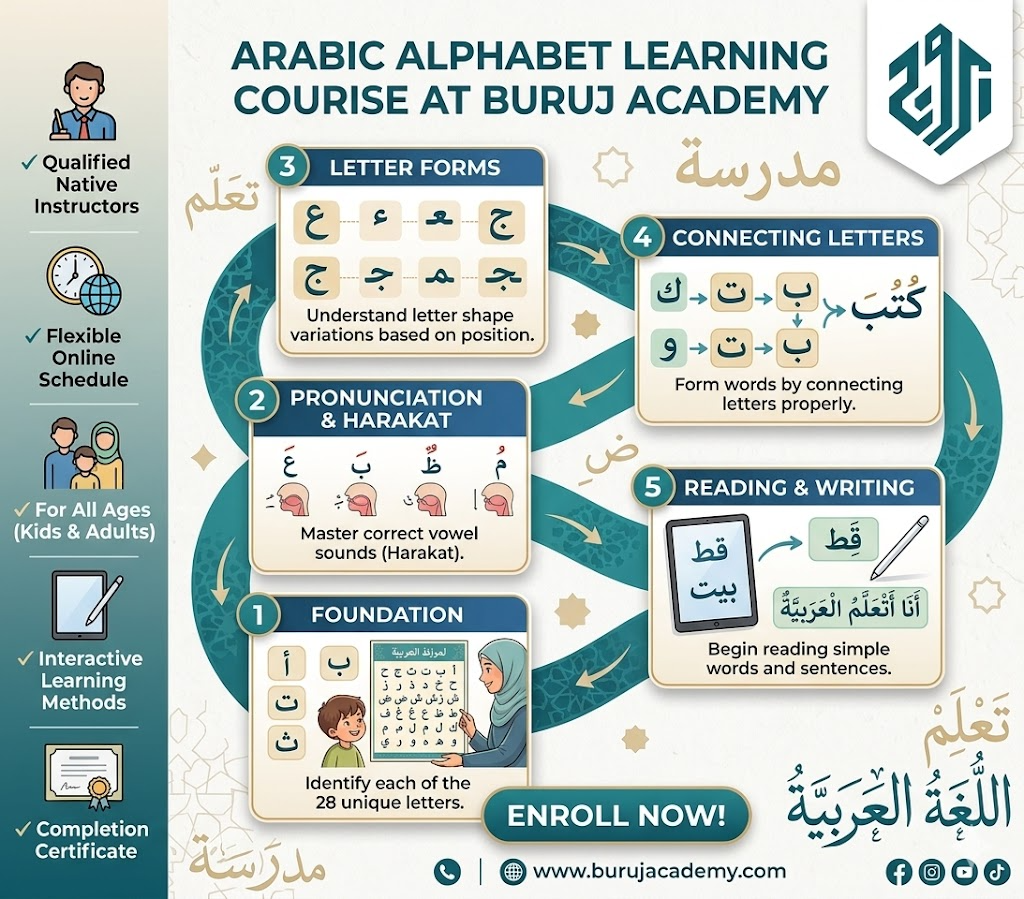
Learning the Arabic alphabet is the non-negotiable first step for any beginner. Arabic uses a 28-letter abjad script written right to left, where most letters change shape depending on their position in a word — beginning, middle, or end.
| Letter Position | Shape Change | Example Letter: ب (Ba) |
| Isolated | Full form | بـ |
| Initial (start) | Connected right | بـ |
| Medial (middle) | Connected both sides | ـبـ |
| Final (end) | Connected left | ـب |
Most adult beginners we work with at Buruj Academy move through letter recognition within three to four weeks when practicing 20 minutes daily.
The critical error we see consistently is students rushing past letter sounds to start vocabulary — this creates pronunciation habits that are very difficult to correct later.
Our dedicated Arabic Alphabet Learning Course addresses this by training letter sounds alongside shapes from lesson one.
For children, our guide to learning Arabic for kids outlines age-appropriate alphabet methods that work particularly well for younger learners.
Get a free trial now in Buruj’s Alphabet course
3. Train Arabic Pronunciation Correctly From the Start
Arabic pronunciation is one of the most common areas where self-study breaks down. Several Arabic sounds have no equivalent in English — including the emphatic consonants (ص، ض، ط، ظ), the deep guttural letters (ع، غ), and the pharyngeal fricatives (ح، خ).
Why Pronunciation Errors Become Permanent Without Correction
When a learner mispronounces a letter for weeks without correction, the muscle memory becomes deeply embedded.
We have worked with intermediate Arabic students who have spent years reading with incorrect letter sounds — undoing those habits requires significantly more effort than building them correctly from the start.
How to Build Correct Arabic Sounds
The most effective method for pronunciation training is audio-first learning: hear the correct sound from a qualified teacher before attempting to reproduce it yourself. Online resources can supplement this, but they cannot replace real-time correction from a trained instructor.
Our Arabic pronunciation resource provides a structured breakdown of the most commonly mispronounced Arabic sounds for English speakers, with phonetic guidance for each letter.
Read also: Top 9 Proven Quranic Miracles
4. Build a Core Arabic Vocabulary of 300–500 Words
Grammar study without vocabulary is one of the most common reasons Arabic learners plateau. We recommend building a working vocabulary of 300–500 high-frequency words before engaging deeply with grammar rules — this gives the grammar structures real words to work with.
Which Vocabulary Should Beginners Prioritize?
| Vocabulary Category | Examples | Why Prioritize |
| Quranic root words | كتب (write/book), علم (knowledge), رحم (mercy) | Appears repeatedly in Quran and Islamic texts |
| Basic nouns | بيت، ماء، رجل، امرأة | Essential for sentence construction |
| Common verbs | ذهب، جاء، قرأ، كتب | Needed for basic communication |
| Connectors | و، في، على، من، إلى | Glue that holds sentences together |
Learning Arabic vocabulary through Quranic root words (three-letter roots) is particularly efficient — each root generates multiple related words, so learning one root unlocks five to ten vocabulary items simultaneously.
This root-based approach is central to how we teach vocabulary in Buruj Academy’s Arabic for Beginners course.
Begin learning Arabic at Buruj with a FREE trial lesson

5. Learn Arabic Grammar Through Structured Nahw and Sarf Study
Arabic grammar is governed by two traditional sciences: Nahw (syntax — how words function in sentences) and Sarf (morphology — how words are formed and change shape). Understanding both is essential for reading fluency and accurate comprehension.
What Is Nahw and Why Does It Matter?
Nahw governs how words relate to each other in a sentence — including case endings (I’rab), subject-verb agreement, and sentence types. Without Nahw, a learner can memorize hundreds of words but will misread sentence meaning frequently.
Discover the Buruj Academy Difference
Step into our virtual classrooms and see how our expert instructors make learning Quran and Arabic intuitive and clear. We focus on overcoming the specific hurdles non-native speakers face, building your confidence and connection with the Quran.
What Is Sarf and Why Does It Matter?
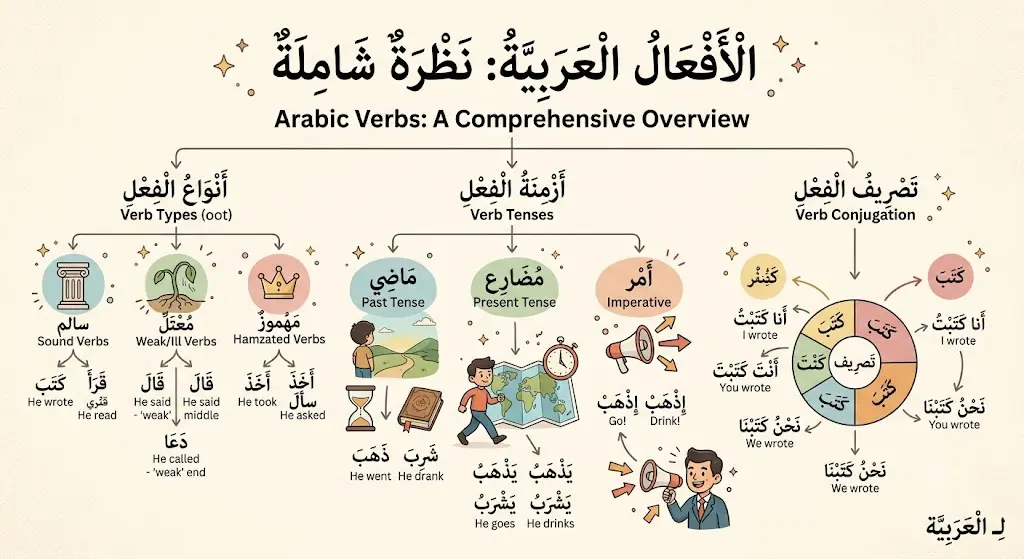
Sarf governs how Arabic words change form based on their grammatical function. A single verb root like كتب (to write) produces dozens of derived forms — كاتب (writer), مكتوب (written), مكتبة (library). Understanding Sarf dramatically accelerates vocabulary growth.
Our detailed article on how to learn Arabic grammar easily covers both sciences in beginner-friendly terms. For those ready to go deeper, our Nahw and Sarf online course provides structured instruction under qualified teachers.
Buruj Academy’s Arabic Grammar Course teaches Nahw and Sarf systematically with clear English explanations tailored specifically for non-native speakers — removing the confusion that comes from studying classical grammar texts without guidance.
Understand the Arabic Grammar with Buruj’s free trial lesson
6. Understand Arabic Sentence Structure Before Writing Full Sentences
Arabic sentence structure differs fundamentally from English. English follows Subject-Verb-Object order (SVO). Arabic commonly uses Verb-Subject-Object (VSO) order in verbal sentences, and Noun-Adjective order in nominal sentences.
Understanding these structural patterns early prevents the habit of mentally translating from English — which is one of the most limiting habits an Arabic learner can develop.
Our guide to Arabic sentence structure provides a clear visual breakdown of both sentence types with examples.
Master the Arabic Language
Join our expert-led courses and build a strong foundation in Classical and Modern Arabic.
Get Your Free Trial7. Develop Arabic Reading Skills Through Consistent Daily Practice
Reading Arabic fluently requires two distinct skills: decoding the script (letter recognition and joining) and reading with correct vowelization (harakat).
Many beginners learn letters but struggle when vowel markings are absent — which is the case in most real-world Arabic texts.
How to Learn Arabic Reading Effectively
The most effective reading progression moves through these stages in order:
- Stage 1: Read fully vowelized (harakat) short texts slowly and accurately
- Stage 2: Read short texts with partial vowelization, using context to infer
- Stage 3: Read unvowelized texts with growing fluency
Buruj Academy’s Arabic Reading Course follows this exact three-stage progression, giving students real Arabic texts at each level — starting with Quranic passages and Islamic phrases before moving to broader Arabic reading material.
Read Arabic fluently with a free Buruj trial
Read also: Most Common Quranic Words
8. Build Arabic Writing Skills Through Dictation and Structured Practice
Arabic writing is a distinct skill that many learners neglect. Proper Arabic handwriting requires understanding letter joining rules, correct stroke direction, and the ability to write from right to left at natural speed.
Dictation (Imla’) is one of the most powerful writing tools we use at Buruj Academy. A teacher reads a passage aloud, and the student writes — this trains spelling accuracy, listening comprehension, and writing mechanics simultaneously.
Our article on improving Arabic writing through dictation explains this method in practical detail.
Buruj Academy’s Learn Arabic Writing Course combines dictation exercises with structured penmanship drills, ensuring students develop both accuracy and speed in Arabic script.
Master Arabic writing with a free Buruj trial
9. Develop Arabic Speaking Confidence Through Structured Conversation
Speaking Arabic is the skill most learners delay — and the delay itself becomes the obstacle. Speaking confidence comes from structured practice, not from waiting until you feel “ready.” The readiness comes through doing.
The Most Common Barrier to Arabic Speaking Progress
In our sessions at Buruj Academy, the most consistent barrier we observe in adult Arabic speaking students is not vocabulary or grammar — it is hesitation caused by fear of making mistakes.
Students who speak imperfectly from early stages progress three to four times faster than those who wait for grammatical certainty before speaking.
Buruj Academy’s Arabic Speaking Course addresses this directly through structured conversation practice with real-time instructor feedback, eliminating hesitation and building natural fluency progressively.
Speak Arabic fluently with a free Buruj trial

Our guide on how to improve Arabic speaking skills provides practical daily habits for building spoken Arabic confidence outside of class.
10. Establish a Consistent Daily Practice Routine
The single most predictive factor in Arabic learning success is not the method — it is consistency. Twenty minutes of daily Arabic practice consistently outperforms two hours of weekly cramming in both retention and fluency development.
| Practice Duration | Frequency | Expected Progress (6 months) |
| 15–20 minutes | Daily | Solid alphabet + 200 vocabulary words + basic grammar |
| 30–45 minutes | Daily | Reading short texts + basic sentence construction |
| 60 minutes | Daily | Intermediate reading + early speaking + grammar fluency |
The key is sustainable scheduling — building Arabic practice into an existing daily routine rather than treating it as a separate task. Morning practice before Fajr, or evenings after work, work well for most adult learners in our Online Arabic Classes.
Learn Arabic Effectively with Buruj Academy’s Expert Instructors
Arabic learning works best with expert guidance, a structured plan, and real-time correction from a qualified teacher.
Buruj Academy offers personalized Online Arabic Classes taught by Al-Azhar University graduates and Ijazah-certified instructors with 12+ years of experience teaching non-Arabic speakers worldwide.
Our Buruj Method — Context-before-abstraction — ensures every student builds real understanding from day one, not just memorized rules.
We provide flexible 1-on-1 sessions with 24/7 scheduling, customized learning plans, and a clear progression from absolute beginner to advanced fluency.
Whether you are starting with the alphabet or refining your grammar, our Arabic for Beginners course or Arabic Grammar course provides the exact structured path you need.
Book your free trial lesson and start your Arabic learning with the right foundation.
Master the Arabic Language
Join our expert-led courses and build a strong foundation in Classical and Modern Arabic.
Get Your Free TrialConclusion
Learning Arabic is one of the most rewarding skills a Muslim can develop — and it is entirely achievable when approached through the right sequence. Start with the alphabet and sounds, build vocabulary through roots, then layer grammar and active skills progressively.
Consistency matters more than session length, and expert guidance matters more than any app or self-study shortcut.
At Buruj Academy, we have guided students from complete zero to confident Arabic reading and speaking — and the path is the same every time: deliberate steps, qualified teachers, and daily practice. Alhamdulillah, every committed student reaches their goal.
Frequently Asked Questions About How to Learn Arabic
How Long Does It Take to Learn Arabic as a Complete Beginner?
Most adult beginners reach basic Arabic reading fluency within six to twelve months of daily 20–30 minute practice with structured instruction. Conversational speaking takes twelve to twenty-four months. Quranic reading with basic comprehension typically takes eight to twelve months. Timelines vary based on consistency, instruction quality, and prior language learning experience.
What Is the Easiest Way to Learn Arabic for English Speakers?
The easiest way to learn Arabic is to follow a sequenced approach: alphabet and sounds first, then high-frequency vocabulary, then grammar. Using a qualified instructor who teaches in English and corrects pronunciation in real time eliminates the most common mistakes that slow independent learners. Audio-first methods with right-to-left reading practice daily accelerate progress significantly.
Can I Learn Arabic on My Own Without a Teacher?
Self-study Arabic is possible for alphabet recognition and basic vocabulary, but highly limited for pronunciation accuracy, grammar application, and speaking fluency. Arabic has sounds that require real-time correction to develop correctly — and grammar errors built through self-study are difficult to correct later. A qualified teacher accelerates progress and prevents costly foundational mistakes.
What Is the Best Way to Learn Arabic Online?
The best way to learn Arabic online is through live 1-on-1 sessions with a qualified instructor combined with structured daily self-practice. Pre-recorded courses and apps can supplement learning but lack real-time correction. Look for instructors with formal Arabic linguistics training, strong experience with non-native speakers, and a clear progression system from beginner to advanced.
How Do I Learn Arabic Fast Without Losing Quality?
Learning Arabic quickly without sacrificing quality requires daily practice (not occasional long sessions), root-based vocabulary learning (one root unlocks multiple words), early speaking practice (do not wait for perfection), and expert instruction that corrects errors before they become habits. Students at Buruj Academy following this approach consistently reach their target level faster than those using self-study methods alone.
Related Articles
Arabic