 Quran
Quran
| Key Takeaways |
| The Quran described embryonic development stages 1,400 years before modern embryology confirmed the same sequential process. |
| Quranic verses accurately reference the barrier between freshwater and saltwater bodies, a phenomenon modern oceanography later verified scientifically. |
| The Quran mentions the expanding universe centuries before Edwin Hubble’s 1929 discovery confirmed cosmic expansion through astronomical observation. |
| Modern geology confirms the Quran’s description of mountains as stabilizing “pegs” driven deep into the earth, matching plate tectonics research. |
| The Quran’s reference to the pain-sensing function of skin aligns precisely with 20th-century discoveries in human neurological pain receptors. |
When non-Muslim scientists encounter specific Quranic verses describing natural phenomena, many express genuine surprise — not because of religious conviction, but because the precision is scientifically remarkable.
The Quran was revealed in 7th-century Arabia, in a society with no telescopes, no microscopes, and no medical laboratories.
Yet Quranic verses on embryology, oceanography, cosmology, geology, and human biology align with discoveries made centuries later by modern science.
Table of Contents:
1. The Quran Described Human Embryonic Development with Scientific Accuracy
The Quran outlines the stages of human embryonic development in a sequence that matches modern embryological findings with remarkable precision. This is one of the most documented and academically discussed of all Quranic scientific miracles.
وَلَقَدْ خَلَقْنَا ٱلْإِنسَـٰنَ مِن سُلَـٰلَةٍۢ مِّن طِينٍۢ ثُمَّ جَعَلْنَـٰهُ نُطْفَةًۭ فِى قَرَارٍۢ مَّكِينٍۢ ثُمَّ خَلَقْنَا ٱلنُّطْفَةَ عَلَقَةًۭ فَخَلَقْنَا ٱلْعَلَقَةَ مُضْغَةًۭ فَخَلَقْنَا ٱلْمُضْغَةَ عِظَـٰمًۭا فَكَسَوْنَا ٱلْعِظَـٰمَ لَحْمًۭا
Wa laqad khalaqnal insāna min sulālatin min ṭīn. Thumma ja’alnāhu nuṭfatan fī qarārin makīn. Thumma khalaqnan nuṭfata ‘alaqatan fakhalaqnal ‘alaqata muḍghatan fakhalaqnal muḍghata ‘iẓāman fakasawnal ‘iẓāma laḥmā
“And certainly did We create man from an extract of clay. Then We placed him as a sperm-drop in a firm lodging. Then We made the sperm-drop into a clinging clot, and We made the clot into a lump of flesh, and We made the lump into bones, and We covered the bones with flesh.” (Al-Mu’minun 23:12–14)
The Arabic word ‘alaqah carries three simultaneous meanings: something that clings, a leech-like form, and a blood clot.
All three descriptions accurately match the appearance and behavior of the embryo at approximately days 22–24 of development — before any human in the 7th century could have observed this.
Canadian embryologist Dr. Keith Moore, author of The Developing Human, noted that this terminology matches what we now observe under modern microscopy.
The word muḍghah — translated as “lump of flesh” — linguistically means “a chewed piece.” Modern imaging reveals that the embryo at the somite stage bears visible indentations along its surface, strikingly resembling bite marks in a piece of clay.
For those building a relationship with the Quran that goes beyond surface reading, understanding the language of the Quran deeply is transformative. Our Quranic Arabic Classes are designed precisely for this — helping students read the Quran in its original language with comprehension, not just pronunciation.
Begin Understanding Quranic Arabic with a FREE Lesson
2. The Quran Described the Barrier Between Freshwater and Saltwater Seas
One of the most visually striking Quranic scientific miracles involves the phenomenon of two bodies of water meeting yet maintaining distinct properties — a barrier that prevents their complete mixing, known in modern science as a halocline.
مَرَجَ ٱلْبَحْرَيْنِ يَلْتَقِيَانِ بَيْنَهُمَا بَرْزَخٌۭ لَّا يَبْغِيَانِ
Marajal baḥrayni yaltaqiyān. Baynahumā barzakhun lā yabghiyān.
“He released the two seas, meeting each other. Between them is a barrier so neither of them transgresses.” (Ar-Rahman 55:19–20)
Modern oceanography confirms that where large rivers meet the sea — or where two ocean bodies converge — water masses of different salinity, temperature, and density maintain a transitional zone.
Jacques Cousteau, the French oceanographer, reportedly expressed surprise upon learning that this physical phenomenon had been described in the Quran more than a millennium before marine science documented it.
The Arabic word barzakh does not mean a physical wall. It describes an invisible boundary — exactly what scientists observe in hydrological terms. The waters meet, interact at the surface, but their core properties remain distinct.
This precision in vocabulary goes far beyond what any 7th-century Arab seafarer could have formulated through observation alone.
3. The Quran Referenced an Expanding Universe More Than 1,400 Years
In 1929, Edwin Hubble confirmed through astronomical observation that galaxies are moving away from one another — evidence that the universe is actively expanding. Fourteen centuries earlier, the Quran described this reality.
وَٱلسَّمَآءَ بَنَيْنَـٰهَا بِأَيْي۟دٍۢ وَإِنَّا لَمُوسِعُونَ
Was-samā’a banaynāhā bi’aydin wa innā lamūsi’ūn.
“And the heaven We constructed with strength, and indeed, We are [its] expanders.” (Adh-Dhariyat 51:47)
The Arabic word mūsi’ūn comes from the root wasi’a, meaning to expand or extend. This is not a metaphor for God’s power — the grammatical structure describes an active, ongoing process: “We are [its] expanders.”
The present continuous tense here is significant. The universe is not described as having been made large. It is described as being actively expanded — which is precisely what the Big Bang’s continuing expansion model confirms.
This verse is particularly important for students building a relationship with the Quran. As we emphasize in our reading the Quran for the first time guide, approaching the Quran with genuine reflection — tadabbur — opens layers of meaning that reward careful, learned study.
4. The Quran Described Mountains as Stabilizing Pegs Matching Modern Geological Findings
The Quran does not describe mountains simply as large landmasses. It describes them with a specific structural function — as stakes or pegs driven into the earth to stabilize it — a concept that modern plate tectonics and isostasy now confirm.
أَلَمْ نَجْعَلِ ٱلْأَرْضَ مِهَـٰدًۭا وَٱلْجِبَالَ أَوْتَادًۭا
Alam naj’alil arḍa mihādā. Wal jibāla awtādā.
“Have We not made the earth a resting place and the mountains as pegs?” (An-Naba’ 78:6–7)
The Arabic word awtād means tent pegs — stakes driven deep into the ground with a large portion beneath the surface.
Modern geology has confirmed that mountain ranges have deep roots extending far below ground level.
The Himalayas, for example, have roots descending roughly 250 kilometers into the earth’s mantle. These roots act as anchors within the tectonic structure.
The isostasy principle in geology — which explains how mountains “float” on the mantle with their hidden mass balancing the visible peak — mirrors the Quranic peg description with precision that is difficult to attribute to coincidence or general observation.
| Quranic Description | Modern Geological Term | Scientific Confirmation |
| Mountains as pegs (awtād) | Isostasy / mountain roots | Confirmed — roots extend 5–10x surface height |
| Stabilizing the earth | Tectonic plate anchoring | Mountains reduce crustal movement |
| Fixed placement | Orogenic belts | Mountains form along collision zones |
Excel in Your Quranic Studies
Join Buruj Academy and master the Quran with our structured, professional curriculum.
Book Your Free Trial5. The Quran Identified the Pain-Sensing Role of Skin
Among the Quranic scientific miracles discussed in academic literature, this one consistently draws the strongest reaction from medical professionals. The Quran states specifically that it is the skin — not simply the body — that experiences pain, and that burned skin would be replaced to restore the sensation of punishment.
إِنَّ ٱلَّذِينَ كَفَرُوا۟ بِـَٔايَـٰتِنَا سَوْفَ نُصْلِيهِمْ نَارًۭا كُلَّمَا نَضِجَتْ جُلُودُهُم بَدَّلْنَـٰهُمْ جُلُودًا غَيْرَهَا لِيَذُوقُوا۟ ٱلْعَذَابَ
Innal-ladhīna kafarū bi’āyātinā sawfa nuṣlīhim nārā. Kullamā naḍijat julūduhum baddalnāhum julūdan ghayrahā liyadhūqul ‘adhāb.
“Indeed, those who disbelieve in Our verses – We will drive them into a Fire. Every time their skins are roasted through We will replace them with other skins so they may taste the punishment.” (An-Nisa’ 4:56)
The theological point here contains a striking scientific implication: the verse specifies that the skin is replaced so that they may taste the punishment. This implies the skin is the organ responsible for pain sensation.
Modern neuroscience confirms this — the skin contains the vast majority of the body’s pain receptors (nociceptors).
When skin is severely burned, pain receptors are destroyed, and sensation is actually reduced. Replacing the skin restores the capacity to feel.
This level of medical precision was entirely absent from 7th-century Arab medicine, Greek humoral theory, or any contemporary tradition. No anatomical framework of the era identified the skin as a distinct pain-sensing organ in this manner.
At Buruj Academy, our Al-Azhar-trained instructors frequently use verses like this one in our Tafseer Al-Quran course to help students understand the depth of Quranic language — and why connecting meaning to text transforms the reading experience entirely.
Begin Understanding Quran With a FREE Trial in
Buruj’s Tafseer Al-Quran Course

Read also: All 55 Names of the Holy Quran in Arabic
6. The Quran Mentioned the Origin of Life from Water
Modern cell biology establishes that all living organisms are composed primarily of water — between 60% and 95% depending on species — and that life’s origin is universally linked to aquatic environments.
The cytoplasm of every living cell is water-based. Without water, no known biological process sustains life.
وَجَعَلْنَا مِنَ ٱلْمَآءِ كُلَّ شَىْءٍ حَىٍّ
Wa ja’alnā minal-mā’i kulla shay’in ḥayy.
“And We made from water every living thing.” (Al-Anbiya’ 21:30)
This statement in the Quran does not say that water is a component of life. It says that every living thing was made from water.
This points not merely to composition but to origin — which aligns with scientific consensus that life originated in primordial aquatic conditions. The Quranic and scientific statements are, in substance, identical.
Discover the Buruj Academy Difference
Step into our virtual classrooms and see how our expert instructors make learning Quran and Arabic intuitive and clear. We focus on overcoming the specific hurdles non-native speakers face, building your confidence and connection with the Quran.
7. The Quran Described the Darkness and Wave Layers of Deep Ocean
The following verse describes multiple, layered wave systems in deep ocean — both surface waves and internal waves that exist beneath the surface.
أَوْ كَظُلُمَـٰتٍۢ فِى بَحْرٍۢ لُّجِّىٍّ يَغْشَىٰهُ مَوْجٌۭ مِّن فَوْقِهِۦ مَوْجٌۭ مِّن فَوْقِهِۦ سَحَابٌۭ ظُلُمَـٰتٌۢ بَعْضُهَا فَوْقَ بَعْضٍ
Aw kaẓulumātin fī baḥrin lujjiyyin yaghshāhu mawjun min fawqihī mawjun min fawqihī saḥāb. Ẓulumātun ba’ḍuhā fawqa ba’d.
“Or like darknesses within a deep sea covered by waves, above which are waves, above which are clouds — darknesses, some of them upon others.” (An-Nur 24:40)
Modern oceanography confirms that internal waves occur far beneath the surface at the boundary between water layers of different density. These subsurface waves are entirely invisible from above.
| Quranic Feature | Scientific Observation |
| Multiple wave layers | Surface waves + internal waves confirmed |
| Deep ocean darkness | Below 200m: complete darkness, no photosynthesis |
| Layered description | Three distinct darkness zones confirmed by oceanographers |
The description of layered darkness is also scientifically precise. Sunlight penetrates only the upper 200 meters of ocean — below that, light disappears in stages.
The Quran describes this as “darknesses, some of them upon others” — a layered progression, not a sudden cutoff. No 7th-century Arab sailor navigated or observed below the ocean’s surface to derive this.
Students who study the Quran’s Arabic directly — reading these verses with understanding — often find that the language itself carries layers of meaning that translations cannot fully convey.
If you are working toward that level of Quranic engagement, our Quran recitation course builds the foundation for reading with both accuracy and comprehension.
Book your first FREE recitation lesson
8. The Quran Referenced the Individual Fingerprint as a Unique Human Identifier
The following verse addresses a skeptic questioning the resurrection — and the Quran responds by affirming Allah’s power to reconstruct even the fingertips precisely. The specific mention of fingertips in the context of precise individual reconstruction is extraordinary.
بَلَىٰ قَـٰدِرِينَ عَلَىٰٓ أَن نُّسَوِّىَ بَنَانَهُۥ
Balā qādirīna ‘alā an nusawwiya banānah.
“Yes, [We are] able to proportion his fingertips.” (Al-Qiyamah 75:4)
Modern forensic science confirmed in the 19th century that fingerprints are unique to each individual — no two humans share the same pattern. This discovery became the foundation of forensic identification systems worldwide.
The Quran’s specific reference to fingertip reconstruction — rather than, say, the face or hands generally — carries a precision that resonates powerfully with this scientific reality.
9. The Quran Stated That the Sun Moves in Its Own Orbit, Not a Fixed Point
For centuries, the dominant scientific view held that the sun was stationary at the center of the solar system. Modern astronomy has since confirmed that the sun is itself in orbital motion — moving through the Milky Way galaxy at approximately 220 kilometers per second.
وَٱلشَّمْسُ تَجْرِى لِمُسْتَقَرٍّۢ لَّهَا
Wash-shamsu tajrī limustaqarrin lahā.
“And the sun runs toward its stopping point.” (Ya-Sin 36:38)
The Arabic word tajrī means “runs” or “flows” — an active verb indicating motion. The sun is described as having its own defined course and destination point (mustaqarr).
Astronomers now confirm the sun orbits the galactic center, completing one orbit approximately every 225–250 million years. It has a trajectory and a defined course through space.
Read also: How Many Arabic Versions of the Quran Are There?
Begin Studying the Quran That Science Continues to Confirm with Buruj Academy
These Quranic miracles are not abstract theology — they are an invitation to engage with the Quran directly, in its original Arabic, with proper recitation and deep understanding.
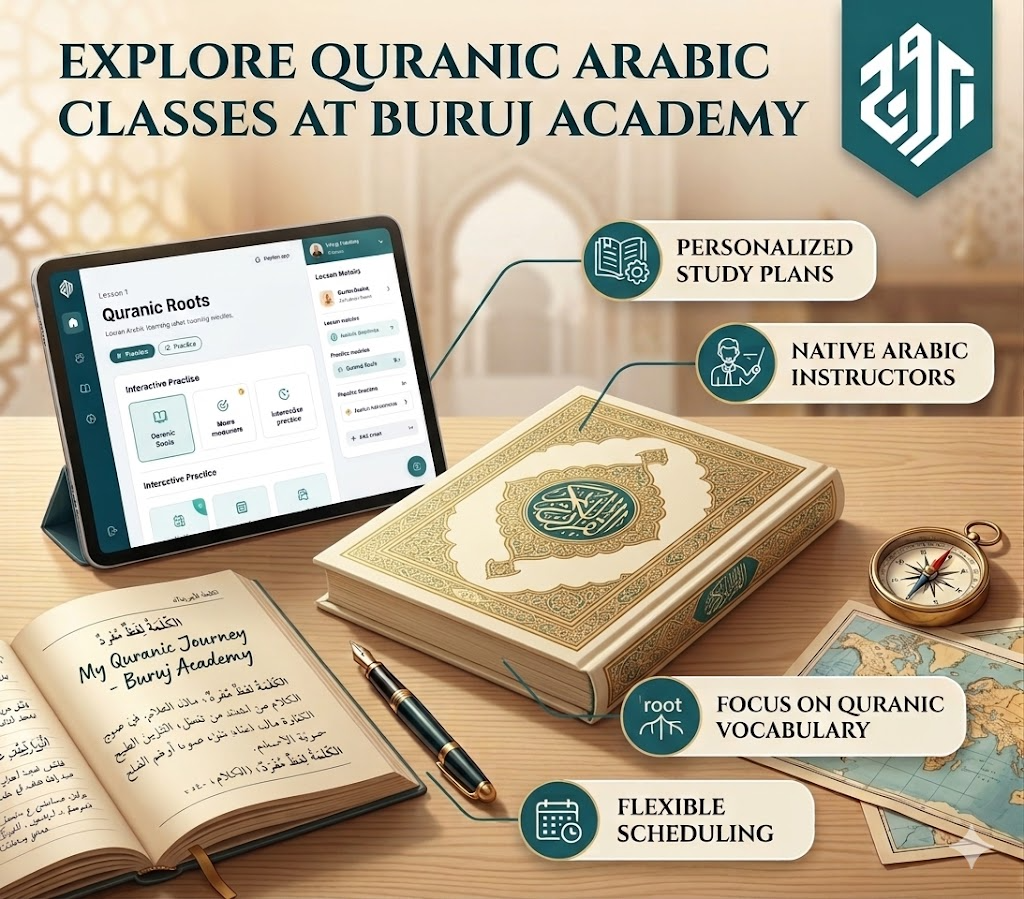
Buruj Academy’s expert team — Al-Azhar University graduates and Ijazah-certified instructors with 12+ years teaching non-Arabic speakers — offers personalized 1-on-1 online sessions through the Buruj Method.
Whether you are beginning with our Quran Reading Course or deepening your understanding through our Quranic Arabic course, every step is guided by qualified instructors with real teaching experience.
Flexible scheduling, real-time feedback, and structured progression from beginner to advanced — all in one place.
Book your free trial lesson today and begin reading the Quran the way it was meant to be read.
Excel in Your Quranic Studies
Join Buruj Academy and master the Quran with our structured, professional curriculum.
Book Your Free TrialConclusion
The Quran was not revealed as a science textbook — it was revealed as divine guidance. Yet the precision with which it describes embryology, oceanography, cosmology, geology, and human biology continues to reward careful, informed study.
Each of these Quranic scientific miracles emerged from a text transmitted faithfully for over 1,400 years without alteration — the same Quran recited in homes and masajid around the world today.
Engaging with these verses in their original Arabic deepens the experience immeasurably. The more accurately you read and understand the Quran, the more these layers of meaning open up — SubhanAllah.
Frequently Asked Questions About Quranic Miracles and Science
Does the Quran Claim to Be a Science Book?
The Quran does not present itself as a scientific manual. Its primary purpose is guidance for humanity in worship, ethics, law, and spiritual development. The scientific accuracy found within it is understood by Muslims as evidence of divine origin — signs (ayāt) embedded in a book whose primary focus lies elsewhere. Science confirms what the Quran mentions; the Quran does not exist to confirm science.
Which Quranic Verses About Science Are Most Cited by Researchers?
The embryology verses in Surah Al-Mu’minun (23:12–14), the expanding universe verse in Surah Adh-Dhariyat (51:47), and the oceanography verses in Surah Ar-Rahman (55:19–20) are most frequently cited in academic and comparative discussions. The skin-pain verse in Surah An-Nisa’ (4:56) is increasingly referenced in medical literature discussions.
How Can I Study the Quran More Deeply to Understand These Verses?
Understanding Quranic verses in their original Arabic — including the precise vocabulary that carries scientific implications — requires structured Quranic Arabic study alongside accurate recitation. Our benefits of memorizing Quran article explains how deep Quranic engagement builds knowledge from multiple directions simultaneously. Combining recitation, memorization, and Arabic comprehension creates the fullest possible connection with the text.