 Quran
Quran
| Key Takeaways |
| The Quran has one preserved Arabic text — but it is recited through ten authenticated recitation traditions called the Ten Qira’at. |
| All Ten Qira’at trace back to the Prophet Muhammad ﷺ through unbroken chains of transmission, making each equally valid and authentic. |
| The most widely recited version globally is Hafs ‘an ‘Asim, followed by Warsh ‘an Nafi’, which is prevalent across North and West Africa. |
| Differences between Qira’at involve vowelization, pronunciation, and elongation — never differences in core meaning or theological content. |
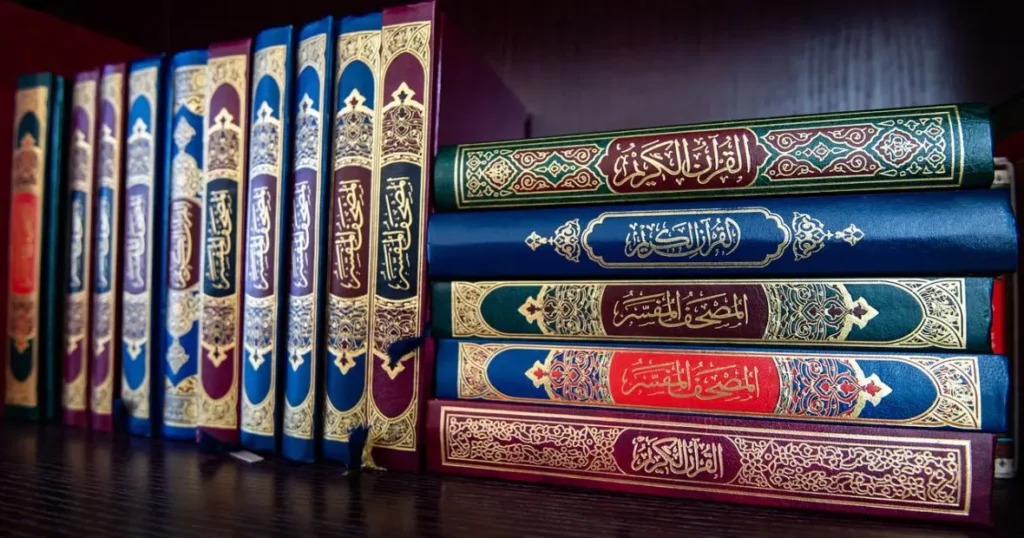
| Printed Mushafs are produced according to specific Qira’at, which is why Arabic Qurans can look slightly different depending on region. |
When students first encounter a Quran printed with unfamiliar vowel markings — or hear a reciter whose pronunciation sounds distinctly different — a natural question arises: are there multiple versions of the Quran in Arabic? It is a question we hear regularly at Buruj Academy, and it deserves a precise, grounded answer.
There is one Quran. Its Arabic text has been preserved with extraordinary precision since the time of the Prophet Muhammad ﷺ. What varies are the authenticated Qira’at — recitation traditions — each transmitted through verified chains of scholarship, representing legitimate variations in pronunciation, vowelization, and recitation rules, all of which were taught by the Prophet himself.
Table of Contents:
How Many Arabic Versions of the Quran Are There?
The Quran exists in one Arabic text, recited through ten authenticated Qira’at (recitation traditions), each traceable to the Prophet Muhammad ﷺ through continuous chains of transmission (Sanad). These are not different versions in the sense of different editions or translations — they are distinct recitation systems, each with its own rules of pronunciation, vowelization, and Tajweed application, all preserved with rigorous scholarly verification across centuries of Islamic scholarship.
The ten Qira’at are named after the seven primary Imams of recitation (the Qurra’ al-Sab’a) plus three additional Imams recognized by classical scholars. Each Imam has two narrators, producing twenty sub-narrations in total.
The ten Qira’at themselves are all classified as Mutawatir — transmitted by so many scholars in each generation that fabrication is impossible.
What Makes a Qira’ah Authentic?
Classical Tajweed scholarship established three conditions for a Qira’ah to be considered authentic.
First, it must agree with the Arabic language grammatically.
Second, it must conform to the Uthmani Mushaf’s written skeleton (rasm).
Third, and most decisively, it must be transmitted through a continuous, unbroken Sanad reaching back to the Prophet ﷺ.
Any recitation tradition meeting all three conditions is accepted as a valid, authentic Qira’ah.
What Are the Ten Qira’at and Their Narrators?
The ten authenticated Qira’at, along with their primary narrators, are documented by Imam Ibn al-Jazari in his foundational work Al-Nashr fi al-Qira’at al-‘Ashr. Each Qira’ah carries the name of its founding Imam and is transmitted through two narrators.
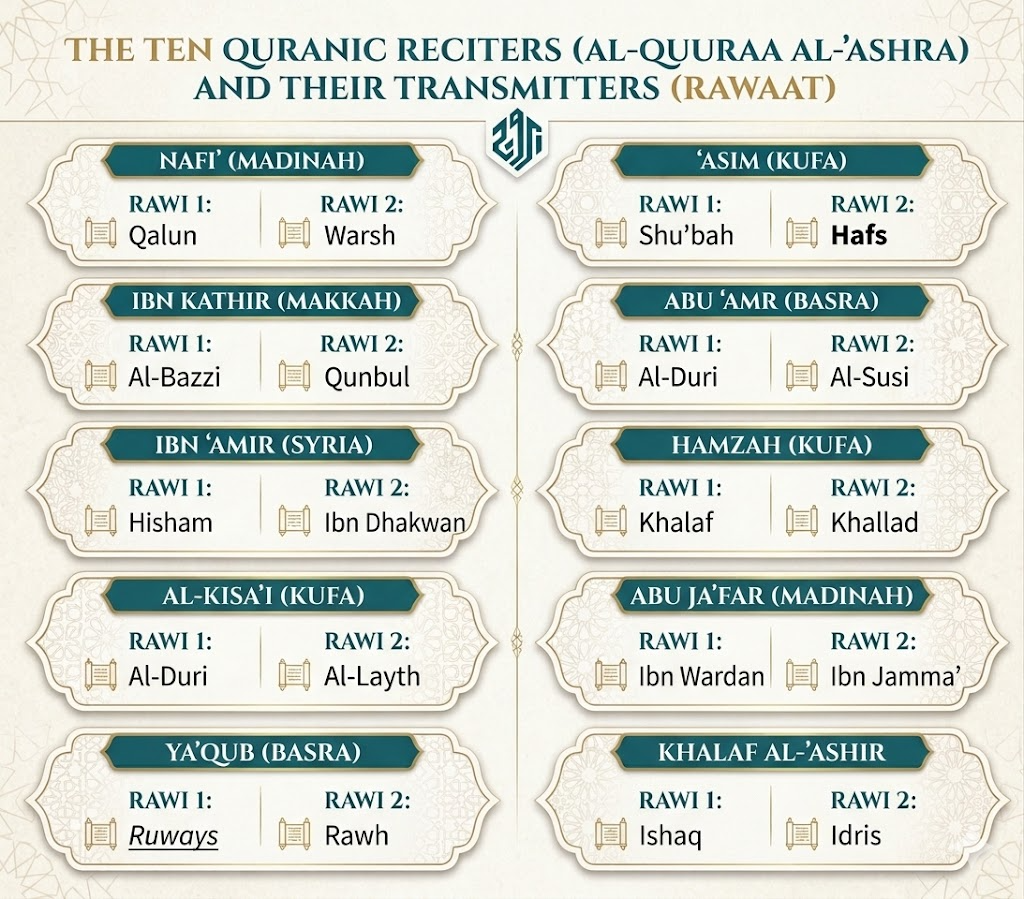
Each of these narrations represents a fully preserved recitation system — not a variant text, but a distinct pronunciation and Tajweed tradition.
At Buruj Academy, our Online Qirat Course connects students with Ijazah-certified instructors who hold authenticated chains of transmission in multiple Qirat.
Book your FREE trial lesson in your path to reciting with Qiraat

What Is the Difference Between the Qira’at in Practice?
The differences between Qira’at are precise, rule-governed, and never affect theological meaning. They involve variations in vowelization (harakat), the length of Madd (elongation), specific letter pronunciations, and rules around pausing (Waqf) and beginning (Ibtida’). Understanding this distinction is essential for any student studying Tajweed rules.
Excel in Your Quranic Studies
Join Buruj Academy and master the Quran with our structured, professional curriculum.
Book Your Free Trial| Category of Difference | Example |
| Vowelization (Harakat) | A word read with Fathah in Hafs may carry Kasrah in Warsh |
| Madd lengths | Elongation counts differ between narrations for specific Madd types |
| Hamzah pronunciation | Hamzah handling varies significantly between Hafs and Warsh |
| Ra’ pronunciation (Tafkhim/Tarqiq) | Warsh applies Tarqiq (lightening) to Ra’ in more positions than Hafs |
These differences are studied systematically in advanced Tajweed. Students exploring the foundations of these rules can read our guide on Makharij al-Huruf to understand how articulation points interact with these variations.
At Buruj Academy, our Online Tajweed Classes for Beginners teach the Hafs ‘an ‘Asim narration, which is the globally standard recitation used by the majority of Muslims worldwide. Our Ijazah-certified instructors and Al-Azhar University graduates ensure students learn with proper Sanad-backed instruction from day one.
Book Your FREE Trial Lesson to Begin Your Tajweed Journey
Read also: All 55 Names of the Holy Quran in Arabic
What Is the Most Widely Used Arabic Version of the Quran?
Hafs ‘an ‘Asim is the dominant recitation globally, used by the vast majority of Muslims across the Middle East, South Asia, Southeast Asia, the West, and increasingly across Africa. The King Fahd Complex for the Printing of the Holy Quran in Madinah prints its Mushafs primarily in the Hafs narration, which has accelerated its global reach significantly over the past century.
Warsh ‘an Nafi’ is the second most widely used narration, predominant across North Africa and West Africa. Students traveling between these regions sometimes encounter recitations that sound noticeably different — particularly in the handling of Hamzah and the Ra’ — which can cause initial confusion until they understand the Qira’at system.
In our sessions at Buruj Academy, we frequently work with students from Moroccan and West African backgrounds who grew up hearing Warsh and then encounter Hafs when studying with us.
The transition requires careful ear-training, which is precisely why our Buruj Method emphasizes sound-before-rules: training the ear to recognize what is correct before introducing theoretical explanations.
Discover the Buruj Academy Difference
Step into our virtual classrooms and see how our expert instructors make learning Quran and Arabic intuitive and clear. We focus on overcoming the specific hurdles non-native speakers face, building your confidence and connection with the Quran.
Are the Different Qira’at All Equally Valid?
Yes — all ten Qira’at are equally valid, equally authentic, and equally the word of Allah. This is a point of scholarly consensus (Ijma’) among Muslim scholars throughout Islamic history. The Prophet Muhammad ﷺ taught recitation variations to different companions, and those companions transmitted them to their students across different regions of the early Muslim world.
The Hadith recorded in Sahih al-Bukhari establishes that the Quran was revealed in seven Ahruf (modes), a narration that classical scholars have connected to the breadth of the Qira’at tradition.
Scholars of Quranic sciences have written extensively on the relationship between the seven Ahruf and the ten Qira’at — a nuanced academic discussion that confirms the divine authorization of the variation.
Students who want to begin reciting with proper foundations should read our guide on reading the Quran for the first time, which addresses how to approach recitation as a beginner before advancing to the study of Qira’at.
Start Reciting with Authentic Guidance at Buruj Academy
Understanding the Qira’at is one dimension of Quranic knowledge — reciting with accuracy is where that knowledge becomes worship.
Buruj Academy’s Online Tajweed Classes provide structured, certified instruction in the Hafs ‘an ‘Asim narration — the globally standard recitation — taught by Al-Azhar University graduates and Ijazah-certified instructors with 12+ years of experience teaching non-Arabic speakers.
Our Buruj Method trains your ear before introducing rules, ensuring what you learn is applied — not just memorized.
Sessions are 1-on-1, flexible, and personalized to your level. Book your free trial lesson and recite with confidence, clarity, and proper transmission.
Take the next step in your learning journey today by enrolling in one of our specialized programs:
- Online Quran Classes
- Online Quran Classes for Beginners
- Online Quran Classes for Adults
- Online Quran Classes for Ladies
- Online Quran Classes for Kids
- Quran Reading Course
- Quran Recitation Course
- Online Ijazah Course
- Online Qirat Course
Don’t wait to transform your relationship with the Holy Quran. Join our global community of students and book your free evaluation session now!
Excel in Your Quranic Studies
Join Buruj Academy and master the Quran with our structured, professional curriculum.
Book Your Free TrialRead also: Top 9 Proven Quranic Miracles
Conclusion
The Quran is one book, preserved in one Arabic text — yet recited through ten authenticated traditions that represent the fullness of what the Prophet Muhammad ﷺ taught. The question of how many Arabic versions of the Quran exist is best answered not with a number alone, but with an understanding of what the Qira’at system truly represents: a living, verified, scholarly transmission of divine speech across generations.
What matters practically for most students is mastering one narration — typically Hafs ‘an ‘Asim — with proper Tajweed and accurate pronunciation. That mastery, built on sound foundations, is the gateway to everything deeper in Quranic study. Insha’Allah, may Allah make that path clear and easy for every student.
Frequently Asked Questions About the Arabic Versions of the Quran
Is There More Than One Arabic Quran?
There is one Arabic Quran. The Quranic text has a single preserved consonantal skeleton (rasm) established by Sayyiduna ‘Uthman ibn ‘Affan. What exists in multiple forms are the ten authenticated Qira’at — recitation traditions varying in pronunciation, vowelization, and Tajweed application — all equally valid and traceable to the Prophet Muhammad ﷺ through verified scholarly chains.
What Is the Difference Between Hafs and Warsh?
Hafs ‘an ‘Asim and Warsh ‘an Nafi’ are two narrations of the Quran from different recitation Imams. Their differences include Ra’ pronunciation, Hamzah handling, and specific Madd lengths. Hafs is dominant globally; Warsh is prevalent in North and West Africa. Neither is more correct — both are fully authenticated Mutawatir recitations taught by the Prophet ﷺ.
Why Do Some Arabic Qurans Look Different?
Printed Mushafs differ in their vowel markings (tashkeel) because they are typeset according to different Qira’at. A Mushaf in the Hafs narration carries different vowel marks than one in the Warsh narration. The underlying Arabic letters, however, follow the same Uthmani rasm. The visual difference reflects pronunciation tradition, not a different text or meaning.
How Many Qira’at Are There in Total?
There are ten authenticated Qira’at, each named after a founding Imam and transmitted through two narrators — producing twenty distinct sub-narrations. Classical scholars, particularly Imam Ibn al-Jazari, documented all ten in detail. Seven of the ten (the Qurra’ al-Sab’a) are most widely known; the remaining three are equally valid but less commonly studied outside specialist scholarship.
Does Learning a Different Qira’ah Change the Meaning of the Quran?
No. The differences between Qira’at never alter the theological meaning or core content of any verse. Variations are strictly phonological and recitation-based — affecting pronunciation, elongation, and vowelization, not doctrinal content. Classical scholars have confirmed this through centuries of Quranic sciences scholarship. Each Qira’ah conveys the same divine message through a distinct, authenticated recitation mode.