 Quran
Quran
| Key Takeaways |
| The Quran has 10 mutawatir (mass-transmitted) recitations, each traced through an unbroken chain back to the Prophet ﷺ. |
| The 7 Qira’at were codified by Imam Ibn Mujahid in the 4th century AH to standardize authentic recitation across the Muslim world. |
| Each Qira’at is named after an Imam and transmitted through two primary narrators called Rawis, giving 14 major narrations total. |
| Hafs ‘an ‘Asim is the most widely used recitation globally, while Warsh ‘an Nafi’ dominates North and West Africa. |
| All 10 Qira’at are equally valid and Quranically authentic — differences lie in pronunciation, voweling, and rules, not meaning. |
When Muslims across the world recite the same Quran, they may sound noticeably different from one another — and both are perfectly correct. This is not inconsistency. It is one of the most profound signs of the Quran’s divine preservation.
The 7 types of recitation of the Quran — known as the Qira’at — are distinct, authenticated systems of Quranic recitation, each transmitted through an unbroken chain of reliable scholars back to the Prophet Muhammad ﷺ. Together with three additional recitations, they form the 10 mutawatir Qira’at that represent the full scope of how the Quran was revealed and preserved.
Table of Contents:
What Are the 7 Types of Recitation of the Quran?
The 7 types of Quranic recitation are seven authenticated systems — each named after a leading Imam — through which the Quran was orally transmitted from the Prophet ﷺ to the Muslim Ummah.
These 7 types of Quranic recitation are not different versions of the Quran. They are different, equally valid ways of pronouncing, vocalizing, and applying Tajweed rules to the same divine text.
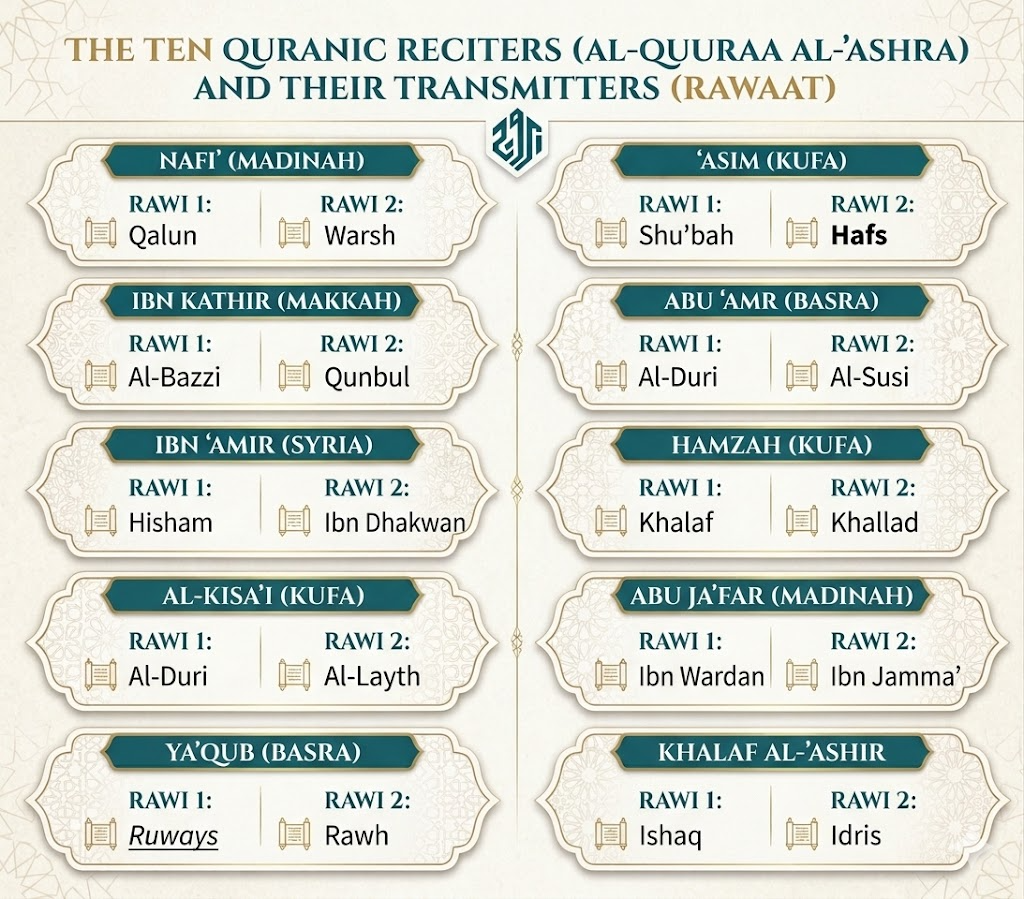
Each of the seven Imams mastered his recitation through direct oral transmission. Each then passed his recitation to two primary students called Rawis (narrators), giving the tradition both preservation and redundancy. This system produced 14 widely recognized narrations from the 7 core Imams.
The differences between the Qira’at include variations in Madd (elongation) lengths, Idgham (assimilation) patterns, Hamzah pronunciation, Imalah (vowel inclination), and occasionally in vowel marking — but never in the core meaning of the text.
At Buruj Academy, our Online Qirat Course connects students with Ijazah-certified instructors who hold authenticated chains of transmission in multiple Qirat.
Book your FREE trial lesson in your path to reciting with Qiraat

Why Were the 7 Qira’at Specifically Formalized?
The 7 Qira’at were specifically formalized by the great scholar Imam Abu Bakr Ibn Mujahid al-Baghdadi (died 324 AH) in his foundational work Kitab al-Sab’ah. Before him, authentic recitations had multiplied across the Muslim world to nearly 50 documented systems, creating a risk of confusion between sound and weak narrations.
Ibn Mujahid selected precisely seven Imams — matching the number of ahruf (modes) mentioned in established hadith literature — to provide the Muslim Ummah with a reliable, bounded set of authenticated recitations.
This was not a theological decree that only seven existed, but a scholarly act of standardization.
It is critical to understand that Ibn Mujahid’s selection of seven did not invalidate the remaining authentic recitations.
The full 10 Qira’at were later documented and systematized, most definitively by Imam Ibn al-Jazari (died 833 AH) in his masterwork An-Nashr fi al-Qira’at al-‘Ashr.
The Prophet ﷺ himself confirmed the legitimacy of multiple recitation modes, as recorded in Sahih al-Bukhari:5041:
“This Quran has been revealed in seven ahruf, so recite from it whichever is easy for you.”
The Complete List of the 7 Qira’at and Their Rawis
The seven Imams of the Qira’at represent different major Islamic cities, reflecting the Quran’s spread across the early Muslim world. Each Imam’s recitation is identified by his name, and his two primary Rawis give us the specific narrations studied today.
| # | Imam (Recitation) | City | Rawi 1 | Rawi 2 |
| 1 | Nafi’ al-Madani | Madinah | Qalun | Warsh |
| 2 | Ibn Kathir al-Makki | Makkah | Al-Bazzi | Qunbul |
| 3 | Abu ‘Amr al-Basri | Basra | Al-Duri | Al-Susi |
| 4 | Ibn ‘Amir al-Dimashqi | Damascus | Hisham | Ibn Dhakwan |
| 5 | ‘Asim al-Kufi | Kufa | Shu’bah | Hafs |
| 6 | Hamzah al-Kufi | Kufa | Khalaf | Khallad |
| 7 | Al-Kisa’i al-Kufi | Kufa | Abu al-Harith | Al-Duri |
Each narration represents a complete, internally consistent system of recitation rules. When we at Buruj Academy teach Tajweed, we teach within the narration of Hafs ‘an ‘Asim — the most widely used recitation globally — but our Al-Azhar-trained instructors understand all 10 Qira’at in depth.
Our instructors are highly skilled in guiding non-Arabic speakers of all ages, whether you are just starting or are working toward the Online Ijazah Course.
Book your FREE trial lesson in your path to Ijazah
The 3 Additional Qira’at That Complete the 10
Beyond the famous seven, Islamic scholarship recognizes three additional authentic recitations that complete the mutawatir ten.
These were systematized primarily by Ibn al-Jazari and are studied through the classical texts Ad-Durrah (for the additional three) and At-Tayyibah (for all ten).
| # | Imam | City | Rawi 1 | Rawi 2 |
| 8 | Abu Ja’far al-Madani | Madinah | Ibn Wardan | Ibn Jummaz |
| 9 | Ya’qub al-Basri | Basra | Ruways | Rawh |
| 10 | Khalaf al-‘Ashir | Baghdad | Ishaq | Idris |
It is worth noting that Khalaf al-‘Ashir (the 10th Imam) is distinct from Khalaf the Rawi of Hamzah (the 6th Imam), though they are the same person. As a Rawi, his narration is called a riwayah; as an independent Imam, his system constitutes an independent qira’ah.
A Brief Profile of Each of the 7 Qira’at Imams
Here is a brief profile of the seven Imams of the Qira’at, who were the leading recitation authorities in major early Islamic cities.
Each Imam established their system of recitation based on direct oral transmission from earlier scholars and Companions of the Prophet ﷺ.
1. What Is the Recitation of Nafi’ al-Madani?
Nafi’ al-Madani (died 199 AH) studied under 70 of the Tabi’in in Madinah, including Abu Ja’far Yazid ibn al-Qa’qa’, who himself learned from Abu Hurayrah and Ibn ‘Abbas.
His recitation is the most geographically widespread in the Arab world today, used across Tunisia, Algeria, Morocco, Libya, and parts of West Africa — through his two Rawis, Qalun and Warsh.
2. What Is the Recitation of Ibn Kathir al-Makki?
Ibn Kathir al-Makki (died 120 AH) was born in Makkah in the year 45 AH and studied under companions of the Prophet ﷺ, including ‘Abdullah ibn al-Sa’ib al-Makhzumi.
His chain connects directly to the Prophet ﷺ with near-immediate transmission. His recitation is transmitted today through Al-Bazzi and Qunbul.
3. What Is the Recitation of Abu ‘Amr al-Basri?
Abu ‘Amr ibn al-‘Ala’ al-Basri (died 154 AH) was born in Makkah and raised in Basra. He studied under Abu Ja’far and others with connected chains to the Prophet ﷺ. His recitation is transmitted through Al-Duri and Al-Susi, and it remains in use in parts of Sudan.
4. What Is the Recitation of Ibn ‘Amir al-Dimashqi?
‘Abdullah ibn ‘Amir al-Yahsubi (died 110 AH) was born in 8 AH and became the leading recitation authority of Syria.
He led prayer at the Umayyad Mosque in Damascus for many years during the era of ‘Umar ibn ‘Abd al-‘Aziz. His recitation reaches us through Hisham and Ibn Dhakwan.
Read also: Best Quran Reciters to Learn Quran
5. What Is the Recitation of ‘Asim al-Kufi?
‘Asim ibn Abi al-Najud al-Kufi (died 127 AH) studied under Zirr ibn Hubaysh and Abu ‘Abd al-Rahman al-Sulami, who both learned from Ibn Mas’ud, ‘Ali ibn Abi Talib, ‘Uthman ibn ‘Affan, Ubayy ibn Ka’b, and Zayd ibn Thabit (may Allah be pleased with them all).
His recitation through Hafs is the dominant recitation used across the Muslim world today.
6. What Is the Recitation of Hamzah al-Kufi?
Hamzah ibn Habib al-Kufi (died 156 AH) was born in the year 80 AH and died in Hulwan. His recitation is known for distinct rules around Hamzah pronunciation and long Madd extensions, transmitted through Khalaf and Khallad.
7. What Is the Recitation of Al-Kisa’i al-Kufi?
‘Ali ibn Hamzah al-Kisa’i (died 189 AH) was a leading scholar of both Qira’at and Arabic grammar. His recitation is transmitted through Abu al-Harith and Al-Duri — notably, Al-Duri also narrated from Abu ‘Amr al-Basri, making him a shared Rawi between two Imams.
Excel in Your Quranic Studies
Join Buruj Academy and master the Quran with our structured, professional curriculum.
Book Your Free TrialHow Are the 7 Qira’at Different from Each Other?
The Qira’at differ in specific, rule-governed ways — never arbitrarily. Students pursuing deeper study through our Online Tajweed Classes will encounter these distinctions systematically. The main categories of difference include the following areas.
| Category of Difference | Example |
| Madd (elongation) lengths | Warsh extends certain Madds to 6 counts; Hafs uses 4–5 |
| Imalah (vowel inclination) | Al-Kisa’i uses Imalah where Hafs does not |
| Hamzah handling | Hamzah’s recitation has specific rules for moving Hamzah |
| Sukun and vowel markings | Occasional differences in short vowels on specific words |
| Sakt (brief pause) | Hafs includes specific Sakt positions not found in other narrations |
These differences reflect the seven ahruf — the multiple valid modes — in which the Quran was revealed as a mercy to facilitate recitation across different Arab tribes.
Every difference between the Qira’at falls within the Arabic script of the ‘Uthmanic Mushaf and was transmitted through verified oral chains.
In our sessions at Buruj Academy, students regularly ask whether learning Hafs means they are missing something from the other Qira’at. The answer is no — Hafs ‘an ‘Asim is a complete, perfectly preserved recitation system.
Exploring other Qira’at is a blessed pursuit for advanced students, but it is never a prerequisite for sound Tajweed or valid recitation. If you are beginning your Tajweed path, our Tajweed for Beginners course is the ideal starting point.
Book Your FREE Trial Lesson to Begin Your Tajweed Journey
Discover the Buruj Academy Difference
Step into our virtual classrooms and see how our expert instructors make learning Quran and Arabic intuitive and clear. We focus on overcoming the specific hurdles non-native speakers face, building your confidence and connection with the Quran.
Which Recitations Are Used in the Muslim World Today?
The geographic distribution of Qira’at today directly reflects historical scholarship centers and transmission routes. Ibn ‘Ashur noted in At-Tahrir wa al-Tanwir that the predominant recitations in use across the Muslim world are as follows.
| Region | Recitation Used |
| Most of the Muslim world (Middle East, South Asia, Southeast Asia, Turkey) | Hafs ‘an ‘Asim |
| Algeria, Morocco, Mauritania, and parts of West Africa | Warsh ‘an Nafi’ |
| Tunisia and parts of Libya | Qalun ‘an Nafi’ (some regions use Warsh) |
| Parts of Sudan | Abu ‘Amr al-Basri (reported by Ibn ‘Ashur) |
| Some communities in the Arabian Peninsula | Warsh or Qalun alongside Hafs |
This distribution explains why a Moroccan reciter and a Pakistani reciter — both reading the authentic Quran — may sound distinctly different in their Madd lengths and vowel tendencies. Both are correct. Both are reciting the preserved Word of Allah.
For non-Arabic speakers beginning their Quranic reading, we recommend starting with the Online Quran Recitation Course at Buruj Academy, which establishes proper foundational skills before exploring the nuances of different Qira’at.
Book your first FREE recitation lesson
What Are the Classical Texts That Codify the Qira’at?
The scholarship of Qira’at is organized through several foundational texts that every serious student of this science should know.
Ash-Shatibiyyah — composed by Imam al-Qasim ibn Firruh al-Shatibi (died 590 AH) — is a poem of 1,173 lines encoding the 7 Qira’at. It remains the primary text studied by students of the seven recitations globally.
Ad-Durrah al-Mudiyyah — composed by Imam Ibn al-Jazari — encodes the 3 additional Qira’at (Imams 8, 9, and 10) as a supplement to the Shatibiyyah.
At-Tayyibah an-Nashr — also by Ibn al-Jazari — is a more advanced poem encoding all 10 Qira’at within a single comprehensive system.
At-Taysir — by Imam Abu ‘Amr ‘Uthman ibn Sa’id al-Dani (died in the 5th century AH) — was the foundational prose reference that the Shatibiyyah later versified. Al-Dani’s work was a milestone in making the 7 Qira’at systematically accessible to students.
Understanding these texts — even at a surface level — helps students appreciate that the Qira’at are not informal traditions.
They are a rigorously documented science with centuries of scholarship behind them. You can explore the foundations of this science through our reading the Quran for the first time guide or deepen your Tajweed knowledge through our essential guide to Tajweed rules.
Read also: How to Recite the Quran with Qirat?
What Is the Difference Between a Qira’ah and a Riwayah?
A Qira’ah (recitation) is attributed to the Imam — the senior authority who mastered and transmitted that system. A Riwayah (narration) is attributed to the Rawi — the student who narrated directly from the Imam.
So we say: Qira’at ‘Asim bi-riwayat Hafs — the recitation of ‘Asim as narrated by Hafs. The Qira’ah is the system; the Riwayah is the specific transmission.
This distinction matters because two Rawis of the same Imam may differ in minor points, giving us distinct narrations within the same Qira’ah.
This layered transmission structure is precisely what makes the Qira’at the most rigorously preserved oral literature in human history.
Master the Quran with Buruj Academy’s Expert Qira’at Instructors
Every authentic recitation of the Quran deserves to be learned correctly — with precision, reverence, and expert guidance.
At Buruj Academy, our Ijazah-certified instructors and Al-Azhar University graduates teach Quranic recitation through verified chains of transmission, helping students worldwide build sound, beautiful Tajweed.
Our Online Qirat Course provides structured, personalized 1-on-1 instruction using the Buruj Method.
Whether you are beginning your Quranic path or pursuing the Online Ijazah Course, our instructors are experienced in teaching non-Arabic speakers across all levels and age groups.
Flexible scheduling, real-time correction, and personalized learning plans make progress consistent and measurable.
Book your free trial lesson today and recite with confidence.
Take the next step in your learning journey today by enrolling in one of our specialized programs:
- Online Quran Classes
- Online Quran Classes for Beginners
- Online Quran Classes for Adults
- Online Quran Classes for Ladies
- Online Quran Classes for Kids
- Quran Reading Course
- Quran Recitation Course
- Online Ijazah Course
- Online Qirat Course
Don’t wait to transform your relationship with the Holy Quran. Join our global community of students and book your free evaluation session now!
Excel in Your Quranic Studies
Join Buruj Academy and master the Quran with our structured, professional curriculum.
Book Your Free TrialConclusion
The 7 types of recitation of the Quran — and the 10 mutawatir Qira’at as a whole — represent one of Islam’s most extraordinary intellectual and spiritual achievements.
Centuries of meticulous scholarship, oral transmission, and devoted preservation have ensured that the Quran reaches us today exactly as it reached the Companions ﷺ.
Understanding the Qira’at is not merely academic. It deepens a Muslim’s awe of the Quran’s preservation and enriches their connection to its recitation. Whether you recite Hafs, Warsh, or Qalun, you are participating in a living chain that extends back to the Prophet ﷺ himself — and that is a remarkable blessing.
Frequently Asked Questions About the 7 Types of Recitation of the Quran
Are the 7 Types of Quranic Recitation Different Versions of the Quran?
No. The 7 Qira’at are not different versions of the Quran — they are different authenticated systems of pronunciation, voweling, and Tajweed application for the same divine text. Every Qira’ah conforms to the ‘Uthmanic Mushaf and was transmitted through verified, unbroken chains back to the Prophet ﷺ. The core meaning of the Quran is identical across all recitations.
What Is the Difference Between the 7 Qira’at and the 10 Qira’at?
The 7 Qira’at were formalized by Ibn Mujahid in the 4th century AH to standardize authentic recitation. The 10 Qira’at include three additional mutawatir recitations — Abu Ja’far, Ya’qub, and Khalaf al-‘Ashir — systematized primarily by Ibn al-Jazari. All 10 are equally authentic and mutawatir; the distinction is historical, not theological.
Which of the 7 Types of Recitation Is Most Widely Used Today?
Hafs ‘an ‘Asim is the most widely used Qira’at globally, dominant across the Middle East, South Asia, Southeast Asia, Turkey, and most English-speaking Muslim communities. Warsh ‘an Nafi’ is the primary recitation across North and West Africa. Qalun ‘an Nafi’ is used in parts of Tunisia and Libya.
Can a Muslim Recite the Quran Using Any of the 7 Qira’at?
Yes. Any of the 10 mutawatir Qira’at is valid for recitation in prayer and daily reading. The condition is that the recitation must be learned correctly through proper instruction — not mixed informally between narrations. Each Qira’at is a complete, internally consistent system that must be applied as a whole, not selectively combined with elements of another.
How Are the Qira’at Relevant to Learning Tajweed Today?
Most Tajweed students — especially non-Arabic speakers — learn Tajweed within the narration of Hafs ‘an ‘Asim, which is the basis for standard Tajweed curricula globally. Studying the other Qira’at is a higher-level pursuit, typically after mastering Tajweed in Hafs. You can build that foundation through our Tajweed for beginners guide and explore deeper rules through resources on Idgham and Ikhfa letters.