 Quran
Quran
| Key Takeaways |
| Learning to read the Quran begins with mastering Arabic letters and their sounds before attempting connected words or full verses. |
| Noorani Qaida is the most structured and widely recommended method for complete beginners starting Quran reading from zero. |
| Consistent daily practice of 20–30 minutes produces measurably faster progress than longer, infrequent sessions for adult learners. |
| Tajweed rules govern correct Quran pronunciation; even basic rules must be introduced early to prevent deeply ingrained errors. |
| Learning with a qualified teacher — rather than apps alone — is essential for accurate pronunciation correction from the first lesson. |
Most non-Arabic speaking Muslims feel a profound pull toward the Quran yet face a very real barrier: they cannot read a single word of Arabic script. That gap between intention and ability is exactly where a structured, expert-guided learning path makes all the difference.
Learning to read the Quran is entirely achievable for any motivated adult, young learner, or new Muslim — when approached in the right sequence.
Table of Contents:
1. Learn the Arabic Alphabet Before Trying to Read the Quran
To learn to read the Quran, you must first master the 28 Arabic letters individually — their shapes, names, and sounds — before attempting to connect them into words. Skipping this foundation is the most common reason adult beginners plateau within weeks and develop reading habits that take months to correct.
Arabic letters behave differently from the Latin alphabet in two critical ways.
First, every letter changes shape depending on whether it appears at the beginning, middle, or end of a word.
Second, Arabic is written right to left, which requires a genuine mental adjustment for English speakers.
Buruj’s Azhari Quran tutors consistently observe that students who rush past isolated letter recognition struggle significantly when letters connect in Quranic words.
Book a FREE trial session with one of Buruj’s Azhari Quran tutors

How Long Does It Take to Learn the Arabic Alphabet?
Most motivated adult beginners at Buruj Academy reach confident letter recognition within 2–3 weeks of daily 20-minute sessions.
Children aged 6–10 often achieve the same milestone in 3–4 weeks with shorter, more playful sessions. The variance depends primarily on consistency, not natural ability.
| Letter Group | Examples | Distinguishing Feature |
| Dotless letters | ا، و، م | Shape alone identifies them |
| Single-dot letters | ب، ن، ز | Dot position (above/below) is critical |
| Multi-dot letters | ث، ش، ق | Dot count distinguishes similar shapes |
| Connector vs. non-connector | Most letters vs. و، ر، ز | Affects word shape significantly |
A useful starting resource for parents introducing children to letter recognition is our guide on Tajweed rules for kids, which covers foundational sound patterns in an age-appropriate format.
2. Begin Noorani Qaida to Build Correct Sound Foundations
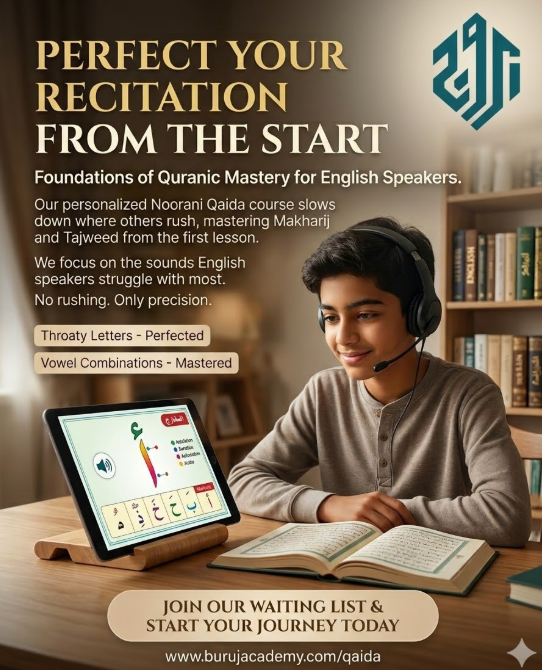
Once you recognize isolated letters, Noorani Qaida is the structured method that bridges letter recognition and actual Quran reading.
Noorani Qaida introduces vowel marks (harakat), letter combinations, and sound patterns in a carefully sequenced progression specifically designed for non-Arabic speakers learning to read Quran.
Buruj Academy’s Noorani Qaida Online Course guides complete beginners through this foundational system with qualified teachers who understand the phonetic challenges native English speakers face.
The Qaida’s genius lies in its sequence: it never introduces a new concept until the student has fully internalized the previous one — a principle our instructors follow rigorously.
Book your FREE trial lesson in the Noorani Qaida course
What Does Noorani Qaida Teach?
The Qaida covers seven core areas in sequence:
| Stage | Content | Purpose |
| 1 | Isolated letters with names | Recognition and recall |
| 2 | Letters with short vowels (Fatha, Kasra, Damma) | Basic sound production |
| 3 | Letters with Sukoon (vowelless) | Reading consonant clusters |
| 4 | Tanween (double vowel endings) | Word-ending accuracy |
| 5 | Madd letters (elongation) | Stretching sounds correctly |
| 6 | Shaddah (doubled letters) | Emphasis and stress |
| 7 | Combined practice words | Pre-Quran reading readiness |
In our sessions, the most revealing moment is Stage 3 — Sukoon. Students who have only learned voweled letters suddenly encounter vowel-less consonants and freeze.
This is normal, and it is precisely why the Qaida must be taught by a live teacher who can model the correct sound in real time.
3. Master Short Vowels and Vowel Marks with Precision
Short vowels — Fatha (ـَ), Kasra (ـِ), and Damma (ـُ) — are the small diacritical marks written above and below Arabic letters that tell the reader how to pronounce each sound.
The Quran is written with these marks in full, which actually makes Quranic Arabic easier to read than most modern Arabic text.
Many beginners underestimate vowel precision. The difference between فَتَحَ (fataha — he opened) and فُتِحَ (futiha — it was opened) is carried entirely by the vowel marks. In Quran reading, a vowel error does not merely sound imprecise — it can alter meaning.
This is why our Ijazah-certified instructors introduce vowel drill exercises from the earliest lessons, not as theory but as practical sound production.
The Prophet Muhammad ﷺ said, as recorded in Sahih al-Bukhari:5027:
“The best among you are those who learn the Quran and teach it.”
This hadith has always reminded us at Buruj Academy that teaching Quran reading is not merely an educational task — it is an act of preserving something sacred, which demands precision from the very first vowel.
4. Learn to Connect Letters Into Words Using Proper Joining Rules
Arabic letters connect differently depending on their position in a word, and understanding these joining patterns is what transforms letter recognition into actual reading.
Approximately 22 of the 28 Arabic letters connect to the letter that follows them; 6 letters (called non-connectors: و، ر، ز، ذ، د، ا) never connect forward.
This step is where students begin reading their first real Arabic words — and it is tremendously motivating.
In our experience, students who reach this stage with solid vowel foundations progress significantly faster than those who arrived here with shaky letter recognition. The investment in Steps 1–3 pays off here directly.
A consistent observation from our instructors: students who practice handwriting connected letters — even briefly — internalize word shapes 40–50% faster than those who rely on reading alone. Writing reinforces the visual memory of letter forms in a way that reading passively cannot replicate.
Read also: Is Listening to the Quran the Same as Reading It?
5. Start Reading Short Quranic Surahs with Proper Guidance
Once connected-word reading feels manageable, beginning with Juz Amma — the 30th and final chapter of the Quran, containing the shortest surahs — is the standard and most effective approach.
These surahs are brief, frequently recited in Salah, and phonetically rich enough to reinforce everything learned in earlier steps.
If you are wondering what it feels like to open the Quran for the very first time, our detailed guide walks through the emotional and practical experience of that milestone with encouraging, step-by-step clarity.
Which Surahs Should Beginners Start With?
| Surah | Verses | Why Start Here |
| Al-Fatiha (1) | 7 | Recited in every prayer unit; essential |
| Al-Ikhlas (112) | 4 | Very short; reinforces Madd sounds |
| Al-Falaq (113) | 5 | Builds Sukoon and Tanween practice |
| An-Nas (114) | 6 | Reinforces Ghunnah and nasal sounds |
| Al-Kawthar (108) | 3 | Shortest surah; excellent first success |
Beginning with Al-Fatiha is non-negotiable. Every Muslim recites it in every unit of every prayer — making its correct reading both a spiritual obligation and the most immediately useful achievement in this entire learning process.
6. Introduce Basic Tajweed Rules to Protect Your Recitation
Tajweed is the science of reciting the Quran with the precise articulation and characteristics that each letter requires. It is not an optional refinement — the Quran itself commands in Surah Al-Muzzammil:
وَرَتِّلِ ٱلْقُرْءَانَ تَرْتِيلًا
Wa rattilil-Qur’āna tartīlā
“And recite the Quran with measured recitation.” (Al-Muzzammil 73:4)
Classical scholars of Tajweed, including Ibn al-Jazari in his famous poem Al-Muqaddimah, defined applying Tajweed as an obligation (fard ‘ayn) upon every Muslim who recites the Quran.
The three errors Tajweed protects against are: clear errors (lahn jali) that change meaning, subtle errors (lahn khafi) that violate letter characteristics, and rhythm errors that distort the natural flow of recitation.
For a structured entry into these rules, our guide on Tajweed for beginners maps out the foundational rules in the sequence our instructors teach them — sound recognition before rule memorization, always.
Excel in Your Quranic Studies
Join Buruj Academy and master the Quran with our structured, professional curriculum.
Book Your Free TrialWhich Tajweed Rules Should New Readers Learn First?
| Rule | What It Governs | Why It Comes First |
| Madd (elongation) | Vowel stretching to 2, 4, or 6 counts | Affects nearly every line of Quran |
| Ghunnah | Nasal resonance in Noon and Meem | Appears in most surahs constantly |
| Qalqalah | Echo on 5 specific letters when vowelless | Audibly obvious when missed |
| Ikhfa | Concealment before 15 specific letters | Very frequent in Quranic text |
Buruj Academy’s Tajweed for Beginners course applies the Buruj Method principle of sound-before-rules: students hear and produce the correct sound under instructor guidance before they ever see the rule written.
This approach prevents the most common Tajweed failure we observe — students who can recite every rule name yet cannot apply a single one correctly in live recitation.
Book Your FREE Trial Lesson to Begin Your Tajweed Journey
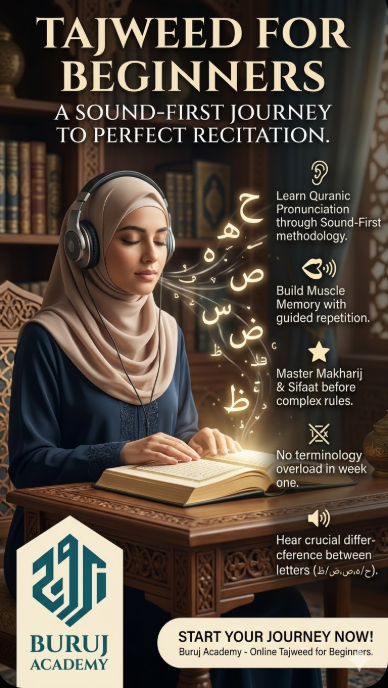
For a deeper understanding of specific rules that appear throughout the Quran, our articles on Ghunnah and its rules and Ikhfa letters in Tajweed provide rule-by-rule breakdowns with Quranic examples.
7. Build a Consistent Daily Practice Routine That Sustains Progress
To learn to read the Quran successfully, consistency matters far more than session length. Research in learning science — and our own observation across thousands of students — confirms that 20–30 minutes of daily focused practice produces faster, more durable progress than two-hour sessions twice per week.
The single most destructive habit we observe in adult self-learners is binge-and-pause cycles: intense practice for several days followed by multi-day breaks.
Arabic phonetic memory degrades rapidly without reinforcement. Letters become confused, sounds blur together, and students feel they are “starting over” after each gap.
Discover the Buruj Academy Difference
Step into our virtual classrooms and see how our expert instructors make learning Quran and Arabic intuitive and clear. We focus on overcoming the specific hurdles non-native speakers face, building your confidence and connection with the Quran.
A Practical Daily Practice Structure for Beginners
| Session Segment | Duration | Activity |
| Review | 5 minutes | Revisit yesterday’s lesson material |
| New learning | 10–15 minutes | Advance one concept or passage |
| Application | 5–10 minutes | Read from current Quran passage |
| Listening | 5 minutes | Listen to a Qari reciting same passage |
The listening component is one most self-learners skip and nearly all our instructors insist upon.
Training the ear alongside the tongue calibrates pronunciation in a way that reading alone never achieves.
We recommend listening to Sheikh Mahmoud Khalil Al-Husary‘s recitation — his Muallim (teaching) version with pauses is specifically designed for learners.
Read also: Best Quran Reciters to Learn Quran
How to Learn to Read the Quran Online?
Online Quran learning has become the most accessible and — when structured correctly — highly effective method for non-Arabic speakers worldwide. The key variables that determine online learning success are teacher qualification, lesson structure, and platform reliability.
Buruj Academy’s Quran Reading Course provides live 1-on-1 online sessions with Ijazah-certified instructors and Al-Azhar University graduates, using a structured curriculum that takes students from complete beginner to independent Quran reading.
Book your Free trial lesson and start reading the Quran
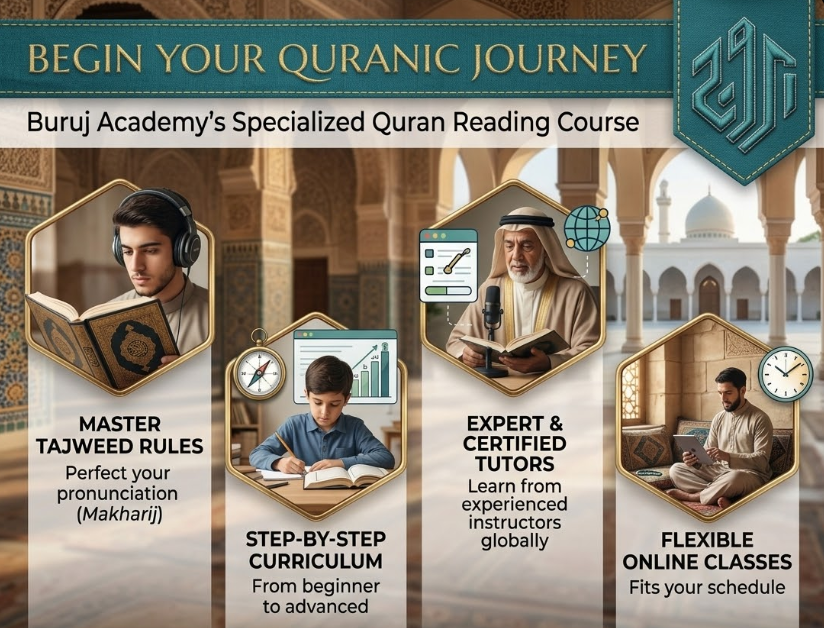
Flexible scheduling across all time zones makes it genuinely practical for working adults, parents, and students balancing multiple commitments.
When evaluating any online Quran learning platform, the non-negotiables are: live teacher interaction (not pre-recorded video), qualified instructors with verifiable credentials, and a structured curriculum with measurable progression milestones.
How to Learn to Read the Quran by Yourself?
Learning to read the Quran by yourself — without any teacher — is possible up to a limited point. A committed self-learner can achieve letter recognition, basic vowel reading, and slow word-by-word reading of simple surahs independently using quality resources.
However, self-study has a hard ceiling that most beginners hit between weeks 4 and 8: pronunciation errors.
Arabic contains sounds that do not exist in English — the ‘ain (ع), the Ghayn (غ), the Haa (ح), the Kha (خ) — and without a qualified teacher’s real-time correction, these sounds calcify incorrectly.
After months of practicing a mispronounced letter, the student has not saved time — they have created a habit that requires significant effort to reverse.
Self-study tools that genuinely help include structured Qaida apps, high-quality Qari audio, and Arabic letter tracing workbooks.
What self-study cannot provide is the immediate, individualized feedback that makes the difference between approximate pronunciation and correct recitation.
How to Learn to Read the Quran in Arabic?
Learning to read the Quran in Arabic means engaging with the Arabic script system directly — not relying on transliteration.
Transliteration (writing Arabic sounds in Latin letters) is a learning crutch that feels helpful initially but actively delays genuine Quran reading. Every minute spent reading transliteration is a minute not spent building Arabic visual recognition.
The Arabic script system used in the Quran (the Uthmani rasm) has specific features that differ even from modern standard Arabic.
The Quran uses diacritical marks (tashkeel) consistently — including Fatha, Kasra, Damma, Sukoon, Shaddah, Tanween, and Madd signs — which makes it phonetically complete in a way that ordinary Arabic text is not.
This is genuinely good news for beginners: the Quran’s script tells you exactly how to pronounce every word.
Start Reading the Quran Confidently with Buruj Academy’s Expert Instructors
Every step in this guide represents a real, sequential milestone that our students at Buruj Academy work through with patient, qualified guidance. Knowing the steps is valuable — having an expert walk alongside you through each one is what converts intention into actual Quran reading.
Buruj Academy offers:
- Ijazah-certified instructors and Al-Azhar University graduates with 12+ years teaching non-Arabic speakers
- The Buruj Method: Sound-before-rules, Consistency-before-speed, Patience-before-performance
- Personalized 1-on-1 online sessions with real-time pronunciation correction
- Flexible scheduling available 24/7 for students in every time zone
- Structured progression from complete beginner to confident Quran recitation
Book your free trial lesson today and take the first real step toward reading the Quran correctly, Insha’Allah.
Take the next step in your learning journey today by enrolling in one of our specialized programs:
- Online Quran Classes
- Online Quran Classes for Beginners
- Online Quran Classes for Adults
- Online Quran Classes for Ladies
- Online Quran Classes for Kids
- Quran Reading Course
- Quran Recitation Course
- Online Ijazah Course
- Online Qirat Course
Don’t wait to transform your relationship with the Holy Quran. Join our global community of students and book your free evaluation session now!
Excel in Your Quranic Studies
Join Buruj Academy and master the Quran with our structured, professional curriculum.
Book Your Free TrialConclusion
Reading the Quran is one of the most rewarding goals a Muslim can pursue — and it is far more achievable than most beginners believe when approached step by step.
The path moves from letter recognition through Noorani Qaida, vowel mastery, word connection, and into actual Quranic text, with Tajweed introduced early enough to protect correct habits.
What makes the difference, consistently, is not talent or prior Arabic exposure. It is structure, qualified guidance, and daily practice sustained long enough to build genuine skill. Start where you are, commit to the sequence, and trust the process — the Quran will meet the effort.
Frequently Asked Questions About How to Learn to Read the Quran
How Long Does It Take an Adult Beginner to Learn to Read the Quran?
Most adult beginners with no Arabic background achieve basic Quran reading — slow but accurate — within 3–6 months of consistent daily practice with a qualified teacher. Students who practice 20–30 minutes daily and attend regular lessons typically progress through Noorani Qaida in 8–12 weeks before moving into beginner surah reading.
Do I Need to Understand Arabic to Learn to Read the Quran?
No. Reading the Quran and understanding Arabic are two separate skills. Millions of Muslims worldwide read the Quran correctly in Arabic without understanding its meaning conversationally. Reading focuses on letter recognition, sound production, and Tajweed — comprehension is a later, separate study. Both are valuable, but neither requires the other as a prerequisite.
Is It Possible to Learn to Read the Quran Online?
Yes — online Quran learning with a live, qualified teacher is highly effective for non-Arabic speakers. The critical requirement is live 1-on-1 instruction with a credentialed teacher who can hear and correct your pronunciation in real time. Pre-recorded video courses alone cannot provide the individualized feedback that accurate Quran reading requires.
Should I Use Transliteration When Learning to Read the Quran?
Transliteration should be avoided as a primary learning tool. While it may briefly help with a single word’s approximate pronunciation, relying on it prevents the brain from building genuine Arabic letter recognition. Students who begin with Arabic script directly — even slowly — consistently outperform transliteration-dependent learners within 4–6 weeks of structured study.