 Quran
Quran
| Key Takeaways |
| The Quran is Allah’s direct, preserved speech — its Arabic text has remained unchanged for over 1,400 years since revelation. |
| The Quran is a complete guide for worship, ethics, family life, law, and personal spiritual development. |
| Reciting the Quran carries measurable reward; each letter earns ten good deeds according to authentic hadith from Tirmidhi. |
| The Quran is the primary source of Islamic law. |
For over 1,400 years, Muslims across every continent have built their daily lives around a single book. No other text shapes how a Muslim prays, thinks, decides, grieves, celebrates, or hopes — and that is not incidental. It is by design.
The Quran is important to Muslims because it is the literal, preserved word of Allah, revealed to the Prophet Muhammad ﷺ as guidance for all of humanity. The Quran governs worship, defines ethics, provides legal frameworks, and offers spiritual healing — making it not simply a religious scripture but the living foundation of Muslim identity and practice.
Table of Contents:
1. The Quran Is the Direct, Preserved Word of Allah
Muslims regard the Quran as the literal speech of Allah — not an inspired text, not a human interpretation, but divine revelation transmitted verbatim through the Angel Jibreel (AS) to the Prophet Muhammad ﷺ.
This belief places the Quran in a category unlike any other scripture in Islamic theology. Allah Himself guaranteed its preservation, as He states:
إِنَّا نَحْنُ نَزَّلْنَا ٱلذِّكْرَ وَإِنَّا لَهُۥ لَحَٰفِظُونَ
Inna nahnu nazzalna al-dhikra wa-inna lahu lahafizoon
“Indeed, it is We who sent down the message, and indeed, We will be its guardian.” (Al-Hijr 15:9)
This promise has been fulfilled — the Arabic Quranic text transmitted today matches precisely what was recited during the Prophet’s lifetime, preserved through both oral transmission and written manuscript.
No other ancient religious text makes this claim with the same degree of verifiable historical documentation.
For Muslims, this divine authorship is not a theological abstraction. It means every word carries absolute authority — not relative, not cultural, not time-bound.
2. The Quran Is the Primary Source of Islamic Law and Guidance
The Quran is the first and highest source of Islamic jurisprudence (Fiqh), preceding the Sunnah, scholarly consensus (Ijma’), and analogical reasoning (Qiyas) in legal hierarchy. Every ruling across the four major madhabs — Hanafi, Maliki, Shafi’i, and Hanbali — traces back to Quranic foundations first.
This legal centrality explains why understanding the Quran is not optional for practicing Muslims.
Halal and haram designations, family law, financial ethics, criminal justice, and personal worship obligations are all rooted in Quranic verses. When scholars debate a contemporary issue, the first question is always: what does the Quran say?
How Does the Quran Influence Muslims’ Daily Lives Through Law?
The Quran’s legal reach extends into areas most non-Muslims might not expect. Marriage contracts, inheritance shares, business transaction ethics, dietary laws, and prayer structure all derive directly from specific verses.
Muslims who study these rulings are not engaging in academic exercise — they are learning how to live correctly before Allah.
| Area of Life | Quranic Foundation |
| Daily Prayer (Salah) | Obligation, direction, and spiritual purpose |
| Marriage and Family | Rights, responsibilities, and conduct |
| Financial Transactions | Prohibition of riba (interest), contracts |
| Dietary Laws | Halal and haram designations |
| Inheritance | Precise shares for family members |
| Personal Ethics | Honesty, justice, care for the vulnerable |
This table illustrates just how deeply Quranic instruction penetrates practical Muslim life — it is not restricted to ritual.
3. Reciting the Quran Is an Act of Worship That Earns Divine Reward
Muslims do not simply read the Quran for information — the act of recitation itself is ‘ibadah (worship). This means every moment spent with the Quran is spiritually remunerative, regardless of whether the reader fully understands the Arabic.
The Prophet Muhammad ﷺ stated, as recorded in Jami’ at-Tirmidhi:
“Whoever reads a letter from the Book of Allah will receive one good deed, and that good deed is multiplied by ten.”
This hadith transforms the Quran from a static text into a dynamic source of ongoing spiritual benefit. A Muslim reciting Surah Al-Fatiha in each unit of prayer is accumulating reward with every syllable — seventeen times daily at minimum.
Why Is Proper Recitation with Tajweed So Important?
Because recitation is worship, the quality of that recitation matters. Tajweed — the science of correct Quranic pronunciation — is not an optional refinement but an obligation during Salah.
Our Al-Azhar-trained instructors at Buruj Academy consistently observe that students who begin learning Tajweed for beginners early develop correct habits that protect the integrity of their worship from the outset.
If you want to ensure your recitation honors the weight of this worship, Buruj Academy’s Online Tajweed Classes provide structured, expert-led training with Ijazah-certified instructors who correct pronunciation in real time.
Book Your FREE Trial Lesson to Begin Your Tajweed Journey

4. The Quran Provides Spiritual Healing and Emotional Strength
Muslims turn to the Quran during hardship because Allah describes it explicitly as a source of healing — not metaphorically, but as a defined function of the scripture itself:
وَنُنَزِّلُ مِنَ ٱلْقُرْءَانِ مَا هُوَ شِفَآءٌ وَرَحْمَةٌ لِّلْمُؤْمِنِينَ
Wa nunazzilu minal-Qur’ani ma huwa shifa’un wa rahmatun lil-mu’minin
“And We send down of the Quran that which is healing and mercy for the believers.” (Al-Isra 17:82)
This verse establishes the Quran as both shifa’ (healing) and rahma (mercy) — dual gifts that address spiritual distress, psychological difficulty, and existential uncertainty.
In our teaching experience at Buruj Academy, students going through major life trials — bereavement, illness, family breakdown, identity crises — describe Quranic recitation as the single most stabilizing practice available to them.
This is not anecdote; it reflects a consistent pattern across our student community spanning 12+ years.
The Quran’s function as emotional and spiritual medicine is one reason Muslims are encouraged to maintain a daily connection with it — not only during crisis, but as a preventative practice.
5. The Quran Is the Foundation of the Five Daily Prayers
Every Muslim prayer (Salah) begins with Surah Al-Fatiha — obligatorily, in every single rak’ah. Without correct Quran recitation, the prayer itself is invalid. This makes Quranic knowledge not merely desirable but structurally necessary for fulfilling the second pillar of Islam.
Beyond Al-Fatiha, Muslims recite additional Quranic verses in every prayer, making Salah a continuous, embedded Quran recitation practice performed seventeen rak’ahs minimum each day.
For a Muslim who prays consistently, this amounts to thousands of hours of Quran recitation over a lifetime — simply through regular worship.
This is precisely why we encourage students who are reading the Quran for the first time to prioritize the short surahs of Juz ‘Amma first — these are the verses they will recite in Salah, making mastery both spiritually and practically urgent.
Excel in Your Quranic Studies
Join Buruj Academy and master the Quran with our structured, professional curriculum.
Book Your Free Trial6. Memorizing the Quran (Hifz) Carries Exceptional Honor in Islam
The Quran is the only scripture in human history memorized in its entirety by millions of believers across every generation — a phenomenon unique in world religious history.
This practice of Hifz (memorization) is not merely cultural; it is rooted in divine elevation of those who carry the Quran in their hearts.
The Prophet Muhammad ﷺ stated, as recorded in Sahih al-Bukhari:
“The best among you are those who learn the Quran and teach it.”
Hafiz / Huffaz (those who have memorized the Quran completely) are granted special status — both in this life through community respect, and in the next through narrated promises of elevated rank.
How Do Muslims Approach Quran Memorization Practically?
Successful Hifz requires system, consistency, and expert guidance. Our Hifz specialists at Buruj Academy — Al-Azhar University graduates with over 12 years of memorization pedagogy experience — have guided students from Juz ‘Amma beginners to complete Hafiz / Huffaz using the Buruj Method’s Consistency-before-speed principle.
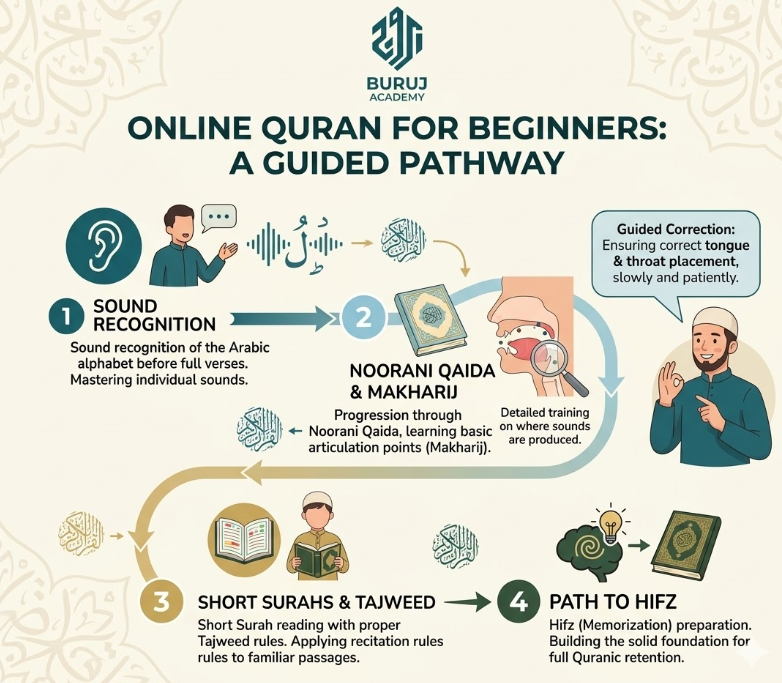
For students beginning this path, our resources on how to memorize Quran faster and the best time to memorize Quran provide evidence-grounded strategies. When you are ready for structured support, Buruj Academy’s Online Quran for Beginners offers personalized memorization pathways built around your schedule and capacity.
Begin Learning Quran With a FREE Trial Lesson
Read also: Juz Amma Memorization for Kids
7. The Quran Defines Muslim Ethics and Character Development
Islamic moral teaching does not exist independently of the Quran — it flows directly from it. Honesty, justice, care for the poor, treatment of parents, gender relations, business conduct, and community responsibility are all addressed with specificity throughout the Quran’s 114 surahs.
إِنَّ ٱللَّهَ يَأْمُرُ بِٱلْعَدْلِ وَٱلْإِحْسَٰنِ وَإِيتَآئِ ذِى ٱلْقُرْبَىٰ
Inna Allaha ya’muru bil-‘adli wal-ihsani wa-ita’i dhil-qurba
“Indeed, Allah orders justice and good conduct and giving to relatives.” (An-Nahl 16:90)
This single verse encapsulates three ethical pillars — ‘adl (justice), ihsan (excellence in conduct), and family generosity — that Muslims are expected to embody. The Quran does not merely prohibit wrong; it actively cultivates virtue.
How Does the Quran Shape Muslim Character Over Time?
Regular Quran engagement — recitation, memorization, reflection — gradually internalizes these ethical principles.
Muslims who maintain a consistent daily Quran reading habit report measurable shifts in patience, gratitude, and ethical decision-making. This is the Quran functioning as what the Prophet ﷺ described: a rope between humans and Allah, held from both ends.
8. The Quran Connects Muslims to a Global, Timeless Community
Every Muslim on earth recites the same Arabic Quran — in Cairo, London, Jakarta, Lagos, and Toronto. This linguistic unity creates a bond that transcends nationality, ethnicity, language, and century.
A Muslim in seventh-century Arabia and a Muslim in twenty-first-century Canada recite identical words in identical Arabic during their prayers.
This shared text is the backbone of the global Muslim Ummah (community). It explains why non-Arabic speaking Muslims invest deeply in learning Quranic Arabic — not just for comprehension, but for full participation in a tradition that spans 1.8 billion people across 1,400 years.
Why Is the Quran the Most Important Book for Non-Arabic Speakers to Engage With?
For Muslims born outside Arabic-speaking contexts, the Quran represents a bridge — to Allah, to Islamic tradition, and to the worldwide Muslim community. Even without fluency, learning to recite correctly creates belonging.
Our Buruj Academy team has observed consistently that the moment a new student recites their first surah correctly with Tajweed, something shifts — they feel, for the first time, genuinely connected to the prayer they have been performing.
Book your FREE trial lesson in your path to Ijazah
9. The Quran Offers Answers to Life’s Most Fundamental Questions
The Quran addresses existence, purpose, death, afterlife, and the nature of the divine with directness that no other Islamic source replicates. Questions that every human being eventually confronts — Who created me? Why am I here? What happens when I die? — are answered within its pages with theological clarity and emotional depth simultaneously.
قُلْ هُوَ ٱللَّهُ أَحَدٌ
Qul huwa Allahu ahad
“Say, ‘He is Allah, [who is] One.'” (Al-Ikhlas 112:1)
This opening of Surah Al-Ikhlas — one of the most frequently recited verses in Islamic practice — encapsulates the core theological answer: Allah is One, unique, self-sufficient, without equal. The entire edifice of Islamic belief rests on this Quranic foundation.
Muslims return to these existential verses during life transitions — births, deaths, crises, and moments of doubt — finding that the Quran addresses not just legal questions but the deepest human needs for meaning and certainty.
10. The Quran Will Intercede for Its Companions on the Day of Judgment
Muslims believe the Quran itself will intercede for those who recited and honored it during their lives. This belief — grounded in authentic hadith — gives Quran engagement a dimension that extends beyond this life entirely.
The Prophet Muhammad ﷺ said, as recorded in Sahih Muslim:
“Read the Quran, for it will come as an intercessor for its companions on the Day of Resurrection.”
This narration transforms every moment spent with the Quran — reciting, memorizing, studying — into a long-term spiritual investment. The Quran is not merely useful in this life; according to Islamic belief, its benefits accompany the believer into the next.
This eschatological dimension explains why Muslims who struggle with recitation — older adults learning for the first time, non-Arabic speakers laboring over pronunciation, students balancing Hifz with full-time work — persist despite difficulty. They are not simply learning a skill. They are building a companion for the Day they will need intercession most.
Read also: Quran Revelation
Discover the Buruj Academy Difference
Step into our virtual classrooms and see how our expert instructors make learning Quran and Arabic intuitive and clear. We focus on overcoming the specific hurdles non-native speakers face, building your confidence and connection with the Quran.
Begin Your Quran Connection with Buruj Academy’s Expert Instructors
Understanding why the Quran is important to Muslims is the first step — but building a real, living relationship with it requires consistent, expert-guided practice.
At Buruj Academy, our Al-Azhar University graduates and Ijazah-certified instructors have helped thousands of non-Arabic speaking Muslims around the world move from complete beginner to confident reciter.
Take the next step in your learning journey today by enrolling in one of our specialized programs:
- Online Quran Classes
- Online Quran Classes for Beginners
- Online Quran Classes for Adults
- Online Quran Classes for Ladies
- Online Quran Classes for Kids
- Quran Reading Course
- Quran Recitation Course
- Online Ijazah Course
- Online Qirat Course
Don’t wait to transform your relationship with the Holy Quran. Join our global community of students and book your free evaluation session now!
We offer flexible, personalized 1-on-1 online sessions through our Quran Reading course and Online Hifz Program, built around your schedule.
Whether you are starting from scratch or refining your Tajweed, our free trial lesson is the best first step. Book your free trial today and begin.
Excel in Your Quranic Studies
Join Buruj Academy and master the Quran with our structured, professional curriculum.
Book Your Free TrialConclusion
The Quran’s importance in Muslim life is not ceremonial — it is structural. It governs prayer, defines ethics, provides legal authority, offers healing, and connects every Muslim to a global community spanning fourteen centuries.
Whether a Muslim is reciting Al-Fatiha in Salah, memorizing a new surah, or turning to the Quran during hardship, they are drawing from the same inexhaustible source.
Understanding this importance is what motivates the learning — and the learning, done consistently with proper guidance, is what deepens that importance further. The relationship between a Muslim and the Quran is lifelong, and every step taken toward it is a step well worth taking.
Frequently Asked Questions About the Importance of the Quran for Muslims
Why Is the Quran the Most Important Book in Islam?
The Quran is Islam’s most important book because it is believed to be the direct, preserved word of Allah — the primary source of Islamic law, worship, ethics, and theology. Unlike hadith, which record the Prophet’s ﷺ words and actions, the Quran is divine speech itself, given ultimate legal and spiritual authority in every area of Muslim life.
How Do Muslims Treat the Quran in Daily Life?
Muslims treat the Quran with extraordinary reverence — performing ritual purification (wudu) before touching the mushaf, reciting it with Tajweed, placing it in elevated positions, and never putting other objects on top of it. Beyond physical reverence, they engage it daily through recitation in Salah, dedicated reading, benefits of memorizing Quran, and Tafsir study.
How Does the Quran Influence Muslims’ Lives Beyond Religious Practice?
The Quran shapes Muslim professional ethics, family relationships, financial decisions, and social responsibilities through specific guidance on justice, honesty, and community care. Muslims do not separate “religious life” from “everyday life” — the Quran’s reach into practical affairs makes that division meaningless. Its influence is continuous and practical, not confined to Friday prayers or Ramadan.
Is It Necessary for Muslims to Understand Arabic to Benefit from the Quran?
Muslims benefit from Quran recitation even without understanding Arabic — reward is tied to the act of recitation itself. However, Arabic comprehension adds transformative depth. Muslims who learn Quranic Arabic report that prayer becomes more focused, Tafsir becomes accessible, and their connection to the text intensifies significantly. Both recitation and comprehension are valued, and one need not precede the other.