The 6 Throat Letters in Arabic: Pronunciation, Makharij, and Tajweed Rules
Key Takeaways
Arabic has exactly 6 throat letters (حروف الحلق), divided across three distinct articulation zones within the throat.
The 6 throat letters are Hamzah (ء), Ha (هـ), ‘Ayn (ع), Ha (ح), Ghayn (غ), and Kha (خ), listed from deepest to closest to the mouth.
When Noon Sakinah or Tanwin precedes any throat letter, the rule of Idh-har Halqi (clear pronunciation) applies with no Ghunnah.
Confusing ‘Ayn (ع) with Hamzah (ء) is the single most common mispronunciation error made by non-Arabic speakers learning Tajweed.
Mastering throat letter articulation requires guided audio training — reading rules alone does not produce correct pronunciation.
Correct Quran recitation depends on knowing exactly where each letter originates in the vocal tract. For six Arabic letters, that origin is the throat — a region most non-Arabic speakers have never consciously trained to use.
These six letters, collectively called حروف الحلق (huruf al-halq), or the Arabic throat letters, each exit from one of three specific zones within the throat. Knowing their precise makharij (articulation points) is what separates guessed pronunciation from accurate recitation — and it directly determines which Tajweed rules apply when these letters follow a Noon Sakinah or Tanwin.
What Are the Throat Letters in Arabic?
The Arabic throat letters are six consonants whose articulation points (makharij) are located within the throat (al-halq) rather than the tongue, lips, or nasal passage. They are: ء (Hamzah), هـ (Ha), ع (‘Ayn), ح (Ha al-Muhmalah), غ (Ghayn), خ (Kha).
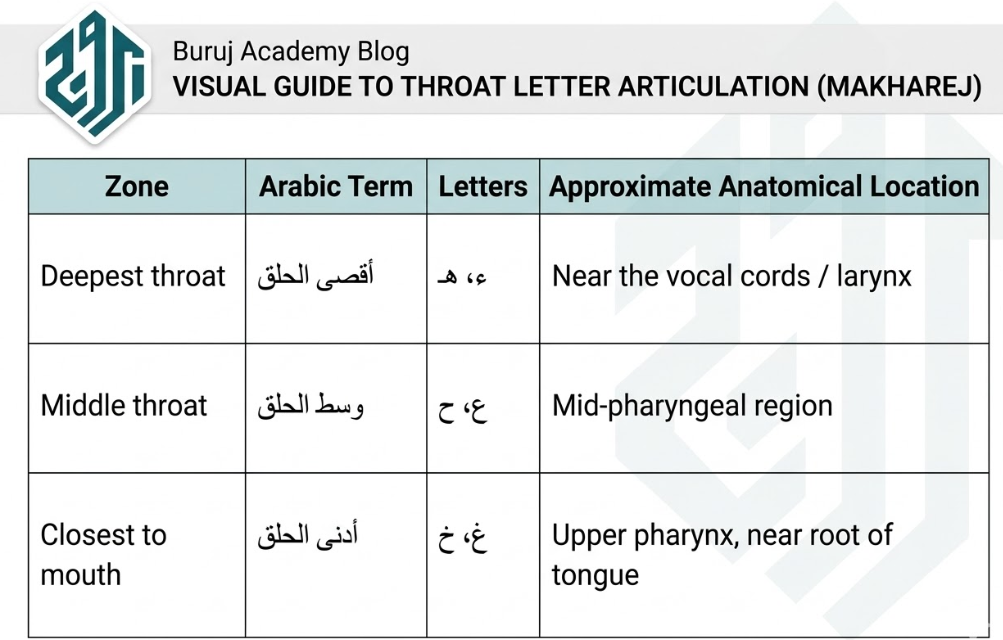
These six are grouped under a single makhraj region — al-halq — which classical Tajweed scholars divide into three sub-zones based on anatomical depth. Each zone produces two letters, and each pair shares similar physical production despite distinct acoustic qualities.
Understanding these letters as a group matters for two reasons: correct independent pronunciation, and their collective role in triggering the Tajweed rule of Idh-har Halqi — clear enunciation without nasal resonance.
The Three Articulation Zones of the Throat Letters
The throat (al-halq) is not a single point. Classical Tajweed science, as established by scholars such as Ibn al-Jazari in al-Muqaddimah al-Jazariyyah, identifies three distinct sub-locations within it.
Each zone produces a pair of letters with related but distinct sounds. The deepest zone produces the most breathy and glottal sounds; the closest zone produces sounds with a slight velar quality.
This three-zone structure is not an academic abstraction — it is precisely what a trained reciter consciously uses during recitation.
Excel in Your Quranic Studies
Join Buruj Academy and master the Quran with our structured, professional curriculum.
A Detailed Look at Each Throat Letter and Its Pronunciation
1. Hamzah (ء)
Hamzah (ء) is a glottal stop produced at the base of the larynx — the same physical mechanism as the catch in the throat before a cough. In Arabic, it is a fully independent consonant, not a vowel marker. Many non-Arabic speakers unconsciously drop it or soften it into a vowel sound, which changes word meaning entirely.
2. Ha (هـ)
Ha (هـ) is produced at the same deep zone but with an open, breathy airflow rather than a stopped closure. It sounds like a soft, open h with significant breath behind it — distinctly different from the English h, which is produced much higher in the vocal tract.
In our Buruj Academy sessions, students consistently find Ha (هـ) easier to approximate in isolation but struggle to maintain its depth inside flowing Quranic recitation, where it tends to shorten and lose its characteristic airiness.
3. ‘Ayn (ع)
‘Ayn (ع) is one of the most challenging Arabic throat letters for non-Arabic speakers. It originates from the middle pharynx with a distinctive constriction — a voiced, slightly strained quality with no equivalent in English. Mispronouncing it as Hamzah (ء) is the most frequent error we correct in Tajweed for Beginners courses at Buruj Academy.
Ha al-Muhmalah (ح) is the voiceless counterpart produced in the same zone — a pharyngeal fricative with a clearly constricted, breathy sound. It is not the same as Ha (هـ) and not the same as the ch in Scottish loch. Its correct production requires conscious pharyngeal narrowing that most students need several weeks of guided practice to internalize.
5. Ghayn (غ)
Ghayn (غ) is voiced. Ghayn (غ) is produced at the upper pharynx, closest to the mouth among the six throat letters. They carry a characteristic velar quality — somewhat resembling the French r or the sound of gargling softly.
6. Kha (خ)
Kha (خ) is voiceless. Kha (خ) involves the back of the tongue approaching the pharyngeal wall, which places them at the boundary between the throat and the back of the oral cavity.
Letter
Voiced / Voiceless
Similar Sound Reference
غ (Ghayn)
Voiced
Similar to French r in Paris
خ (Kha)
Voiceless
Similar to Scottish ch in loch
ع (‘Ayn)
Voiced
No English equivalent — mid-pharyngeal constriction
ح (Ha)
Voiceless
No English equivalent — deeper than h, with constriction
ء (Hamzah)
Voiced (glottal)
Similar to the glottal stop in Cockney butter
هـ (Ha)
Voiceless (breathy)
Deeper, more open version of English h
At Buruj Academy, our Al-Azhar-trainedinstructors use a specific diagnostic exercise: having students alternate between ء and ع in isolation before embedding them in words. This reveals immediately whether the student is producing a glottal stop or a genuine pharyngeal constriction — two sounds that feel deceptively similar to untrained ears.
What Is Idh-har Halqi and Why Do the Throat Letters Cause It?
Idh-har Halqi (الإظهار الحلقي) is the Tajweed rule that requires the Noon Sakinah (نْ) or Tanwin (ً ٍ ٌ) to be pronounced clearly and distinctly — without any Ghunnah (nasal resonance) — when followed by any of the six throat letters.
The reason is rooted in makhraj logic: Noon Sakinah originates from the tip of the tongue and nasal passage, while all six throat letters originate deep in the throat.
There is no shared point of articulation between them, which makes assimilation (Idgham) or concealment (Ikhfa) phonetically impossible without distorting either letter. The result is clear, unmerged pronunciation.
This makes Idh-har Halqi one of the four rules of Noon Sakinah and Tanwin alongside Idgham, Iqlab, and Ikhfa. If you are building a structured understanding of these rules, our guide on Tajweed for beginners covers the full rule system from the ground up.
Excel in Your Quranic Studies
Join Buruj Academy and master the Quran with our structured, professional curriculum.
Throat Letters Examples from the Quran with Idh-har Halqi
The following verified examples illustrate Idh-har Halqi in action. In each case, the Noon Sakinah or Tanwin before the throat letter must be pronounced fully and clearly, without merging into or being colored by the following letter.
(Noon Sakinah distinct and clear before Kha — no concealment or assimilation.)
Discover the Buruj Academy Difference
Step into our virtual classrooms and see how our expert instructors make learning Quran and Arabic intuitive and clear. We focus on overcoming the specific hurdles non-native speakers face, building your confidence and connection with the Quran.
How the Throat Letters Interact with Other Tajweed Rules
Understanding the throat letters as a group clarifies why they behave differently from letters triggering other Noon Sakinah rules. The table below summarizes the contrast:
Rule
Triggering Letters
Effect on Noon Sakinah / Tanwin
Idh-har Halqi
ء هـ ع ح غ خ (6 throat letters)
Pronounced clearly — no Ghunnah
Idgham
ي ر م ل و ن (6 letters)
Noon merges into the following letter
Iqlab
ب only
Noon converts to Meem with Ghunnah
Ikhfa
15 remaining letters
Noon concealed with partial Ghunnah
For a deeper study of how Ghunnah interacts with these rules, our full guide on Ghunnah and its rules explains the nasal resonance principles that Idh-har specifically avoids.
The throat letters are also unique in that they have no overlap with Ikhfa letters or Idgham letters — the three rule categories are mutually exclusive in classical Tajweed scholarship.
Common Pronunciation Mistakes with Arabic Throat Letters
1. Replacing ‘Ayn (ع) with Hamzah (ء)
This is the most damaging substitution error in Quran recitation. Both letters feel like “throat sounds” to untrained ears, but ‘Ayn requires active mid-pharyngeal constriction while Hamzah is a clean glottal stop. Substituting one for the other changes Arabic words entirely — for example, عَالَم (‘ālam, “world”) becomes something phonetically unrecognizable.
2. Softening Ha (هـ) Into a Weak Whisper
Non-Arabic speakers frequently reduce Ha (هـ) to a barely audible breath, losing its deep laryngeal quality. In Quranic recitation, this causes the letter to functionally disappear, which violates the rule of giving each letter its full haqq (essential right).
3. Confusing Ghayn (غ) and Kha (خ) With Each Other
Because both letters share the same zone and similar quality, students sometimes substitute one for the other. The key distinction is voicing: Ghayn vibrates the vocal cords; Kha does not. Minimal pair drilling — repeating غ and خ alternately in structured exercises — is the most effective correction technique we use at Buruj Academy.
Excel in Your Quranic Studies
Join Buruj Academy and master the Quran with our structured, professional curriculum.
Master Tajweed Throat Letters with Buruj Academy’s Expert Instructors
The six Arabic throat letters cannot be mastered through reading alone — correct articulation requires trained ears, real-time feedback, and consistent guided practice.
Buruj Academy’s Online Tajweed Classes are led by Ijazah-certified instructors and Al-Azhar University graduates with 12+ years of experience teaching non-Arabic speakers. Our Tajweed for Beginners course uses the Buruj Method — sound-before-rules — training your ear to hear correct throat letter production before introducing formal rule application.
Every student receives personalized 1-on-1 sessions with real-time pronunciation correction, flexible scheduling, and a structured progression from letter-level accuracy to fluent Quranic recitation.
Join a supportive learning environment tailored to your pace and lifestyle. Start your journey toward excellence by enrolling in one of our specialized tracks:
Book your free trial lesson today and let our instructors hear your recitation — one session is enough to identify exactly which throat letters need targeted work.
Frequently Asked Questions About Throat Letters in Arabic
What Are the 6 Throat Letters in Arabic Tajweed?
The 6 Arabic throat letters are Hamzah (ء), Ha (هـ), ‘Ayn (ع), Ha al-Muhmalah (ح), Ghayn (غ), and Kha (خ). They are grouped as huruf al-halq and divided across three throat zones: deepest (ء, هـ), middle (ع, ح), and closest to mouth (غ, خ). All six trigger Idh-har Halqi when preceded by Noon Sakinah or Tanwin.
Why Are Throat Letters Called Huruf Al-Idh-har in Tajweed?
Throat letters are called huruf al-idh-har because their articulation points share no proximity with the Noon Sakinah’s makhraj. This phonetic distance makes merging or concealing the Noon impossible without distortion, so classical Tajweed scholarship mandates clear, unmodified pronunciation — idh-har (إظهار) — when they follow Noon Sakinah or Tanwin.
How Do I Learn to Pronounce ‘Ayn (ع) Correctly?
Correct ‘Ayn (ع) pronunciation requires conscious constriction of the mid-pharynx while voicing — a movement most non-Arabic speakers have never made intentionally. Effective techniques include: sustained isolated repetition, minimal pair contrast with Hamzah (ء), and audio mirroring with a qualified instructor. Reading descriptions helps understand the target; only guided audio practice produces the correct sound consistently.
Is Idh-har Halqi Applied Within One Word or Between Two Words?
Idh-har Halqi applies in both cases — within a single word (كَلِمَة وَاحِدَة) and across two consecutive words (كَلِمَتَيْن). Whether the Noon Sakinah is mid-word followed by a throat letter, or at the end of one word while the next word begins with a throat letter, the rule is identical: pronounce the Noon clearly with no Ghunnah.
Can I Learn Throat Letter Pronunciation Without a Teacher?
Phonetic awareness from written descriptions is valuable preparation, but self-study alone rarely produces correct throat letter production — particularly for ‘Ayn (ع) and Ha (ح), which have no English equivalents. A qualified instructor provides immediate corrective feedback that recorded audio cannot replicate. Most students in our experience require 3–6 weeks of consistent guided sessions before throat letters feel natural in flowing recitation.
Unlock Your Potential at Buruj Academy: Enroll Today and Elevate Your Knowledge!
Join Buruj Academy and embark on a transformative learning journey designed to expand your skills and understanding. Experience expert guidance, interactive courses, and a supportive community that empowers you to achieve academic excellence and personal growth. Start your path to success today!
 Tajweed