 Tajweed
| Key Takeaways |
| Madd Iwad occurs only during waqf (pausing) on a word ending in tanwin al-fath, replacing the tanwin with a two-count elongation. |
| The ta marbuta (ة) is excluded from Madd Iwad — when pausing on it, the letter is pronounced as a silent ha, not elongated. |
| Madd Iwad is measured at exactly two harakaat (counts), equivalent to the Natural Madd (Madd Asli), making it one of the foundational madd types. |
| Tanwin al-damm and tanwin al-kasr do not trigger Madd Iwad — only the fath (double fatha) activates this rule during waqf. |
| In connected recitation (wasl), Madd Iwad disappears entirely — the tanwin is pronounced normally and no elongation occurs. |
When a student first encounters a word like غَفُورًا or رَحِيمًا in Quranic recitation, a common question arises: do we simply drop the tanwin when pausing, or do we replace it with something? The answer lies in one of the most elegantly logical rules in Tajweed — Madd Iwad.
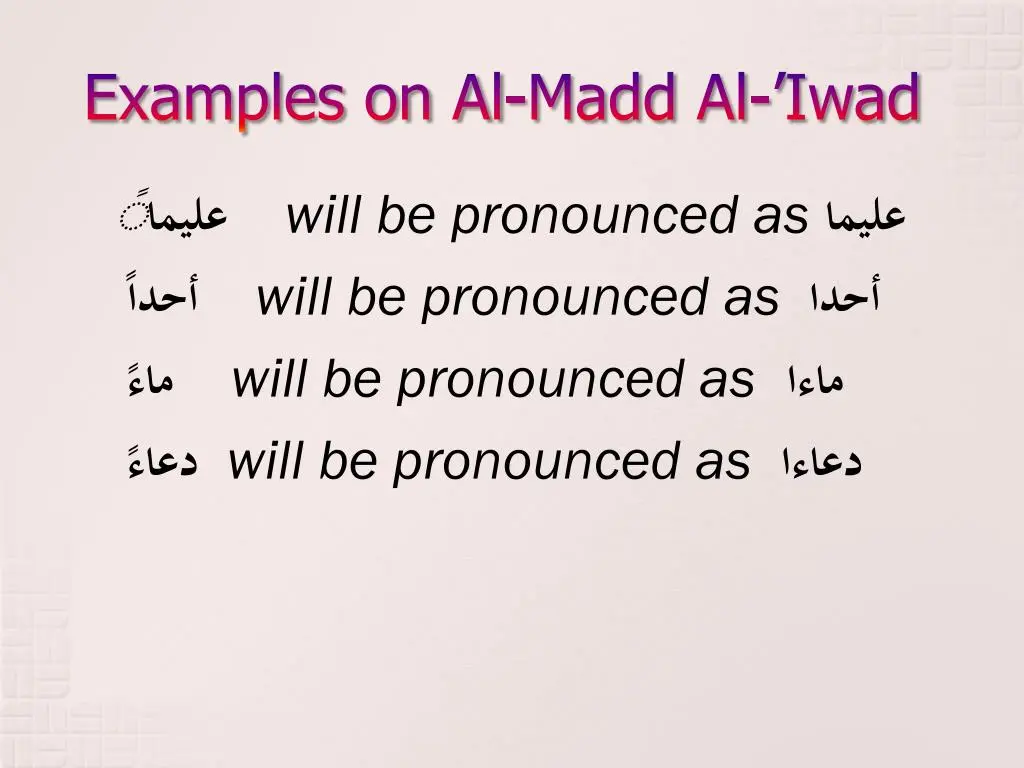
Madd Iwad (مد العوض) is the elongation that substitutes for tanwin al-fath during waqf. The nun sound of the tanwin is replaced by an alif maddiyya held for two harakaat.
This substitution only applies when pausing — during wasl, the tanwin is recited normally with no elongation.
Table of Contents:
What Is the Definition of Madd Iwad in Tajweed?
Madd Iwad is defined as the elongation that occurs when a reciter pauses (waqf) on a word ending in tanwin al-fath (double fatha), substituting the tanwin’s nun sound with an alif held for two counts. The word “iwad” (عوض) itself means compensation or substitution — the alif compensates for the omitted tanwin.
Classical Tajweed scholars explained this rule with precision. Al-Dabbaa’ in his work Al-Idaa’a described a related application involving haa al-kinaya (the pronoun “ha”), but the majority of scholars and the mainstream Hafs ‘an ‘Asim tradition define Madd Iwad specifically as the waqf-based replacement of tanwin al-fath with an alif maddiyya.
The rule is structurally simple: wherever you see a word with tanwin al-fath that is not followed by a ta marbuta, pausing on it produces Madd Iwad. Words like بَصِيرًا, رَحِيمًا, and عَلِيمًا all follow this pattern.
If you are building your Tajweed foundations systematically, our Tajweed for Beginners course at Buruj Academy covers Madd Iwad within a structured progression that connects rule knowledge to live recitation practice from the very first lesson.
Book Your FREE Trial Lesson to Begin Your Tajweed Journey

What Are the Rules Governing Madd Iwad?
Three rules govern Madd Iwad precisely, and each one is non-negotiable in authentic recitation.
Rule One: Madd Iwad Only Occurs During Waqf
Madd Iwad is entirely a waqf (pausing) phenomenon. During wasl (connected recitation), the tanwin al-fath is pronounced as a nun, and no elongation occurs.
A student reading رَّحِيمًا in a continuous verse does not apply Madd Iwad — the tanwin functions normally. Only upon choosing to pause on that word does the rule activate.
Rule Two: Only Tanwin Al-Fath Triggers Madd Iwad
This specificity is critical. Tanwin al-damm (double damma, ٌ) and tanwin al-kasr (double kasra, ٍ) do not produce Madd Iwad under any condition.
When pausing on words with these tanwin types, the tanwin is simply dropped — no alif is added, and no elongation occurs.
This is one of the most common errors we observe in our Online Tajweed Classes at Buruj Academy, particularly among students who overgeneralize the rule.
Book Your FREE Trial Lesson to Begin Your Tajweed Journey

Rule Three: Ta Marbuta Is Excluded
The ta marbuta (ة) is the most important exception to Madd Iwad. When a word ends in a ta marbuta with tanwin al-fath — such as رَحْمَةً or شَجَرَةً — pausing on it does not produce Madd Iwad. Instead, the ta marbuta is pronounced as a silent ha (هـ). No alif elongation is added.
| Word | Tanwin Type | Waqf Pronunciation | Madd Iwad? |
| غَفُورًا | Fath | غَفُورَا (2 counts) | ✅ Yes |
| رَّحِيمٌ | Damm | رَّحِيم (drop tanwin) | ❌ No |
| كَرِيمٍ | Kasr | كَرِيم (drop tanwin) | ❌ No |
| رَحْمَةً | Fath + ta marbuta | رَحْمَه (silent ha) | ❌ No (exception) |
| أَلْفَافًا | Fath | أَلْفَافَا (2 counts) | ✅ Yes |
What Are the Examples of Madd Iwad in the Quran?
The Quran contains abundant examples of Madd Iwad, appearing across a wide variety of word patterns. Understanding these examples in context strengthens a student’s ability to recognize and apply the rule instinctively during recitation.
Examples of Madd Iwad on a Written Alif
Many words contain tanwin al-fath on a clearly written alif, making Madd Iwad visually intuitive.
أَفْوَاجًا
Afwajaa (when pausing)
“In multitudes.” (An-Nasr 110:2)
Pausing on this word replaces tanwin with a two-count alif — a clear, classroom-tested example of Madd Iwad.
نَهَرًا
Naharaa (when pausing)
“A river.”
The alif is written and the tanwin al-fath replaces cleanly with the elongated sound.)
Examples of Madd Iwad on an Unwritten (Implied) Alif
Some words in the Quran carry tanwin al-fath on a letter whose alif is not written in the Uthmani script — such as words ending in alif maqsura (ى). These also produce Madd Iwad during waqf.
Words like هُدًى, غُزًى, and سُوًى appear with alif maqsura endings. During wasl, the tanwin nun is audible. During waqf, the tanwin drops and the final sound is held for two harakaat.
In our sessions at Buruj Academy, students learning these examples for the first time often find the implied-alif category more challenging. The written alif category clicks quickly — it is visible on the page. The implied-alif category requires trained listening, and this is where working with an Ijazah-certified instructor makes a measurable difference in how quickly the pattern becomes second nature.
Book a FREE trial session with one of Buruj’s Azhari Quran tutors

Read also: Surah Taha Benefits
Additional Quranic Examples of Madd Iwad
| Arabic Word | Waqf Pronunciation | Surah Reference |
| بَصِيرًا | بَصِيرَا | Multiple occurrences |
| تَوَّابًا | تَوَّابَا | Al-Baqarah, An-Nisa |
| رُكْبَانًا | رُكْبَانَا | Al-Baqarah 2:239 |
| رِجَالًا | رِجَالَا | Al-Hajj 22:27 |
| عَلِيمًا | عَلِيمَا | Multiple occurrences |
These examples reinforce a core principle: Madd Iwad is a waqf rule, and recognizing tanwin al-fath on non-ta-marbuta words is the only identification skill a student needs to apply it correctly.
Excel in Your Quranic Studies
Join Buruj Academy and master the Quran with our structured, professional curriculum.
Book Your Free TrialWhat Are the Types and Categories of Madd Iwad?
Madd Iwad falls under the category of the Natural Madd (Madd Asli or Madd Tabii) in terms of its measure and governing principle. Understanding its position within the madd classification system helps students apply it correctly.
| Madd Category | Madd Type | Measure | Trigger |
| Madd Asli (Natural) | Madd Tabii | 2 harakaat | Presence of a madd letter without hamza or sukoon after it |
| Madd Asli (Natural) | Madd Iwad | 2 harakaat | Waqf on tanwin al-fath (non-ta marbuta words) |
| Madd Far’i (Secondary) | Madd Muttasil | 4–5 harakaat | Madd letter followed by hamza in same word |
| Madd Far’i (Secondary) | Madd Munfasil | 4–5 harakaat | Madd letter followed by hamza in next word |
Madd Iwad shares the two-harakaat measure with the Madd Tabii. It is categorized as a subsidiary of the natural madd because its elongation does not depend on a secondary cause (hamza or sukoon) — it depends solely on the waqf condition and the presence of tanwin al-fath.
For a thorough understanding of the Madd Asli and how it relates to Madd Iwad, our article on Madd Asli explains the foundational elongation rules in accessible detail.
How Does Madd Iwad Differ from Other Madd Types in Tajweed?
Students who have studied essential Tajweed rules often ask how Madd Iwad relates to other elongation types, particularly Madd Badal and Madd Tabii. The distinctions are important.
1. Madd Iwad vs. Madd Tabii (Natural Madd):
Both Madd Iwad and Madd Tabii are measured at two harakaat, but Madd Tabii occurs whenever a madd letter appears without a following hamza or sukoon — in both wasl and waqf. Madd Iwad only exists during waqf and arises specifically from the substitution of tanwin al-fath.
2. Madd Iwad vs. Madd Badal:
Madd Badal involves a hamza followed by a madd letter within the same word — the madd letter substitutes for a second hamza. Madd Iwad involves no hamza at all; its alif is the substitute for tanwin.
3. Madd Iwad vs. Madd Arid Lissukoon:
Madd Arid Lissukoon occurs when a reciter pauses on any madd letter that is followed by a letter receiving waqf sukoon. It can be extended 2, 4, or 6 harakaat. Madd Iwad is always exactly two harakaat — no variation, no options.
This fixed, two-harakaat measure is part of why we classify Madd Iwad alongside the natural madd. It carries the same certainty and the same simplicity of measure.
How to Learn and Apply Madd Iwad Correctly During Recitation?
Knowing the rule is only half the skill. Applying Madd Iwad correctly during live Quran recitation requires trained recognition and consistent practice. Here is the approach our instructors at Buruj Academy use with non-Arabic speaking students.
Step One — Identify the Tanwin Al-Fath
Train your eye to spot the double fatha (ً) immediately. Every time you see it on a word without a ta marbuta, flag it mentally as a Madd Iwad candidate for waqf.
Step Two — Check for Ta Marbuta:
Before applying the rule, confirm the word does not end in (ة). If it does, the rule does not apply — pause with silent ha instead.
Step Three — Apply Two Harakaat Precisely:
The elongation must be exactly two counts — no more, no less. Over-elongating into four counts is a recognized error that changes the madd category entirely.
Step Four — Practice Wasl vs. Waqf Contrast:
Read a verse that includes a tanwin al-fath word both in connected recitation and with deliberate waqf. Hearing and producing the contrast between the nun (wasl) and the alif (waqf) builds the automatic rule response that fluent reciters develop.
Our Tajweed classes for beginners at Buruj Academy incorporate this four-step approach within structured recitation drills, ensuring that Madd Iwad becomes a reflex — not a conscious calculation — within a few weeks of consistent practice.
For students who want to understand how Madd Iwad connects to the broader system of Tajweed rules, our guide on how to read Quran with Tajweed provides the wider framework.
Read also: Surah Naba Benefits
Discover the Buruj Academy Difference
Step into our virtual classrooms and see how our expert instructors make learning Quran and Arabic intuitive and clear. We focus on overcoming the specific hurdles non-native speakers face, building your confidence and connection with the Quran.
Master Tajweed with Buruj Academy’s Expert Online Tajweed Classes
Madd Iwad is a precise, rule-bound elongation — and precision is exactly what Buruj Academy’s Online Tajweed Classes are designed to deliver.
Our instructors are Al-Azhar University graduates and Ijazah-certified specialists with 12+ years of experience teaching non-Arabic speakers.
Through the Buruj Method — sound-before-rules — students hear correct recitation before analyzing rule mechanics, building genuine accuracy rather than theoretical knowledge.
Join a supportive learning environment tailored to your pace and lifestyle. Start your journey toward excellence by enrolling in one of our specialized tracks:
- Online Tajweed Classes
- Tajweed Classes for Beginners
- Tajweed Classes for Adults
- Tajweed Classes for Sisters
- Tajweed Classes for Kids
- Advanced Tajweed Course
- Amli Tajweed Course (Practical Application)
Ready to transform your recitation? book your free assessment and start your path to Tajweed mastery today!
Excel in Your Quranic Studies
Join Buruj Academy and master the Quran with our structured, professional curriculum.
Book Your Free TrialEvery student receives a personalized 1-on-1 session with real-time correction, flexible scheduling, and a structured progression from foundational madd rules to advanced Tajweed mastery.
Book your free trial lesson today and experience the difference expert instruction makes.
Conclusion
Madd Iwad is one of Tajweed’s most logically elegant rules: the tanwin al-fath, which cannot be pronounced in isolation during waqf, is gracefully compensated by a two-count alif. This substitution maintains the rhythm and beauty of Quranic recitation while honoring the phonological reality of the Arabic language.
Mastering Madd Iwad requires three things — recognizing tanwin al-fath, confirming the absence of ta marbuta, and applying exactly two harakaat during waqf.
With qualified guidance and consistent recitation practice, this rule becomes natural and automatic. Insha’Allah, every verse you pause on beautifully will reflect the care you invested in learning it correctly.
Frequently Asked Questions About Madd Iwad
What Is Madd Iwad in Simple Terms?
Madd Iwad is the Tajweed rule that replaces the tanwin al-fath (double fatha) with a two-count alif elongation when a reciter pauses on a word. The Arabic word “iwad” means substitute or compensation — the alif compensates for the omitted tanwin nun sound during waqf.
Does Madd Iwad Apply During Connected Recitation?
No. Madd Iwad only occurs during waqf (pausing). During wasl (connected recitation), the tanwin al-fath is pronounced as a normal nun sound, and no elongation is added. The rule is entirely conditional on the reciter choosing to pause on the relevant word.
Why Is the Ta Marbuta Excluded from Madd Iwad?
The ta marbuta (ة) is excluded because its waqf pronunciation follows a separate rule — it is read as a silent ha (هـ). Adding an alif elongation in this case would contradict the established classical waqf convention for ta marbuta, which has its own distinct phonological behavior during pausing.
How Many Harakaat Is Madd Iwad Held For?
Madd Iwad is always held for exactly two harakaat — equivalent to the Natural Madd (Madd Tabii). There is no permitted variation of four or six counts for this madd type. This fixed measure distinguishes it from Madd Arid Lissukoon, which allows multiple elongation levels.
What Is the Difference Between Madd Iwad and Madd Arid Lissukoon?
Madd Arid Lissukoon occurs when a reciter pauses on any word ending with a madd letter before a letter receiving waqf sukoon — it can be 2, 4, or 6 harakaat. Madd Iwad specifically replaces tanwin al-fath with an alif during waqf and is fixed at exactly two harakaat with no variation permitted.