 Quran
Many Muslims recite Ayatul Kursi daily without knowing which of its reported virtues actually trace back to the Prophet ﷺ. Confusion between authentic hadith and popular folklore has spread through social media faster than scholarly verification ever could.
Ayatul Kursi carries two firmly authenticated benefits: nightly protection from Shaytan (Sahih al-Bukhari 2311) and recognition as the greatest verse in the Quran (Sahih Muslim 810).
Several widely shared claims about reciting it a fixed number of times, however, have no basis in authentic hadith.
Table of Contents:
What Is Ayatul Kursi?
Ayatul Kursi is verse 255 of Surah Al-Baqarah, the second and longest chapter of the Quran. It describes Allah’s Oneness, His eternal life, and His Kursi extending over the heavens and the earth.
The name comes directly from the Arabic word kursi appearing within the verse itself. Scholars have differed on its precise meaning, with some describing it as Allah’s knowledge and others as a literal created reality tied to His throne.
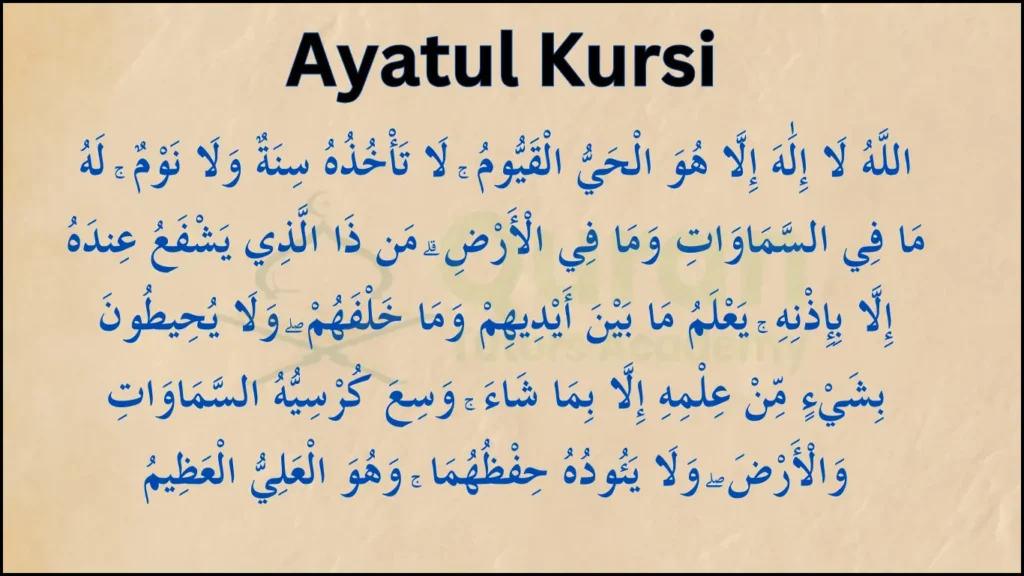
اللَّهُ لَا إِلَٰهَ إِلَّا هُوَ الْحَيُّ الْقَيُّومُ ۚ لَا تَأْخُذُهُ سِنَةٌ وَلَا نَوْمٌ ۚ لَّهُ مَا فِي السَّمَاوَاتِ وَمَا فِي الْأَرْضِ ۗ مَن ذَا الَّذِي يَشْفَعُ عِندَهُ إِلَّا بِإِذْنِهِ ۚ يَعْلَمُ مَا بَيْنَ أَيْدِيهِمْ وَمَا خَلْفَهُمْ ۖ وَلَا يُحِيطُونَ بِشَيْءٍ مِّنْ عِلْمِهِ إِلَّا بِمَا شَاءَ ۚ وَسِعَ كُرْسِيُّهُ السَّمَاوَاتِ وَالْأَرْضَ ۖ وَلَا يَئُودُهُ حِفْظُهُمَا ۚ وَهُوَ الْعَلِيُّ الْعَظِيمُ
Allahu la ilaha illa huwa alhayyu alqayyoomu la takhuthuhu sinatun wala nawmun lahu ma fee alssamawati wama fee alardi man tha allathee yashfaAAu AAindahu illa biithnihi yaAAlamu ma bayna aydeehim wama khalfahum wala yuheetoona bishayin min AAilmihi illa bima shaa wasiAAa kursiyyuhu alssamawati waalarda wala yaooduhu hifthuhuma wahuwa alAAaliyyu alAAatheemu
“Allah – there is no deity except Him, the Ever-Living, the Sustainer of [all] existence. Neither drowsiness overtakes Him nor sleep. To Him belongs whatever is in the heavens and whatever is on the earth. Who is it that can intercede with Him except by His permission? He knows what is [presently] before them and what will be after them, and they encompass not a thing of His knowledge except for what He wills. His Kursi extends over the heavens and the earth, and their preservation tires Him not. And He is the Most High, the Most Great.” (Al-Baqarah 2:255)
This opening line establishes Tawhid — Allah’s absolute Oneness — before the verse moves into His knowledge, His Kursi, and His unmatched greatness.
In our Quran classes at Buruj Academy, we’ve noticed that many students memorize Ayatul Kursi quickly because of its rhythmic structure, but few can explain what each clause affirms about Allah.
Start Learning Quran With a FREE Trial Lesson
Ayatul Kursi Is the Greatest Verse in the Entire Quran
Ayatul Kursi holds the explicit rank of the single greatest verse in the Quran, a status the Prophet ﷺ confirmed directly to his companion Ubayy ibn Ka’b. This is not scholarly opinion — it is a direct prophetic statement recorded in Sahih Muslim.
The Prophet ﷺ asked Ubayy ibn Ka’b which verse in the Quran he considered greatest. When Ubayy recited the opening of Ayatul Kursi, the Prophet ﷺ struck his chest affectionately and told him to rejoice in that knowledge (Sahih Muslim 810).
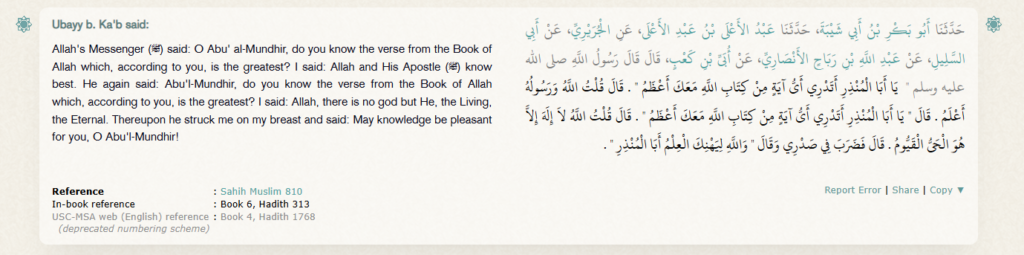
This hadith is agreed upon by scholars as authentic without dispute. It places Ayatul Kursi in a category no other single verse of the Quran shares — a direct prophetic ranking rather than a later scholarly inference.
We find this hadith useful when teaching students why certain verses receive special attention in daily adhkar.
1. Reciting Ayatul Kursi Before Sleep Brings Allah’s Protection Until Morning
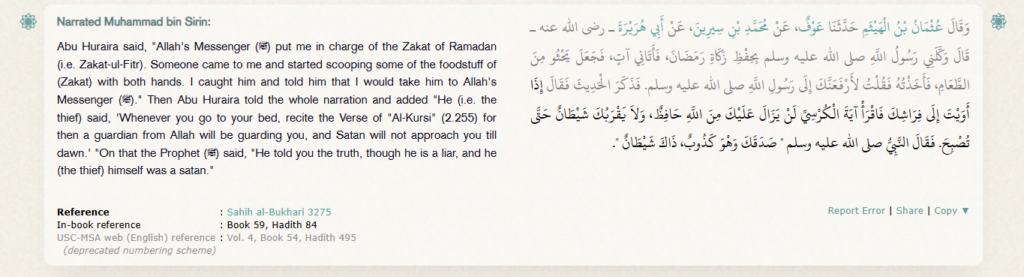
Reciting Ayatul Kursi before sleep places a guardian from Allah over the reciter for the entire night, and no devil approaches until morning. This benefit comes from one of the most detailed and authentic hadiths in Sahih al-Bukhari, involving Abu Hurairah and a jinn.
Abu Hurairah was guarding the Zakat al-Fitr stores when he caught someone stealing food. The thief pleaded to be released, promising to teach him words of benefit. He told Abu Hurairah that reciting Ayat al-Kursi before bed would bring a guardian from Allah who protects him until dawn, keeping Shaytan away.
When Abu Hurairah reported this to the Prophet ﷺ, he confirmed, “He told you the truth, though he is a liar.” The thief was Shaytan himself (Sahih al-Bukhari 3275).
How This Hadith Differs From Ordinary Protection Duas?
Most protection duas ask Allah directly for safety. Ayatul Kursi’s protective benefit works differently — it is a declarative statement of Allah’s attributes, not a request, yet the Prophet ﷺ confirmed it still results in guarded sleep.
This distinction matters for correct understanding. Reciting it is an act of remembrance and affirmation of Tawhid, and the protection follows as a consequence rather than as something explicitly petitioned for within the verse.
Students in our Quran Reading Course often ask why this verse works differently from a typical dua — and this narrative context from Sahih al-Bukhari is exactly why.
Book your Free trial lesson and start reading the Quran
Read also: Arabic Vowels for Kids
2. Reciting Ayatul Kursi After Every Prayer Leaves Only Death Before Paradise
Whoever recites Ayatul Kursi after every obligatory prayer has nothing standing between them and entering Paradise except death itself. This narration is graded authentic (sahih) and recorded through Abu Umamah al-Bahili.
The Prophet ﷺ said that whoever recites Ayatul Kursi after every obligatory prayer, nothing prevents him from entering Paradise except death — meaning he remains alive (Sunan an-Nasa’i, Ibn Hibban; graded sahih by al-Albani).
This hadith is distinct from a separate, weaker chain sometimes cited for the same virtue. Scholars have noted textual variation across compilations, but the core narration through an-Nasa’i and Ibn Hibban is accepted as authentic by hadith specialists.
| Benefit | Source | Grading |
| Guardian from Allah at night | Sahih al-Bukhari 3275 / 2311 | Sahih (authentic) |
| Greatest verse in the Quran | Sahih Muslim 810 | Sahih (authentic) |
| Only death before Paradise (after prayer) | Sunan an-Nasa’i, Ibn Hibban | Sahih (authentic) |
This table separates the three strongest, most frequently cited hadiths so students can see their grading at a glance rather than treating every claim as equally reliable.
Many of our students at Buruj Academy ask which adhkar to prioritize after Salah. We consistently point to this hadith first, since its authenticity is well-documented, unlike many circulating post-prayer formulas.
3. Ayatul Kursi Pairs With the Last Two Verses of Surah Al-Baqarah for Nightly Protection
Reciting the final two verses of Surah Al-Baqarah at night is described by the Prophet ﷺ as sufficient protection for that night, and many scholars recommend pairing this with Ayatul Kursi as part of nightly adhkar. This is a separate, independently authentic hadith.
The Prophet ﷺ said, “If somebody recited the last two verses of Surat Al-Baqara at night, that will be sufficient for him” (Sahih al-Bukhari 5009).
Imam an-Nawawi explained that “sufficient” carries layered meaning — sufficiency in place of night prayer, protection from devils, or protection from harm. Ibn Hajar noted a related narration specifying it suffices “instead of standing in prayer for one night.”
Combining Ayatul Kursi with these closing verses of Surah Al-Baqarah builds a fuller nightly practice, similar in spirit to pairing it with the protective recitations discussed in our guide on the benefits of Surah Al-Hadid.
Discover the Buruj Academy Difference
Step into our virtual classrooms and see how our expert instructors make learning Quran and Arabic intuitive and clear. We focus on overcoming the specific hurdles non-native speakers face, building your confidence and connection with the Quran.
Excel in Your Quranic Studies
Join Buruj Academy and master the Quran with our structured, professional curriculum.
Book Your Free Trial4. Consistent Recitation of Ayatul Kursi Strengthens Reflection on Allah’s Attributes
Beyond the specific hadith-based rewards, consistent recitation of Ayatul Kursi trains the heart to internalize Allah’s Oneness, knowledge, and dominion — a spiritual benefit scholars describe even where no separate numerical reward is authentically attached. This is the verse’s deeper, non-quantified value.
Ayatul Kursi packs sweeping theological content into a single verse: Allah’s eternal life, His freedom from fatigue, His knowledge encompassing all things, and His authority over the heavens and earth.
Why Scholars Emphasize Meaning Over Mechanical Repetition
Classical scholars, including Ibn Kathir in his tafsir, focus commentary on unpacking each clause of Ayatul Kursi rather than promoting a fixed repetition count for extra reward. The verse’s spiritual weight comes from its content, not from arithmetic.
This is a pattern we emphasize heavily in our teaching. In our experience at Buruj Academy, students who recite Ayatul Kursi while reflecting on each phrase — rather than rushing through it by habit — report a noticeably deeper connection to their daily Salah within a few weeks.
Building this reflective habit is central to what we teach in our Online Quran Hifz Course, where meaning and Tajweed are taught together rather than as separate skills.
Start Hifz today with a FREE trial session

Read also: Daily Routine for Kids in Arabic
What Is the Truth About Reciting Ayatul Kursi 41, 70, 100, or 313 Times?
Claims that reciting Ayatul Kursi a specific number of times — 41 times, 70 times, 100 times, or 313 times — produces a guaranteed spiritual reward have no basis in any authentic hadith collection. These are unauthenticated folk claims that circulate widely online without scholarly sourcing.
Islamic scholarship researchers have specifically investigated similar numerical claims attached to Ayatul Kursi, such as reciting it 40 times at sunset for “the reward of 40 Hajj,” or reciting it after wudu for “40 degrees in status.” These narrations could not be located in any of the six authentic hadith collections.
The 70 Times Ayatul Kursi Benefits Are Considered Fabricated
The claim that reciting Ayatul Kursi upon leaving home brings 70,000 protective angels traces only to a single obscure medieval text, not to any recognized hadith collection. Scholars examining its chain found a narrator explicitly accused of fabricating hadiths by Imam al-Bukhari, Imam Abu Dawud, and Imam an-Nasa’i.
Hanafi scholars at Darul Ifta Birmingham searched extensively for the “70 times raises rank” narration and could not locate it in the six authentic books of hadith or in any reliable compilation. The only source found quoted heavily from a book known for including unreferenced weak and fabricated material.
Benefits of Reciting Ayatul Kursi 313 Times and 100 Times Claims Are Not Authentic
Similarly, the specific figures of 313 recitations or 100 recitations of Ayatul Kursi for guaranteed outcomes do not appear in Sahih al-Bukhari, Sahih Muslim, or any of the four Sunan collections. These numbers appear to originate from later folk practice rather than prophetic instruction.
Scholars caution strongly against spreading such narrations. The Prophet ﷺ warned that whoever intentionally attributes a fabricated statement to him should prepare for punishment, which is why hadith verification matters even for well-intentioned virtue-seeking.
This does not diminish Ayatul Kursi’s real status. Its authentically confirmed virtues — protection before sleep, its rank as the greatest verse, and the reward after prayer — already place it above nearly every other verse in the Quran without needing invented multipliers.
Learn Ayatul Kursi With Proper Meaning and Tajweed at Buruj Academy
Understanding Ayatul Kursi’s authentic virtues means nothing without reciting it correctly and reflecting on its meaning consistently. Buruj Academy helps students build both skills together, not separately.
Our Ijazah-certified instructors and Al-Azhar University graduates bring over 12 years of experience teaching non-Arabic speakers Tajweed, memorization, and Quranic meaning.
Through the Buruj Method’s sound-before-rules approach, students build correct pronunciation before tackling rule terminology.
Every learning plan is personalized to age, level, and pace, delivered through flexible 1-on-1 online sessions with real-time correction. Whether you’re memorizing Ayatul Kursi for the first time or refining decades-old recitation, our instructors adapt to where you are.
Book a free trial lesson today and start reciting Ayatul Kursi with the confidence of proper Tajweed and authentic understanding.
Take the next step in your learning journey today by enrolling in one of our specialized programs:
- Online Quran Classes
- Online Quran Classes for Beginners
- Online Quran Classes for Adults
- Online Quran Classes for Ladies
- Online Quran Classes for Kids
- Quran Reading Course
- Quran Recitation Course
- Online Ijazah Course
- Online Qirat Course
Don’t wait to transform your relationship with the Holy Quran. Join our global community of students and book your free evaluation session now!
Excel in Your Quranic Studies
Join Buruj Academy and master the Quran with our structured, professional curriculum.
Book Your Free TrialConclusion
Ayatul Kursi’s real strength lies in what the Prophet ﷺ actually confirmed about it — nightly protection, its rank as the greatest verse, and reward after prayer — not in invented repetition counts that spread through unsourced forwards. Separating the two protects both the integrity of the Sunnah and the sincerity of the worship behind reciting it.
Approached with reflection rather than mechanical counting, this single verse offers more theological depth than its 50 Arabic words suggest. Consistency in reciting it, paired with genuine understanding of its meaning, matters more than chasing a specific number.
Read also: Benefits of Surah Baqarah
Frequently Asked Questions About the Benefits of Ayatul Kursi
Is It Authentic That Ayatul Kursi Should Be Recited 41 Times?
No authentic hadith supports reciting Ayatul Kursi exactly 41 times for any specific reward. This number does not appear in Sahih al-Bukhari, Sahih Muslim, or the recognized Sunan collections, and should not be treated as an established Sunnah practice.
What Are the Benefits of Reciting Ayatul Kursi Before Sleep?
Reciting Ayatul Kursi before sleep brings a guardian from Allah who protects the reciter through the night, keeping Shaytan away until morning. This is confirmed directly in Sahih al-Bukhari 3275, through the well-known narration of Abu Hurairah and the jinn.
Is the “313 Times” Recitation of Ayatul Kursi Authentic?
No, reciting Ayatul Kursi 313 times has no basis in any authentic hadith collection. This figure does not appear in Sahih al-Bukhari, Sahih Muslim, or any reliable Sunan compilation, and should be treated as an unverified folk claim.
Why Is Ayatul Kursi Called the Greatest Verse in the Quran?
The Prophet ﷺ personally confirmed this ranking when his companion Ubayy ibn Ka’b identified it as the greatest verse he knew. The Prophet ﷺ struck his chest affectionately and praised his knowledge, a narration recorded in Sahih Muslim 810.
Should Ayatul Kursi Be Recited After Every Prayer?
Yes, reciting Ayatul Kursi after every obligatory prayer is supported by an authentic (sahih) hadith stating that nothing then prevents the reciter from entering Paradise except death. This practice is recommended by Imam an-Nawawi and widely followed as Sunnah.