 Quran
Quran

| Key Takeaways |
| Noorani Qaida integrates Tajweed from lesson one, embedding correct pronunciation habits before full Quran reading begins. |
| Makharij (articulation points) must be learned alongside each Arabic letter — not after completing the alphabet. |
| The Noon Sakinah and Tanwin rules — Ikhfa, Idgham, Iqlab, and Izhar — are introduced during the Qaida’s later stages. |
| Consistent short daily sessions of 15–20 minutes produce faster mastery than longer, irregular practice. |
| A qualified teacher is necessary for Noorani Qaida with Tajweed — self-study cannot correct makhraj errors you cannot hear yourself making. |
For non-Arabic speakers, the first barrier to reading the Quran is not vocabulary or grammar — it is sound. Arabic contains letters that do not exist in English, produced from places in the throat and mouth that most beginners have never consciously used.
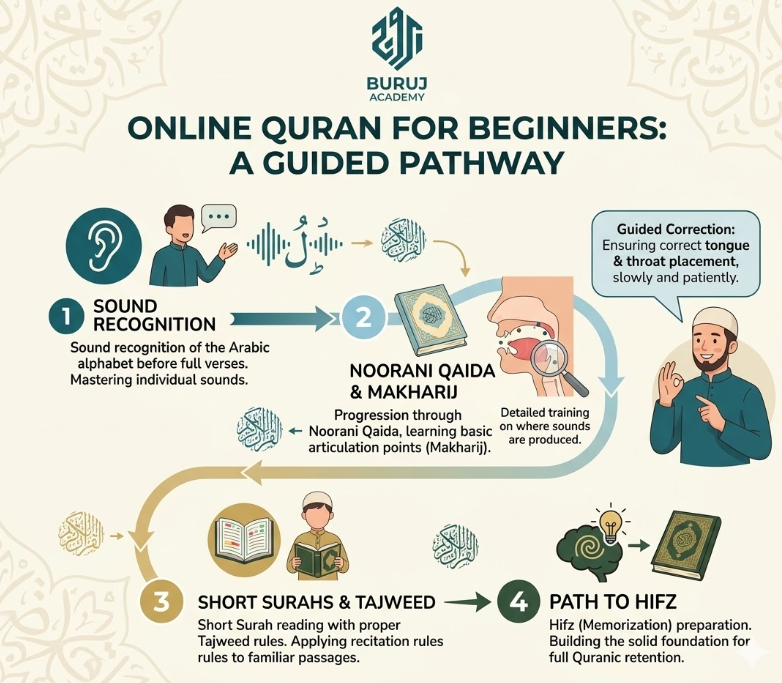
Learning Noorani Qaida with Tajweed means building both skills simultaneously: recognizing Arabic letters and producing them correctly from their proper articulation points. Done right, this foundation eliminates the mispronunciation habits that take years to unlearn later.
Table of Contents:
1. Understand Why Noorani Qaida With Tajweed Is the Most Effective Method
Noorani Qaida with Tajweed is the most effective method for non-Arabic speakers to begin Quran reading because it trains correct letter sounds from the very first lesson, preventing mispronunciation habits from forming.
Noorani Qaida is a structured phonics primer composed by Sheikh Noor Muhammad Haqqani for non-Arabic speakers. It progresses from individual letter recognition through joined letters, vowel marks (harakat), and eventually basic Tajweed rules.
When Tajweed principles — specifically makharij al-huruf (articulation points) and sifat al-huruf (letter attributes) — are integrated from the beginning, students build accurate recitation reflexes rather than reading habits that require painful correction later.
In our experience at Buruj Academy, students who learn letters without simultaneous makhraj instruction often spend months re-learning sounds they embedded incorrectly in their first weeks. The Buruj Method addresses this directly: Sound-before-rules — we train the ear and tongue before we introduce any written rule.
Buruj Academy’s Noorani Qaida Online Course integrates Tajweed phonetics into every lesson from day one, taught by Ijazah-certified instructors with 12+ years of experience teaching non-Arabic speakers.
Book your FREE trial lesson in the Noorani Qaida course
Read also: Best App to Learn Quran with Tajweed
2. Master the Arabic Alphabet with Correct Makharij
To learn Noorani Qaida with Tajweed correctly, every letter must be associated with its makhraj — the precise anatomical point where the sound originates — before progressing to joined letters or vowel marks.
Classical Tajweed scholarship identifies 17 primary articulation points grouped across five regions: the jawf (oral cavity), the throat (halq), the tongue (lisan), the lips (shafatain), and the nasal passage (khayshum). Each Arabic letter belongs to a specific makhraj within these regions.
Which Letters Require the Most Attention for Non-Arabic Speakers?
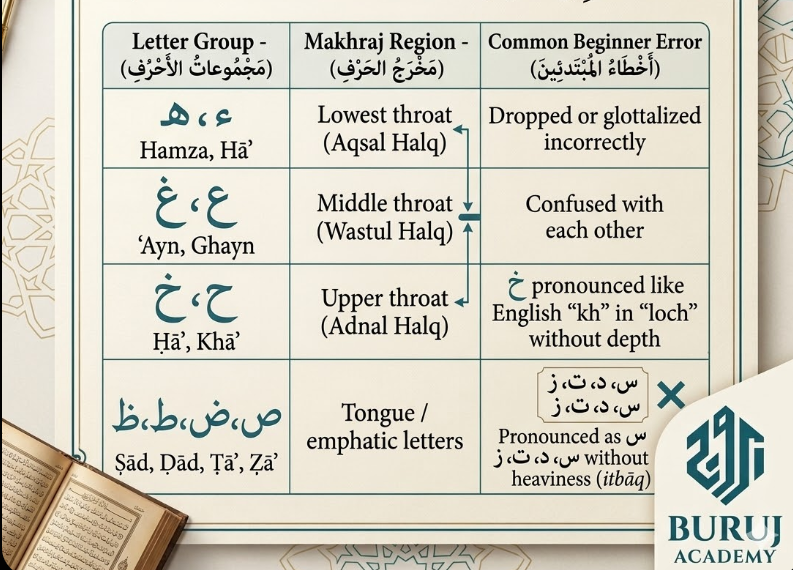
The throat letters — ء (Hamza), هـ (Ha), ع (Ain), غ (Ghain), ح (Ha), خ (Kha) — are consistently the most challenging for English speakers because English produces no sounds from the throat. Beginners frequently substitute familiar English approximations, which corrupt meaning in recitation.
Excel in Your Quranic Studies
Join Buruj Academy and master the Quran with our structured, professional curriculum.
Book Your Free Trial3. Learn Harakat (Vowel Marks) with Their Effect on Sound Quality
Harakat in Noorani Qaida are not simply pitch changes — each vowel mark interacts with the letter’s makhraj and sifat, affecting whether the sound is heavy (tafkhim) or light (tarqiq).
The three primary harakat — Fathah (َ), Kasrah (ِ), and Dhammah (ُ) — transform isolated letters into readable syllables. At this stage, Tajweed integration means understanding that Tafkhim (heaviness) and Tarqiq (lightness) are not decorative — they are obligatory properties that change based on the letter being voweled.
How Tafkhim and Tarqiq Apply During the Harakat Stage
The seven letters requiring permanent Tafkhim — خ، ص، ض، غ، ط، ق، ظ — must be pronounced with consistent heaviness regardless of which vowel follows. Meanwhile, letters like ل، ر have conditional heaviness depending on context.
At Buruj Academy, we observe that students who rush through harakat without understanding their interaction with letter properties develop flat, toneless recitation — technically readable but devoid of the acoustic precision that Tajweed requires.
Book a FREE trial session with one of Buruj’s Azhari Tajweed teachers

4. Practice Tanween and Sukoon with Their Tajweed Implications
Tanween and Sukoon are the Noorani Qaida stage where foundational Tajweed rules first become directly applicable — making this the most technically layered step in the learning progression.
Tanween adds a Noon sound to the end of indefinite nouns. Sukoon marks a vowel-less consonant. Both carry immediate Tajweed consequences that Noorani Qaida introduces in simplified form before the full ruleset is taught in dedicated Tajweed study.
Sukoon and the Qalqalah Letters
When Sukoon falls on any of the five Qalqalah letters — ق، ط، ب، ج، د — a slight echoing release is obligatory. This is not stylistic; it is a required attribute classified under Sifat al-Huruf. Students learn to feel this echo physically before they memorize the rule’s name.
For deeper understanding of Qalqalah in recitation, our article on Qalqalah letters explains the application in full Quranic verses.
Tanween Before the Rules Stage
Tanween prepares students for Noon Sakinah rules studied formally later. At the Qaida stage, we introduce students to the sound of Ghunnah (nasal resonance) before naming the rules that govern it. Our article on Ghunnah and its rules provides the complete framework for when students are ready to advance.
Discover the Buruj Academy Difference
Step into our virtual classrooms and see how our expert instructors make learning Quran and Arabic intuitive and clear. We focus on overcoming the specific hurdles non-native speakers face, building your confidence and connection with the Quran.
5. Study Madd Letters and Madd Rules as They Appear in Noorani Qaida
Madd (elongation) rules represent one of the most distinguishing features of Tajweed recitation, and Noorani Qaida introduces the foundational Madd letters — ا، و، ي — before the full classification of Madd types is studied.
The three Madd letters produce elongated sounds when they appear after a matching vowel: Alif after Fathah, Waw after Dhammah, Ya after Kasrah. At the Qaida stage, students learn the natural elongation (Madd Tabii) of two counts — the baseline from which all other Madd types extend.
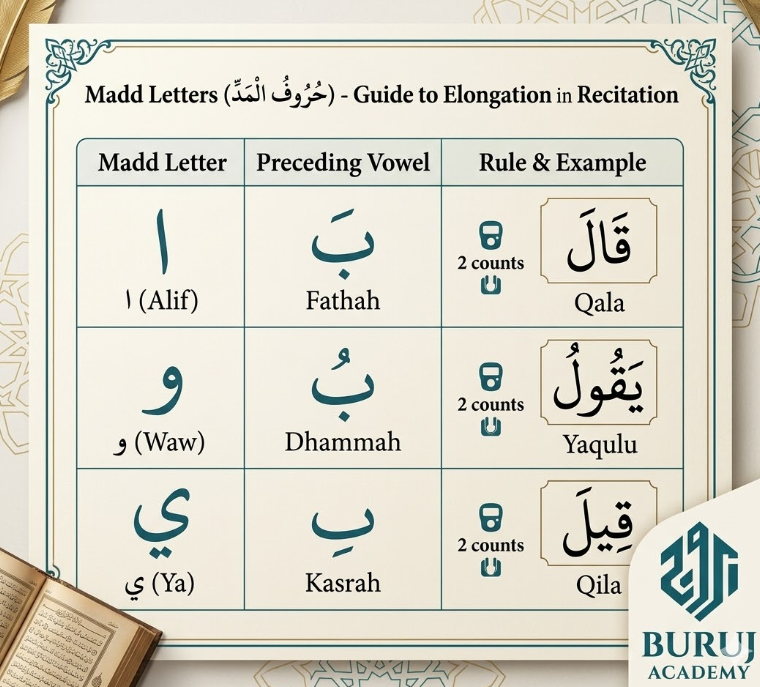
Rushing through Madd at this stage is among the most common mistakes we see in students who later arrive for formal Tajweed instruction. An imprecise two-count Madd Tabii makes learning Madd Muttasil and Madd Munfasil — which extend to four and five counts — significantly harder to calibrate.
6. Learn the Noon Sakinah and Tanween Rules Through Noorani Qaida’s Later Sections
The Noon Sakinah and Tanween rules — Izhar, Idgham, Iqlab, and Ikhfa — are introduced in the advanced sections of Noorani Qaida and represent the student’s first encounter with full Tajweed rule application.
These four rules govern what happens to Noon Sakinah (ن with Sukoon) or Tanween when followed by specific letters. Classical Tajweed scholarship assigns each of the 28 Arabic letters to one of these four categories based on the relationship between the Noon sound and the following letter’s makhraj.
A Practical Overview of the Four Rules
| Rule | Trigger Letters | Tajweed Effect |
| Izhar (Clear pronunciation) | ء هـ ع غ ح خ (6 throat letters) | Noon pronounced clearly with no merging |
| Idgham (Merging) | ي ن م و ل ر (6 letters) | Noon merges into following letter — with or without Ghunnah |
| Iqlab (Conversion) | ب (1 letter only) | Noon converted to Meem sound with Ghunnah |
| Ikhfa (Concealment) | 15 remaining letters | Noon partially concealed with nasal resonance |
For Idgham’s full application with Quranic examples, our article on Idgham rules in Tajweed covers both the with-Ghunnah and without-Ghunnah categories in detail. For Ikhfa specifically, our guide to Ikhfa letters in Tajweed lists all 15 trigger letters with examples.
Through Buruj Academy’s Tajweed for Beginners course, students transition from Qaida-level rule introduction to full Tajweed application with Al-Azhar-trained instructors ensuring accuracy at every stage.
Begin Learning Quran With a FREE Trial Lesson
Read also: How to Learn Quran with Tajweed at Home
7. Apply Everything Through Guided Recitation of Short Quranic Verses
The final and most important stage of learning Noorani Qaida with Tajweed is live application — reciting actual Quranic verses under qualified teacher supervision, with real-time correction of every makhraj, Madd, and rule application.
Noorani Qaida traditionally concludes with short Quranic passages that consolidate all learned material: letters, harakat, Sukoon, Tanween, Madd, and Noon Sakinah rules appearing in real recitation context. This stage cannot be adequately self-taught.
Consider this example from Surah Al-Ikhlas:
قُلْ هُوَ اللَّهُ أَحَدٌ
Qul huwallahu ahad
“Say, He is Allah, [who is] One.” (Al-Ikhlas 112:1)
This single ayah contains: Sukoon on لْ requiring clear pronunciation, the Lam of اللَّهُ requiring Tafkhim after Dhammah, and Tanween on أَحَدٌ requiring Izhar before the following letter.
For students preparing to read the Quran independently after completing Noorani Qaida, our guide on reading the Quran for the first time provides the next structured steps. Students aiming toward memorization can also explore our foundational Tajweed for beginners resource for continued development.
Excel in Your Quranic Studies
Join Buruj Academy and master the Quran with our structured, professional curriculum.
Book Your Free TrialStart Your Noorani Qaida with Tajweed Journey at Buruj Academy
Learning Noorani Qaida with Tajweed correctly from the beginning is the most valuable investment a Quran learner can make — it determines the quality of every recitation that follows for the rest of your life.
Buruj Academy’s Noorani Qaida Online Course offers:
- Ijazah-certified instructors and Al-Azhar University graduates
- 12+ years of experience teaching non-Arabic speakers globally
- The Buruj Method: Sound-before-rules — training correct pronunciation before rule memorization
- Personalized 1-on-1 online sessions with real-time makhraj correction
- Flexible scheduling available 24/7 for students worldwide
- Clear progression from first letter through complete Qaida with Tajweed integration
Join a supportive learning environment tailored to your pace and lifestyle. Start your journey toward excellence by enrolling in one of our specialized tracks:
- Online Tajweed Classes
- Tajweed Classes for Beginners
- Tajweed Classes for Adults
- Tajweed Classes for Sisters
- Tajweed Classes for Kids
- Advanced Tajweed Course
- Amli Tajweed Course (Practical Application)
Book your free trial lesson today and experience the difference structured, teacher-led Qaida instruction makes — Insha’Allah, your Quran reading will never be the same.
Frequently Asked Questions About Learning Noorani Qaida with Tajweed
Can Adults Learn Noorani Qaida with Tajweed, or Is It Only for Children?
Noorani Qaida with Tajweed is highly effective for adults. The structured phonics progression helps adult learners systematically correct pronunciation from their first lesson. In our experience at Buruj Academy, adults who begin with Qaida-integrated Tajweed progress to confident Quran reading significantly faster than those who attempt to learn letters and rules separately.
How Long Does It Take to Complete Noorani Qaida with Tajweed?
Most students complete Noorani Qaida with Tajweed in three to six months with consistent daily practice of 15–20 minutes. This range varies based on prior Arabic exposure, session frequency, and whether instruction is teacher-led or self-guided. Teacher-led instruction consistently produces faster and more accurate results than self-study.
Is It Possible to Learn Noorani Qaida with Tajweed Online?
Yes — online learning is fully effective for Noorani Qaida with Tajweed when conducted as live 1-on-1 sessions with a qualified instructor. The teacher must be able to hear the student’s recitation in real time to correct makhraj errors immediately. Pre-recorded video courses alone are insufficient for accurate Tajweed correction.
What Is the Difference Between Noorani Qaida and Baghdadi Qaida?
Noorani Qaida, compiled by Sheikh Noor Muhammad Haqqani, is specifically designed for non-Arabic speakers and integrates phonics with Tajweed principles progressively. Baghdadi Qaida is an older method primarily used in South Asian traditional settings. Noorani Qaida’s structured progression makes it the more widely recommended choice for English-speaking beginners today.
Do I Need to Know Arabic Before Starting Noorani Qaida?
No prior Arabic knowledge is needed. Noorani Qaida is specifically designed for complete beginners with zero Arabic background. It begins with individual letter recognition and builds systematically through every foundational reading skill, making it the ideal starting point for any non-Arabic speaker beginning their Quran reading path.