 Quran
Quran
| Key Takeaways |
| Memorizing the entire Quran is Fard Kifayah — a collective obligation lifted when enough community members fulfill it. |
| No individual Muslim is sinfully accountable for not memorizing the full Quran, but the reward for doing so is immense. |
| Every Muslim carries a personal obligation to memorize specific portions: Al-Fatihah and at least one short surah for Salah. |
| The Ummah is collectively sinful if no Huffaz exist in a community, making Hifz a communal religious responsibility. |
| Scholars unanimously agree that beginning Hifz, even partially, carries tremendous spiritual merit and draws one closer to Allah. |
Every Muslim encounters this question at some point — whether from genuine curiosity, guilt about not memorizing, or a child asking why their friend is in Hifz class. It is a question that deserves a clear, scholarly answer rooted in authentic Islamic sources.
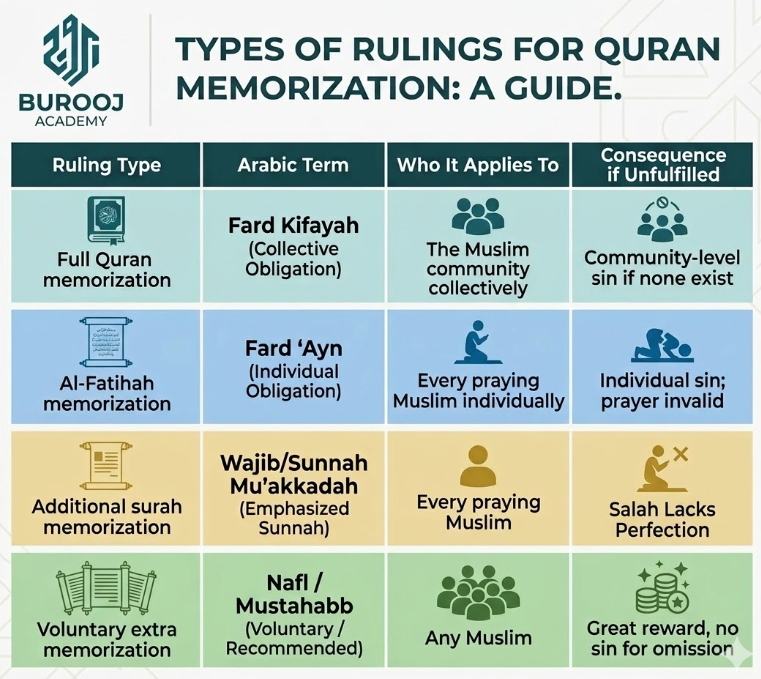
Memorizing the entire Quran is Fard Kifayah — a collective communal obligation — not Fard ‘Ayn (an individual obligation on every Muslim). However, every Muslim must memorize enough Quran to perform their daily prayers correctly, making partial memorization personally obligatory for all.
Table of Contents:
Is Memorizing the Quran Mandatory?
No, it is not mandatory for every Muslim to memorize the Quran. Memorizing the complete Quran is classified as Fard Kifayah in Islamic jurisprudence — an obligation that falls on the Muslim community collectively. When a sufficient number of people in a community memorize the Quran, the obligation is fulfilled for all. If no one does, the entire community bears collective sin.
This classification comes from the recognized scholarly consensus within the four major Sunni madhabs. Imam an-Nawawi and other classical scholars held this position, based on the necessity of preserving the Quran’s oral transmission across generations.
The distinction matters practically. No individual Muslim is sinfully accountable for not completing full Hifz. However, the absence of Huffaz from a Muslim community is a communal failure with real religious consequences.
Read also: Best Time to Memorize Quran
Is Memorizing Al-Fatihah Mandatory for Every Muslim?
Yes — memorizing Surah Al-Fatihah is Fard ‘Ayn on every Muslim who performs Salah. The Prophet ﷺ said, as recorded in Sahih al-Bukhari (756): “There is no prayer for the one who does not recite the Opening of the Book.” This is the individual memorization obligation that applies to every single Muslim, without exception.
Al-Fatihah must be memorized with correct pronunciation to constitute a valid prayer. Scholars also generally hold that memorizing at least a short surah or additional verses beyond Al-Fatihah is either obligatory or a confirmed Sunnah for correct Salah.
At Buruj Academy, our Online Hifz Program begins exactly here — ensuring students first master Al-Fatihah and the short surahs of Juz 30 with proper Tajweed before advancing to full Hifz.
Our Al-Azhar-trained Hifz specialists understand that the foundation of every Muslim’s memorization starts with valid Salah, not ambition alone.
Start Hifz today with a FREE trial session
Discover the Buruj Academy Difference
Step into our virtual classrooms and see how our expert instructors make learning Quran and Arabic intuitive and clear. We focus on overcoming the specific hurdles non-native speakers face, building your confidence and connection with the Quran.
What Are the Rewards of Memorizing the Quran Even If It Is Not Individually Obligatory?
The fact that full Hifz is not individually obligatory does not diminish its immense reward — if anything, the voluntary nature of pursuing it makes the spiritual merit even greater. The Prophet ﷺ described the Hafiz with extraordinary honor, as recorded in Sahih Muslim (798): “The one who is proficient in reciting the Quran will be with the noble, obedient scribes.”
The rewards span both this life and the Hereafter, and scholars have elaborated on them extensively based on authentic hadiths. You can read a detailed treatment of these blessings in our article on the benefits of memorizing the Quran.
What Does the Quran Say About Those Who Carry It?
The Hafiz occupies a unique station in Islamic tradition. The Prophet ﷺ indicated that the Hafiz will be honored on the Day of Judgment, that their parents will receive crowns of light, and that their intercession for family members will be accepted — all in narrations from verified hadith collections.
Allah ﷻ describes the Quran itself:
إِنَّا نَحۡنُ نَزَّلۡنَا ٱلذِّكۡرَ وَإِنَّا لَهُۥ لَحَٰفِظُونَ
Inna nahnu nazzalnadh-dhikra wa inna lahu lahafizoon
“Indeed, it is We who sent down the Reminder, and indeed, We will be its guardian.” (Al-Hijr 15:9)
Scholars note that Allah’s preservation of the Quran is achieved partly through the hearts of the Huffaz — making the memorizer a living vessel of divine preservation.
Excel in Your Quranic Studies
Join Buruj Academy and master the Quran with our structured, professional curriculum.
Book Your Free TrialRead also: Best Age to Memorize Quran
Is Memorizing the Quran Mandatory for Children?
Memorizing the Quran is not individually obligatory on children in a legal sense — children have not yet reached the age of Taklif (religious accountability). However, scholars and educators unanimously emphasize beginning Hifz in childhood as the most effective and spiritually sound approach, given the brain’s natural capacity for memorization at young ages.
Parents carry responsibility for their children’s Islamic education, including teaching them enough Quran to pray correctly.
Introducing children to Hifz early fulfills multiple responsibilities simultaneously — proper Salah preparation, Quran relationship-building, and preservation of the communal obligation.
Buruj Academy’s Hifz for Kids uses age-appropriate techniques including short sessions, positive reinforcement, and engaging revision methods — designed specifically for children aged 4–15 with instructors trained in child pedagogy.
Start your child’s Hifz classes for free session
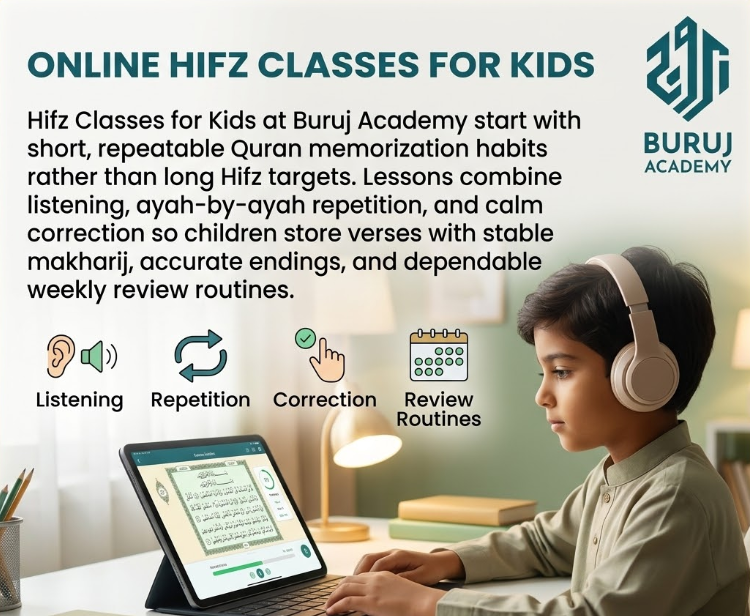
In our experience at Buruj Academy, children who begin memorization between ages 5 and 10 demonstrate significantly faster retention and stronger long-term recall than those who begin in their teens, even when the younger children spend fewer total hours per week on memorization.
What Portion of the Quran Should Every Muslim Memorize at Minimum?
Every Muslim who prays must memorize Surah Al-Fatihah as a personal religious obligation.
Beyond that, scholars differ on the exact minimum, but the majority position holds that memorizing additional short surahs is at minimum a confirmed Sunnah — and many scholars classify it as obligatory for valid Salah.
A practical minimum framework used by traditional scholars looks like this:
| Memorization Level | What to Memorize | Status |
| Absolute minimum | Surah Al-Fatihah | Fard ‘Ayn — individually obligatory |
| Recommended minimum | Al-Fatihah + 3–5 short surahs | Wajib / Sunnah Mu’akkadah |
| Communal obligation | Complete Quran (30 Juz) | Fard Kifayah — collectively obligatory |
| Highly recommended | Juz Amma (Juz 30) | Strongly recommended for all Muslims |
Buruj Academy’s Juz 30 Memorization course targets this practical minimum beautifully — helping students memorize the most commonly recited surahs with proper Tajweed, making their Salah more varied and spiritually enriching.
Book Your First Session in Buruj’s Juz 30 Memorization Course

Explore our Quran memorization schedule guide for a structured approach to reaching this level.
Can Adults Fulfill the Communal Hifz Obligation Later in Life?
Absolutely — and many do so with remarkable success. The Fard Kifayah ruling carries no age restriction. Adults who pursue Hifz are participating in the fulfillment of a communal religious duty while simultaneously accumulating the profound personal rewards of becoming a Hafiz.
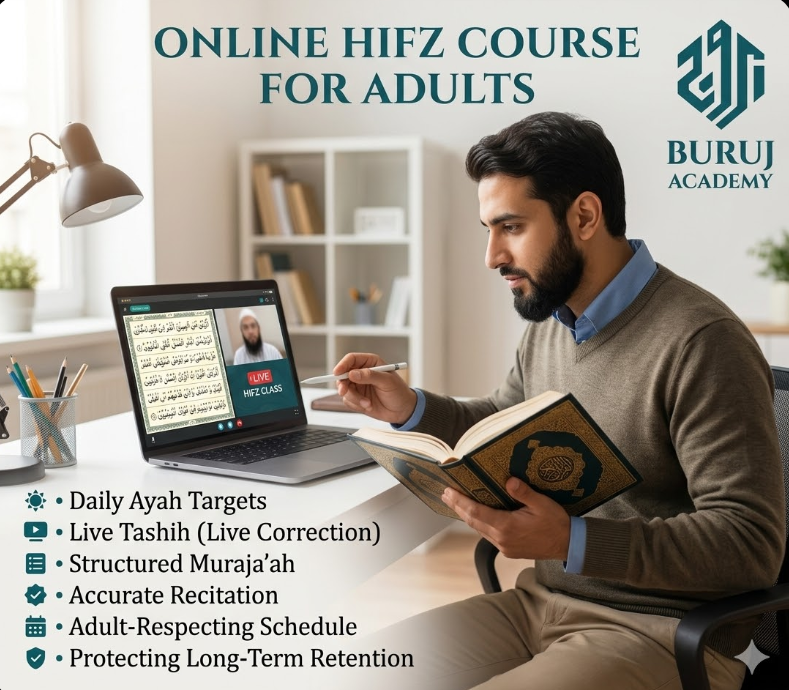
The common misconception that Hifz is only for children prevents many capable adults from pursuing one of the most spiritually rewarding acts available to a Muslim. We have guided hundreds of adults at Buruj Academy through their memorization — professionals, parents, and retirees alike — using systems built specifically for adult learning patterns.
Buruj Academy’s Hifz for Adults provides realistic strategies for those balancing work, family, and Quran memorization, with flexible pacing and retention systems designed for busy adults.
Book Your Free Trial Lesson with Burruj’s Hifz Course for Adults
For practical guidance on accelerating this process, our article on how to memorize Quran faster offers evidence-based techniques our instructors use daily.
Discover the best time to memorize Quran — both spiritually and scientifically — to maximize your daily retention as an adult learner.
Excel in Your Quranic Studies
Join Buruj Academy and master the Quran with our structured, professional curriculum.
Book Your Free TrialEmbark on Your Journey to Becoming a Hafiz
Carry the words of the Divine in your heart and transform your life through the noble pursuit of Hifz. At Buruj Academy, we provide a structured, supportive, and highly personalized environment to help you achieve your memorization goals, whether you are starting with the final chapters or aspiring to complete the entire Quran.
Our experienced tutors employ proven techniques to ensure long-term retention (Mutqin) and spiritual growth, making the path to memorization accessible for every member of the family.
Take the first step toward this lifelong blessing by enrolling in a program tailored to your pace:
- Online Hifz Program (Comprehensive Quran Memorization)
- Juz 30 Memorization Course (Perfect for focused starts)
- Hifz Classes for Kids (Engaging and interactive)
- Hifz Classes for Adults (Flexible scheduling for busy lives)
- Hifz Classes for Sisters (Private, supportive learning)
- Short Surah Memorization Course (Ideal for daily prayers)
- Hifz Ijazah Course (For advanced students seeking certification)
Don’t let another day pass without moving closer to your goal. Join Buruj Academy today and schedule your free trial session to begin your Hifz journey!
Frequently Asked Questions About Quran Memorization Obligation
Is it a sin to not memorize the entire Quran?
No — not memorizing the complete Quran is not sinful for an individual Muslim. Full Quran memorization is Fard Kifayah, a collective obligation. However, failing to memorize Surah Al-Fatihah is individually sinful, as it renders Salah invalid. Communities entirely lacking Huffaz bear collective religious responsibility for that gap.
What is the minimum Quran every Muslim must memorize?
Every Muslim who prays must memorize Surah Al-Fatihah — this is an individual obligation without exception. Beyond Al-Fatihah, memorizing additional short surahs is a confirmed Sunnah or obligatory according to most scholars, making Juz Amma a practical and strongly recommended minimum for all Muslims.
Does memorizing the Quran have a specific reward in Islam?
Yes — the rewards are substantial and well-documented in authentic hadiths. The Hafiz is promised an elevated rank in Jannah, their parents receive crowns of light on the Day of Judgment, and they are described as being among the noble scribes in the Hereafter, as narrated in Sahih Muslim (798).
Is Hifz only for children, or can adults memorize the Quran too?
Hifz is not restricted to children. Adults memorize the Quran successfully at all ages. While younger learners generally retain faster, adult learners bring discipline, motivation, and understanding that compensate effectively. With proper guidance and consistent daily practice, adults regularly complete Hifz of Juz 30 and beyond. Explore our reading the Quran for the first time guide if you are just beginning.
What is Fard Kifayah and how does it apply to Quran memorization?
Fard Kifayah is a collective religious obligation in Islamic jurisprudence — fulfilled when enough community members perform it, lifted from all others when they do. Applied to Quran memorization, it means the Ummah must ensure Huffaz exist in every community. If none do, the entire community bears sin for neglecting this communal duty.