 Arabic
| Key Takeaways |
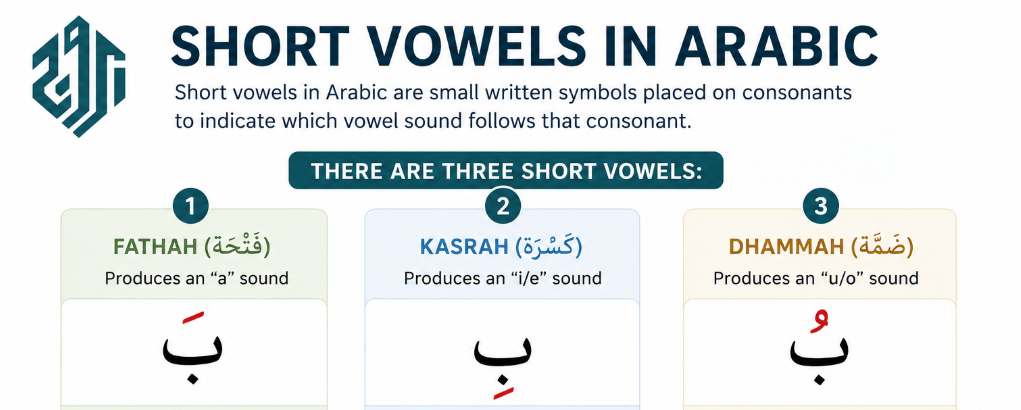
| Arabic has three short vowel marks — Fatha, Kasra, and Damma — plus Sukoon, which shows no vowel sound at all. |
| Fatha is a small diagonal line above a letter and makes an “ah” sound, as in بَ (ba). |
| Kasra sits below a letter and makes an “ee” sound, as in بِ (bi), while Damma sits above and makes “oo,” as in بُ (bu). |
| Children typically recognize all three short vowels within 2–3 weeks of daily 10-minute practice sessions. |
| Long vowels extend the short vowel sound using the letters Alif, Waw, or Yaa, turning “ba” into “baa.” |
Learning Arabic letters is only half the picture — without vowel marks, a child cannot actually read a word out loud. Many parents notice their child can name every letter of the alphabet but freezes the moment a real word appears on the page.
Arabic vowels for kids fall into three short marks — Fatha, Kasra, and Damma — plus Sukoon for a silent consonant. Each mark sits directly on a letter and tells a child exactly which sound to make, turning static letters into readable, spoken words.
Table of Contents:
What Are Arabic Vowels for Kids?
Arabic vowels are small marks placed above or below a letter that tell a reader which sound to add after the consonant. Without a vowel mark, a letter like بـ has no sound of its own — it simply sits silently on the page waiting for direction.
In our sessions at Buruj Academy, one pattern shows up again and again with young beginners. A child memorizes the 28 letters perfectly through songs and flashcards, then stares blankly at a simple three-letter word.
The letters alone were never going to be enough. Vowels are the missing piece that turns a row of shapes into an actual sound a child can say out loud.
This is exactly why we introduce vowel marks early and consistently in our Online Arabic Classes for Kids, rather than treating them as an advanced afterthought.
Book your FREE Arabic trial online Arabic class at Buruj

The Three Short Vowels Every Child Should Learn First
Arabic has three short vowels, and each one has its own name, shape, and sound. Learning all three together — rather than one at a time — helps children compare them and hear the differences clearly from day one.
| Vowel Name | Arabic Symbol | Shape & Position | Sound It Makes |
| Fatha | ـَ | Small diagonal line above the letter | “ah” (like in “cat”) |
| Kasra | ـِ | Small diagonal line below the letter | “ee” (like in “see”) |
| Damma | ـُ | Small curl above the letter, like a tiny waw | “oo” (like in “food”) |
Notice that Fatha and Damma both sit above the letter, while Kasra always sits underneath. This position rule is one of the fastest ways for kids to tell the marks apart at a glance.
How Does Fatha Change the Sound of an Arabic Letter?
Fatha is a small diagonal stroke placed directly above an Arabic letter, and it adds a short “ah” sound right after that letter. It is the first vowel we teach at Buruj Academy because its sound is short, clear, and easy for young mouths to produce.
When Fatha sits above the letter ب (baa), the letter becomes بَ, pronounced “ba” — like the beginning of the English word “bat.” The same rule applies to every letter in the alphabet.
Students learning our Arabic Alphabet Learning Course often find Fatha the easiest starting point because the mouth barely moves, making it low-pressure for nervous beginners.
Fatha Examples Across Different Letters
Seeing Fatha applied to several letters in a row helps a child notice the pattern instead of memorizing each combination separately.
| Letter | With Fatha | Pronunciation | Simple Meaning Clue |
| ب | بَ | “ba” | sound in “bat” |
| ت | تَ | “ta” | sound in “tap” |
| د | دَ | “da” | sound in “dad” |
| س | سَ | “sa” | sound in “sun” (short) |
Try this with your child: point to any letter card, draw a tiny diagonal line above it, and ask them to add the “ah” sound. Repeat with five different letters in under two minutes.
Get a free trial now in Buruj’s Alphabet course
What Sound Does Kasra Add Below an Arabic Letter?
Kasra is a short diagonal line placed underneath an Arabic letter, and it produces an “ee” sound immediately following that letter. Its position below the letter is the single clearest visual signal for a young reader to notice.
When Kasra appears beneath ب, the combination becomes بِ, pronounced “bi” — similar to the “bee” sound but shorter and lighter.
This under-the-letter placement never changes, which makes Kasra highly predictable once a child learns to look down.
We often tell parents in our Online Arabic Classes that Kasra confusion usually clears up the moment a child physically traces the line with a finger, moving downward instead of upward.
Read also: Arabic Noorani Qaida for Kids
A Simple Trick for Remembering Kasra’s Position
Children often mix up Fatha and Kasra at first because both are small diagonal lines. We use a physical memory trick that has worked consistently across many of our beginner classes.
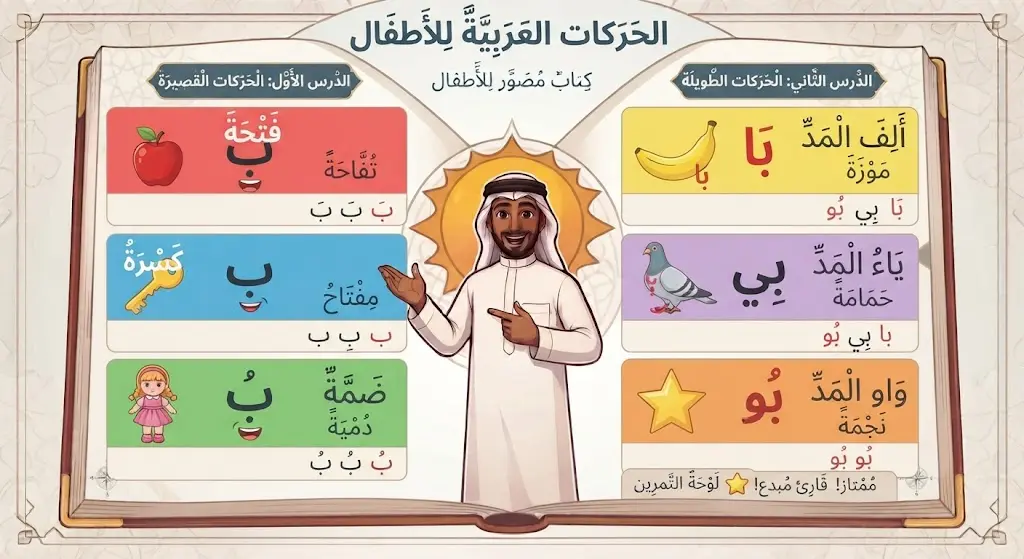
- Fatha “stands up tall” above the letter, like a person standing straight
- Kasra “sits down low” beneath the letter, like a person sitting on the floor
- Practice by having your child stand for every Fatha they see and crouch for every Kasra
This kind of movement-based learning keeps young attention spans engaged far longer than flashcards alone.
Discover the Buruj Academy Difference
Step into our virtual classrooms and see how our expert instructors make learning Quran and Arabic intuitive and clear. We focus on overcoming the specific hurdles non-native speakers face, building your confidence and connection with the Quran.
Master the Arabic Language
Join our expert-led courses and build a strong foundation in Classical and Modern Arabic.
Get Your Free TrialHow Is Damma Different From Fatha in Both Shape and Sound?
Damma is a small curved mark placed above an Arabic letter, resembling a tiny waw, and it produces an “oo” sound right after the letter. Though it shares the above-letter position with Fatha, its rounded shape and rounder sound make it distinct once children slow down to look closely.
When Damma sits above ب, the letter becomes بُ, pronounced “bu” — similar to the “oo” in “book.” The lips actually round forward to produce this sound, which is a helpful physical cue for kids to notice and mimic.
Comparing All Three Short Vowels Side by Side
Putting Fatha, Kasra, and Damma on the same letter at once is one of the most effective drills we use, because it forces a child to focus entirely on the mark rather than guessing from context.
| Vowel Applied to ب | Written Form | Sound | Lip Position |
| Fatha | بَ | “ba” | Mouth opens wide |
| Kasra | بِ | “bi” | Mouth stays narrow, corners stretch |
| Damma | بُ | “bu” | Lips round forward |
Ask your child to say all three sounds back to back — “ba, bi, bu” — while watching their mouth in a mirror. The visible lip changes make the differences stick faster than sound alone.
How Do Long Vowels Extend the Short Vowel Sounds?
Long vowels stretch a short vowel sound using one of three letters — Alif, Waw, or Yaa — so that “ba” becomes “baa,” a sound held roughly twice as long. Long vowels always build directly on top of a short vowel a child has already mastered, which is why we introduce them only after Fatha, Kasra, and Damma feel automatic.
Alif extends Fatha, turning بَ into با, pronounced “baa.” Waw extends Damma, turning بُ into بُو, pronounced “boo.” Yaa extends Kasra, turning بِ into بِي, pronounced “bee.”
Read also: Arabic Reading Practice for Kids
Short Vowel and Long Vowel Pairs
Seeing each short vowel next to its matching long vowel partner makes the extension pattern click for most children within a single session.
| Short Vowel | Extending Letter | Long Vowel Result | Sound |
| Fatha (بَ) | Alif (ا) | با | “baa” (held longer) |
| Kasra (بِ) | Yaa (ي) | بِي | “bee” (held longer) |
| Damma (بُ) | Waw (و) | بُو | “boo” (held longer) |
A useful timing trick: ask your child to clap once for a short vowel and clap-and-hold for a long vowel, so the length difference becomes something they physically feel rather than only hear.
Simple Practice Exercises to Try With Your Child Today
Repetition across short, playful sessions builds vowel recognition far more reliably than one long study session ever could. We recommend 10–15 minutes daily rather than longer, infrequent sessions, since young attention naturally drifts after that window.
Exercise 1 — Vowel Spotting Game
Write five letters on cards, each with a different vowel mark. Ask your child to say the letter-plus-vowel sound out loud as quickly as they can, then shuffle and repeat.
Exercise 2 — Mystery Vowel Challenge
Say a sound out loud, such as “mi,” and ask your child to write the letter م with the correct vowel mark underneath. This flips the usual direction of the exercise and strengthens recall from a completely different angle.
Exercise 3 — Build a Silly Word
Combine three letters with vowels of your child’s choosing to build a nonsense word. Sound it out together — the goal is fluent blending, not real meaning, so silliness is genuinely welcome here.
Learn Arabic Vowels the Right Way with Buruj Academy
Mastering Fatha, Kasra, Damma, and Sukoon gives children the exact tools they need to sound out real Arabic words with confidence. Getting this foundation right early prevents frustration and guesswork later on.
Buruj Academy’s Online Arabic Classes for Kids are taught by Al-Azhar University graduates with over 12 years of experience teaching non-Arabic speakers of all ages.
Each child receives a Personalized Learning Plan matched to their age and pace, delivered through flexible, patient 1-on-1 online sessions. Real-time correction means vowel mistakes get fixed immediately, before they turn into habits.
Ready to see how quickly your child can start sounding out real Arabic words? Book a free trial lesson with Buruj Academy today.
Enroll your child in one of our specialized, kid-friendly tracks today:
- Online Quran Classes for Kids
- Tajweed Classes for Kids
- Hifz Classes for Kids
- Online Arabic Classes for Kids
- Quranic Arabic Course for Kids
- Noorani Qaida Course for Kids
- Islamic Studies Classes for Kids
Ready to watch your child grow in knowledge and character? Join the Buruj Academy family and book a free trial session for your child today!
Master the Arabic Language
Join our expert-led courses and build a strong foundation in Classical and Modern Arabic.
Get Your Free TrialConclusion
Arabic vowels turn silent, motionless letters into words a child can actually read out loud, and that shift happens through just four small marks. Fatha, Kasra, and Damma each add a distinct short sound, while Sukoon marks the moments where no sound is added at all.
Long vowels then build naturally on top of these short sounds once a child feels confident, stretching “ba” into “baa” through Alif, Waw, or Yaa. With short daily practice and playful repetition, most children move from recognizing individual marks to blending full words within a matter of weeks.
Read also: Daily Routine for Kids in Arabic
Frequently Asked Questions About Arabic Vowels for Kids
What Age Should a Child Start Learning Arabic Vowels?
Most children are ready to begin learning Fatha, Kasra, and Damma between ages 4 and 6, once they can reliably recognize individual Arabic letters. Starting vowel marks too early, before letter recognition is solid, often causes confusion rather than faster progress.
How Long Does It Take for a Child to Learn All Three Short Vowels?
With daily 10–15 minute practice sessions, most children recognize and correctly apply Fatha, Kasra, and Damma within 2–3 weeks. Consistency matters far more than session length — short daily practice consistently outperforms occasional longer sessions.
What Is the Difference Between a Short Vowel and a Long Vowel in Arabic?
A short vowel like Fatha, Kasra, or Damma adds one quick sound after a letter, while a long vowel stretches that same sound roughly twice as long using Alif, Waw, or Yaa. Long vowels are always introduced after short vowels are fully mastered.
Why Does My Child Keep Confusing Fatha and Kasra?
Fatha and Kasra look similar because both are small diagonal lines, differing mainly in position — Fatha above the letter, Kasra below it. Physical movement tricks, like standing for Fatha and crouching for Kasra, typically resolve this confusion within a few practice sessions.