 Arabic
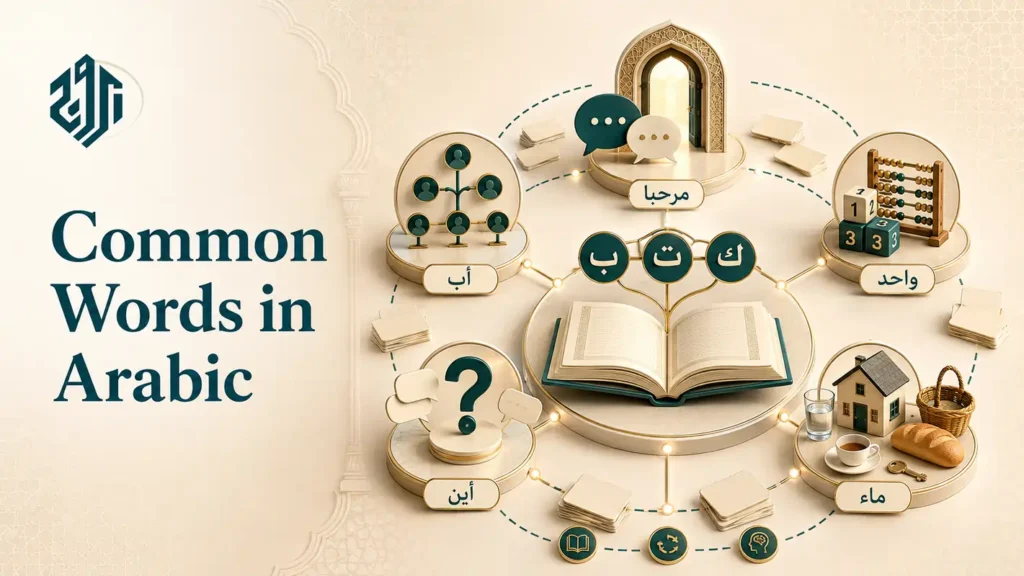
| Key Takeaways |
| Everyday Arabic relies on roughly 300 to 500 high-frequency words for basic daily conversations and comprehension. |
| Common Arabic greeting words like مرحبا and السلام عليكم carry distinct social and religious weight in daily use. |
| Modern Standard Arabic and spoken dialects share core vocabulary but differ significantly in pronunciation and everyday phrasing. |
| Grouping words by category — greetings, family, numbers, food — speeds up retention far more than random memorization. |
| Daily exposure through short phrases and repetition builds functional Arabic vocabulary faster than studying grammar rules alone. |
Many new Arabic learners open a textbook, meet 200 unfamiliar words on page one, and close it within a week. That frustration is avoidable with the right starting vocabulary.
The most common Arabic words cover greetings, family terms, numbers, and daily expressions — a core set of roughly 300 to 500 words that native speakers use in the majority of everyday conversations. Mastering these first builds real confidence before grammar complexity enters the picture.
Table of Contents:
What Are the Most Common Words in Arabic for Daily Conversation?
The most common Arabic words fall into predictable categories: greetings, courtesy phrases, family terms, numbers, colors, food, and question words. These roughly 100 to 150 words appear in nearly every daily interaction, from greeting a neighbor to ordering a meal.
Linguists studying frequency in Modern Standard Arabic and major spoken dialects consistently find that a small set of words does most of the communicative work.
In our sessions at Buruj Academy, we’ve observed that adult beginners who memorize these core categories in their first two weeks recognize spoken Arabic far sooner than those who jump straight into grammar textbooks.
This pattern matches general second-language acquisition research: a limited high-frequency vocabulary set unlocks disproportionate comprehension.
Arabic is no exception, and its root-based structure makes the payoff even larger, since one root often unlocks several related words at once.
Before diving into categories, it helps to understand why Arabic vocabulary feels different from European languages at first. Every word connects to a three-letter root, and recognizing that root is often more useful than memorizing the word in isolation.
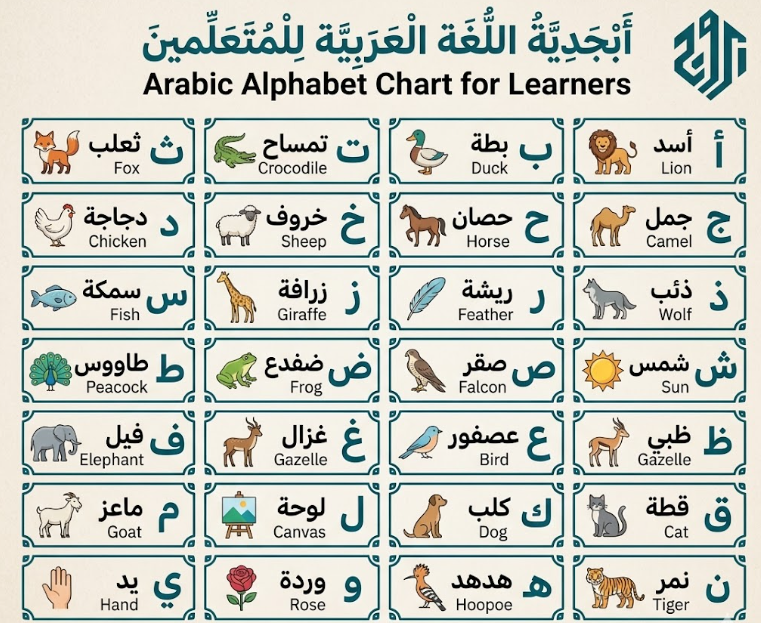
Our Arabic alphabet with pictures for kids guide is a helpful starting point if letter shapes still feel unfamiliar.
Why Root-Based Learning Speeds Up Arabic Vocabulary Retention
Arabic words are built from three-letter roots that carry a core meaning across multiple related words. The root ك-ت-ب (k-t-b), tied to writing, produces كتاب (book), كاتب (writer), and مكتبة (library).
Once a learner spots this pattern, vocabulary stops feeling like hundreds of disconnected items. Instead, it becomes a smaller set of roots that branch into predictable forms.
Table 1 shows how three common roots expand into everyday vocabulary.
| Root | Core Meaning | Related Words |
| د-ر-س (d-r-s) | study/lesson | دَرْس (lesson), مدرسة (school), مدرّس (teacher) |
| ع-ل-م (ʿ-l-m) | knowledge | عِلْم (knowledge), معلومات (information), عالِم (scholar) |
| ح-ب-ب (ḥ-b-b) | love/liking | حُبّ (love), حبيب (beloved), يحب (he loves) |
Recognizing roots like these turns vocabulary study into pattern recognition rather than rote memorization of unrelated items.
At Buruj Academy, our Online Arabic Classes teach vocabulary through this root-based, context-before-abstraction approach from the very first lesson, rather than presenting isolated word lists disconnected from real sentence use.
Book your FREE Arabic trial online Arabic class at Buruj

What Are The Most Frequent Greeting Expressions in Arabic?
Arabic greetings range from the universal السلام عليكم (peace be upon you) to the casual مرحبا (hello), and choosing the right one depends on context, formality, and relationship. Getting greetings right is often a learner’s first real test of cultural fluency.
السلام عليكم carries religious and social weight beyond a simple “hello.” It is a greeting exchanged among Muslims worldwide, and the expected response is وعليكم السلام (and peace be upon you too).
مرحبا works in nearly any setting, formal or casual, and doesn’t carry the same religious specificity. أهلا وسهلا, meaning “welcome,” is commonly used when receiving a guest into a home or space.
| Arabic | Transliteration | Meaning | Typical Use |
| السلام عليكم | As-salamu alaykum | Peace be upon you | Universal Islamic greeting |
| وعليكم السلام | Wa alaykum as-salam | And peace be upon you | Standard reply |
| مرحبا | Marhaban | Hello | General, any context |
| أهلا وسهلا | Ahlan wa sahlan | Welcome | Greeting a guest |
| صباح الخير | Sabah al-khair | Good morning | Morning greeting |
| مساء الخير | Masaa al-khair | Good evening | Evening greeting |
Common Mistakes Non-Native Speakers Make With Greetings
Students frequently reply to السلام عليكم with مرحبا instead of the expected وعليكم السلام, which sounds mismatched to native ears even though both are polite. We regularly hear this exact substitution during introductory conversation practice.
Another frequent slip is using مساء الخير in the morning out of habit from English-language patterns, where “good evening” and “good morning” feel interchangeable in casual speech. Arabic speakers notice this mismatch immediately, since time-of-day greetings are used precisely.
Our instructors also notice students dropping the response entirely and repeating the same greeting back, rather than switching to the reply form. This small habit is easy to correct with a few days of deliberate practice pairing each greeting with its exact response.
If greetings feel shaky, our how to improve Arabic speaking skills article covers structured practice methods that build this kind of conversational muscle memory.
Read More: How to Learn Arabic Vocabulary?
What Are the Most Important Family and Relationship Words in Arabic?
Family vocabulary in Arabic distinguishes maternal and paternal relatives with separate words, unlike English’s single terms for “uncle” or “aunt.” أب (father), أم (mother), أخ (brother), and أخت (sister) form the core, but extended family requires more precision.
عمّ refers specifically to a paternal uncle, while خال refers to a maternal uncle — two entirely different words for what English collapses into one term. The same distinction applies to aunts: عمّة (paternal aunt) versus خالة (maternal aunt).
This precision reflects how Arabic-speaking cultures track lineage and family structure. Learning the distinction early prevents confusion in real conversations about family, which come up constantly in daily social interaction.
| Arabic | Transliteration | Meaning |
| أب | Ab | Father |
| أم | Umm | Mother |
| أخ | Akh | Brother |
| أخت | Ukht | Sister |
| عمّ | Amm | Paternal uncle |
| خال | Khaal | Maternal uncle |
| جدّ | Jadd | Grandfather |
| جدّة | Jaddah | Grandmother |
A Practical Exercise for Family Vocabulary
Try building your own family tree using only Arabic labels, starting with immediate family and expanding outward to aunts, uncles, and grandparents. Write each person’s name next to their correct Arabic term.
This exercise works because it ties vocabulary to real people you already know, rather than abstract examples. Students in our beginner-level Arabic sessions consistently retain family vocabulary faster than color or number vocabulary, likely because the emotional connection to real relatives reinforces memory.
Once the paternal and maternal uncle and aunt distinction feels natural, most other family terms follow the same logical pattern without much additional effort.
Read More: Beautiful Arabic Words with Deep Meaning to Enrich Your Vocabulary
How Do Arabic Numbers Work in Daily Speech?
Arabic numbers from one to ten form the foundation for counting, telling time, prices, and dates, and they follow a distinct grammatical rule where numbers three through ten reverse gender agreement with the noun they count. This reversal confuses nearly every beginner at first encounter.
واحد (one) through عشرة (ten) are the essential starting set. Beyond ten, Arabic numbers combine ones and tens in a pattern that becomes predictable once the first twenty are memorized.
The gender reversal rule means a feminine noun takes a masculine-form number, and a masculine noun takes a feminine-form number, for the numbers three through ten specifically. This is one of the more counterintuitive rules in Arabic grammar for English speakers.
Table 4 lists numbers one through ten with their standalone forms.
| Number | Arabic | Transliteration |
| 1 | واحد | Wahid |
| 2 | اثنان | Ithnan |
| 3 | ثلاثة | Thalatha |
| 4 | أربعة | Arba’a |
| 5 | خمسة | Khamsa |
| 6 | ستة | Sitta |
| 7 | سبعة | Sab’a |
| 8 | ثمانية | Thamaniya |
| 9 | تسعة | Tis’a |
| 10 | عشرة | Ashara |
For a full breakdown of counting rules, gender agreement, and higher numbers, our dedicated numbers in Arabic guide walks through the complete system step by step.
Read also:Understanding Arabic Dialects
Discover the Buruj Academy Difference
Step into our virtual classrooms and see how our expert instructors make learning Quran and Arabic intuitive and clear. We focus on overcoming the specific hurdles non-native speakers face, building your confidence and connection with the Quran.
Master the Arabic Language
Join our expert-led courses and build a strong foundation in Classical and Modern Arabic.
Get Your Free TrialWhat Question Words Should Beginners Memorize First in Arabic?
Question words unlock two-way conversation, and Arabic’s core set — ماذا (what), من (who), متى (when), أين (where), لماذا (why), and كيف (how) — appears in nearly every functional exchange. Memorizing these six words early transforms passive vocabulary into active conversation ability.
من هذا؟ (Who is this?) and أين البيت؟ (Where is the house?) are examples of how quickly these words combine with vocabulary already covered to form real questions. This is the point where isolated word lists start becoming actual communication.
كيف حالك؟ (How are you?) deserves special mention, since it is one of the most frequently used phrases in daily Arabic and often the first full question a beginner learns to both ask and answer.
| Arabic | Transliteration | Meaning |
| ماذا | Madha | What |
| من | Man | Who |
| متى | Mata | When |
| أين | Ayna | Where |
| لماذا | Limadha | Why |
| كيف | Kayfa | How |
Building Simple Questions With These Words
A useful exercise is combining each question word with a family or greeting term already learned. من أبوك؟ (Who is your father?) uses vocabulary from two categories at once, reinforcing both simultaneously.
We’ve found in our teaching that students who practice combining categories — questions with family words, questions with numbers — retain both sets faster than studying them in isolation.
This layered approach mirrors how the Buruj Method in Arabic grammar course builds context before introducing abstract grammar rules.
Our Arabic sentence structure guide explains how these questions fit into complete sentence patterns once individual words feel comfortable.
Understand the Arabic Grammar with Buruj’s free trial lesson
What Are Common Arabic Food and Daily Life Words?
Food and daily-life vocabulary — خبز (bread), ماء (water), شاي (tea), قهوة (coffee), and بيت (house) — forms the backbone of practical, survival-level Arabic that gets used in markets, restaurants, and homes daily. These words see far more real-world repetition than abstract vocabulary categories.
طعام (food) and مطعم (restaurant) share the same root, reinforcing the root-pattern connection covered earlier in this article. Recognizing that shared root makes both words easier to remember together rather than separately.
سيارة (car), مدينة (city), and شارع (street) round out the essential daily-life category, covering the vocabulary needed for basic navigation and errands in an Arabic-speaking environment.
Table 6 organizes core food and daily-life vocabulary by category.
| Category | Arabic | Transliteration | Meaning |
| Food | خبز | Khubz | Bread |
| Food | ماء | Maa | Water |
| Food | شاي | Shay | Tea |
| Food | قهوة | Qahwa | Coffee |
| Daily Life | بيت | Bayt | House |
| Daily Life | سيارة | Sayyara | Car |
| Daily Life | مدينة | Madina | City |
| Daily Life | شارع | Shari’ | Street |
A Practical Market Dialogue Exercise
Practice ordering at an imaginary market stall using only the words above: أريد خبزاً وماءً, من فضلك (I want bread and water, please). This kind of short, functional sentence builds confidence quickly because it mirrors a real transaction.
Students consistently tell our instructors that food vocabulary feels more “usable” than any other category, likely because it comes up daily regardless of whether someone travels, cooks, or simply orders at a restaurant. This immediate usability is exactly why we recommend starting daily-life categories early rather than saving them for later lessons.
Read More: The Most Beautiful Arabic Words and Their Meanings
How Should Beginners Practice and Retain These Words Daily?
Daily retention of Arabic vocabulary depends on spaced repetition, categorized grouping, and active use in short sentences rather than passive flashcard review alone. Combining new words with previously learned categories multiplies retention far beyond isolated memorization.
Reviewing five to ten words per day, grouped by category, tends to outperform cramming fifty unrelated words in a single sitting. Our instructors consistently notice this pattern across both children and adult learners.
Writing new words by hand, even briefly, engages a different memory pathway than simply reading them on a screen. This small habit compounds significantly over several weeks of consistent practice.
A Seven-Day Practice Schedule
Table 7 outlines a simple weekly rotation for reviewing the categories covered in this article.
| Day | Focus Category | Practice Task |
| 1–2 | Greetings | Practice full greeting-and-reply pairs aloud |
| 3–4 | Family | Build a labeled family tree |
| 5 | Numbers | Count objects around the house in Arabic |
| 6 | Questions | Form five questions using new vocabulary |
| 7 | Food & Daily Life | Practice a short market dialogue |
This kind of structured rotation is precisely what our Online Arabic Classes for Beginners are built around, pairing each vocabulary category with guided speaking practice rather than leaving retention to chance.
For more structured vocabulary techniques beyond this weekly rotation, our mastering Arabic vocabulary tips article expands on memory techniques suited to different learning styles.
Begin learning Arabic at Buruj with a FREE trial lesson

Discover the Buruj Academy Difference
Step into our virtual classrooms and see how our expert instructors make learning Quran and Arabic intuitive and clear. We focus on overcoming the specific hurdles non-native speakers face, building your confidence and connection with the Quran.
Master the Arabic Language
Join our expert-led courses and build a strong foundation in Classical and Modern Arabic.
Get Your Free TrialBuild Real Arabic Fluency With Buruj Academy’s Expert Instructors
Recognizing common words is the first step, but real fluency comes from consistent, guided practice with proper pronunciation feedback. Vocabulary lists alone rarely translate into confident, spoken Arabic without structured support.
Buruj Academy’s Online Arabic Classes pair every student with instructors who hold Al-Azhar University backgrounds and 12+ years of experience teaching non-native speakers specifically.
Our Buruj Method builds vocabulary through context before abstraction, exactly as demonstrated throughout this article.
Every learning plan is personalized to age, level, and pace, with real-time pronunciation correction built into flexible 1-on-1 sessions available around the clock.
Book a free trial lesson today and experience firsthand how quickly structured, expert-guided practice turns memorized word lists into real conversational confidence.
Begin your transformation today by choosing the path that fits your goals:
- Online Arabic Classes (General & Comprehensive)
- Arabic Course for Beginners
- Arabic Alphabet Learning Course
- Online Arabic Classes for Kids
- Arabic Classes for Adults
- Arabic Grammar Course (Nahw & Sarf)
- Intermediate Arabic Course (B1/B2)
- Arabic Speaking Course (Conversational Fluency)
- Arabic Reading Course (Literary Excellence)
- Learn Arabic Writing Course (Calligraphy & Composition)
Ready to speak with confidence? Join the global community at Buruj Academy and book your free placement interview today!
Master the Arabic Language
Join our expert-led courses and build a strong foundation in Classical and Modern Arabic.
Get Your Free TrialConclusion
Fluency rarely starts with grammar textbooks — it starts with the words people actually use every day. Greetings, family terms, numbers, and daily vocabulary form the foundation everything else builds on.
Grouping words by root and category, rather than memorizing random lists, turns Arabic from an intimidating wall of script into a recognizable, learnable system. The exercises throughout this article are designed to make that shift practical, not just theoretical.
Consistent daily practice, even five words at a time, compounds into real conversational ability far faster than most learners expect.
Frequently Asked Questions About Common Arabic Words
How Many Common Words Does a Beginner Need to Speak Basic Arabic?
Around 300 to 500 high-frequency words cover most daily conversational needs, including greetings, family terms, numbers, and common verbs. This is far fewer than the tens of thousands of words in a full Arabic dictionary, making early fluency achievable.
What Is the Difference Between Modern Standard Arabic and Spoken Dialect Words?
Modern Standard Arabic is used in writing, news, and formal settings, while spoken dialects vary by region and are used in daily conversation. Core vocabulary often overlaps, but pronunciation and casual phrasing differ significantly between the two.
Is It Better to Learn Arabic Words by Category or Alphabetically?
Category-based learning, such as grouping greetings, family terms, or numbers together, builds faster retention than alphabetical word lists. Categories mirror how vocabulary is actually used in real conversation, reinforcing memory through context.
How Long Does It Take to Memorize 100 Common Arabic Words?
Most learners memorize 100 core words within two to four weeks with daily, categorized practice of 5 to 10 words per day. Retention improves significantly when words are grouped by root or theme rather than studied in random order.