 Arabic
| Key Takeaways |
| Kasra (كَسْرَة) is a short vowel diacritic written as a small diagonal line placed beneath Arabic letters, producing the short “i” sound. |
| Kasra changes any consonant into a syllable with an “i” vowel, making it one of three essential short vowels alongside fatha and damma. |
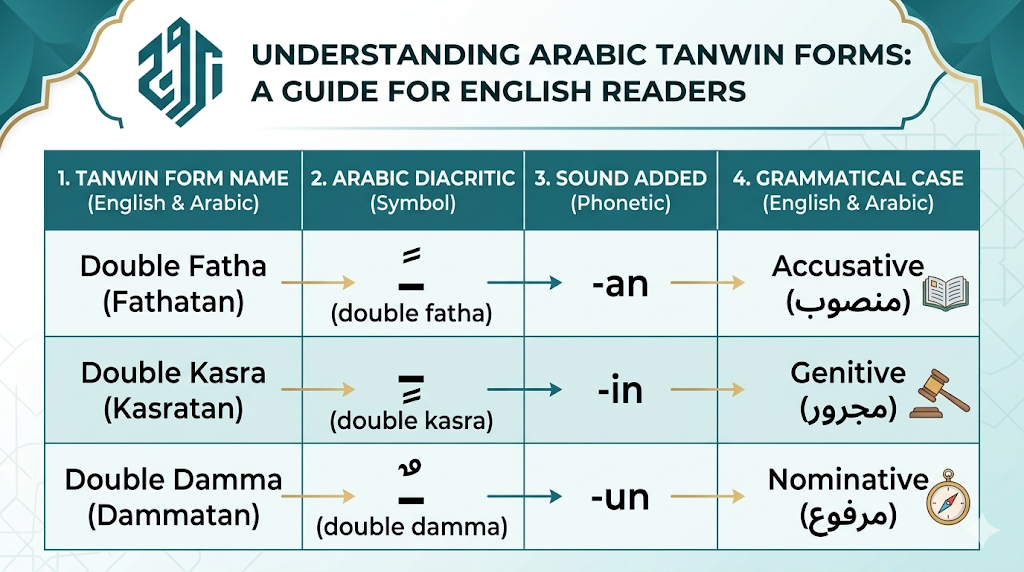
| Kasra tanwin (كَسْرَتَيْن) doubles the kasra mark, adding a final “-in” sound and functioning as the indefinite genitive case marker in Arabic grammar. |
Every Arabic learner encounters kasra early — and almost every beginner mispronounces it in the same predictable way. The small diagonal line sitting beneath an Arabic letter carries enormous weight: it determines meaning, grammar case, and word identity all at once.
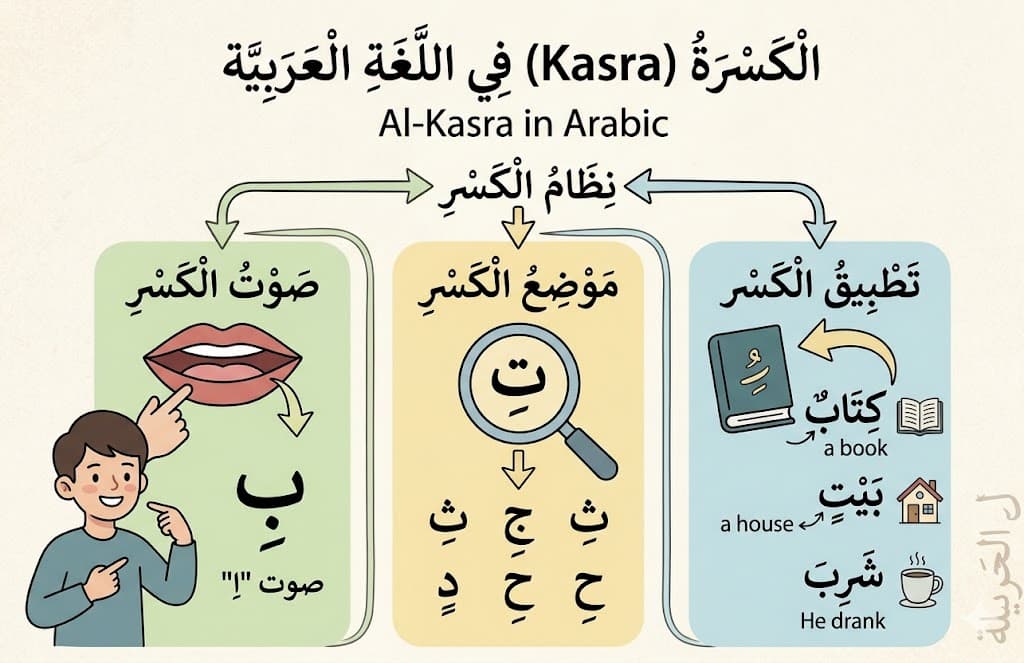
Kasra is the short vowel diacritic that produces the “i” sound in Arabic, placed beneath any consonant to create a syllable pronounced with a raised front vowel. Along with fatha (the “a” sound above letters) and damma (the “u” sound), kasra completes the trio of short vowel markers that make Arabic a fully vocalized, phonetically precise language.
Table of Contents:
What Is Kasra in Arabic and How Is It Written?
Kasra (كَسْرَة) is a short vowel sign in Arabic, written as a small diagonal stroke placed directly beneath a consonant letter. It consistently signals one sound: a short, clean “i” — similar to the vowel in the English word “sit” but produced with more front-tongue precision. Every Arabic consonant, when marked with kasra, becomes a syllable ending in that “i” sound.
The word “kasra” itself comes from the Arabic root ك-س-ر, meaning “to break.” Grammarians named it this because the jaw “breaks” downward slightly when producing the sound — a useful physical anchor for beginners learning to identify the vowel by feel.
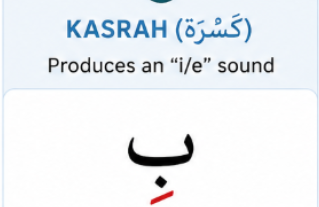
Kasra looks like this beneath a letter: بِ (bi), كِ (ki), لِ (li). The mark never appears above the letter — that position belongs to fatha and damma. If you see a small line beneath any Arabic letter, you are reading kasra without exception.
How to Pronounce Kasra Correctly in Arabic Words?
Kasra produces a short “i” vowel — but the Arabic “i” is not identical to English “i” sounds. In Arabic, the tongue sits mid-raised at the front of the mouth with the jaw slightly lowered. The sound is clean, brief, and never glides into a longer “ee” shape unless a ي (yaa) follows.
In our Arabic Speaking Classes at Buruj Academy, English-speaking students consistently make two errors with kasra.
First, they over-elongate it, turning the short “i” into a full “ee” sound.
Second, students influenced by American English sometimes centralize the vowel toward “uh,” losing the front-of-mouth position entirely.
Both errors change word meanings and become deeply embedded habits if uncorrected in the first weeks of study.
Book your free trial to start speaking Arabic fluently
The Correct Mouth Position for Kasra
To produce accurate kasra, position your mouth this way:
- Raise the front of the tongue toward the hard palate — not touching, but close
- Allow the jaw to drop slightly (the “breaking” motion the grammarians described)
- Release the vowel as a short, clipped sound — do not hold or extend it
- Keep the lips relaxed, not spread wide as in an English “ee” smile
Practice by saying the English word “bit” and isolating the vowel. That brief “i” in the middle is your target — then train yourself to produce it without the surrounding English consonants.
Kasra in Arabic Letters
When kasra is placed beneath any Arabic letter, that letter immediately gains the “i” vowel sound. The table below shows kasra applied to a selection of Arabic consonants, giving you both the Arabic script and the correct romanized pronunciation.
| Arabic Letter | Name | With Kasra | Pronunciation |
| ب | Baa | بِ | bi |
| ت | Taa | تِ | ti |
| س | Siin | سِ | si |
| ك | Kaaf | كِ | ki |
| م | Miim | مِ | mi |
| ن | Nuun | نِ | ni |
| ل | Laam | لِ | li |
| ر | Raa | رِ | ri |
| د | Daal | دِ | di |
| ف | Faa | فِ | fi |
Every consonant follows the same rule without exception. This consistency makes kasra one of the most learnable elements of Arabic for beginners. If you can recognize the mark and produce the sound once, you can apply it to all 28 letters immediately.
Our Arabic alphabet course walks through the full consonant inventory before vowel marks are added, which is the sequence we recommend.
Get a free trial now in Buruj’s Alphabet course
Kasra in Arabic Words
Seeing kasra in isolated letters is useful for drilling. Seeing it inside real words is what builds actual Arabic reading ability. The examples below are drawn from everyday Modern Standard Arabic vocabulary, with each kasra marked and explained.
Everyday Nouns Containing Kasra
| Arabic Word | Transliteration | Meaning | Kasra Location |
| بِنْت | bint | girl | beneath ب |
| كِتَاب | kitaab | book | beneath ك |
| بِئْر | bi’r | well | beneath ب |
| مِفْتَاح | miftaah | key | beneath م |
| لِسَان | lisaan | tongue / language | beneath ل |
| فِكْرَة | fikra | idea / thought | beneath ف |
| رِجَال | rijaal | men | beneath ر |
| سِكِّين | sikkiin | knife | beneath both س and ك |
Notice that كِتَاب (kitaab) carries kasra beneath the kaf, then a long “aa” vowel. The kasra gives the syllable “ki,” and the alif that follows extends a different vowel entirely. Learning to distinguish where kasra ends and long vowels begin is a skill that develops quickly with consistent reading practice.
Kasra in Common Prepositions
Kasra appears prominently in Arabic prepositions — words you will use in nearly every sentence you construct.
| Preposition | Transliteration | Meaning |
| بِـ | bi- | by / with / in |
| لِـ | li- | for / to |
| فِي | fii | in / inside |
| مِنْ | min | from |
| إِلَى | ilaa | to / toward |
بِ and لِ are single-letter prepositions that attach directly to the following word. They carry kasra as their only vowel. فِي is particularly instructive: the kasra beneath ف creates “fi,” and the ي that follows extends it into the long vowel “fii.” This is exactly how short kasra transitions into the long “ee” sound — a pattern every Arabic learner must master early.
If you want to understand how these prepositions function inside real Arabic sentences, our Arabic sentence structure guide explains their grammatical role with worked examples.
At Buruj Academy, our Arabic for Beginners course introduces kasra alongside these high-frequency prepositions from the very first lessons — because students who learn vowels through real words retain them far faster than those who drill isolated letters alone.
Begin learning Arabic at Buruj with a FREE trial lesson

How Does Kasra Function in Arabic Grammar?
In Arabic grammar, kasra on the final syllable of a noun signals the genitive case (المجرور, al-majruur). The genitive case marks nouns that follow prepositions or appear as the second element in a possessive construction (إضافة, idaafa).
This is one of the most important functions of kasra that beginners often overlook. When you see a final kasra on a noun, the word is grammatically “pulled down” by either a preposition or a possessive chain.
Read also: Arabic Pronouns
Discover the Buruj Academy Difference
Step into our virtual classrooms and see how our expert instructors make learning Quran and Arabic intuitive and clear. We focus on overcoming the specific hurdles non-native speakers face, building your confidence and connection with the Quran.
Master the Arabic Language
Join our expert-led courses and build a strong foundation in Classical and Modern Arabic.
Get Your Free TrialKasra in Possessive Constructions (Idaafa)
| Arabic Phrase | Transliteration | Meaning | Why Kasra? |
| بَيْتُ الرَّجُلِ | baytu r-rajuli | the man’s house | الرجل is the second element — genitive |
| كِتَابُ الطَّالِبِ | kitaabu t-taalibi | the student’s book | الطالب is the second element — genitive |
| بَابُ الغُرْفَةِ | baabu l-ghurfati | the room’s door | الغرفة is the second element — genitive |
After a preposition, the noun following it always takes kasra on its final syllable:
- فِي البَيْتِ — fii l-bayti — “in the house” (kasra on بيت)
- مِنَ الجَامِعَةِ — mina l-jaami’ati — “from the university” (kasra on جامعة)
- إِلَى المَدِينَةِ — ila l-madiinati — “to the city” (kasra on مدينة)
This grammatical role of kasra is part of what makes Arabic an i’raab (إعراب) language — a language where case endings carry syntactic information.
Our Arabic grammar learning guide explains the full case system in a structured, beginner-accessible way.
What Is Kasra Tanwin?
Kasra tanwin (التنوين بالكسر) uses two kasra marks stacked beneath the final letter of an indefinite noun, producing the sound “-in” at the end of the word. It is written as ـٍ and represents the indefinite genitive case — the grammatical ending for an indefinite noun that follows a preposition or appears as the second element of an indefinite possessive.
The difference between kasra and kasra tanwin is both visual and phonetic:
| Feature | Kasra (ـِ) | Kasra Tanwin (ـٍ) |
| Visual form | Single diagonal line | Double diagonal line |
| Sound produced | Short “-i” | Short “-in” |
| Definiteness | Both definite and indefinite | Indefinite only |
| Grammatical role | Genitive case (definite) | Genitive case (indefinite) |
| Example | الرَّجُلِ (ar-rajuli) | رَجُلٍ (rajulin) |
رَجُلٌ (a man — nominative indefinite) becomes رَجُلٍ (of a man — genitive indefinite) when kasra tanwin is applied. The tanwin “-in” sound at the end signals both indefiniteness and the genitive case simultaneously.
In our Buruj Academy sessions, we observe that students sometimes confuse kasra tanwin with a simple double mark. Training the eye to immediately distinguish single kasra from tanwin kasra — and the ear to hear the final “-n” — is a milestone we target within the first month of grammar instruction.
Read also:How Dammah Works in Arabic
Fatha, Kasra, and Damma in Arabic
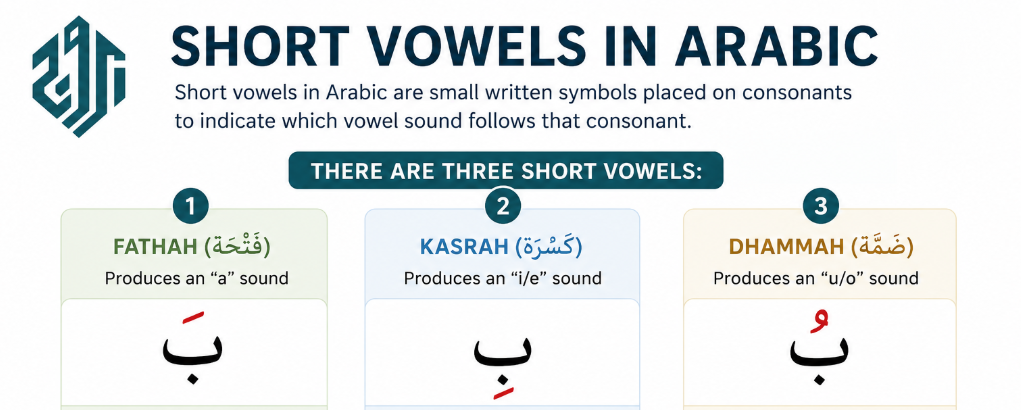
The three short vowel diacritics in Arabic — fatha, kasra, and damma — form the complete system of short vowel marking. Understanding each one in relation to the others clarifies the system as a whole and prevents the common confusion between similar-sounding words.
| Vowel | Arabic Name | Written Form | Position | Sound | Example | Meaning |
| Fatha | فَتْحَة | ـَ | Above the letter | Short “a” (as in “cat”) | كَتَبَ | he wrote |
| Kasra | كَسْرَة | ـِ | Below the letter | Short “i” (as in “sit”) | كِتَاب | book |
| Damma | ضَمَّة | ـُ | Above the letter | Short “u” (as in “put”) | كُتُب | books |
The contrast between these three vowels on the same root letters produces entirely different words — a feature that makes short vowel recognition essential for accurate Arabic reading. Consider the root ك-ت-ب (related to writing):
- كَتَبَ (kataba) — he wrote (fatha throughout)
- كِتَاب (kitaab) — book (kasra on kaf)
- كُتُب (kutub) — books (damma throughout)
The same three consonants, different vowels, three completely different meanings. This is why learning to see and read short vowel marks — especially in early study — is not optional. Our guide on vowels in Arabic covers the full vowel system including the long vowels that extend from each short vowel mark.
Practical Exercises to Master Kasra in Arabic
Reading about kasra builds understanding. Practicing with structured exercises builds fluency. The following exercises move from recognition to production to contextual use — the sequence our instructors follow in the Buruj Method.
Exercise 1: Kasra Recognition Drill
Read each word aloud, identify every kasra, and write the transliteration:
| Arabic Word | Your Transliteration |
| بِسْمِ | __________ |
| مِنْ | __________ |
| فِي | __________ |
| لِقَاء | __________ |
| مِصْبَاح | __________ |
Answers: bismi / min / fii / liqaa’ / misbaaH
Exercise 2: Fill in the Correct Short Vowel
Each word below is missing its vowel marks. Add kasra where the correct vowel is “i”:
- ك_تَاب (k_taab — the vowel on ك is ___)
- م_فْتَاح (m_ftaah — the vowel on م is ___)
- ف_كْرَة (f_kra — the vowel on ف is ___)
Answers: All three take kasra — كِتَاب, مِفْتَاح, فِكْرَة.
Read also: Indefinite Pronouns in Arabic
Exercise 3: Kasra in Sentences
Read these short Arabic sentences and identify every word carrying kasra:
- الكِتَابُ فِي البَيْتِ — Al-kitaabu fii l-bayti — “The book is in the house.”
- مِنَ المَدْرَسَةِ إِلَى الجَامِعَةِ — Mina l-madrasa ila l-jaami’a — “From the school to the university.”
In sentence 1, kasra appears in كِتَابُ (ki-), فِي (fi-), and البَيْتِ (final genitive). In sentence 2, kasra appears in مِنَ (mi-) and on the genitive endings of both nouns.
For students who want to build Arabic reading through graded, structured practice, our Arabic Reading course applies exactly this progression — recognition drills, fill-in exercises, and sentence-level reading — with a qualified instructor providing real-time feedback.
Read Arabic fluently with a free Buruj trial

Build Your Arabic Foundation with Buruj Academy’s Expert Instructors
Mastering kasra — and the entire Arabic vowel system — requires structured instruction, not guesswork. Buruj Academy’s Online Arabic Classes provide the systematic foundation every learner needs, guided by Al-Azhar University graduates with 12+ years of experience teaching non-native Arabic speakers worldwide.
Our Buruj Method — built on context-before-abstraction — means you learn kasra through real words and real sentences from day one, not abstract drills in isolation. Every student receives:
- Personalized 1-on-1 sessions with Ijazah-certified instructors
- Real-time pronunciation correction for kasra and all Arabic vowel sounds
- Customized learning plans by age, level, and learning style
- Flexible 24/7 scheduling for working adults and busy parents
Book your free trial lesson today and begin reading Arabic with confidence.
Begin your transformation today by choosing the path that fits your goals:
- Online Arabic Classes (General & Comprehensive)
- Arabic Course for Beginners
- Arabic Alphabet Learning Course
- Online Arabic Classes for Kids
- Arabic Classes for Adults
- Arabic Grammar Course (Nahw & Sarf)
- Intermediate Arabic Course (B1/B2)
- Arabic Speaking Course (Conversational Fluency)
- Arabic Reading Course (Literary Excellence)
- Learn Arabic Writing Course (Calligraphy & Composition)
Ready to speak with confidence? Join the global community at Buruj Academy and book your free placement interview today!
Master the Arabic Language
Join our expert-led courses and build a strong foundation in Classical and Modern Arabic.
Get Your Free TrialConclusion
Kasra is small in appearance but large in function. A single diagonal stroke beneath a letter determines pronunciation, signals grammatical case, and — when paired with yaa — creates one of Arabic’s long vowels. The gap between students who read Arabic confidently and those who struggle often comes down to how thoroughly they internalized these three short vowels at the beginning of their study.
Work through the recognition and production exercises in this guide regularly, pay attention to kasra in the Arabic you encounter daily, and notice how its grammatical role shifts between prepositions, possessives, and indefinite nouns. Consistent, deliberate practice with kasra is one of the most efficient investments any Arabic learner can make at any stage.
Frequently Asked Questions About Kasra in Arabic
What Is the Difference Between Kasra and Fatha in Arabic?
Kasra is a short diagonal line placed beneath a letter, producing the short “i” vowel sound. Fatha is a short diagonal line placed above a letter, producing the short “a” sound. Both are vowel diacritics, but they appear in opposite positions and produce completely different sounds that change word meanings entirely.
Does Kasra Always Appear Below the Letter in Arabic Script?
Yes, kasra is always written beneath the consonant it modifies — without exception. This distinguishes it visually from fatha and damma, both of which appear above the letter. If you see a vowel mark below any Arabic letter, it is kasra and produces the short “i” sound.
What Is Kasra Tanwin in Arabic and When Is It Used?
Kasra tanwin consists of two kasra marks stacked beneath the final letter of an indefinite noun, producing the ending sound “-in.” It marks the indefinite genitive case — appearing when an indefinite noun follows a preposition or appears as the second element of an indefinite possessive construction.