 Arabic

| Key Takeaways |
| Basic Arabic conversation begins with mastering 50–80 high-frequency words covering greetings, questions, and daily actions before moving to grammar. |
| Modern Standard Arabic (MSA) greetings like Marhaba and Kayfa haluk are universally understood across all Arabic-speaking regions. |
| Arabic sentence structure follows Verb-Subject-Object order in formal speech, but Subject-Verb-Object in common conversational patterns non-native speakers find more intuitive. |
| Practical exercises like shadowing native speakers and daily 10-minute conversation drills accelerate spoken fluency faster than grammar study alone. |
| Non-native English speakers typically hold basic Arabic conversations after 3–4 months of structured daily practice with vocabulary and sentence pattern focus. |
Starting a conversation in Arabic feels daunting when you don’t know where to begin. The script looks unfamiliar, the sounds are new, and grammar rules seem endless before you’ve said a single word.
Basic Arabic conversation becomes manageable — and genuinely enjoyable — when you build it layer by layer: greetings first, then question words, then simple sentence patterns, then real practice. That sequence is exactly what this guide follows, giving you usable Arabic from the very first step.
Table of Contents:
What Are the Basics of Arabic Conversation for Daily Situations?
The basics of Arabic conversation for daily situations include four core exchanges: introducing yourself, asking for directions, ordering food, and expressing needs.
Mastering these four scenarios with 5–10 phrases each gives you functional conversational ability in the most common real-world contexts non-native speakers encounter.
Self-Introduction Phrases
Self-introduction is the entry point to every relationship in Arabic-speaking contexts. Here is a complete beginner exchange:
| Arabic | Transliteration | English |
| ما اسمك؟ | Ma ismuk? | What is your name? (to male) |
| اسمي أحمد | Ismi Ahmad | My name is Ahmad |
| من أين أنت؟ | Min ayna anta? | Where are you from? (to male) |
| أنا من إنجلترا | Ana min Inglitara | I am from England |
| كم عمرك؟ | Kam umruk? | How old are you? |
| عمري ثلاثون سنة | Umri thalathoona sana | I am thirty years old |
| ما مهنتك؟ | Ma mihnatuk? | What is your job? |
| أنا مهندس | Ana muhandis | I am an engineer |
Practice Exercise — The Mirror Introduction:
Stand in front of a mirror and introduce yourself fully in Arabic. Use the table above as your script, substituting your actual name, country, age, and profession.
Record yourself once. Listen back. Notice which sounds feel unnatural — those are your pronunciation targets for the following week.
1. Start with Arabic Greetings and Everyday Phrases That Open Every Conversation
The foundation of basic Arabic conversation is a core set of greetings and responses that Arabic speakers use daily in every context — from family settings to workplaces.
Learning these first gives you immediate, functional language you can use and hear recognized by any Arabic speaker, regardless of their regional dialect.
| Arabic | Transliteration | English Meaning |
| مرحباً | Marhaban | Hello |
| أهلاً وسهلاً | Ahlan wa sahlan | Welcome / Hello (warm) |
| السلام عليكم | As-salamu alaykum | Peace be upon you |
| وعليكم السلام | Wa alaykum as-salam | And upon you peace (reply) |
| كيف حالك؟ | Kayfa haluk? | How are you? (to a male) |
| كيف حالكِ؟ | Kayfa haluki? | How are you? (to a female) |
| بخير، شكراً | Bikhair, shukran | Fine, thank you |
| إلى اللقاء | Ila al-liqa’ | Goodbye (formal) |
| مع السلامة | Ma’a as-salama | Goodbye (everyday) |
One important pattern to notice immediately: Arabic distinguishes between masculine and feminine in the second-person pronoun. Kayfa haluk addresses a man; kayfa haluki addresses a woman.
This gender distinction runs throughout Arabic conversation, so recognizing it early builds a critical instinct.
Practice Exercise: Write out the greeting exchange below, covering the Arabic column, and practice saying both sides aloud — once as the speaker, once as the responder.
Speaker: As-salamu alaykum
Responder: Wa alaykum as-salam
Speaker: Kayfa haluk?
Responder: Bikhair, shukran. Wa anta? (Fine, thank you. And you? — to a male)
Repeat this three times daily for one week. In our experience at Buruj Academy, students who drill greetings aloud — rather than just reading them — retain them permanently within five days.
2. Build Your Conversational Arabic Vocabulary Around the 60 Words You Actually Need
Conversational Arabic phrases don’t require a large vocabulary. Research in language acquisition consistently shows that roughly 80% of everyday spoken language uses fewer than 1,000 words — and for basic conversation, 50–80 targeted words are enough to function. The key is choosing the right 60 words.
For non-native speakers learning Arabic, our Online Arabic Speaking Course focuses exactly on this principle: high-frequency vocabulary before grammar rules, context before abstraction.
Book your free trial to start speaking Arabic fluently

Which Word Categories to Prioritize First
| Category | Example Words | Why It Matters |
| Question words | مَن (who), ما (what), أين (where), متى (when), كيف (how), لماذا (why) | Every conversation involves questions |
| Common verbs | يريد (wants), يذهب (goes), يأكل (eats), يتكلم (speaks), يفهم (understands) | Actions are the engine of sentences |
| Numbers 1–20 | واحد، اثنان، ثلاثة… | Prices, times, quantities |
| People words | أنا (I), أنت (you-m), أنتِ (you-f), هو (he), هي (she), نحن (we) | Pronouns are non-negotiable |
| Place words | بيت (house), سوق (market), مدرسة (school), مطعم (restaurant) | Location is central to daily conversation |
Practice Exercise — The Word-a-Day Method:
Choose one word from each category above per day. For each word:
- Write it in Arabic script
- Say it aloud five times
- Build one sentence using it (even a simple one)
Example for the word يريد (wants):
- هو يريد ماءً. (Huwa yurid ma’an.) — He wants water.
- أنا أريد قهوة. (Ana uridu qahwa.) — I want coffee.
If you’re starting from absolute zero with Arabic letters, our guide on how to learn Arabic for beginners and our Arabic course for beginners walks you through script recognition before vocabulary building.
Begin learning Arabic at Buruj with a FREE trial lesson

3. Understand the Arabic Sentence Patterns That Make Conversation Click
Knowing words without sentence structure is like having bricks without cement. Arabic has specific patterns that beginners must internalize to form correct, natural-sounding basic conversation.
The good news: a handful of patterns cover the vast majority of daily spoken Arabic.
A. The Nominal Sentence (الجملة الاسمية)
Arabic uses two main sentence types. The nominal sentence — which begins with a noun or pronoun — is the most beginner-friendly and appears constantly in conversation.
Structure: Subject + Predicate (no verb “to be” in present tense)
| Arabic | Transliteration | English |
| أنا طالب | Ana talib | I am a student (male) |
| هي مدرِّسة | Hiya mudarrisa | She is a teacher |
| البيت كبير | Al-baytu kabir | The house is big |
| الطقس جميل | At-taqs jamil | The weather is beautiful |
Notice that Arabic drops “is/am/are” entirely in the present tense. This is one of the features that makes basic Arabic conversation simpler than English in some ways once you understand the logic.
B. The Verbal Sentence (الجملة الفعلية)
The verbal sentence begins with a verb and follows a Verb-Subject-Object structure in formal Arabic. In everyday conversational Arabic, however, Subject-Verb-Object order is also widely used and understood.
| Arabic | Transliteration | English |
| أشرب الشاي | ashrob ash-shay | I drink tea |
| يعمل في المكتب | ya’mal fil-maktab | He works in the office |
| ندرس العربية | nadrus al-arabiyya | We study Arabic |
For a deeper understanding of how Arabic sentence patterns function at the structural level, our article on Arabic sentence structure for beginners provides a full breakdown with examples.
Practice Exercise — Sentence Builder Drill:
Using the table below, mix and match to build 10 different sentences:
| Pronoun | Verb | Object |
| أنا (I) | أشرب (drink) | ماء (water) |
| هو (he) | يأكل (eats) | خبزاً (bread) |
| هي (she) | تقرأ (reads) | كتاباً (a book) |
| نحن (we) | ندرس (study) | العربية (Arabic) |
Form sentences like: Hiya taqra’ kitaban (She reads a book). Say each one aloud, then write it out.
Read also: Do All Muslims Speak Arabic?
4. Master the Arabic Question Words That Drive Real Conversation
Arabic conversation for beginners stalls most often because students don’t know how to keep a conversation going. The single most effective tool for sustaining dialogue is question words. Six question words unlock the ability to ask about virtually any topic.
| Question Word | Arabic | Transliteration | Example Sentence |
| What | ما / ماذا | Ma / Matha | ماذا تريد؟ Matha turid? — What do you want? |
| Who | مَن | Man | مَن هذا؟ Man hatha? — Who is this? |
| Where | أين | Ayna | أين المطعم؟ Ayna al-mat’am? — Where is the restaurant? |
| When | متى | Mata | متى تذهب؟ Mata tathhab? — When are you going? |
| How | كيف | Kayfa | كيف تقول هذا؟ Kayfa taqool hatha? — How do you say this? |
| Why | لماذا | Limatha | لماذا تتعلم العربية؟ Limatha tata’allam al-arabiyya? — Why do you study Arabic? |
In our conversation classes at Buruj Academy, we observe that students who drill question words in paired exercises — one student asks, one answers — progress through conversational ability significantly faster than those practicing reading alone. Questions force active vocabulary retrieval rather than passive recognition.
5. Learn How to Navigate Common Conversational Arabic Phrases in Real Contexts
Conversational Arabic phrases that handle real-life situations — shopping, asking directions, expressing understanding — are the bridge between classroom Arabic and actual communication.
These phrases are formulaic, highly reusable, and worth memorizing as complete units.
Read also:Top Podcasts for Learning Arabic
Arabic Phrases for Understanding and Clarification
These are among the most practically important phrases for any beginner:
| Arabic | Transliteration | English |
| لم أفهم | Lam afham | I didn’t understand |
| هل يمكنك التكرار؟ | Hal yumkinuk at-tikrar? | Can you repeat? |
| تكلم ببطء من فضلك | Takallam bibot’ min fadlak | Speak slowly, please |
| ما معنى هذه الكلمة؟ | Ma ma’na hathihi al-kalima? | What does this word mean? |
| هل تتكلم الإنجليزية؟ | Hal tatakallam al-ingliziyya? | Do you speak English? |
Discover the Buruj Academy Difference
Step into our virtual classrooms and see how our expert instructors make learning Quran and Arabic intuitive and clear. We focus on overcoming the specific hurdles non-native speakers face, building your confidence and connection with the Quran.
Master the Arabic Language
Join our expert-led courses and build a strong foundation in Classical and Modern Arabic.
Get Your Free TrialPhrases for Shopping and Daily Needs
| Arabic | Transliteration | English |
| بكم هذا؟ | Bikam hatha? | How much is this? |
| هذا غالٍ | Hatha ghali | This is expensive |
| أريد هذا من فضلك | Urid hatha min fadlak | I want this, please |
| أين الحمام؟ | Ayna al-hammam? | Where is the bathroom? |
| هل عندك…؟ | Hal indak…? | Do you have…? |
Understanding Arabic tenses matters even at the beginner conversational level — the difference between urid (I want — present) and aradtu (I wanted — past) changes meaning completely and affects daily communication.
Practice Exercise — Role-Play Scenarios:
With a study partner or alone using a recording device, act out these two mini-scenarios:
Scenario A (Shopkeeper):
- You: Bikam hatha? (How much is this?)
- Shopkeeper: Hatha bi ishrin junaihan. (This is 20 pounds.)
- You: Hatha ghali. Hal indak shay’ arkhas? (This is expensive. Do you have something cheaper?)
Scenario B (Asking directions):
- You: Ayna al-mat’am min fadlak? (Where is the restaurant, please?)
- Response: Al-mat’am ala al-yamin. (The restaurant is on the right.)
- You: Shukran jazilan. (Thank you very much.)
6. Use Arabic Verb Conjugation Patterns to Expand What You Can Say
One of the fastest ways to multiply your conversational ability is understanding that Arabic verbs follow predictable patterns. Once you know the root and the pattern, you can conjugate for different subjects without memorizing each form individually.
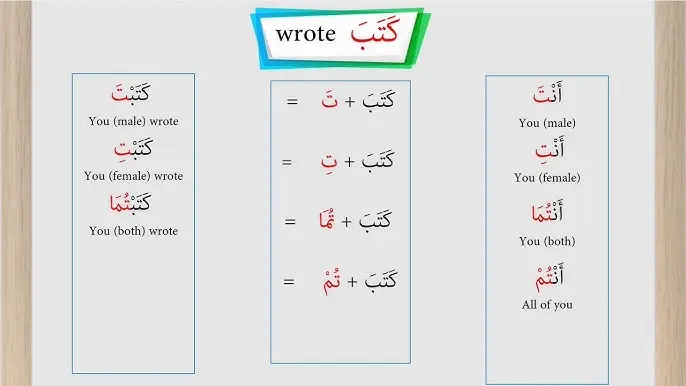
Arabic verbs are built on three-letter roots (الجذر الثلاثي). The root د-ر-س (d-r-s) carries the meaning of studying/learning. From it:
| Subject | Arabic Verb | Transliteration | English |
| أنا (I) | أدرس | Adrisu | I study |
| أنت (you-m) | تدرس | Tadrusu | You study |
| أنتِ (you-f) | تدرسين | Tadrusin | You study (f) |
| هو (he) | يدرس | Yadrusu | He studies |
| هي (she) | تدرس | Tadrusu | She studies |
| نحن (we) | ندرس | Nadrusu | We study |
This same pattern applies to hundreds of Arabic verbs. The Arabic present tense follows consistent prefix and suffix patterns once you recognize them.
Practice Exercise 7 — Root Conjugation Practice:
Take the verb كتب (k-t-b, meaning to write) and conjugate it for all six subjects above, following the same prefix-suffix pattern as darasa. Then build one sentence for each conjugation using something from your daily life.
Example: Ana aktubu risala. — I write a letter.
For irregular verb patterns that behave differently from the standard root system, our article on irregular verbs in Arabic covers the most common exceptions you’ll encounter in conversation.
7. Practice Daily with Structured Exercises to Build Real Conversational Fluency
Understanding Arabic conversation and speaking Arabic conversation are two different skills. Fluency only develops through consistent, structured output practice.
The most common mistake we see at Buruj Academy is students who understand 80% of what they read but freeze when asked to speak — because they’ve never practiced producing language under real-time conditions.
Read also: Arabic Speaking Classes
The 15-Minute Daily Conversation Practice Plan
| Time | Activity | Purpose |
| 0–3 min | Greeting drill (aloud, from memory) | Automaticity of core phrases |
| 3–8 min | Sentence building using new vocabulary | Active production |
| 8–12 min | Shadowing: listen and repeat after native audio | Pronunciation + rhythm |
| 12–15 min | Self-recording: answer 3 questions in Arabic | Output fluency |
Shadowing is one of the most effective tools for non-native speakers learning to sound natural in Arabic.
Choose a short audio clip of a native Arabic speaker (news broadcasts, YouTube content in MSA, or Arabic podcast snippets) and repeat exactly what you hear — matching rhythm, speed, and pronunciation.
Even 3–4 minutes of daily shadowing produces measurable improvements in spoken naturalness within 3–4 weeks in our instructors’ experience.
For students who want structured speaking practice with real-time correction from qualified instructors, Buruj Academy’s Arabic Speaking Course provides personalized 1-on-1 sessions focused specifically on conversational fluency — not just grammar comprehension.
Book your free trial to start speaking Arabic fluently
How to Learn Conversational Arabic Basics Without Getting Stuck in Grammar?
Learning conversational Arabic gets stuck when grammar study replaces actual speaking practice.
The most effective approach prioritizes functional phrases and high-frequency vocabulary first, then uses grammar to explain what you already say naturally.
Understanding Arabic grammar is valuable — but it should accelerate your speech, not delay it.
Three principles prevent the common grammar-freeze pattern:
1. Phrases before rules:
Learn Ana min Inglitara as a complete unit before learning why min is a preposition of origin. You speak first; you understand the structure later.
2. Errors before perfection:
Conversation requires risk. Making grammatical errors in gender agreement or verb conjugation is normal and expected at the beginner stage. Native speakers universally appreciate the attempt and correct gently.
3. Repetition before variety:
Drill the same 10–15 phrases until they become automatic. Automaticity in core phrases frees mental space to focus on new vocabulary in real conversations.
Understanding Arabic masculine and feminine nouns does matter for grammatical accuracy — but frame it as something you’ll refine over time, not a barrier to speaking now.
Start Speaking Arabic with Buruj Academy’s Expert-Led Arabic Classes
Basic Arabic conversation is a skill — and like every skill, it develops fastest under qualified, personalized instruction. Our Online Arabic Classes at Buruj Academy are designed specifically for non-native English speakers who want to move from silence to confident spoken Arabic.
Our Al-Azhar University graduates and Ijazah-certified instructors bring 12+ years of experience teaching Arabic to complete beginners globally. Every class is:
- 1-on-1 and personalized — your pace, your goals, your gaps
- Built on the Buruj Method: Context-before-abstraction, meaning you speak real Arabic from session one
- Flexible with 24/7 scheduling to fit working professionals and busy parents
- Focused on real-time pronunciation correction — the feedback that textbooks cannot give
Book your free trial lesson today and speak your first Arabic sentences with a qualified teacher by your side.
Begin your transformation today by choosing the path that fits your goals:
- Online Arabic Classes (General & Comprehensive)
- Arabic Course for Beginners
- Arabic Alphabet Learning Course
- Online Arabic Classes for Kids
- Arabic Classes for Adults
- Arabic Grammar Course (Nahw & Sarf)
- Intermediate Arabic Course (B1/B2)
- Arabic Speaking Course (Conversational Fluency)
- Arabic Reading Course (Literary Excellence)
- Learn Arabic Writing Course (Calligraphy & Composition)
Ready to speak with confidence? Join the global community at Buruj Academy and book your free placement interview today!
Master the Arabic Language
Join our expert-led courses and build a strong foundation in Classical and Modern Arabic.
Get Your Free TrialConclusion
Arabic conversation is not a mountain you climb all at once — it’s a series of reachable steps, each one building on the last. Greetings lead to vocabulary; vocabulary leads to sentence patterns; sentence patterns lead to real exchanges. What separates students who speak Arabic confidently from those who remain stuck in theory is one thing: consistent, structured practice that prioritizes output over passive reading.
Start with what matters most — the words and phrases you’ll actually use — and trust that grammar will follow naturally as your ear and tongue grow familiar with the language. Alhamdulillah, Arabic rewards the persistent learner who speaks imperfectly today and refines tomorrow.
Frequently Asked Questions About Basic Arabic Conversation
What Are the Most Important Phrases to Learn First in Arabic Conversation?
The most important phrases to learn first are greetings (As-salamu alaykum, Marhaban, Kayfa haluk?), basic responses (Bikhair, shukran), and the six question words (who, what, where, when, how, why). These 15–20 items form the skeleton of any beginner Arabic exchange and appear in virtually every conversational context.
What Are the Most Important Phrases to Learn First in Arabic Conversation?
The most important phrases to learn first are greetings (As-salamu alaykum, Marhaban, Kayfa haluk?), basic responses (Bikhair, shukran), and the six question words (who, what, where, when, how, why). These 15–20 items form the skeleton of any beginner Arabic exchange and appear in virtually every conversational context.
How Long Does It Take to Hold a Basic Arabic Conversation?
Most non-native speakers can hold a simple Arabic conversation — greetings, self-introduction, basic questions and answers — within 2–4 months of structured daily practice averaging 20–30 minutes. In our instructors’ experience, students who practice speaking aloud daily (not just reading) reach this milestone significantly faster than those who study passively.
Is Modern Standard Arabic Good for Everyday Conversation?
Modern Standard Arabic is understood across all Arabic-speaking regions and is the ideal starting point for non-native speakers. While regional dialects vary significantly, MSA serves as the common foundation in formal speech, media, and education. Beginning with MSA ensures your Arabic is universally understood, with dialect exposure added naturally over time.
What Is the Difference Between Arabic Conversation for Beginners and Intermediate Speakers?
Beginner Arabic conversation relies on memorized phrases, simple present-tense sentences, and formulaic exchanges. Intermediate conversation involves spontaneous sentence construction, past and future tense usage, and navigating unexpected topics. The key transition happens when learners move from retrieving memorized phrases to producing original sentences — typically after 6–9 months of consistent practice.