 Arabic

Most learners spend months studying Arabic vocabulary and grammar — yet freeze the moment someone speaks to them. That gap between knowing Arabic and actually speaking it is one of the most frustrating experiences our students describe when they first reach us.
Buruj Academy’s Arabic speaking calsses close that gap through structured conversation practice led by Al-Azhar-trained instructors. Real speaking fluency comes from real speaking — and that is precisely what our classes are built around.
Table of Contents:
Why Do Arabic Speaking Classes Work Differently Than Self-Study?
Joining structured Arabic-speaking classes produces measurable results that self-study simply cannot replicate, because spoken fluency requires real-time feedback, not just exposure to content.
When you speak with a qualified instructor, errors in pronunciation, sentence structure, and word order are corrected the moment they occur — before they become ingrained habits.
In our Arabic speaking courses at Buruj Academy, the most consistent pattern we observe is this: students who have studied Arabic independently for months arrive with good passive vocabulary but no ability to construct sentences under conversational pressure.
Within four to six weeks of structured speaking practice, the same students begin formulating responses without pausing to translate internally. The difference is not vocabulary — it is structured output.
Self-study tools provide input. Speaking classes provide supervised output, which is the actual mechanism of fluency development.
What Makes a Good Arabic Speaking Class?
The quality of an arabic speaking course depends on three non-negotiable elements.
First, the instructor must be a native-level speaker with formal linguistic training — not simply a fluent speaker.
Second, sessions must include real conversational exchange, not just scripted dialogues.
Third, correction must be immediate, specific, and followed by a second attempt from the student.
Buruj Academy’s instructors — all Al-Azhar University graduates — are trained specifically in second-language acquisition for non-native speakers. Our Arabic speaking course is built on the context-before-abstraction method: students learn words and phrases within real communicative situations before grammar rules are formally introduced.
Book your free trial to start speaking Arabic fluently

What Do Arabic Speaking Lessons Cover?
Arabic speaking lessons at a structured level cover far more than basic greetings. A well-designed arabic speaking course in english covers pronunciation accuracy, sentence construction, real-world vocabulary, and the ability to sustain a natural conversation across everyday topics.
| Skill Area | What Students Practice | Typical Timeline |
| Arabic sound production | Correct articulation of ع، غ، خ، ح، ص، ض | Weeks 1–3 |
| Basic sentence construction | Subject-verb-object patterns in MSA | Weeks 2–6 |
| Everyday conversational topics | Greetings, directions, family, work | Weeks 3–8 |
| Question formation | How, when, where, who constructions | Weeks 5–10 |
| Sustained conversation | 3–5 minute dialogue on a chosen topic | Weeks 8–16 |
Each stage builds on the previous one. Trying to skip to sustained conversation without first mastering sound production is the most common mistake adult learners make when self-studying.
Our Arabic for beginners course runs parallel to speaking training for students who need to build foundational literacy alongside oral skills.
Begin learning Arabic at Buruj with a FREE trial lesson
How Arabic Pronunciation Is Taught in Speaking Classes
Arabic pronunciation is one of the highest barriers for English speakers, specifically because six to eight Arabic sounds do not exist in English. These include the pharyngeal sounds ع and ح, the emphatic consonants ص and ض, and the voiced uvular غ.
A qualified nativa Arabic instructor does not simply model these sounds — they identify the precise articulation point in the mouth, guide the student’s attempt, and correct deviations immediately.
In our 12+ years of teaching non-native speakers, we have found that students who receive individual pronunciation correction in their first ten sessions retain correct sound habits far longer than those who learn from audio recordings alone.
The ear needs a human reference point, and the vocal tract needs guided practice. Our guide to Arabic pronunciation online covers the technical foundations in detail.
How to Choose the Right Arabic Speaking Course Online?
Choosing an arabic speaking course online requires evaluating instructor credentials, class format (group vs. one-on-one), curriculum structure, and the presence of real conversational practice.
Group classes are more affordable but offer less individual correction time. One-on-one sessions allow the entire lesson to focus on your specific speaking errors and goals.
Read also: Basic Arabic Conversation
Discover the Buruj Academy Difference
Step into our virtual classrooms and see how our expert instructors make learning Quran and Arabic intuitive and clear. We focus on overcoming the specific hurdles non-native speakers face, building your confidence and connection with the Quran.
Master the Arabic Language
Join our expert-led courses and build a strong foundation in Classical and Modern Arabic.
Get Your Free Trial| Course Format | Best For | Correction Quality | Progress Speed |
| Group Classes | Budget learners, social motivation | Moderate | Slower |
| One-on-One Online | Targeted improvement, busy adults | High | Faster |
| App-Based Practice | Supplementary review only | Very low | Minimal alone |
| Self-Study Audio | Passive exposure only | None | Very slow alone |
Buruj Academy’s Arabic Speaking Course uses an exclusively one-on-one format. Every session is a live, structured conversation between the student and a trained instructor — with a personalised plan that adapts as the student progresses.
Book your free trial to start speaking Arabic fluently
What to Look for in Arabic Speaking Courses
When comparing arabic speaking courses, these are the markers that separate effective programmes from ineffective ones.
First, instructors should hold formal credentials — Al-Azhar University degrees or equivalent.
Second, the syllabus should specify what conversational topics are covered at each level.
Third, there should be a free trial session so you can assess teaching quality before committing.
Buruj Academy offers a free trial Arabic-speaking lesson with no obligation. We encourage every prospective student to test the quality of instruction directly before enrolling.

How Speaking Arabic Lessons Are Structured for Adults and Beginners
Speaking Arabic lessons for adults and absolute beginners require a different pacing model than lessons for heritage speakers or intermediate students. Beginners need slower sound introduction, more repetition cycles, and confidence-building moments built into the lesson structure itself.
At Buruj Academy, our beginner speaking track typically follows this progression:
Week 1–2: Core Arabic sounds, basic greetings, and self-introduction
Week 3–4: Family vocabulary, simple question-and-answer exchanges
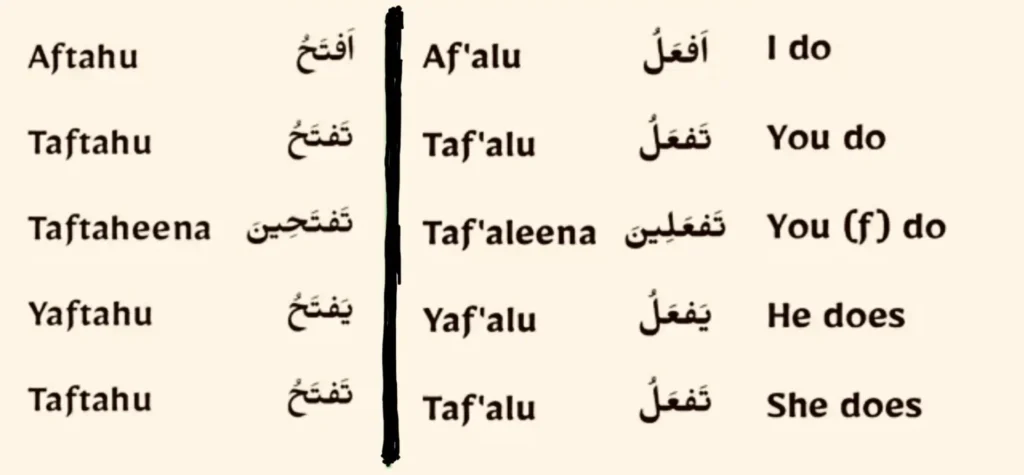
Week 5–6: Everyday verbs in present tense, short conversational scenarios
Week 7–8: Combining tenses, expressing preferences and opinions
Week 9–12: Sustained topic-based conversation with reduced instructor prompting
Our instructors are trained to resist over-correction in early sessions — targeted feedback on the most impactful errors produces better outcomes than correcting everything at once.
For deeper reading on tense use in Arabic conversation, our guides on Arabic tenses and the Arabic present tense provide solid supporting knowledge.
Read also: Do All Muslims Speak Arabic?
How an Arabic Speaking Course in English Bridges the Language Gap
An arabic speaking course in english means all instruction, explanations, and grammar guidance are delivered in English — with Arabic used progressively as proficiency grows.
This is essential for non-native speakers who cannot yet understand Arabic-medium instruction. It prevents confusion, allows precise grammatical explanation, and creates a safe space for making and learning from errors.
Buruj Academy’s instructors are fully bilingual and trained in English-medium Arabic pedagogy. They know exactly which grammatical concepts require English-language explanation and when to shift instruction toward full Arabic immersion.
Build Arabic Speaking Fluency with Buruj Academy’s Expert Instructors
Speaking Arabic confidently is an achievable goal — but it requires the right environment, the right instructor, and the right method from the start.
Buruj Academy’s Arabic Speaking Course gives you all three:
- Al-Azhar University graduates with 12+ years teaching non-native speakers
- The Buruj Method — context-before-abstraction, consistency-before-speed
- Personalised 1-on-1 sessions with real-time pronunciation and fluency correction
- Flexible 24/7 scheduling built for working adults and parents
- Free trial lesson — assess our quality before committing
Book your free trial lesson today and begin speaking Arabic with genuine confidence, Insha’Allah.
Begin your transformation today by choosing the path that fits your goals:
- Online Arabic Classes (General & Comprehensive)
- Arabic Course for Beginners
- Arabic Alphabet Learning Course
- Online Arabic Classes for Kids
- Arabic Classes for Adults
- Arabic Grammar Course (Nahw & Sarf)
- Intermediate Arabic Course (B1/B2)
- Arabic Speaking Course (Conversational Fluency)
- Arabic Reading Course (Literary Excellence)
- Learn Arabic Writing Course (Calligraphy & Composition)
Ready to speak with confidence? Join the global community at Buruj Academy and book your free placement interview today!
Master the Arabic Language
Join our expert-led courses and build a strong foundation in Classical and Modern Arabic.
Get Your Free TrialConclusion
Speaking Arabic is not a distant goal reserved for those with years of study behind them. With the right structured practice and qualified instruction, non-native speakers begin producing real, confident Arabic speech far sooner than they expect. What makes the difference is not more time spent studying — it is guided speaking practice with immediate, expert feedback.
Buruj Academy’s Arabic Speaking Course is designed to give students exactly that environment: one-on-one sessions, Al-Azhar-trained instructors, and a clear progression from hesitant beginner to confident speaker. The fluency you are aiming for is built one session at a time.
Frequently Asked Questions About Arabic Speaking Classes
How Long Does It Take to Speak Basic Arabic After Starting Classes?
Most students in our one-on-one Arabic speaking course reach basic conversational ability — greetings, simple questions, and short exchanges — within six to eight weeks of consistent weekly sessions. Progress accelerates significantly when students practise outside sessions using the vocabulary and phrases introduced by their instructor. Daily fifteen-minute review is more effective than weekend cramming.
Are Arabic Speaking Classes Online as Effective as In-Person Lessons?
Online Arabic-speaking classes are equally effective as in-person lessons when they are conducted one-on-one with a qualified instructor and include real-time audio interaction. The speaking correction process does not require physical presence — it requires immediate feedback, which online platforms deliver without limitation. Buruj Academy has taught thousands of students globally through online sessions with measurable, consistent results.
What Is the Difference Between Modern Standard Arabic and Spoken Dialect Classes?
Modern Standard Arabic (MSA) is the formal, written, and broadcast form of Arabic understood across all Arabic-speaking regions. Dialects — Egyptian, Levantine, Gulf — are regionally specific spoken forms. Buruj Academy’s Arabic Speaking Course focuses on MSA speaking, which provides a universal foundation applicable across all Arabic-speaking contexts, particularly for Muslims seeking to understand Arabic religious content.
Can Complete Beginners Join Arabic Speaking Courses?
Absolute beginners are welcome in Buruj Academy’s Arabic Speaking Course. Our instructors begin from the level of individual sound production and basic vocabulary, building speaking ability systematically. Students who also need to build reading foundations can combine the speaking course with our Arabic for Beginners course for a fully integrated learning experience.
How Do I Know If an Arabic Speaking Course Is Right for My Level?
If you can understand written Arabic but struggle to produce spoken responses, you need speaking-focused classes rather than grammar or reading instruction. If you are a complete beginner, a course that combines foundational sound training with early conversational practice — like Buruj Academy’s programme — is the appropriate starting point. Our free trial lesson allows you to assess the right entry point with your instructor directly.