 Arabic
| Key Takeaways |
| The Arabic present tense (المضارع, al-muḍāri’) expresses ongoing, habitual, and future actions simultaneously in one verb form. |
| Present tense verbs change their prefix and suffix according to the subject’s person, gender, and number across 14 conjugation patterns. |
| Negation of the present tense uses لا (lā) for simple negation and لَنْ (lan) for future negation, each affecting meaning differently. |
| The root-and-pattern system (الجذر والوزن, al-jidhru wal-wazn) governs all present tense forms — mastering it unlocks hundreds of verbs at once. |
Arabic grammar intimidates many learners at first glance — but the present tense is the key that opens the entire verbal system. Once you understand how Arabic verbs move in the present, reading Quran, understanding khutbahs, and building sentences all become measurably easier.
The Arabic present tense — called المضارع (al-muḍāri’, literally “the resembling one”) — covers present, ongoing, and future actions within a single form. The Arabic present tense is built from a past-tense root by adding specific prefixes and suffixes that signal who is acting, their gender, and whether they are singular, dual, or plural.
Table of Contents:
What Is the Arabic Present Tense?
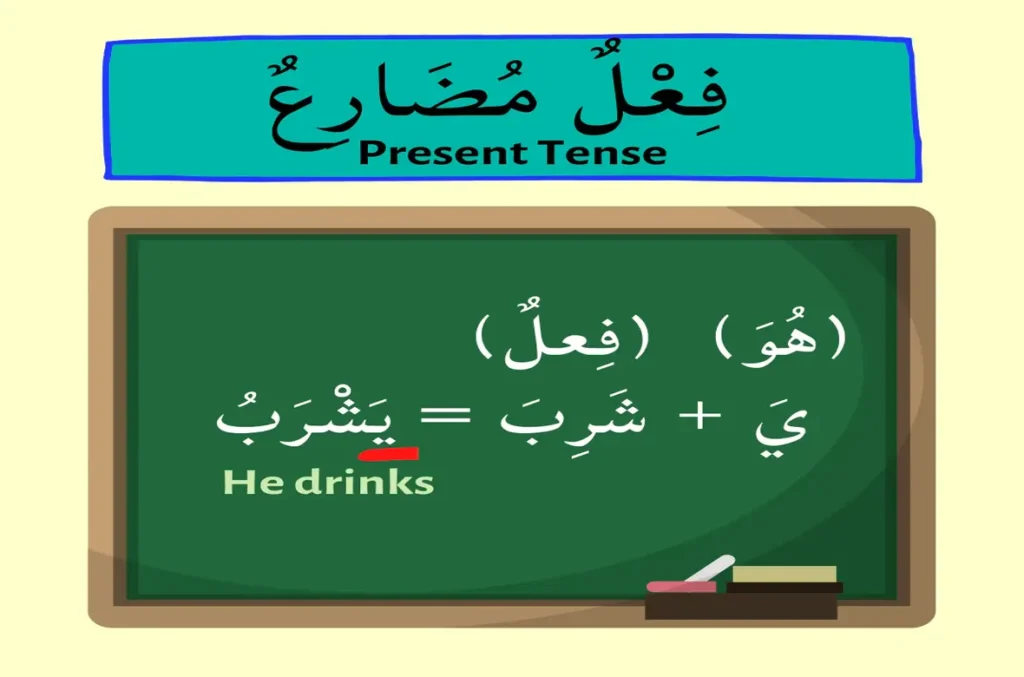
The Arabic present tense, المضارع (al-muḍāri’), is a verb form that expresses an action currently happening, habitually repeated, or expected in the future. It is identified by one of four prefix letters — أ، ن، ي، ت — remembered by the mnemonic word أَنَيْتُ (anaytu). These prefixes are the structural signature of every present-tense verb in Arabic.
Unlike English, which uses separate words (“I am writing,” “I write,” “I will write”), Arabic uses one form — يَكْتُبُ (yaktubu) — to cover all three meanings depending on context. This economy is not vagueness; it is precision through context.
At Buruj Academy, our Arabic Grammar Course begins with the present tense for a deliberate reason: it is the most frequently occurring verb form in both everyday Arabic and the Quran. Students who master it early gain immediate traction in reading and comprehension.
Understand the Arabic Grammar with Buruj’s free trial lesson

How Is the Arabic Present Tense Formed?
The present tense is formed by taking the three-letter root (الجذر, al-jidhru) of any verb and applying the present-tense pattern (وزن المضارع, wazn al-muḍāri’). The base pattern is يَفْعَلُ (yaf’alu) for Form I verbs — this is the third-person masculine singular, which serves as the dictionary reference form.
The Four Present-Tense Prefix Letters
Every present-tense verb begins with one of these four letters:
| Prefix | Arabic | Person |
| أَ (a-) | أَكْتُبُ | First person singular (I) |
| نَ (na-) | نَكْتُبُ | First person plural (We) |
| يَ (ya-) | يَكْتُبُ | Third person masculine |
| تَ (ta-) | تَكْتُبُ | Second person / Third person feminine |
These prefixes carry the subject information that English conveys through separate pronouns.
The Three Vowel Patterns of the Middle Root Letter
In Form I verbs, the middle root letter of the present tense carries one of three short vowels — fatḥah (a), ḍammah (u), or kasrah (i). This must be learned with each verb, as it is not predictable:
- يَكْتُبُ (yaktubu) — he writes (middle vowel: ḍammah)
- يَفْتَحُ (yaftaḥu) — he opens (middle vowel: fatḥah)
- يَجْلِسُ (yajlisu) — he sits (middle vowel: kasrah)
The Complete Arabic Present Tense Conjugation Chart
The full conjugation of كَتَبَ / يَكْتُبُ (kataba / yaktubu — to write) covers 14 forms based on person, gender, and number. This chart is the foundation of Arabic verb mastery.
| Pronoun (Arabic) | Pronoun (English) | Present Tense Verb | Transliteration |
| أنا | I | أَكْتُبُ | aktubu |
| أنتَ | You (m. sg.) | تَكْتُبُ | taktubu |
| أنتِ | You (f. sg.) | تَكْتُبِينَ | taktubīna |
| هو | He | يَكْتُبُ | yaktubu |
| هي | She | تَكْتُبُ | taktubu |
| أنتما (m.) | You (dual m.) | تَكْتُبَانِ | taktubāni |
| أنتما (f.) | You (dual f.) | تَكْتُبَانِ | taktubāni |
| هما (m.) | They (dual m.) | يَكْتُبَانِ | yaktubāni |
| هما (f.) | They (dual f.) | تَكْتُبَانِ | taktubāni |
| نحن | We | نَكْتُبُ | naktubu |
| أنتم | You (m. pl.) | تَكْتُبُونَ | taktubūna |
| أنتنّ | You (f. pl.) | تَكْتُبْنَ | taktubna |
| هم | They (m. pl.) | يَكْتُبُونَ | yaktubūna |
| هنّ | They (f. pl.) | يَكْتُبْنَ | yaktubna |
Notice that هو (he) and هي (she) share the same prefix ta- in third-person feminine singular — this is one of the most common points of confusion we address early in our Arabic classes.
Book your FREE Arabic trial online Arabic class at Buruj

What Are the Main Usages of the Arabic Present Tense?
The Arabic present tense (المضارع) serves three primary functions: expressing an action happening right now, describing a habit or repeated action, and indicating a future event — all without changing the verb form. Context, adverbs, and particles determine which meaning applies in any given sentence.
Usage 1 — Ongoing Action (الحال, al-ḥāl)
When the present tense describes what is happening at this moment, it functions like the English continuous tense:
يَقْرَأُ مُحَمَّدٌ الْقُرْآنَ الآنَ
Muḥammad is reading the Quran right now.
The word الآنَ (al-ān — now) signals present continuity.
Usage 2 — Habitual Action (الاستمرارية, al-istimrāriyya)
The present tense expresses repeated or habitual actions without any modification:
يُصَلِّي أَحْمَدُ الْفَجْرَ كُلَّ يَوْمٍ
Ahmad prays Fajr every day.
Usage 3 — Future Action (المستقبل, al-mustaqbal)
With particles like سَـ (sa-, prefix) or سَوْفَ (sawfa), the present tense shifts to future meaning:
سَأَكْتُبُ الرِّسَالَةَ غَدا
I will write the letter tomorrow.
سَوْفَ يَحْضُرُ الطَّالِبُ
The student will attend.
This triple function makes the present tense the most versatile and frequently used verb form in Arabic, which is precisely why Quranic Arabic is so dense with it.
Master the Arabic Language
Join our expert-led courses and build a strong foundation in Classical and Modern Arabic.
Get Your Free TrialHow Do You Negate the Arabic Present Tense?
Negation of the Arabic present tense uses three distinct particles — لا (lā), and لَنْ (lan), each carrying a different grammatical and semantic weight. Choosing the wrong particle changes the meaning significantly, so distinguishing them is a non-negotiable step in Arabic grammar.
1. Negation with لا (lā) — Simple Present Negation
لا negates a present-tense verb in its default state (مرفوع, marfū’ — nominative), expressing that something simply does not happen:
لا يَكْذِبُ الْمُؤْمِنُ
The believer does not lie.
This is the most common negation in Quranic Arabic and everyday speech.
2. Negation with لَنْ (lan) — Future Negation (نصب, naṣb)
لَنْ negates the future and places the verb in the subjunctive (مَنْصُوب, manṣūb), marked by a fatḥah at the end:
لَنْ أَكْذِبَ
I will never lie / I shall not lie.
Note the final fatḥah on أَكْذِبَ — this grammatical shift is the sign of naṣb.
| Particle | Meaning | Grammatical Case | Example |
| لا (lā) | Does not / Do not | مرفوع marfū’ (default) | لا يَكْتُبُ — He does not write |
| لَنْ (lan) | Will not / Shall never | مَنْصُوب manṣūb (-a ending) | لَنْ يَكْتُبَ — He will not write |
In our sessions, the لَمْ / لَنْ distinction is where the majority of intermediate students make errors — not because they lack knowledge of the rule, but because they haven’t yet internalized why the verb ending changes.
We address this by practicing the sound of each ending before discussing its grammatical name, consistent with the Buruj Method’s context-before-abstraction approach.
How Does the Arabic Present Tense Compare to Past and Future Tenses?
The Arabic present tense sits at the center of the three-tense system, distinguished from the past (الماضي, al-māḍī) and the future (المستقبل, al-mustaqbal) by its structural markers, not by radically different verb roots.
All three tenses derive from the same root, making the system learnable as a unified system rather than three separate memorization tasks.
| Feature | الماضي (al-māḍī) Past | المضارع (al-muḍāri’) Present | المستقبل (al-mustaqbal) Future |
| Structure | Suffix-based | Prefix-based | Present + سَـ or سَوْفَ |
| Example (he) | كَتَبَ (kataba) | يَكْتُبُ (yaktubu) | سَيَكْتُبُ (sayaktubu) |
| Negation | ما / لَمْ | لا / لَنْ | لَنْ (lan) |
The key structural insight: the past tense works by adding suffixes to the root; the present tense works by adding prefixes and suffixes together. This is why grammarians call the present tense المضارع — it “resembles” the noun in its flexibility and in carrying i’rāb (grammatical case endings).
If you want to build a solid foundation across all three tenses, our Arabic for Beginners course introduces this comparative framework systematically from the first lessons.
Begin learning Arabic at Buruj with a FREE trial lesson

Quranic Examples of the Arabic Present Tense
The Quran is saturated with present-tense verbs — understanding them directly elevates comprehension during ṣalāh and Quran reading. Here are verified examples:
نَعْبُدُ appears in one of the most recited verses of the entire Quran:
إِيَّاكَ نَعْبُدُ وَإِيَّاكَ نَسْتَعِينُ
Iyyāka na’budu wa-iyyāka nasta’īn
“It is You we worship and You we ask for help.” (Al-Fatihah 1:5)
نَعْبُدُ — present tense, first person plural, from عَبَدَ — we worship; نَسْتَعِينُ — present tense, Form X, first person plural — we seek help
يَعْلَمُ demonstrates the third-person masculine singular:
وَاللَّهُ يَعْلَمُ مَا تَصْنَعُونَ
Wallāhu ya’lamu mā taṣna’ūn
“And Allah knows that which you do.” (Al-Ankabut 29:45)
يَعْلَمُ — he knows; تَصْنَعُونَ — you [plural masculine] do/make — both present tense
Learners who recognize these patterns hear structured grammar during ṣalāh, not just sounds — and that recognition is transformative. Our Quranic Arabic Classes are built specifically around making this recognition second nature for non-Arabic speakers.
Begin Understanding Quranic Arabic with a FREE Lesson

Discover the Buruj Academy Difference
Step into our virtual classrooms and see how our expert instructors make learning Quran and Arabic intuitive and clear. We focus on overcoming the specific hurdles non-native speakers face, building your confidence and connection with the Quran.
Start Mastering Arabic Grammar with Buruj Academy’s Expert Instructors
The Arabic present tense is not one topic among many — it is the structural core of Arabic communication and Quranic comprehension. Mastering its conjugations, negation rules, and usage patterns positions every other grammar concept to fall into place faster.
Buruj Academy’s Arabic Grammar Course is taught by Al-Azhar University graduates with 12+ years of experience teaching non-Arabic speakers globally.
We use the Buruj Method — context-before-abstraction, patience-before-performance — ensuring you understand why Arabic works before memorizing how.
Every student receives a personalized 1-on-1 learning plan with flexible scheduling.
Book your free trial lesson today and take your first structured step toward Arabic fluency.
Begin your transformation today by choosing the path that fits your goals:
- Online Arabic Classes (General & Comprehensive)
- Arabic Course for Beginners
- Arabic Alphabet Learning Course
- Online Arabic Classes for Kids
- Arabic Classes for Adults
- Arabic Grammar Course (Nahw & Sarf)
- Intermediate Arabic Course (B1/B2)
- Arabic Speaking Course (Conversational Fluency)
- Arabic Reading Course (Literary Excellence)
- Learn Arabic Writing Course (Calligraphy & Composition)
Ready to speak with confidence? Join the global community at Buruj Academy and book your free placement interview today!
Master the Arabic Language
Join our expert-led courses and build a strong foundation in Classical and Modern Arabic.
Get Your Free TrialConclusion
The Arabic present tense — المضارع (al-muḍāri’) — is far more than a grammar point. It is the engine of Arabic expression, carrying ongoing, habitual, and future meanings within a single, elegantly structured form.
From the opening of Al-Fatihah to everyday conversation, it appears constantly, which means every hour you invest in understanding it pays dividends across every dimension of your Arabic learning.
Start with the conjugation chart, internalize the negation particles and their grammatical effects, then expose yourself to Quranic examples daily. The patterns will become instinctive faster than most learners expect — especially with structured guidance built around how non-Arabic speakers actually learn.
Frequently Asked Questions About the Arabic Present Tense
What Does المضارع (al-muḍāri’) Mean in Arabic Grammar?
المضارع (al-muḍāri’) literally means “the resembling one.” Classical Arabic grammarians named it this because the present-tense verb resembles a noun (ism) in its capacity to carry grammatical case endings (i’rāb) — unlike the past tense, which has fixed endings regardless of its grammatical position in the sentence.
How Many Conjugation Forms Does the Arabic Present Tense Have?
The Arabic present tense has 14 conjugation forms, covering all combinations of person (first, second, third), gender (masculine, feminine), and number (singular, dual, plural). Mastering all 14 forms is essential for reading Quranic Arabic accurately, since the Quran uses the full range of these forms across its verses.
What Is the Difference Between لا and لَنْ in Negating the Present Tense?
لا (lā) negates the present tense in a simple, neutral way — “does not / do not” — and leaves the verb in its default form (marfū’). لَنْ (lan) negates a future action with emphasis — “will not / shall never” — and grammatically requires the verb to shift to the subjunctive (manṣūb), changing the final vowel from ḍammah to fatḥah.
Is the Arabic Present Tense the Same in Quranic and Modern Standard Arabic?
The core structure is identical. Both Quranic Arabic (الفصحى القرآنية) and Modern Standard Arabic (الفصحى المعاصرة) use the same prefix system, conjugation patterns, and negation particles. The primary difference lies in vocabulary and some verb forms unique to classical Quranic usage. Understanding the structure of MSA gives a strong foundation for both registers.
How Long Does It Take to Memorize the Arabic Present Tense Conjugation Chart?
In our instructors’ experience, a motivated adult beginner can memorize the full 14-form conjugation table within 1–3 weeks of daily 15-minute practice. Recognition — being able to identify a conjugated verb when reading — typically comes faster than production. The dual forms and feminine plural tend to be the last to solidify, usually requiring an additional week of targeted reinforcement.
Related Articles
Arabic