 Arabic
| Key Takeaways |
| Arabic letter recognition games reduce beginner anxiety by building familiarity through repetition in low-pressure, playful formats. |
| Crossword puzzles targeting Arabic letters reinforce spelling patterns and shape recognition simultaneously, accelerating reading readiness. |
| Matching and sorting activities that group letters by shape family (e.g., ب ت ث) accelerate alphabet mastery for non-native learners. |
| Consistent daily practice of 15–20 minutes using varied game formats outperforms infrequent longer study sessions for letter retention. |
| Digital quiz tools combined with physical tracing activities address both visual and kinesthetic learning styles in adult and child learners. |
Learning the Arabic alphabet does not have to feel like memorizing 28 unfamiliar symbols. When learners engage with letters through structured play, recognition becomes automatic — not forced.
Games, crossword activities, and hands-on exercises build the neural pathways that pure repetition cannot. For non-Arabic speakers of any age, these methods turn letter anxiety into genuine confidence, laying the foundation for Quran reading and Arabic fluency.
Table of Contents:
1. Grouping Arabic Letters by Shape Family Is the Most Effective Starting Activity
The most effective first activity for any beginner is grouping Arabic letters by their shared base shape. Arabic has 28 letters, but many share the same skeleton — differentiated only by the number and position of dots. For example, ب (baa), ت (taa), and ث (thaa) share one base form.
This is the single insight that changes everything for our students at Buruj Academy. When beginners see the alphabet as a set of shape families rather than 28 unrelated symbols, the memorization load drops dramatically. We consistently observe that students who start with shape-grouping activities reach confident letter recognition in roughly half the time compared to those who learn letters in strict alphabetical order.
How to Run a Shape-Family Sorting Activity
Write each letter on a separate card, then ask the learner to group cards that “look similar.” The sorting itself is the lesson — it trains the eye to detect the subtle distinctions (dots above, dots below, no dots) that define Arabic letters.
| Shape Family | Letters in Family | Distinguishing Feature |
| One base shape | ب ت ث | 1, 2, or 3 dots below/above |
| Curved arch | ج ح خ | 1 dot above, no dot, 1 dot above |
| Angular rise | د ذ | No dot, 1 dot above |
| Looped tail | ر ز | No dot, 1 dot above |
| Tooth-and-dot | س ش | No dots, 3 dots above |
This table gives you the starting framework. If you want a structured pathway beyond this activity, our Arabic Alphabet Learning course guides beginners through every shape family with instructor-led feedback.
Get a free trial now in Buruj’s Alphabet course
2. Arabic Letter Matching Games Build Recognition Speed Through Repetition
Arabic letter matching games train the eyes to distinguish letter shapes with increasing speed. The learner sees a letter and must find its pair — whether that pair is the same letter in a different position (isolated vs. connected form) or the letter paired with its name.
Matching games work because they require active retrieval, not passive reading. In our instructors’ experience, adult beginners who spend even ten minutes daily on matching activities show measurably faster letter identification within two weeks.
The key is varying what gets matched: sometimes letter-to-letter, sometimes letter-to-sound, sometimes letter-to-transliteration.
Three Matching Game Formats That Work
Format 1 — Isolated to Connected Forms: Show the isolated form (ع) and ask the learner to match it to a word where it appears at the beginning (عَلَى). This bridges alphabet knowledge to real reading.
Format 2 — Letter-to-Sound Cards: Pair each letter card with a card showing a simple Arabic word that begins with that sound. The learner matches ق to قَلَم (qalam — pen), for example.
Format 3 — Mirror Matching: Show the same letter in two scripts — printed and handwritten — and ask the learner to confirm they are the same. This solves a common frustration: “The letter looks different in books versus handwriting.”
For children specifically, our Online Arabic Classes for Kids incorporate these game formats into every foundational lesson, keeping young learners engaged while building genuine letter recognition — not just rote responses.
Book a FREE Arabic trial for your Child

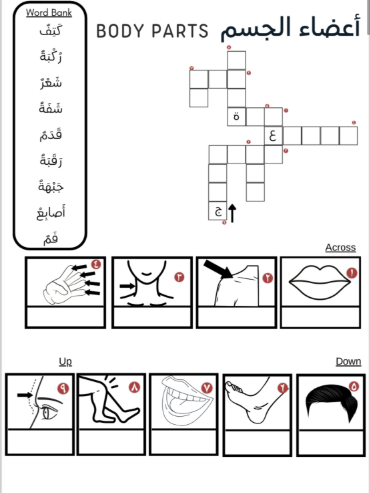
3. Arabic Letter Crossword Puzzles Reinforce Spelling and Shape Recognition Together
An Arabic letter crossword is a targeted activity where learners fill in missing letters within short Arabic words, guided by transliteration clues or picture prompts. Unlike English crosswords, the focus at beginner level is on single letters — not full vocabulary — making this an alphabet reinforcement tool, not a spelling test.
Crossword activities work because they force the learner to retrieve a specific letter shape from memory and write it in context. This is fundamentally different from recognition tasks (matching, sorting) — it requires production.
We use simplified crossword grids in our beginner sessions at Buruj Academy, typically 3×3 or 4×4, with two to three pre-filled letters to reduce overwhelm.
How to Build a Beginner Arabic Letter Crossword
A well-constructed beginner crossword uses short, familiar words — ideally words the learner has already encountered. Here is a sample framework:
| Clue Type | Example Clue | Target Word | Missing Letter |
| Picture clue | Image of a hand | يَد (yad) | ي |
| Transliteration | “baab” (door) | بَاب | ب |
| English meaning | “heart” | قَلْب | ق |
| Sound prompt | Starts with “siin” | سَمَاء | س |
For learners who want to go deeper into reading Arabic words beyond just the alphabet, the beginners’ guide to Modern Standard Arabic from our blog bridges exactly this gap — from letter knowledge to real word and sentence reading.
4. Digital Arabic Letters Games and Quizzes Accelerate Retention for All Ages
Digital arabic letters games quiz formats — whether apps, browser tools, or structured flashcard systems — give learners immediate feedback that physical activities cannot.
When a learner taps the wrong letter and sees an instant correction, the error is caught before it becomes a habit. This is the core advantage of well-designed digital tools.
The most effective digital formats for Arabic alphabet learning are timed letter-identification quizzes, drag-and-drop letter ordering, and audio-matching games where the learner hears a sound and selects the correct letter.
We recommend using digital tools for five to ten minutes at the end of a study session — not as a replacement for physical writing, but as a retention check.
Read also: The Quickest Way to Learn Arabic
What to Look for in an Arabic Alphabet Quiz Tool
Not all quiz tools are equally effective. When evaluating a digital resource, check for these features:
- Audio pronunciation by a native speaker for every letter
- All four letter forms shown (isolated, initial, medial, final)
- Immediate corrective feedback — not just a red X, but the correct answer displayed
- Spaced repetition — letters you miss appear more frequently
- Progress tracking — so learners can see measurable improvement
One proven system is Anki with a purpose-built Arabic alphabet deck, which applies spaced repetition science to letter memorization. For a broader overview of tools and structured approaches, our guide on how to learn the Arabic alphabet reviews methods specifically tested with non-native learners.
Master the Arabic Language
Join our expert-led courses and build a strong foundation in Classical and Modern Arabic.
Get Your Free Trial5. Tracing and Writing Activities Embed Letter Shapes Into Muscle Memory
Tracing Arabic letters is not a children’s activity — it is a neurological tool. The physical act of writing a letter activates motor memory alongside visual memory, creating two retrieval pathways instead of one. This is why learners who trace and write alongside digital study retain letters significantly faster than those who only use screens.
For beginners, the standard sequence we use at Buruj Academy is: watch → trace → copy → write from memory. Each stage adds a layer of independent recall.
A common error we see in self-study learners is jumping directly to “write from memory” before the tracing stage has established the motor pattern — this produces sloppy letter shapes that are hard to self-correct later.
A Practical Tracing Activity Sequence
| Stage | Activity | Purpose |
| Watch | Observe instructor writing the letter | Understand stroke direction |
| Trace | Trace dotted letter outlines | Build motor memory |
| Copy | Write letter next to a visible model | Develop independence |
| Recall | Write letter from memory | Test retention |
| Apply | Write a simple word containing the letter | Connect letter to real usage |
This is the exact sequence detailed in our Learn Arabic Writing course, which includes structured worksheets for every letter, progressively reducing the amount of guidance provided. For parents supporting children specifically, how to write in Arabic for kids offers age-appropriate tracing sequences and printable resources.
Book your free trial to start writing Arabic
6. Storytelling and Picture-Word Games Make Arabic Alphabet Activities Meaningful
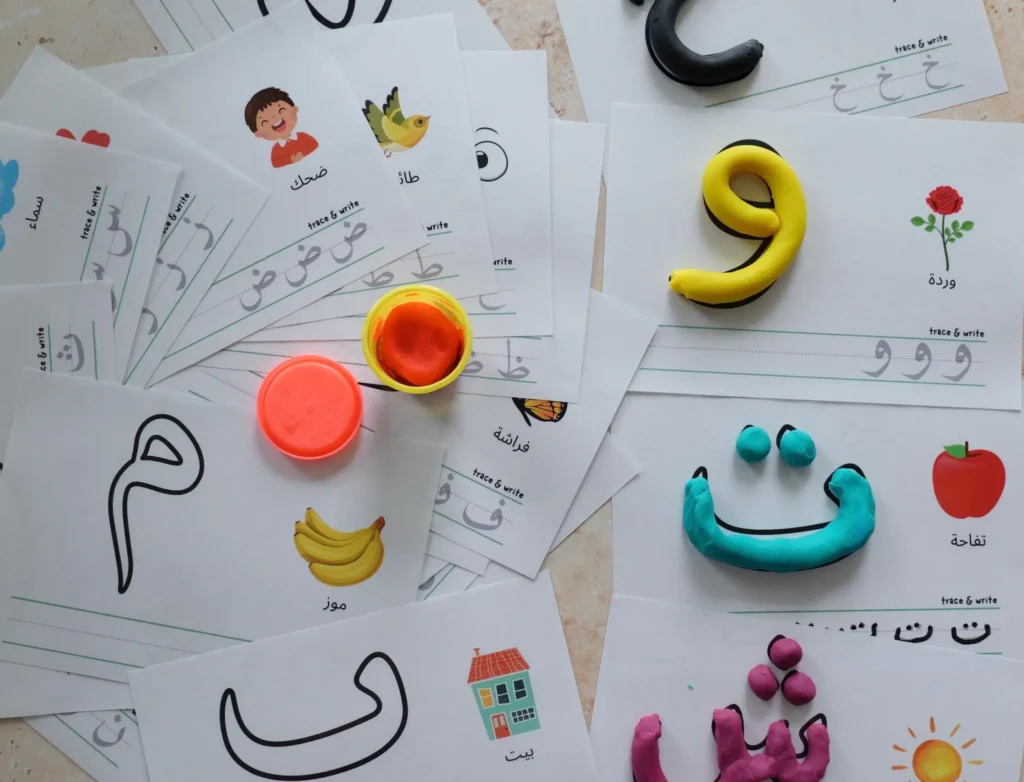
One of the most powerful — and underused — arabic alphabet activities is connecting each letter to a memorable image or short story. Classical Arabic pedagogy has long used visual association: the letter ب (baa) resembles a boat with a dot underneath; the letter و (waw) curves like a hook.
These visual anchors are not random — they exploit the brain’s natural tendency to remember images far better than abstract symbols.
Picture-word association games work as follows: the learner sees a letter alongside a simple Arabic word beginning with that letter, accompanied by a visual image of the word. The image, the letter shape, and the sound are encoded together, creating a three-way memory link.
Fun Ways to Learn the Arabic Letters Through Story Association
For children, a complete letter-story approach works best: each letter has a short character narrative. For adults, a single strong visual anchor per letter is more efficient. Here is a sample set:
| Letter | Sound | Visual Story Hook |
| أ (alif) | “a” | A tall standing pole |
| ب (baa) | “b” | A boat with one dot beneath |
| ع (ayn) | deep “a” | An eye (عَيْن, ayn, means eye in Arabic) |
| ق (qaaf) | “q” | A bowl with two dots — deep from the throat |
| م (miim) | “m” | A round mouth shape |
For children beginning this process, learning Arabic words for kids and Arabic stories for kids from our blog offer letter-rich content that makes these associations come alive in context.
7. Structured Alphabet Revision Games Prevent Forgetting After Initial Learning
Learning a letter once is not the same as knowing it. The most common plateau we see at Buruj Academy is this: a student completes the alphabet, feels confident, then two weeks later cannot recall eight to ten letters reliably. This is the forgetting curve in action — and it is entirely preventable with structured revision games.
The most effective revision format is a simple but strict daily game: show 28 letter cards in random order and time the identification. Record the time. Repeat daily.
The goal is not just accuracy — it is speed. When a learner identifies every letter correctly in under 90 seconds, reading Arabic words becomes possible because letter recognition is automatic, not effortful.
A Weekly Arabic Alphabet Revision Game Schedule
| Day | Revision Activity | Duration |
| Saturday | Timed full-alphabet card identification | 10 minutes |
| Sunday | Shape-family sorting from memory | 10 minutes |
| Monday | Letter-to-sound audio quiz (digital) | 10 minutes |
| Tuesday | Write all 28 letters from memory | 15 minutes |
| Wednesday | Crossword with 5 familiar words | 15 minutes |
| Thursday | Mixed matching game (all forms) | 10 minutes |
| Friday | Review errors from the week only | 10 minutes |
This schedule keeps total daily commitment under 15 minutes while covering every recall modality.
For a broader system that places alphabet mastery within the full Arabic learning pathway, our guide on the easiest way to learn Arabic explains how letter fluency connects to grammar, vocabulary, and reading readiness.
For parents with children on this path, top Arabic games for kids offers additional activity formats suited for younger learners.
Read also: How to Exercise the Arabic Alphabet?
Discover the Buruj Academy Difference
Step into our virtual classrooms and see how our expert instructors make learning Quran and Arabic intuitive and clear. We focus on overcoming the specific hurdles non-native speakers face, building your confidence and connection with the Quran.
Start Learning Arabic Letters the Right Way with Buruj Academy’s Expert-Led Alphabet Course
Games and activities build momentum — expert instruction builds accuracy. Buruj Academy’s Arabic Alphabet Learning course combines structured game-based learning with live instructor feedback, ensuring learners build correct letter recognition, accurate pronunciation, and confident writing from day one.
Our instructors are Al-Azhar University graduates with 12+ years teaching non-native speakers globally. Every session is personalized, 1-on-1, and scheduled around your life. The Buruj Method — context-before-abstraction, consistency-before-speed — means you progress at a pace that sticks.
Book your free trial lesson today and experience the difference structured, expert-guided alphabet learning makes from your very first session.
Begin your transformation today by choosing the path that fits your goals:
- Online Arabic Classes (General & Comprehensive)
- Arabic Course for Beginners
- Arabic Alphabet Learning Course
- Online Arabic Classes for Kids
- Arabic Classes for Adults
- Arabic Grammar Course (Nahw & Sarf)
- Intermediate Arabic Course (B1/B2)
- Arabic Speaking Course (Conversational Fluency)
- Arabic Reading Course (Literary Excellence)
- Learn Arabic Writing Course (Calligraphy & Composition)
Ready to speak with confidence? Join the global community at Buruj Academy and book your free placement interview today!
Master the Arabic Language
Join our expert-led courses and build a strong foundation in Classical and Modern Arabic.
Get Your Free TrialConclusion
Learning the Arabic alphabet is far more achievable than most beginners expect — especially when the right activities replace rote memorization. Shape-family grouping, matching games, crossword exercises, digital quizzes, tracing sequences, and story associations each target a different aspect of letter mastery, working together to build the automatic recognition that fluent Arabic reading requires.
Consistency matters more than duration. Fifteen focused minutes daily with varied game formats will outperform irregular longer sessions every time. Insha’Allah, with the right structure and patient guidance, every learner — adult or child — can move from complete beginner to confident letter recognition faster than they imagined possible.
Frequently Asked Questions About Arabic Alphabet Games and Activities
What Are the Best Arabic Alphabet Activities for Complete Beginners?
The best starting activities for complete beginners are shape-family sorting and letter-to-sound matching games. Both reduce the initial overwhelm of 28 unfamiliar letters by creating categories and patterns. Tracing activities should follow immediately after — within the first week — to add motor memory to visual recognition before any reading practice begins.
How Long Does It Take to Learn the Arabic Alphabet Through Games?
In our instructors’ experience, consistent learners using daily game-based activities for 15–20 minutes typically reach reliable recognition of all 28 letters within three to five weeks. Speed of identification — the real marker of readiness for reading — usually follows in weeks six to eight with daily timed practice.
Are Arabic Letter Crossword Puzzles Effective for Adults?
Yes — arabic letter crossword puzzles are particularly effective for adult learners because they require active production, not just passive recognition. Adults benefit from the structured challenge and immediate self-checking that crosswords provide. Starting with 3×3 grids using three to four familiar words prevents frustration while still demanding genuine recall effort.
Can Children Learn the Arabic Alphabet Through Games Without a Teacher?
Children can make meaningful progress with games and activities, but consistent accuracy — especially pronunciation and letter-form correctness — requires instructor feedback at some point. Games work best as daily reinforcement between guided sessions, not as a standalone curriculum. A structured course like Buruj Academy’s Online Arabic Classes for Kids ensures game-based learning is built on accurate foundations.