 Arabic
| Key Takeaways |
| Arabic has 28 letters, each with up to four distinct forms depending on word position: isolated, initial, medial, and final. |
| Mastering articulation points (makharij) before writing prevents mispronunciation habits that take months to correct later. |
| Daily 20-minute focused sessions outperform infrequent long sessions for building Arabic letter recognition and muscle memory. |
| Connecting letters change shape significantly; practicing the beginning-middle-end forms systematically is non-negotiable for reading fluency. |
| Printable Arabic alphabet charts with vowel markings (harakat) accelerate recognition speed when used alongside live instructor correction. |
Most non-Arabic speakers attempting the Arabic alphabet hit the same wall: they recognize a letter in isolation, then completely miss it inside a word. That gap between recognition and reading is where most self-study efforts stall permanently.
Exercising the Arabic alphabet correctly means training letter recognition, sound production, and script formation together — not separately. These eight steps, drawn from Buruj Academy’s 12+ years of teaching non-Arabic speakers, close that gap systematically.
Table of Contents:
1. Train Your Ear on Each Letter’s Sound Before You Write a Single Stroke
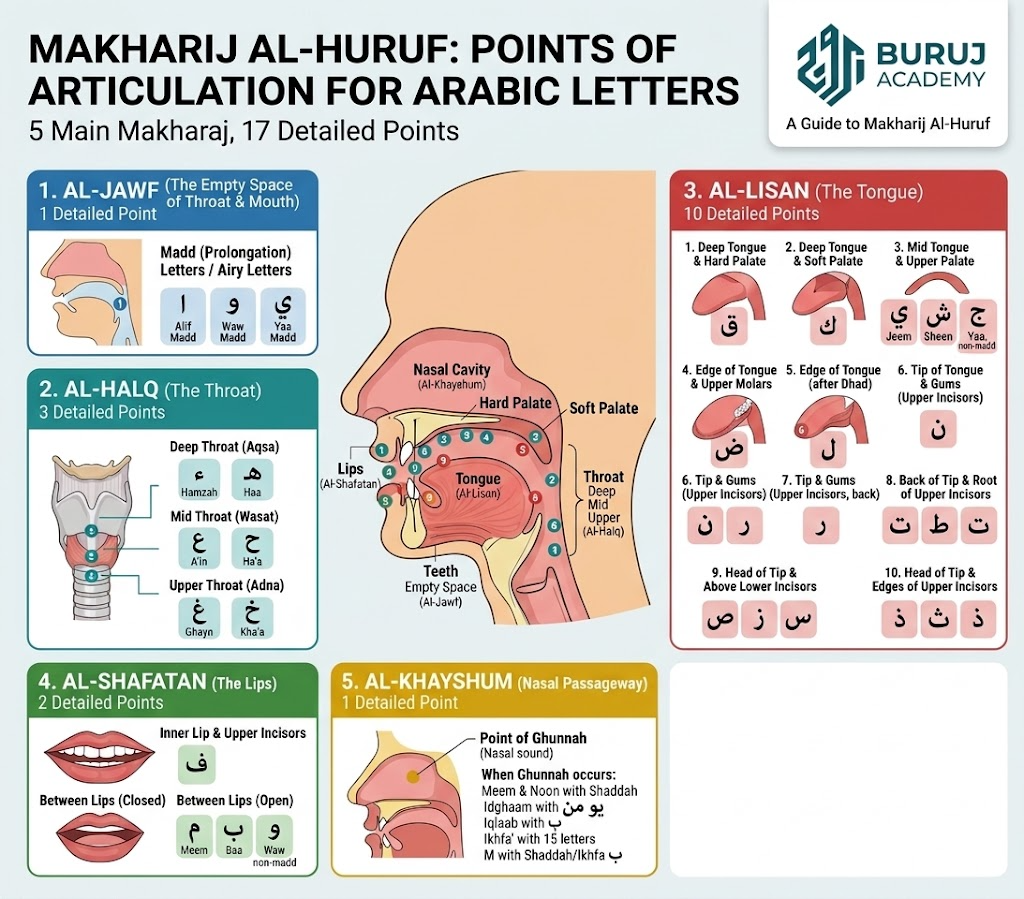
To exercise the Arabic alphabet effectively, begin with sound — not shape. Arabic contains sounds absent from English, including letters produced deep in the throat (like خ and غ) and emphatic consonants (like ص and ض) that alter surrounding vowels. Attempting to write before hearing correctly builds the wrong muscle memory from day one.
Every Arabic letter has a precise articulation point (makhraj). The letter ع (Ayn), for instance, originates from the middle of the throat — a sound most English speakers have never produced.
Our native instructors at Buruj Academy consistently observe that students who spend their first two sessions on listening alone progress through letter writing 40% faster than those who start with pencil and paper immediately.
Spend at least two sessions listening to each letter pronounced in isolation, then in words. Use reliable audio resources where native speakers or qualified instructors demonstrate the sounds clearly and accurately.
Why Throat and Emphatic Letters Require Special Attention
Throat letters (حروف الحلق) — ء، ه، ع، ح، غ، خ — and emphatic letters — ص، ض، ط، ظ — cannot be approximated. Substituting ح (Ha) with the English “h” creates a completely different sound. This distinction matters not only for Arabic speaking but for correct Quran recitation. Our Arabic Pronunciation Online resource explains these distinctions in accessible detail for beginners.
2. Use an Arabic Alphabet Chart That Shows Beginning, Middle, and End Forms Together
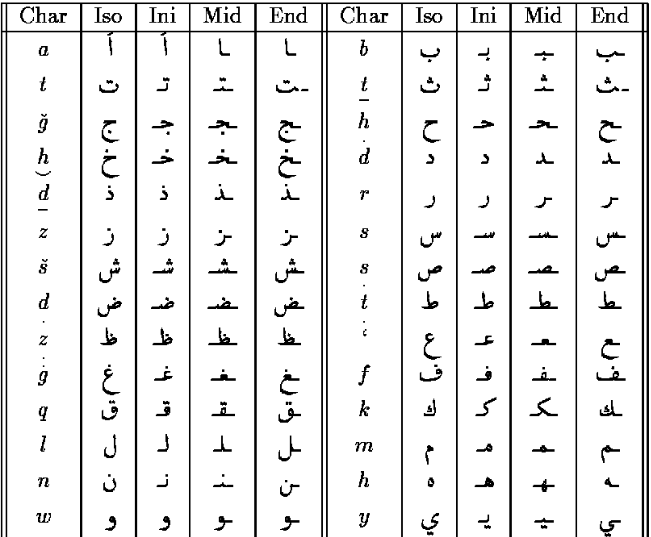
An Arabic alphabet chart showing all four positional forms — isolated, initial (beginning), medial (middle), and final (end) — is the single most important reference tool for any beginner. Without it, students learn 28 letters and then feel lost when they encounter the same letter looking completely different inside a word.
Consider the letter ع (Ayn): in isolation it looks like ع, at the beginning of a word it becomes عَ, in the middle it contracts to ـعـ, and at the end it appears as ـع. These are not four different letters — they are the same letter wearing four different forms.
A well-structured Arabic alphabet chart beginning, middle, and end lays these out side by side so your brain builds the connection immediately.
| Letter Name | Isolated | Initial | Medial | Final |
| Alif | ا | اَ | ـا | ـا |
| Ba | ب | بـ | ـبـ | ـب |
| Ayn | ع | عـ | ـعـ | ـع |
| Meem | م | مـ | ـمـ | ـم |
| Ha (final) | ه | هـ | ـهـ | ـه |
Print this chart and keep it visible during every practice session. A good Arabic alphabet chart printable version allows you to annotate your own pronunciation notes alongside each form.
3. Practice Arabic Letters in Grouped Families to Build Shape Recognition Faster
Grouping Arabic letters by shared skeletal shapes dramatically accelerates recognition. Rather than memorizing 28 unrelated symbols, you train your eye to detect the base shape first, then identify the distinguishing feature — usually the number and position of dots.
The letters ب (Ba), ت (Ta), and ث (Tha) share the exact same base shape. The only difference is the number of dots: one below, two above, three above respectively. The letters ج (Jeem), ح (Ha), and خ (Kha) share another base form, differentiated by dot placement. Training this way means learning one shape that unlocks three letters simultaneously.
| Shape Family | Letters in Family | Distinguishing Feature |
| Ba family | ب ت ث | Dots: 1 below, 2 above, 3 above |
| Jeem family | ج ح خ | Dot: inside, none, above |
| Seen family | س ش | Teeth shape: no dots, 3 dots above |
| Sad family | ص ض | Rounded body: no dot, one dot |
| Ain family | ع غ | Open shape: no dot, one dot above |
This grouped approach is central to our Arabic Alphabet Learning Course at Buruj Academy, where students consistently report feeling confident with letter recognition within the first three weeks using this method.
Get a free trial now in Buruj’s Alphabet course
4. Add Vowel Markers (Harakat) to Your Arabic Alphabet Practice from Week One
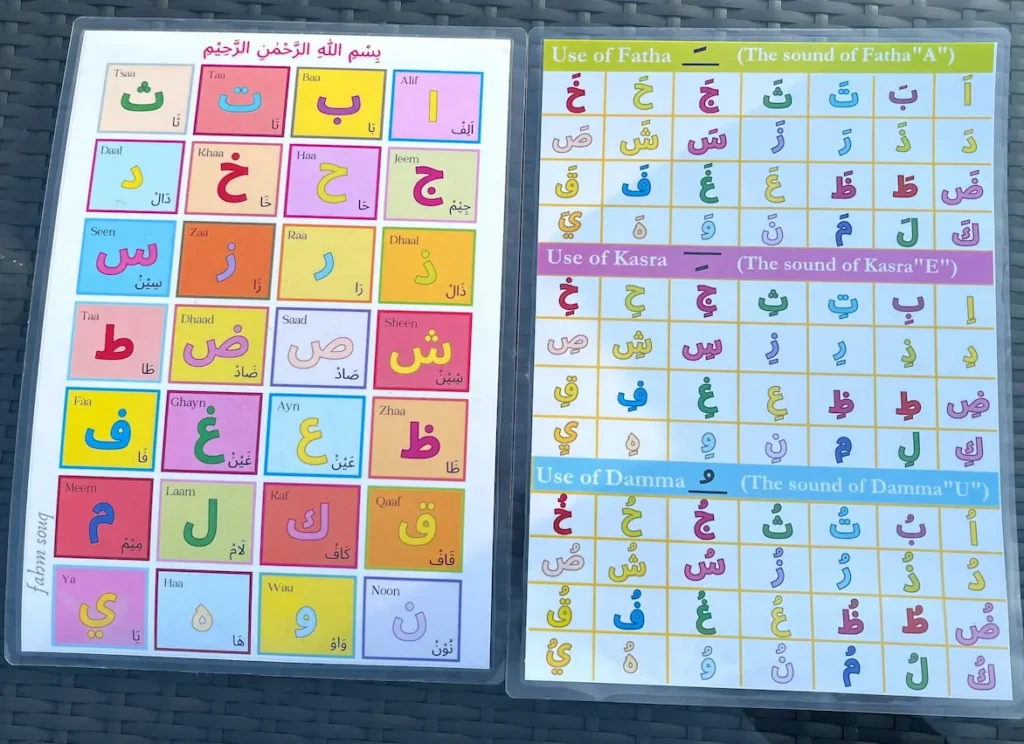
Arabic alphabet practice without harakat (short vowels) creates a reading crutch that is painful to break later. The three core harakat — Fatha (َ), Kasra (ِ), and Dhamma (ُ) — transform a consonant into a complete syllable. The letter ب alone means nothing until a vowel marker activates it: بَ (ba), بِ (bi), بُ (bu).
Many beginners delay harakat practice, assuming it is an advanced topic. This is one of the most common and costly mistakes we see.
In Buruj Academy’s beginner sessions, we introduce harakat alongside the first five letters — never after. The brain learns letter + sound as one unit, which is exactly how Arabic reading works.
A solid understanding of vowels in Arabic — including Sukoon (ْ), Shadda (ّ), and Tanween — is essential before attempting full word reading. Practice each letter you learn with all three short vowel sounds: every new letter gets the full ba-bi-bu treatment before moving forward.
Master the Arabic Language
Join our expert-led courses and build a strong foundation in Classical and Modern Arabic.
Get Your Free Trial5. Use Arabic Letters Worksheets to Build Handwriting Muscle Memory Through Correct Stroke Order
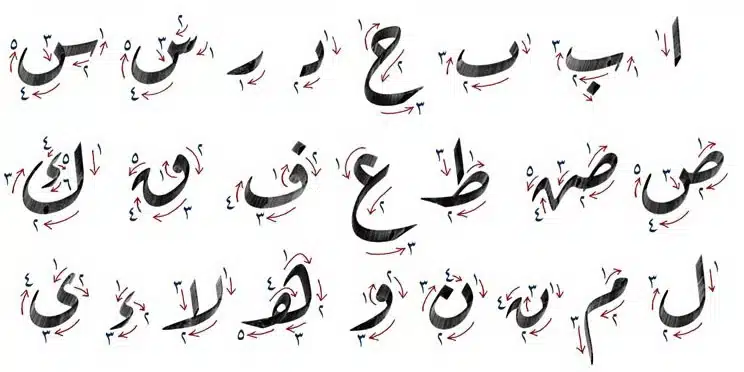
Writing Arabic correctly requires learning stroke direction and sequence — not just shape copying. Arabic is written right to left, and each letter has a specific stroke order that professional calligraphers and teachers follow.
Practicing incorrect stroke order produces letters that look roughly correct in isolation but become illegible when connected in fast handwriting.
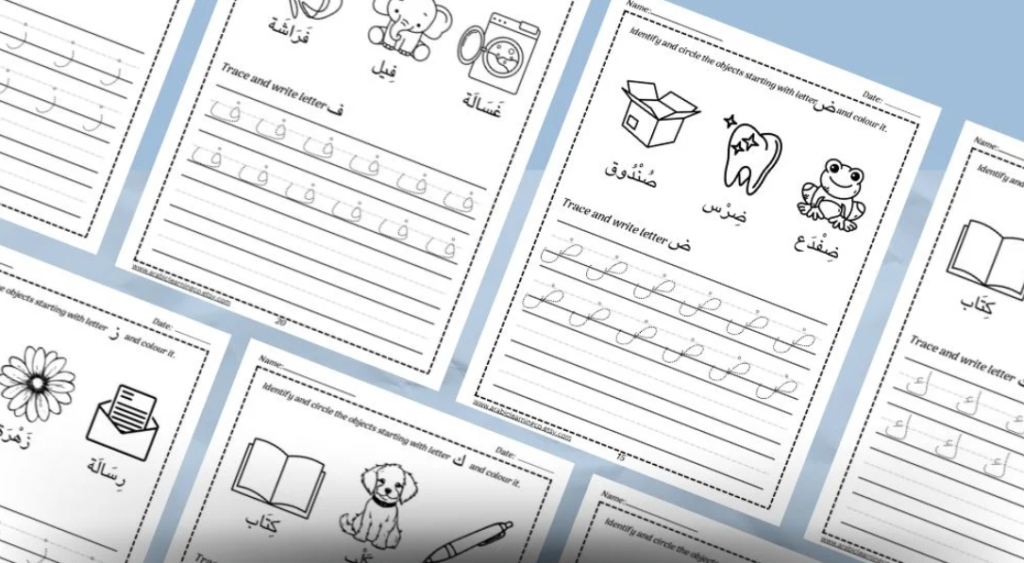
Arabic letters worksheets for kindergarten level beginners — whether children or adults — use tracing exercises that guide the hand through the correct stroke path before freehand writing begins. This approach works for adult beginners too, because the issue is identical: the hand has no prior muscle memory for Arabic scripts.
Free Arabic Alphabet Worksheets for Kids from learnarabicworksheets.com bundles tracing, writing practice, and coloring into a single A4 PDF pack. The activities progress logically: recognition first, then tracing, then independent writing. Coloring activities are embedded throughout to maintain engagement across a full session.
Our instructors recommend spending no more than 15 minutes per session on handwriting — quality of attention matters more than quantity of strokes.
For parents supporting young learners, our Arabic Kids Books recommendations include excellent supplementary writing practice materials.
For structured classroom-level guidance, our Online Arabic Classes for Kids provide live instructor supervision during writing exercises.
Book a FREE Arabic trial for your Child

Read also: The Quickest Way to Learn Arabic
6. Read Short Arabic Words Aloud Daily Using Letters You Have Already Learned
Alphabet exercise does not stay at the letter level for long — it must graduate to short words within the first two weeks. Reading short words aloud reinforces letter connection, trains the eye to track right-to-left movement, and forces the brain to process positional forms in real reading context.
Begin with three-letter words using only the letters you have studied. The word كَتَبَ (kataba — he wrote) uses Ka, Ta, and Ba — all learnable within the first week.
The word بَيْت (bayt — house) introduces the Alif-Ya combination. Short words keep exercises manageable while building reading momentum that motivates continued practice.
This progression — from isolated letters to short words — mirrors how we structure our Arabic for Beginners course at Buruj Academy, where students with Al-Azhar-trained instructors move into word-level reading within 10–14 days of starting.
For a fuller picture of how this fits into overall language acquisition, our beginner’s guide to Modern Standard Arabic offers practical context.
Begin learning Arabic at Buruj with a FREE trial lesson

7. Use Spaced Repetition to Review Previously Learned Arabic Letters Before Each New Session
Spaced repetition is the scientifically established method for transferring information from short-term to long-term memory.
For Arabic alphabet practice, this means revisiting letters learned in previous sessions before introducing new ones — not at random, but at calculated increasing intervals.
The practical application is straightforward: in session four, review letters from sessions one through three before introducing any new material.
In session eight, review all letters learned so far with a timed recognition drill — seeing the letter for two seconds and producing its name and sound. This prevents the “I learned it then forgot it” cycle that derails most self-study attempts.
| Session | New Letters | Review Focus |
| 1 | ا ب ت ث | None |
| 2 | ج ح خ | Session 1 letters |
| 3 | د ذ ر ز | Sessions 1–2 letters |
| 4 | س ش ص ض | All previous |
| 5 | ط ظ ع غ | All previous, timed drill |
For children especially, spacing review into short daily sessions outperforms weekend marathon study. Our learning Arabic alphabet for kids guide provides age-appropriate scheduling frameworks for parents.
8. Get Live Instructor Feedback to Correct Pronunciation and Writing Errors Before They Become Habits
Self-study can carry a learner through letter recognition and basic writing — but it cannot correct pronunciation errors the learner cannot hear, or writing habits the learner cannot see are wrong. This is the ceiling of solo practice. Live instructor feedback breaks through it.
In our experience at Buruj Academy, students who practice independently for three months before taking structured lessons spend the first four to six lessons unlearning bad habits — particularly vowel shortening, incorrect emphatic consonant placement, and reversed stroke direction in writing. Students who begin with qualified instruction from the start reach word-level reading fluency in roughly half the time.
Buruj Academy’s Arabic Alphabet Learning Course provides 1-on-1 sessions with Al-Azhar University graduates who specialize in teaching non-native speakers. Real-time correction during pronunciation drills is irreplaceable.
For a fuller understanding of the overall learning path, see how to learn the Arabic alphabet and how long it realistically takes to learn Arabic.
Discover the Buruj Academy Difference
Step into our virtual classrooms and see how our expert instructors make learning Quran and Arabic intuitive and clear. We focus on overcoming the specific hurdles non-native speakers face, building your confidence and connection with the Quran.
Read also: Learn Arabic Alphabet Games, Activities, and Crossword
Start Exercising the Arabic Alphabet with Buruj Academy’s Expert Instructors
Mastering the Arabic alphabet is the gateway to Quran reading, Arabic speaking, and a lifetime of Islamic learning. These eight steps work — when practiced consistently with proper guidance.
Buruj Academy offers everything you need in one place:
- Al-Azhar University graduates with Ijazah-certified expertise
- 12+ years teaching non-Arabic speakers globally
- The Buruj Method: Sound-before-rules, Context-before-abstraction
- Personalized 1-on-1 online sessions with flexible 24/7 scheduling
- Real-time pronunciation and writing correction from day one
Book your free trial lesson with Buruj Academy’s Arabic Alphabet Learning Course today and begin building the correct foundation from your very first session.
Begin your transformation today by choosing the path that fits your goals:
- Online Arabic Classes (General & Comprehensive)
- Arabic Course for Beginners
- Arabic Alphabet Learning Course
- Online Arabic Classes for Kids
- Arabic Classes for Adults
- Arabic Grammar Course (Nahw & Sarf)
- Intermediate Arabic Course (B1/B2)
- Arabic Speaking Course (Conversational Fluency)
- Arabic Reading Course (Literary Excellence)
- Learn Arabic Writing Course (Calligraphy & Composition)
Ready to speak with confidence? Join the global community at Buruj Academy and book your free placement interview today!
Master the Arabic Language
Join our expert-led courses and build a strong foundation in Classical and Modern Arabic.
Get Your Free TrialConclusion
Exercising the Arabic alphabet is not simply a matter of memorizing shapes — it is a structured process of training ears, eyes, and hands together. Starting with sound, building through positional forms, reinforcing with spaced repetition, and correcting errors early with a qualified instructor makes the difference between a foundation that holds and one that cracks under the weight of actual reading.
Every one of these steps has a purpose rooted in how Arabic script and sound actually function. Follow them in sequence, practice daily even in short sessions, and the alphabet that once seemed overwhelming will become instinctive — Insha’Allah — sooner than you expect.
Frequently Asked Questions About Exercising the Arabic Alphabet
How Many Letters Does the Arabic Alphabet Have?
The Arabic alphabet has 28 letters. Each letter has up to four positional forms — isolated, initial, medial, and final — meaning learners effectively work with over 100 distinct shapes. Grouping letters by shared skeletal shape and practicing all four forms from the beginning makes this manageable for complete beginners.
How Long Does It Take to Learn the Arabic Alphabet from Scratch?
Most non-Arabic speaking adults recognize all 28 letters and their basic forms within three to four weeks of consistent daily practice — approximately 20 minutes per session. Connecting letters fluently within words, with correct pronunciation, typically takes six to eight weeks of structured instruction with live feedback.
Can I Use an Arabic Alphabet Chart in English to Start Learning?
An Arabic alphabet chart english — showing Arabic letters alongside English transliterations — is a helpful starting tool. However, it should be used as a bridge, not a permanent crutch. Transliterations cannot represent sounds like ع, ح, or خ accurately. Transition to pure Arabic reading practice as early as possible, ideally within the first two to three weeks.
What Is the Best Way for Kids to Practice the Arabic Alphabet?
Children learn the Arabic alphabet most effectively through short, daily sessions combining visual tracing worksheets, audio repetition, and simple games. Sessions of 10–15 minutes daily outperform one-hour weekly sessions. Arabic letters worksheets for kindergarten learners that use tracing, coloring, and connect-the-dots activities engage children while building correct stroke habits early.
Should I Learn to Write Arabic Letters Before I Learn to Read Them?
Reading and writing should develop together, not sequentially. Learn a letter’s sound and recognition first, then practice its written form in the same session. Delaying writing until reading is “complete” means missing the reinforcement that handwriting provides for letter memory. Both skills strengthen each other when practiced as a pair from the beginning.