 Arabic
Millions of people want to learn Arabic but assume quality instruction always carries a price tag. That assumption is wrong. Structured, progressive, and genuinely effective Arabic learning is available at zero cost — if you know exactly where to look and in what order to use these resources.
You can learn Arabic for free by combining a structured alphabet foundation, a reliable free grammar resource, daily vocabulary drilling, and free listening practice through YouTube. The key is sequencing these tools correctly, not collecting them randomly — and that sequenced approach is exactly what we teach at Buruj Academy every day.
Table of Contents:
1. Master the Arabic Alphabet Through Free Charts
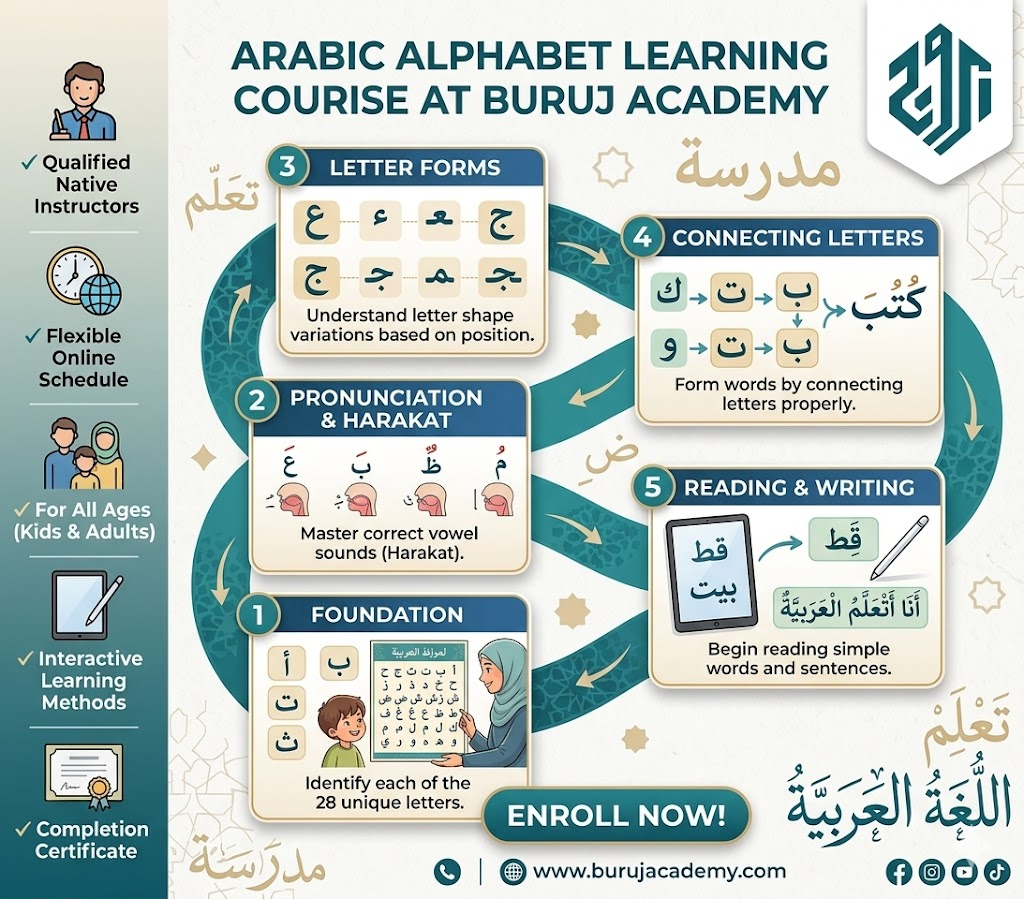
Learning the Arabic alphabet is the non-negotiable first step for every non-Arabic speaker, regardless of your goal — Quranic reading, conversation, or grammar study.
Arabic uses a cursive script of 28 letters, most of which change shape depending on their position in a word. Attempting vocabulary or grammar without this foundation wastes every hour you invest later.
We consistently observe at Buruj Academy that students who skip the script phase — relying on transliteration instead — plateau at a very early stage. Their reading never activates, which blocks listening comprehension and grammar recognition simultaneously.
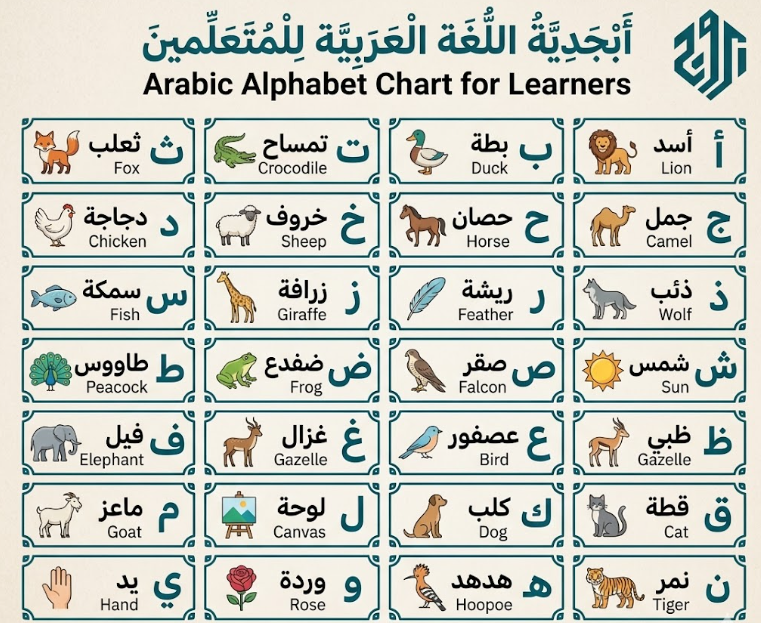
Free resources for alphabet mastery include dedicated apps and structured YouTube playlists. Duolingo Arabic opens with a solid alphabet introduction using gamified letter-recognition drills.
If children are learning alongside you, our guide on learning the Arabic alphabet for kids offers age-appropriate methods that work beautifully as a family activity.
For those who want structured, personalised instruction from day one, Buruj Academy’s Arabic Alphabet Learning course provides one-on-one sessions with Al-Azhar-trained instructors who correct letter formation and pronunciation in real time — something no free app can replicate.
Get a free trial now in Buruj’s Alphabet course
2. Use Free Apps to Build Daily Vocabulary and Early Grammar
Free Arabic learning apps serve a specific and valuable function: they keep you returning to the language every day through habit-forming mechanics. That daily contact — even fifteen minutes — compounds into real acquisition over weeks and months.
| App | Free Content | Best For |
| Duolingo | Full Arabic course (MSA) | Beginners needing daily habit |
| Memrise | Vocabulary sets with native speaker audio | Intermediate vocabulary drilling |
| Busuu | Beginner A1–A2 Arabic lessons | Structured grammar exposure |
| Anki | Free desktop/Android app + community decks | Long-term vocabulary retention |
Duolingo covers MSA basics — alphabet, common nouns, essential phrases, and simple sentence patterns — through bite-sized lessons with immediate feedback. Its significant limitation is vocabulary ceiling: learners who progress past A2 will outgrow it.
Memrise extends vocabulary meaningfully using native-speaker video clips that train your ear alongside your reading eye.
Anki, the spaced-repetition flashcard platform, is free on desktop and Android and allows you to download community-built Arabic decks from AnkiWeb, covering everything from Quranic vocabulary to Egyptian dialect phrases.
We recommend learners use one app daily — not three — to avoid the trap of bouncing between resources without depth. Choose the one that matches your learning style and stick to it for at least sixty days before evaluating your progress.
To build a broader vocabulary foundation, our article on mastering Arabic vocabulary provides practical techniques that complement free app learning effectively.
3. Follow a Free Structured Grammar Course Online
Apps alone will not teach you Arabic grammar in any systematic way. For grammar — the architecture that makes Arabic sentences meaningful — you need a structured course with sequenced lessons and clear explanations. Fortunately, one of the best such resources in the world is entirely free.
Madinah Arabic’s free online course contains over 90 grammar and morphology lessons covering the full range of MSA and classical Arabic structures.
Developed on the framework of the Madinah Books — the same curriculum taught at the Islamic University of Madinah — this resource addresses noun cases (I’rab), verb conjugations, definiteness, dual and plural forms, and much more. Each lesson includes audio, images, and clear English explanations.
Our article on how to learn Arabic grammar easily extends these foundations with practical techniques tailored for English speakers working through MSA grammar.
Additionally, understanding Arabic sentence structure — the VSO (verb-subject-object) pattern that differs fundamentally from English — is the next logical step after basic grammar exposure.
| Grammar Level | What to Focus On |
| Beginner | Definite/indefinite articles, basic noun-adjective agreement, pronouns |
| Elementary | Present tense verbs, dual and plural forms, simple sentences |
| Intermediate | Past and future tenses, I’rab (case endings), verb patterns (awzan) |
| Advanced | Broken plurals, passive forms, attached pronouns, complex sentences |
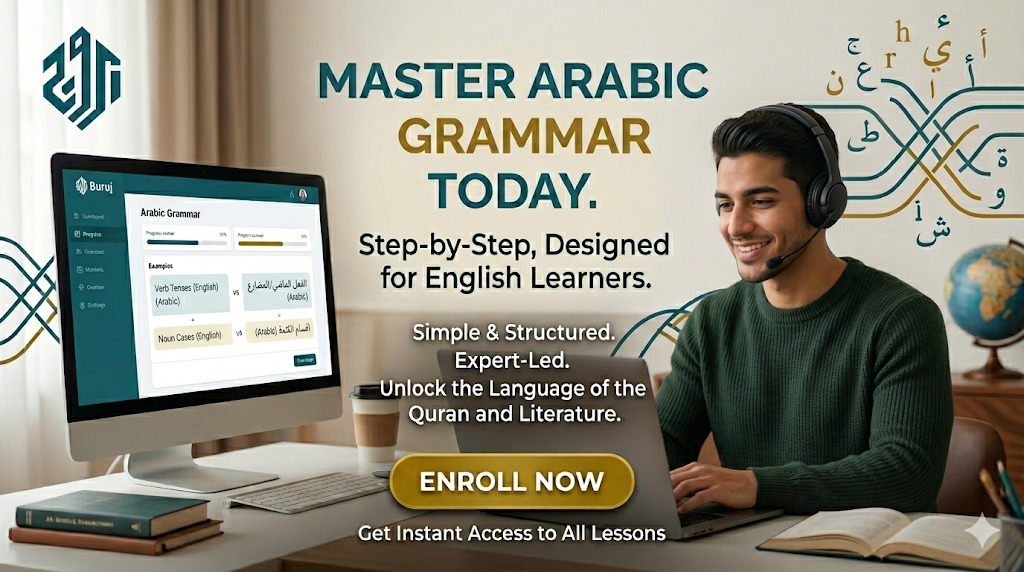
For learners who find self-study grammar challenging, Buruj Academy’s Arabic Grammar course provides live one-on-one instruction from Al-Azhar graduates who explain MSA grammar in structured English — with real-time correction that written lessons cannot provide.
Understand the Arabic Grammar with Buruj’s free trial lesson
4. Learn Arabic for Free Through YouTube Channels
YouTube is one of the most powerful free Arabic learning tools available, provided you use it actively — pausing, repeating, and writing down new structures — rather than passively watching as background noise. Several channels offer genuinely high-quality, sequenced instruction at no cost whatsoever.
ArabicPod101 on YouTube publishes a structured library of audio-visual lessons from absolute beginner through advanced, covering grammar, vocabulary, listening comprehension, and cultural context.
Their 30-day vocabulary challenge playlist alone introduces 300 words through sentences at varied speeds — an excellent supplement to any app.
We recommend choosing one channel, finding its beginner playlist, and watching in strict sequential order. Jumping between channels creates the illusion of learning without the structural foundation that makes Arabic stick.
Master the Arabic Language
Join our expert-led courses and build a strong foundation in Classical and Modern Arabic.
Get Your Free Trial5. Build Arabic Speaking Skills Using Free Language Exchange Tools
Reading and grammar are only two thirds of language acquisition. Speaking — producing Arabic aloud with real feedback — is where many free learners stall. The good news is that free conversation practice is accessible through language exchange communities.
Tandem and HelloTalk are free platforms where you connect with native Arabic speakers who want to learn your language. You practice Arabic; they practice English — a mutually beneficial exchange that provides authentic pronunciation exposure and real conversational feedback.
This kind of native speaker interaction is irreplaceable for building confidence, especially for learners targeting spoken Egyptian Arabic or Levantine dialects.
Our guide on how to improve Arabic speaking skills provides targeted techniques for building speaking confidence that pair exceptionally well with these free exchange platforms.
For pronunciation specifically, our article on Arabic pronunciation online addresses the specific sounds that English speakers consistently struggle with — such as the ع (ʿayn), غ (ghayn), خ (kha), and the emphatic consonants — with exercises you can practice independently.
If you are interested in learning Egyptian Arabic specifically — the most widely understood spoken dialect across the Arab world — our Arabic Speaking course at Buruj Academy provides structured, live conversational practice with native instructors.
Book your free trial to start speaking Arabic fluently

6. Immerse Yourself in Free Arabic Media for Listening Comprehension
Listening comprehension develops through repeated, meaningful exposure to natural Arabic speech. Free Arabic media provides exactly this — and there is an abundance of it available.
Al Jazeera Arabic broadcasts continuously online at aljazeera.net and provides exposure to clear, formal MSA used in professional journalism. For beginners, Al Jazeera’s learning platform offers graded Arabic lessons across six academic levels.
Easy Arabic on YouTube conducts street interviews in Egypt, Palestine, and Tunisia with dual-language subtitles — an excellent resource for simultaneous reading and listening at a natural speech pace.
For those focused on Quranic Arabic, free recitation audio from renowned reciters — available on platforms like Quran.com — provides the most authentic exposure to classical Arabic phonology.
Listening to Quran recitation daily, even without full comprehension, trains your ear to the sound patterns of classical Arabic in ways that accelerate grammar recognition significantly.
Our article on the beginners’ guide to Modern Standard Arabic explains how MSA and Quranic Arabic relate — an important distinction for learners deciding which variety to prioritize.
How Can Kids Learn Arabic Online for Free?
Children learn Arabic through rhythm, repetition, visual association, and play — and free resources designed specifically for young learners exist in abundance. Parents should approach free Arabic learning for children with the same structured sequencing as adults: alphabet first, then vocabulary, then simple phrases and songs.
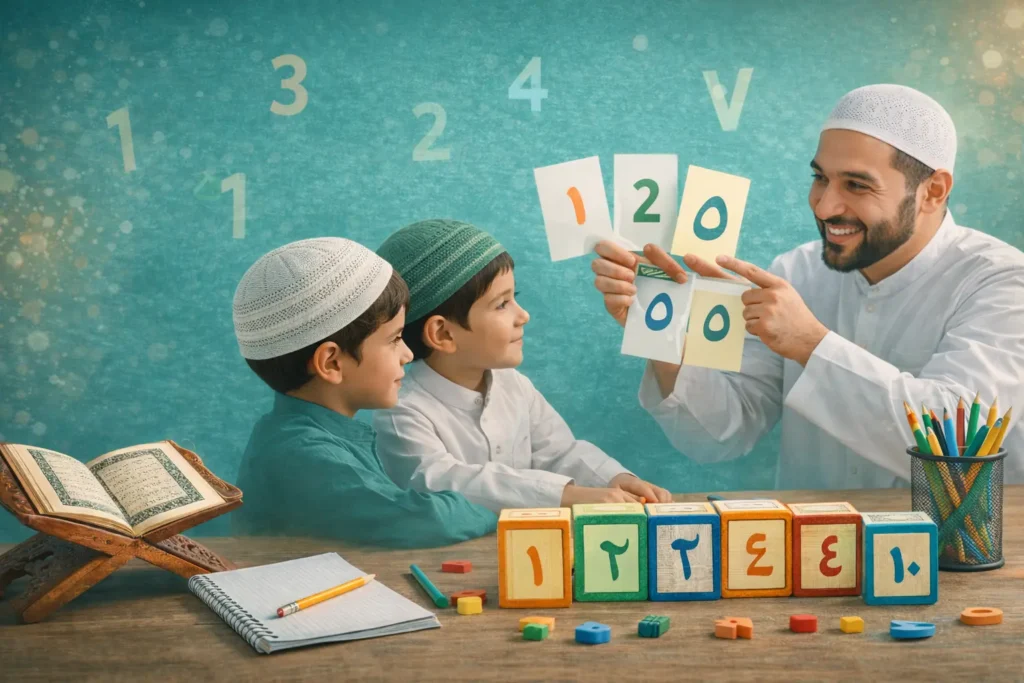
Duolingo’s Arabic for Kids offers a child-friendly interface with the same gamification adults use. YouTube channels like Learn Arabic with Zakaria use animated, bite-sized cartoons that hold young attention spans while introducing letters and basic vocabulary. Our own blog library for young learners covers everything from Arabic sentences for kids to Arabic stories for kids,Arabic games for kids, and Arabic numbers for kids — all free, practical, and parent-friendly.
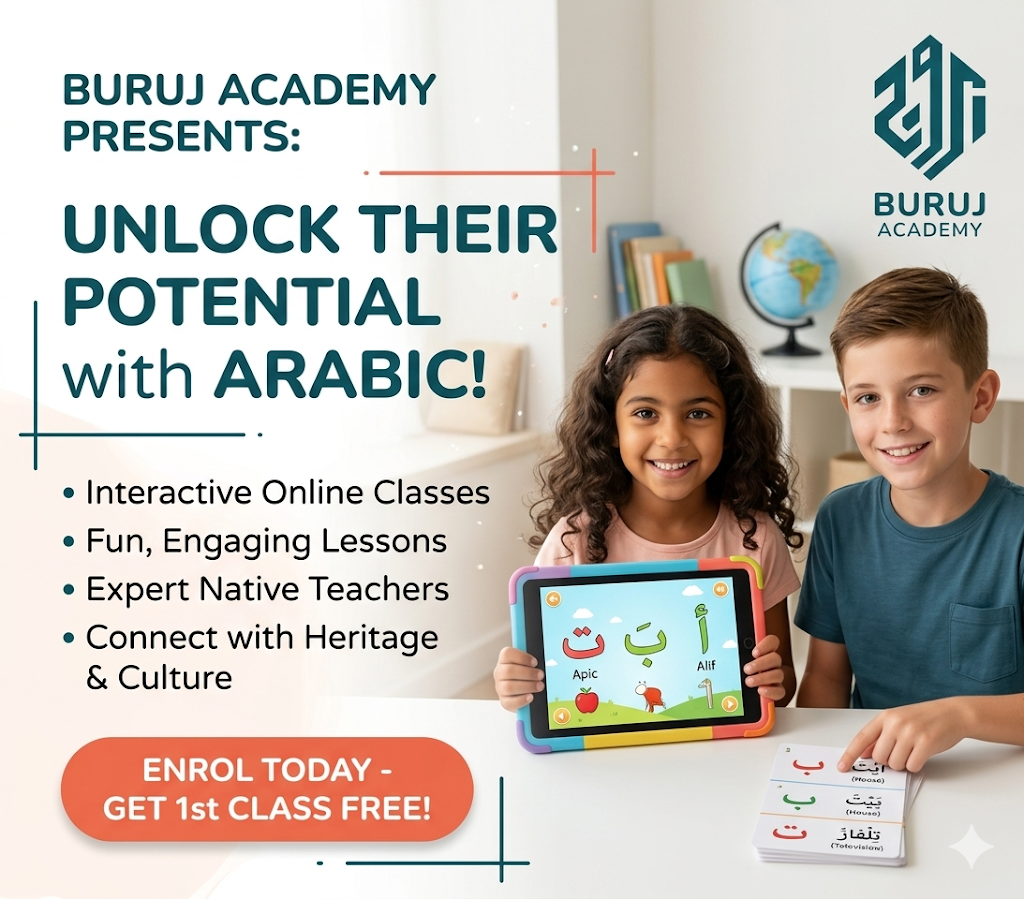
For families wanting structured instruction beyond free resources, Buruj Academy’s Online Arabic Classes for Kids course pairs children with Al-Azhar-trained instructors experienced in child pedagogy, offering age-appropriate one-on-one sessions that accelerate progress dramatically beyond what apps alone achieve.
Book a FREE Arabic trial for your Child
What Is the Best Free Arabic Learning App?
The best free Arabic learning app depends on your specific goal, not a single universal ranking. For alphabet and beginner vocabulary, Duolingo has the lowest barrier to entry and the strongest habit-forming mechanics.
For vocabulary retention through spaced repetition, Anki is the most effective free tool available, particularly when paired with community Arabic decks from AnkiWeb. For structured grammar,
For speaking exposure, Tandem and HelloTalk provide real-conversation practice no app algorithm can replicate.
The mistake most free learners make is using a single app and expecting fluency. Real progress comes from combining tools: one app for daily habit, one structured course for grammar, and one human practice channel for speaking. Our article on the easiest way to learn Arabic explains precisely how these layers interact into a complete self-study system.
Discover the Buruj Academy Difference
Step into our virtual classrooms and see how our expert instructors make learning Quran and Arabic intuitive and clear. We focus on overcoming the specific hurdles non-native speakers face, building your confidence and connection with the Quran.
Learn Arabic Effectively at Buruj Academy with Expert Instructors
Free resources take you far — but a qualified instructor takes you further, faster, and without the errors that self-study often builds in silently.
At Buruj Academy, our Online Arabic Classes are taught by Al-Azhar University graduates with 12+ years of experience teaching non-native speakers globally.
Our key advantages include the Buruj Method (Context-before-abstraction), personalized one-on-one sessions, flexible 24/7 scheduling, real-time pronunciation correction, and structured progression from alphabet mastery to advanced fluency.
We offer a free trial lesson with no commitment — so you can experience the difference expert instruction makes before investing a single dirham or dollar.
Begin your transformation today by choosing the path that fits your goals:
- Online Arabic Classes (General & Comprehensive)
- Arabic Course for Beginners
- Arabic Alphabet Learning Course
- Online Arabic Classes for Kids
- Arabic Classes for Adults
- Arabic Grammar Course (Nahw & Sarf)
- Intermediate Arabic Course (B1/B2)
- Arabic Speaking Course (Conversational Fluency)
- Arabic Reading Course (Literary Excellence)
- Learn Arabic Writing Course (Calligraphy & Composition)
Ready to speak with confidence? Join the global community at Buruj Academy and book your free placement interview today!
Master the Arabic Language
Join our expert-led courses and build a strong foundation in Classical and Modern Arabic.
Get Your Free TrialConclusion
Learning Arabic for free is genuinely possible — the resources exist, the tools are effective, and the path is clear. The learners who succeed are those who sequence their free tools correctly: alphabet first, then structured grammar, then vocabulary drilling, then listening immersion, then speaking practice. Random app usage without that structure rarely leads anywhere lasting.
Alhamdulillah, this is an extraordinary time to learn Arabic. Whether your goal is understanding the Quran, connecting with your heritage, or speaking confidently with 420 million Arabic speakers worldwide, the foundation you build today — even through free resources — is a foundation that serves you for life. When you are ready to accelerate that progress with expert guidance, Buruj Academy is here.
Frequently Asked Questions About Learning Arabic for Free
Can You Really Learn Arabic for Free Without a Teacher?
You can reach a functional intermediate level — reading, understanding basic grammar, and managing everyday vocabulary — using free resources alone. Apps like Duolingo, free grammar courses on Madinah Arabic, and YouTube channels give genuine structured learning. A qualified teacher, however, corrects errors that self-study builds invisibly — particularly pronunciation and grammar mistakes that solidify into habits without expert correction.
How Long Does It Take to Learn Basic Arabic for Free?
Most consistent learners reach basic functional ability — reading the alphabet, understanding simple sentences, and holding brief conversations — within three to six months of daily 20–30 minute practice using free tools. This estimate assumes consistent daily study. Irregular study of the same total hours takes significantly longer due to forgetting between sessions.
Is Learning Egyptian Arabic Free Online?
Yes. Egyptian Arabic is one of the most widely available dialect varieties online, partly because Egyptian media dominates Arab entertainment. Free resources include YouTube’s Easy Arabic channel,HelloTalk for native speaker practice, and dedicated Egyptian dialect content on ArabicPod101. Our article on how to learn Arabic covers dialect selection in detail.
What Is the Best Free Website to Learn Basic Arabic?
Madinah Arabic is the strongest free website for structured Arabic learning, offering over 90 grammar lessons, a dedicated reading course for the alphabet, and vocabulary resources — all at no cost. It covers both MSA and Quranic Arabic systematically, making it suitable for both conversational and religious study goals.
How Can I Learn the Arabic Alphabet for Free Online?
The Madinah Arabic free Reading Course and Duolingo Arabic both cover the full Arabic alphabet with audio support. For a more visual, interactive approach, the ArabicPod101 YouTube channel has dedicated alphabet playlists. Consistent daily practice of 15–20 minutes produces recognizable alphabet mastery within two to three weeks for most beginners.