 Arabic
| Key Takeaways |
| Arabic has 28 letters, each with up to 4 positional forms; mastering letter shapes is the non-negotiable first step. |
| Modern Standard Arabic (MSA) is the universally understood written form and the best starting dialect for beginners. |
| Consistent daily practice of 20–30 minutes outperforms long irregular sessions for Arabic acquisition at every level. |
| Arabic vowel markers (harakat) are essential beginner tools; removing them too early causes lasting pronunciation errors. |
| Structured instruction from qualified teachers accelerates Arabic learning significantly faster than self-study alone. |
Learning Arabic as a complete beginner can feel overwhelming — a new script, unfamiliar sounds, and a grammar system unlike anything in European languages. Many students spend months circling the same beginner material without a clear path forward.
The most effective way to learn Arabic for beginners is to follow a structured sequence: master the alphabet first, build sound accuracy before vocabulary, then layer grammar onto real language exposure.
With the right method and consistent effort, beginners reach functional reading ability within three to six months.
Table of Contents:
1. Understand Why Arabic Requires a Different Learning Approach Than Most Languages
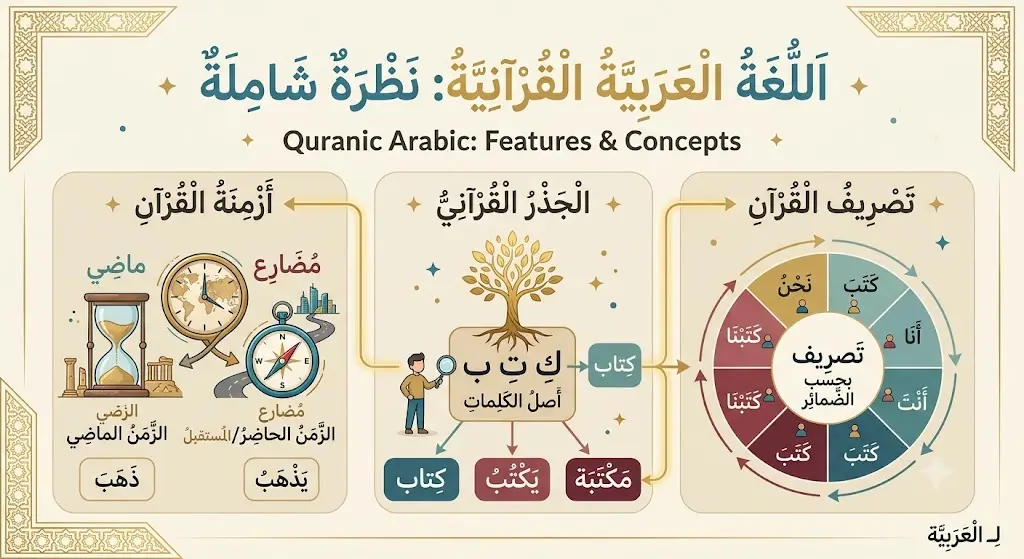
Arabic is a Semitic language — structurally unlike English, French, or Spanish in almost every dimension. Most words derive from three-letter roots, and meaning shifts dramatically based on vowel patterns and prefixes. Approaching Arabic with European-language habits leads to frustration quickly.
Understanding this from day one reframes the challenge. You are not learning a harder version of something familiar.
You are learning a genuinely different linguistic system — and that is worth embracing deliberately, not rushing through.
Before exploring why learning Arabic is one of the most rewarding decisions a Muslim can make, beginners benefit most from setting realistic expectations: Arabic rewards consistency and structured progression, not speed or shortcuts.
At Buruj Academy, our Arabic for Beginners course is built around exactly this principle — our Al-Azhar-trained instructors teach context and sound before rules, ensuring students build real foundations rather than memorized fragments.
Begin learning Arabic at Buruj with a FREE trial lesson

2. Learn the Arabic Alphabet Before Anything Else
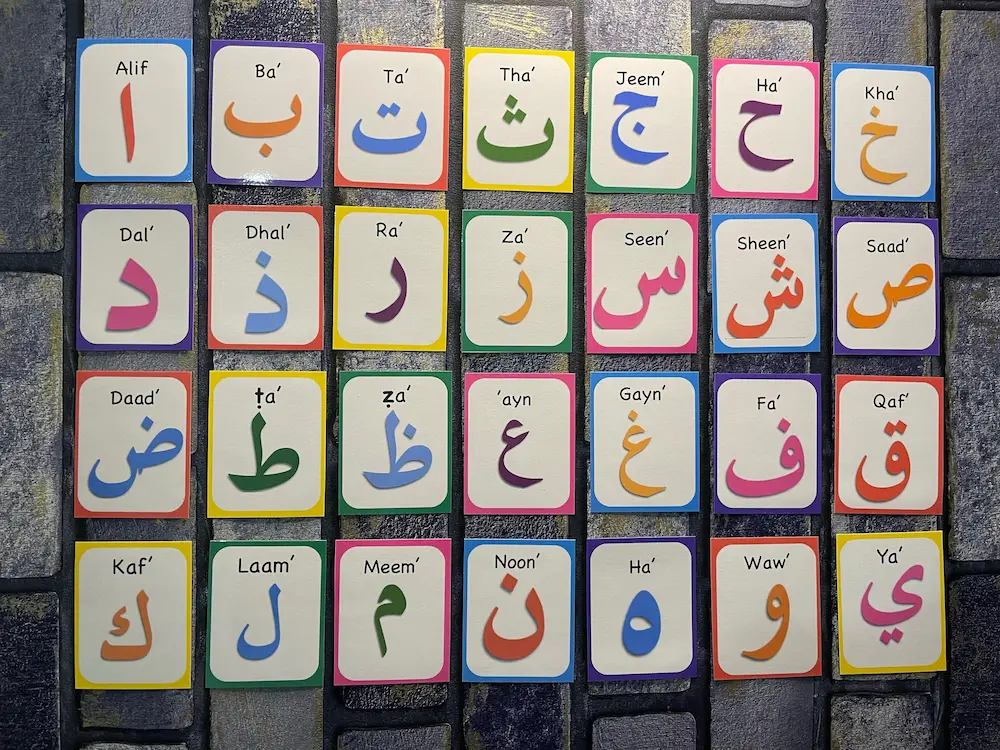
To start learning Arabic, your first milestone is the 28-letter Arabic alphabet. Each letter has up to four written forms depending on its position — isolated, initial, medial, and final. Skipping this step and jumping to vocabulary or phrases creates reading gaps that become much harder to correct later.
The Arabic script is written right to left, and most letters connect to their neighbors. This connection system is logical and consistent once you internalize it.
We typically see students who spend two to three focused weeks on letter recognition and writing move through subsequent stages significantly faster than those who rush past this phase.
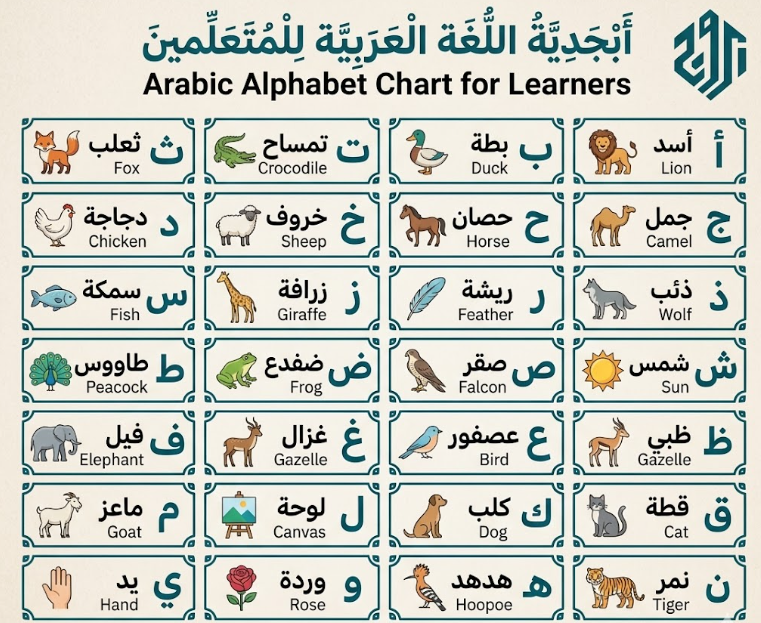
How Long Does It Take to Learn the Arabic Alphabet?
Most adult beginners with daily 20-minute practice sessions can recognize all 28 letters and their positional forms within two to four weeks. Writing them accurately takes slightly longer — typically four to six weeks for clean, consistent script.
Our complete guide on how to learn the Arabic alphabet walks through the letter groups and the most effective recognition sequence.
| Letter Group | Letters | Shared Feature |
| Sun Letters (Shamsiyyah) | ت ث د ذ ر ز س ش ص ض ط ظ ل ن | Assimilate the “al-” definite article |
| Moon Letters (Qamariyyah) | ب ج ح خ ع غ ف ق ك م هـ و ي أ | Preserve the “al-” definite article sound |
| Connector Letters | Most of the 28 letters | Connect to both sides within a word |
| Non-Connectors | ا د ذ ر ز و | Connect only to the right |
Understanding moon and sun letters in Arabic early saves significant confusion when beginners first encounter the definite article in real text.
Buruj Academy’s Arabic Alphabet Learning Course provides structured letter-by-letter instruction with qualified instructors who correct handwriting and pronunciation simultaneously.
Get a free trial now in Buruj’s Alphabet course
3. Master Arabic Vowels and Harakat Before Reading Unvoweled Text
Arabic vowels — called harakat — are short diacritical markers placed above or below letters. They indicate the vowel sounds (a, i, u) that native speakers know by context but beginners cannot yet infer. The three short vowels are Fathah (a), Kasrah (i), and Dammah (u).
Beginners who skip vowel study and try to read unvoweled Arabic texts too early develop guessing habits that undermine reading accuracy for years. Voweled texts, like the Quran and most beginner Arabic books, are the correct starting environment.
Our detailed guide on vowels in Arabic covers not only the three short vowels but also long vowels, tanwin (nunation), and sukoon — all of which a beginner must understand before progressing to sentence reading.
What Are the Essential Vowel Markers Beginners Must Learn?
| Vowel Marker | Arabic Name | Sound | Example |
| َ (above) | Fathah | “a” as in “cat” | كَتَبَ (kataba) |
| ِ (below) | Kasrah | “i” as in “sit” | كِتَاب (kitaab) |
| ُ (above) | Dammah | “u” as in “put” | كُتُب (kutub) |
| ْ (above) | Sukoon | No vowel | مَكْتَب (maktab) |
| ً ٍ ٌ | Tanwin | Double vowel sound | كِتَابٌ (kitaabun) |
Each of these markers changes word meaning significantly. One of the most consistent patterns we observe at Buruj Academy is that students who spend adequate time on harakat in weeks three through six read new vocabulary accurately on first encounter, while those who rushed past this stage misread familiar words repeatedly.
4. Choose Modern Standard Arabic as Your Starting Form
Modern Standard Arabic (MSA) — called الفصحى (Al-Fusha) — is the universally understood written and formal spoken form of Arabic. It is used in news media, literature, Islamic texts, and formal communication across all 22 Arab countries.
For a Muslim beginner, MSA is the only logical starting point. It directly connects to Quranic Arabic, classical Islamic scholarship, and formal written communication — all far more valuable long-term than a single regional dialect.
Our beginner’s guide to Modern Standard Arabic explains exactly how MSA relates to Quranic Arabic and why this foundation makes advancing to classical texts significantly easier.
How Does Modern Standard Arabic Differ from Dialects?
MSA follows consistent grammar rules documented across centuries. Dialects — Egyptian, Levantine, Gulf, Moroccan — vary significantly in vocabulary and pronunciation, and none of them connect to classical Islamic texts the way MSA does.
A beginner who learns MSA first can understand formal Arabic content globally and then layer a dialect later with relative ease.
Buruj Academy’s Online Arabic Classes focus on MSA as the structural foundation, with Al-Azhar-trained instructors who understand both the classical roots and modern application of the language.
Book your FREE Arabic trial online Arabic class at Buruj

5. Build Vocabulary Through Root-Based Learning, Not Memorization Lists
Arabic vocabulary follows a root system — most words derive from three-letter roots that carry a core meaning. The root ك-ت-ب (k-t-b), for example, produces كَتَبَ (he wrote), كِتَاب (book), كَاتِب (writer), مَكْتَبَة (library), and مَكْتَب (office or desk).
Learning vocabulary by root means that understanding one root unlocks five to ten related words instantly. This is far more efficient than isolated word-list memorization. Our guide on mastering Arabic vocabulary walks through this root-based method with practical examples for beginners.
In our sessions at Buruj Academy, students who adopt root-based vocabulary learning consistently outperform those using flashcard lists by a measurable margin — typically recognizing 30–40% more new words in context after the first two months.
| Arabic Root | Core Meaning | Sample Derived Words |
| ك-ت-ب (k-t-b) | Writing | كِتَاب (book), كَاتِب (writer), مَكْتَبَة (library) |
| د-ر-س (d-r-s) | Studying | دَرَسَ (he studied), دَرْس (lesson), مَدْرَسَة (school) |
| ع-ل-م (ʿ-l-m) | Knowledge | عِلْم (knowledge), عَالِم (scholar), مَعْلُومَة (information) |
| ق-ر-أ (q-r-ʾ) | Reading | قَرَأَ (he read), قِرَاءَة (reading), قُرْآن (Quran) |
Read also: The Difference Between Ikhfa, Idgham, Izhar, and Iqlab in Tajweed
6. Learn Arabic Grammar Progressively, Starting with Sentence Structure
Arabic grammar — النَّحْو (An-Nahw) — is systematic and logical, but introduces concepts unfamiliar to English speakers: grammatical gender for every noun, dual forms alongside singular and plural, and case endings (i’rab) that indicate a word’s grammatical function.
Beginners should not attempt to master grammar abstractly before encountering real sentences. The most effective sequence is: see a real sentence, understand its meaning, then learn the grammatical rule it demonstrates. This context-before-abstraction approach is the foundation of Buruj Academy’s teaching method.
Our guide on how to learn Arabic grammar easily and our Arabic sentence structure guide provide the exact progression we recommend for beginners moving from isolated vocabulary into functional sentences.
Master the Arabic Language
Join our expert-led courses and build a strong foundation in Classical and Modern Arabic.
Get Your Free TrialWhat Are the Most Important Grammar Concepts for Arabic Beginners?
Three grammatical foundations cover the majority of what beginners encounter in reading and conversation:
Grammatical Gender: Every Arabic noun is either masculine or feminine — including objects. Feminine nouns typically end in ة (Taa Marbutah). Adjectives must agree in gender with their nouns.
Definite and Indefinite: The definite article ال (al-) marks specific nouns. Indefinite nouns carry tanwin endings. Understanding this distinction is essential for reading even the simplest Arabic sentences.
Nominal vs. Verbal Sentences: Arabic has two basic sentence types — nominal sentences (subject + predicate, often without a verb “to be”) and verbal sentences (verb + subject + object). Recognizing both from early stages builds real reading comprehension rather than pattern-matching habits.
Buruj Academy’s Arabic Grammar Course covers these foundations systematically, taught by Ijazah-certified instructors who explain grammatical rules with real Quranic and classical Arabic examples.
Understand the Arabic Grammar with Buruj’s free trial lesson

7. Develop Arabic Pronunciation Accuracy from the Very Beginning
Arabic contains sounds that do not exist in English — the emphatic consonants (ص، ض، ط، ظ), the pharyngeal sounds (ع، ح), and the uvular sounds (خ، غ، ق). Mispronouncing these from the beginning creates habits that become increasingly difficult to correct at intermediate and advanced levels.
Pronunciation accuracy matters especially for Muslims whose goal includes Quranic recitation. Mispronouncing ض as “d” or ع as a glottal stop changes the meaning of Arabic words and, more significantly, Quranic text.
Our Arabic pronunciation guide addresses the most common errors English speakers make and how to correct them systematically.
The single most common issue we encounter with self-taught Arabic students at Buruj Academy is pronunciation habits that were acceptable for casual conversation but incompatible with Quranic recitation. Correcting these after twelve months of reinforcement takes two to three times longer than learning correctly from the start.
Which Arabic Sounds Are Hardest for English Speakers?
| Arabic Sound | Letter | Common English-Speaker Error | Correction Approach |
| Pharyngeal voiced | ع | Replaced with glottal stop | Constrict mid-throat, not the glottis |
| Pharyngeal voiceless | ح | Replaced with “h” | Whispered, from deep throat |
| Uvular stop | ق | Replaced with “k” | Back of tongue at uvula, not velum |
| Emphatic “s” | ص | Replaced with plain “s” | Tongue retracted, jaw lowered |
| Emphatic “d” | ض | Replaced with “d” or “z” | Side of tongue, emphatic resonance |
Buruj Academy’s Arabic Speaking Course specifically addresses these pronunciation gaps with real-time instructor feedback in every session.
Book your free trial to start speaking Arabic fluently

8. Practice Arabic Reading Daily with Structured, Voweled Texts
Reading Arabic requires active daily practice — not occasional exposure. The script, the letter forms, and the left-to-right scanning suppression all require neurological habituation that only consistent repetition builds. Beginners who read Arabic for 15–20 minutes daily make measurable progress within weeks. Those who read once or twice weekly plateau quickly.
Start with fully voweled texts — children’s Arabic readers, Quranic text with full harakat, and beginner Arabic textbooks.
Our Arabic reading course at Buruj Academy sequences reading materials by difficulty, ensuring students are always challenged but never overwhelmed.
Read Arabic fluently with a free Buruj trial
9. Develop Arabic Writing Skills Alongside Reading for Reinforced Learning
Arabic writing is a separate skill from reading — and a powerful one for retention. The act of writing Arabic letters by hand reinforces letter recognition, positional form memory, and word structure in ways that passive reading does not.
Beginners should begin writing practice from the first week of alphabet study — tracing letters, then copying words, then writing simple sentences from dictation. Our guide on improving Arabic writing with dictation explains why dictation exercises are among the highest-value writing practice tools for Arabic beginners.
Buruj Academy’s Learn Arabic Writing Course builds writing accuracy from letter formation through sentence construction, with instructors who correct script quality and grammatical accuracy together.
Read also: How to Learn Arabic for Free?
Discover the Buruj Academy Difference
Step into our virtual classrooms and see how our expert instructors make learning Quran and Arabic intuitive and clear. We focus on overcoming the specific hurdles non-native speakers face, building your confidence and connection with the Quran.
Start Learning Arabic the Right Way with Buruj Academy
Learning Arabic for beginners requires the right sequence, the right teacher, and the right consistency. Skipping steps leads to gaps that slow progress significantly later. Structured guidance from day one is the most time-efficient path forward.
Buruj Academy offers:
- Al-Azhar University graduates and Arab native instructors with 12+ years teaching non-Arabic speakers
- The Buruj Method: Context-before-abstraction, Consistency-before-speed
- Personalized 1-on-1 online sessions with flexible 24/7 scheduling
- Real-time pronunciation correction and individualized learning plans
- Proven progression from alphabet to sentence reading to grammar mastery
Book your free trial lesson today and begin with an expert instructor who will map your exact starting point and build a personalized plan — Insha’Allah.
Begin your transformation today by choosing the path that fits your goals:
- Online Arabic Classes (General & Comprehensive)
- Arabic Course for Beginners
- Arabic Alphabet Learning Course
- Online Arabic Classes for Kids
- Arabic Classes for Adults
- Arabic Grammar Course (Nahw & Sarf)
- Intermediate Arabic Course (B1/B2)
- Arabic Speaking Course (Conversational Fluency)
- Arabic Reading Course (Literary Excellence)
- Learn Arabic Writing Course (Calligraphy & Composition)
Ready to speak with confidence? Join the global community at Buruj Academy and book your free placement interview today!
Master the Arabic Language
Join our expert-led courses and build a strong foundation in Classical and Modern Arabic.
Get Your Free TrialConclusion
Arabic is not learned in a single leap — it is built layer by layer, from alphabet to vowels, from vocabulary roots to sentence structure, from reading practice to speaking confidence. The students who make the most consistent progress are those who follow a logical sequence, practice daily, and invest in qualified instruction from the beginning.
Every step in this guide reflects what our instructors at Buruj Academy observe working consistently with adult beginners across different backgrounds and goals.
Whether your motivation is Quranic comprehension, Islamic scholarship, or conversational ability, the path begins the same way: one letter, one sound, one structured session at a time. Alhamdulillah, Arabic is learnable — and with the right guidance, it is learnable well.
Frequently Asked Questions About Learning Arabic for Beginners
How Long Does It Take to Learn Arabic as a Complete Beginner?
Most beginners reach functional reading ability in three to six months with daily 20–30 minute practice sessions. Conversational fluency in Modern Standard Arabic typically requires 18–24 months of consistent structured study. Timeline varies significantly based on daily study time, instruction quality, and prior exposure to Semitic languages.
Is Arabic Hard to Learn for English Speakers?
Arabic is genuinely challenging for English speakers due to the unfamiliar script, new sounds, and grammatical structures unlike English. However, difficulty is not impossibility. With structured instruction and consistent daily practice, English-speaking adults reach solid beginner milestones within weeks and reading competence within months.
Where Should a Complete Beginner Start Learning Arabic Online?
A complete beginner should start with the Arabic alphabet using a structured course or qualified instructor — not apps alone. After achieving letter recognition, progress to vowel markers, then simple vocabulary, then basic grammar. Buruj Academy’s Arabic for Beginners course provides this exact sequence with personalized instructor guidance.
Should Beginners Learn Modern Standard Arabic or a Dialect First?
Modern Standard Arabic (MSA) is the recommended starting point for Muslim beginners. MSA connects directly to Quranic Arabic, classical Islamic texts, and formal written Arabic understood across all Arab countries. Dialects can be added later with considerably less effort once MSA foundations are solid.
Related Articles
Arabic