 Quran
Quran
| Key Takeaways |
| Hafsa bint Umar (RA), daughter of the second Caliph, was entrusted with the first official Mushaf after the Quran’s compilation. |
| Multiple female Companions memorized the Quran fully, including Aisha (RA), who also transmitted thousands of hadiths with Quranic precision. |
| Islam permits and encourages girls and women to pursue Hifz. |
| A girl pursuing Hifz is called a Hafiza — the feminine Arabic form — and holds the same spiritual rank as a male Hafiz. |
| Consistent daily sessions of 30–45 minutes, strong Tajweed foundations, and a qualified female teacher are the three pillars of successful Hifz for girls. |
The history of Quran memorization is inseparable from the contributions of women. From the earliest generation of Islam, female Companions preserved, recited, and transmitted the Quran with the same dedication and precision as their male counterparts.
Today, women and girls across the world achieve Hifz at every age — and the question is not whether they can, but how to do it well. A girl who memorizes the Quran earns the title Hafiza, carries an immense spiritual honor, and fulfills a role the female Companions of the Prophet ﷺ established 1,400 years ago.
Table of Contents:
Who Is the First Female Hafiz of Quran?
Hafsa bint Umar ibn al-Khattab (RA) is the first female Hafiz. Among the female Companions of the Prophet ﷺ, Hafsa bint Umar ibn al-Khattab (RA) holds a uniquely historic position — she was entrusted with the custody of the first official written Mushaf compiled under Abu Bakr (RA) during his caliphate, and later referenced during the standardization under Uthman (RA).
Her memorization was so trusted and precise that she became the guardian of the Quran in both written and oral form.
While several female Companions memorized the Quran completely, Hafsa (RA) stands at the intersection of memorization and official Quranic preservation — making her historically unparalleled among women.
Why Hafsa bint Umar (RA) Holds a Unique Place in Quranic History
Hafsa (RA) was not only a Hafiza but also a deeply learned woman. She was a wife of the Prophet ﷺ, the daughter of Umar ibn al-Khattab (RA), and a transmitter of hadith. Her home became the trusted location for the Mushaf — a responsibility that required both memorization mastery and scholarly reliability.
Classical scholars of Quranic sciences confirm that Hafsa (RA) was among those who memorized the entire Quran during the Prophet’s lifetime.
Her role in the Quranic compilation narrative is documented in Sahih al-Bukhari (Hadith 4987), which records the story of the Mushaf’s transfer to her custody.
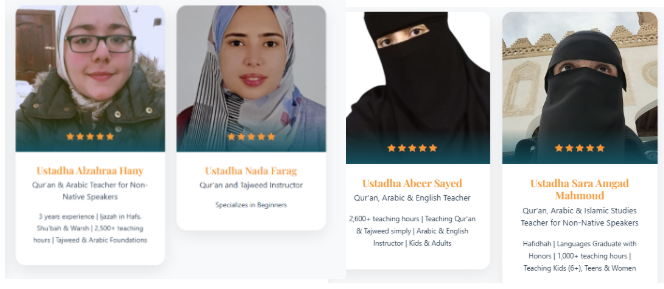
Buruj Academy’s Hifz for Sisters course is designed specifically for female learners, connecting them with qualified female Hafiza instructors who hold Ijazah certification and understand the practical realities women face — from scheduling around family responsibilities to managing memorization during different life phases.
Book Your Free Trial Lesson with Burruj’s Hifz Course for Ladies
Which Female Companions Memorized the Quran?
Several female Companions are documented in classical Islamic scholarship as having memorized the Quran fully during the era of the Prophet ﷺ and the early Caliphs. These women are among the most authoritative transmitters of Quranic knowledge in Islamic history.
| Female Companion | Known For | Scholarly Significance |
| Hafsa bint Umar (RA) | Custodian of the first Mushaf | Memorizer and guardian of the written Quran |
| Aisha bint Abi Bakr (RA) | Wife of the Prophet ﷺ, major hadith transmitter | Quran memorizer and primary source of Sunnah |
| Umm Salama (RA) | Wife of the Prophet ﷺ | Known for precision in recitation and narration |
| Umm Waraqah bint Abdullah (RA) | Led prayers in her household | The Prophet ﷺ visited her and called her “the martyr” |
Umm Waraqah (RA) is particularly significant. She had memorized the entire Quran and the Prophet ﷺ himself appointed her to lead the members of her household in prayer, as recorded in classical hadith collections.
This demonstrates the Prophet’s direct recognition of a woman’s Hifz as a qualification for religious leadership within her sphere.
In Quran female teachers’ experience at Buruj Academy, we often share these historical examples with female students who doubt whether Hifz is truly “for them.”
When a student learns that the Prophet ﷺ himself visited a woman’s home out of reverence for her memorization, that doubt disappears immediately.
Book a FREE trial session with one of Buruj’s Azhari Quran female tutors
Can a Girl Be a Hafiz of the Quran?
Yes, a girl can memorize the entire Quran and is called a Hafiza (حافظة) — the feminine form of Hafiz in Arabic. There is no Islamic prohibition, scholarly disagreement, or jurisprudential obstacle to a girl or woman pursuing and completing Hifz.
The Quran itself addresses believers of both genders equally in its commands and honors. The memorizers who carry the Quran in their hearts are among the most honored in Islamic tradition, regardless of gender.
As documented in Sahih al-Bukhari (Hadith 5027), the Prophet ﷺ said the best among people are those who learn the Quran and teach it — a statement that applies equally to men and women.
What Does “Hafiza” Mean?
Hafiza (حافظة) is the Arabic feminine noun for one who preserves and protects — in Islamic usage, one who has memorized the entire Quran by heart. The root word حفظ (Hifz) means to guard, preserve, and protect.
When a girl completes her memorization, she earns this title with the same spiritual weight as a male Hafiz.
The honor is identical. The reward described in hadith literature — that a Hafiz will intercede for ten family members on the Day of Judgment — applies to Hafizas equally, as understood by classical scholars across all major madhabs.
Read alos: Best Free Online Quran Classes for Sisters Learning Hifz
How Can a Girl Become a Hafiza?
Becoming a Hafiza requires four foundational pillars working together: correct Tajweed, a structured memorization system, consistent revision, and qualified guidance. Without all four, memorization is slower, less accurate, and harder to retain.
Step 1: Build a Tajweed Foundation Before Memorizing
The single most common mistake we see in girls beginning Hifz is rushing into memorization before their recitation is correct. Memorizing with errors means memorizing the errors — and correcting entrenched mispronunciations later is far harder than learning correctly from the start.
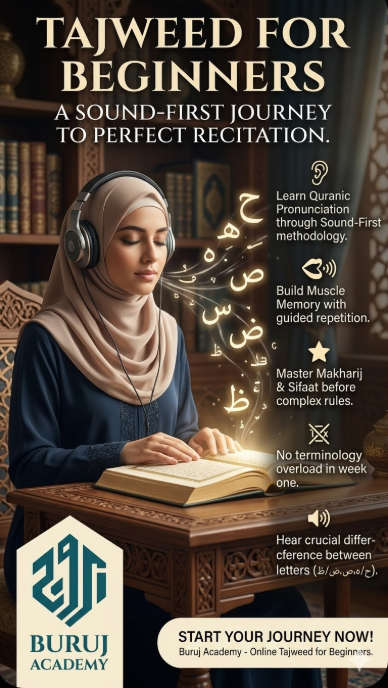
A minimum of 2–3 months of focused Tajweed study before Hifz is our standard recommendation at Buruj Academy. Our Tajweed for Beginners course builds the phonetic accuracy girls need before their first memorization session. You can explore more about building this foundation through our guide on Tajweed for beginners.
Book Your FREE Trial Lesson to Begin Your Tajweed Journey
Read also: Who Is a Hafiz?
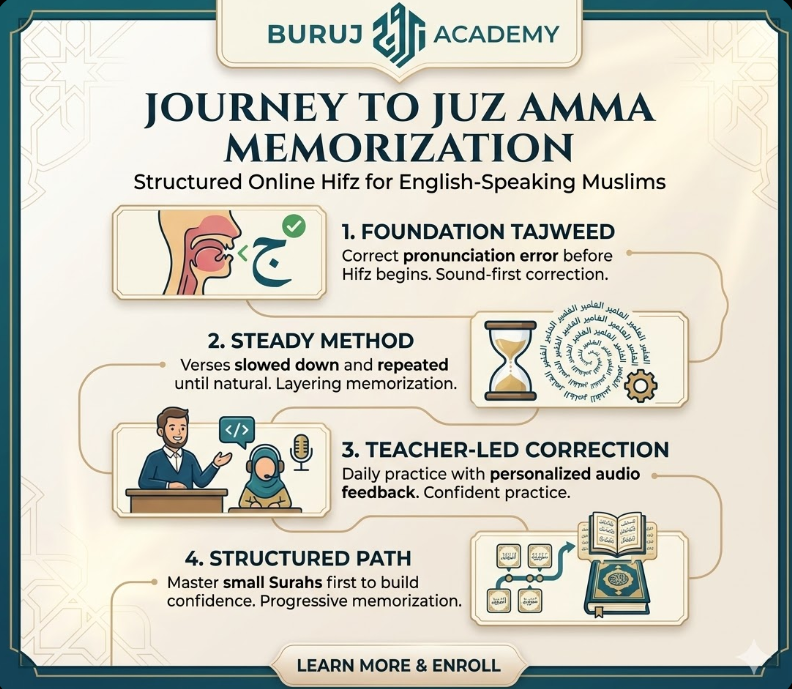
Step 2: Begin with Juz Amma and Build Confidence
Juz 30 contains the short surahs most commonly used in daily prayer. Starting here gives a girl early wins — she memorizes surahs she already partially knows, hears them in salah immediately, and builds confidence before tackling longer surahs.
Our Juz 30 Memorization course is specifically designed as a standalone program and as a Hifz entry point, with instructors who pace sessions appropriately for beginners. For those who want to understand how to approach memorization systematically, our Quran memorization schedule guide provides a complete framework.
Book Your First Session in Buruj’s Juz 30 Memorization Course
Step 3: Apply the Three-Part Daily Session Structure
Every effective Hifz session for a girl should contain three distinct components — new memorization, same-day review, and older revision. Skipping revision is the primary reason students lose previously memorized material.
| Session Component | Time Allocation | Purpose |
| New memorization | 15–20 minutes | Learning new verses with accuracy |
| Same-day review | 10 minutes | Solidifying today’s new material |
| Previous revision | 15–20 minutes | Maintaining already-memorized portions |
This three-part structure, applied consistently over 45–50 minutes daily, is what separates students who complete Hifz from those who plateau. We explore this and additional strategies in our guide on how to memorize Quran faster.
Excel in Your Quranic Studies
Join Buruj Academy and master the Quran with our structured, professional curriculum.
Book Your Free TrialStep 4: Protect Memorization Through Structured Revision
New memorization without revision is like writing in sand. The most common challenge we see among female students at Buruj Academy is strong new memorization paired with weak revision — leading to accumulated loss that eventually feels overwhelming.
A practical revision system divides memorized material into rotating daily review slots. A girl who has memorized 5 Juz, for example, should cycle through each Juz every 5–7 days.
Our guide on how to revise memorized Quran offers a complete system. For motivation through the longer phases of Hifz, our resource on how to stay motivated during Hifz addresses the emotional realities honestly.
Who Are the Best Female Hafizas Known Today?
While individual female Hafizas rarely achieve international public profiles in the same way male Qaris do, the Muslim world has many celebrated female Quran memorizers and reciters whose voices and recitations are widely shared and studied.
Female Hafizas from Egypt, Saudi Arabia, Indonesia, and Malaysia are particularly prominent in Quranic recitation circles.
Many women hold Ijazah — the formal chain of transmission authorizing them to teach and certify others — meaning they carry unbroken chains of transmission going back to the Prophet ﷺ himself.
| Region | Notable Pattern | Significance |
| Egypt | Female Hafizas trained at Al-Azhar affiliates | Formal certification with sanad (chain) |
| Indonesia | Largest female Hifz competition participants globally | Institutional Hifz programs for girls |
| Saudi Arabia | Female Quranic institutes in Madinah and Makkah | Direct access to the two holy sites |
| UK / USA | Growing number of Western-born female Hafizas | Community-driven Hifz in non-Muslim-majority contexts |
The Ijazah tradition among women is particularly meaningful — an Ijazah-certified female reciter carries a chain of transmission through her female teachers, sometimes traced through generations of women scholars.
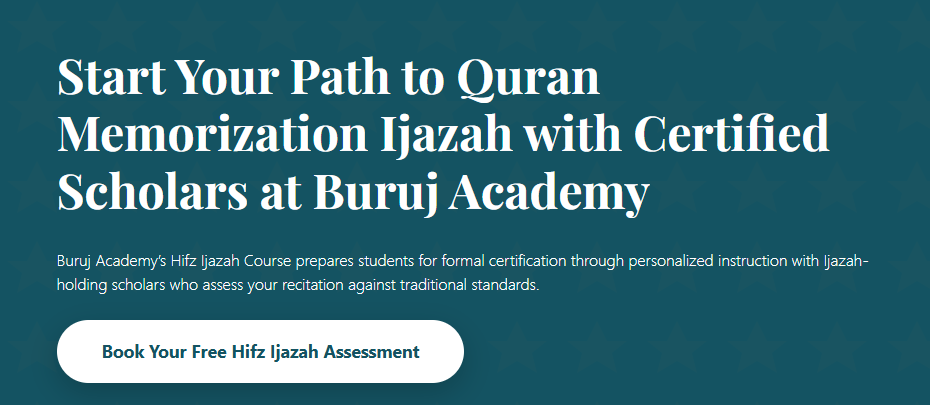
Our Hifz Ijazah course is open to female students who have completed their memorization and wish to formalize their certification.
Book your FREE trial lesson in your path to Ijazah
Discover the Buruj Academy Difference
Step into our virtual classrooms and see how our expert instructors make learning Quran and Arabic intuitive and clear. We focus on overcoming the specific hurdles non-native speakers face, building your confidence and connection with the Quran.
Read also: What Is the Reward for Becoming a Hafiz?
Start Your Daughter’s or Your Own Hifz at Buruj Academy
Hifz is one of the most spiritually rewarding achievements a Muslim woman or girl can pursue — and the right guidance makes all the difference between a completed memorization and an abandoned one.
Buruj Academy’s Hifz for Kids course and Hifz for Sisters course provide:
- Ijazah-certified, female Hafiza instructors with Al-Azhar University training
- Personalized 1-on-1 sessions with flexible scheduling
- The Buruj Method: Consistency-before-speed, building sustainable Hifz habits
- Real-time correction and individualized revision plans
- Age-appropriate pacing for children and adult learners
Book your free trial lesson and begin with an instructor who has guided hundreds of female students to completion — Insha’Allah, you or your daughter will be next.
Take the first step toward this lifelong blessing by enrolling in a program tailored to your pace:
- Online Hifz Program (Comprehensive Quran Memorization)
- Juz 30 Memorization Course (Perfect for focused starts)
- Hifz Classes for Kids (Engaging and interactive)
- Hifz Classes for Adults (Flexible scheduling for busy lives)
- Hifz Classes for Sisters (Private, supportive learning)
- Short Surah Memorization Course (Ideal for daily prayers)
- Hifz Ijazah Course (For advanced students seeking certification)
Don’t let another day pass without moving closer to your goal. Join Buruj Academy today and schedule your free trial session to begin your Hifz journey!
Excel in Your Quranic Studies
Join Buruj Academy and master the Quran with our structured, professional curriculum.
Book Your Free TrialConclusion
The female Hafiza is not a modern phenomenon — she is a continuation of a tradition that began with the wives and Companions of the Prophet ﷺ. Hafsa (RA), Aisha (RA), and Umm Waraqah (RA) established that women’s memorization is not peripheral but central to the preservation of the Quran itself.
For any girl or woman asking whether Hifz is possible for her — the answer from Islamic history, classical scholarship, and our own teaching experience at Buruj Academy is an unambiguous yes.
With correct Tajweed, a structured system, qualified guidance, and consistent revision, becoming a Hafiza is an achievable, life-changing goal.
Frequently Asked Questions About Female Hafiz of Quran
What Is a Female Hafiz of Quran Called?
A female Hafiz of Quran is called a Hafiza (حافظة) — the feminine Arabic form of the title. The word comes from the root حفظ (Hifz), meaning to preserve and protect. A Hafiza holds the same spiritual honor and scholarly recognition as a male Hafiz in Islamic tradition, with no distinction in reward or rank.
At What Age Can a Girl Start Hifz?
Girls can begin structured Hifz as early as age 4–6, once basic letter recognition is established. In our experience at Buruj Academy, ages 7–12 represent the strongest memorization window — the mind retains more easily and revision habits form quickly. Adults can also complete Hifz successfully at any age with a structured, patient approach.
How Long Does It Take a Girl to Memorize the Quran?
With daily sessions of 45–60 minutes and consistent revision, most girls memorize the complete Quran in 2–5 years. Younger children in dedicated programs often complete it in 3–4 years. Adults typically take 4–6 years with realistic pacing. The best time to memorize Quran and daily session consistency are the strongest predictors of completion speed.
Is There an Ijazah for Female Hafizas?
Yes. Ijazah — the formal certification authorizing a memorizer to teach and transmit the Quran — is fully available to women. Female Ijazah-certified scholars carry authenticated chains of transmission (sanad) back to the Prophet ﷺ. Buruj Academy’s Hifz Ijazah course guides female students through this formal certification process under qualified instructors.