 Islamic
| Key Takeaways |
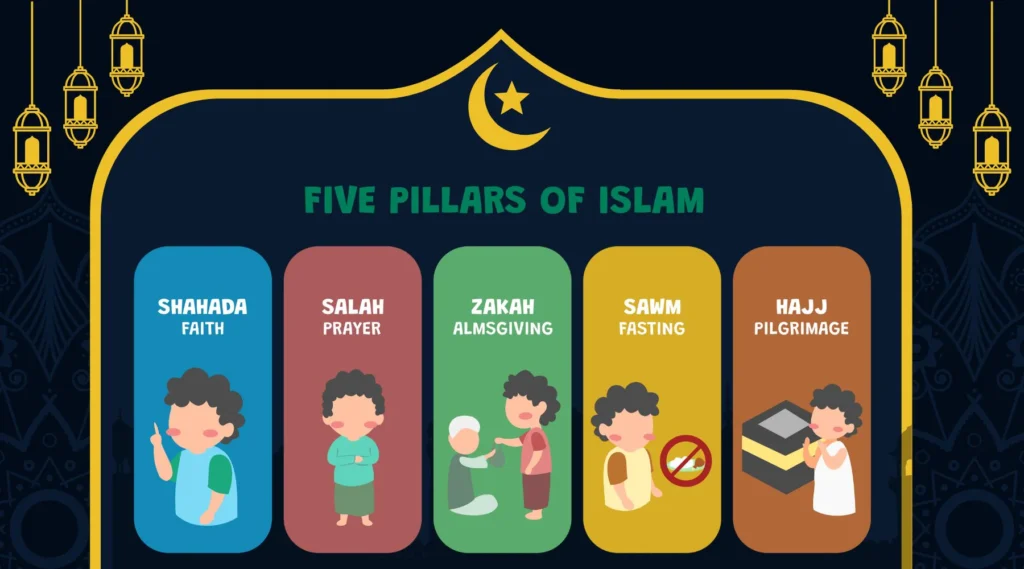
| The 5 pillars of Islam are Shahada, Salah, Zakat, Sawm, and Hajj — the foundational acts every Muslim child should know. |
| Children typically begin learning Salah between ages 7–10, with formal obligation beginning at puberty according to Islamic scholarship. |
| Teaching the pillars through daily routines, visual aids, and age-appropriate stories makes abstract concepts concrete for young minds. |
| Zakat teaches children generosity and social responsibility — values that shape character far beyond the act of giving itself. |
| Parents in the West can reinforce all five pillars at home without a madrasa, using consistent habits and structured Islamic study. |
Muslim parents in the West carry a beautiful and demanding responsibility: raising children who know their faith not just as a list of rules, but as a living, breathing way of life. The 5 pillars of Islam are the natural starting point for that foundation.
The five pillars — Shahada, Salah, Zakat, Sawm, and Hajj — are the core acts of worship that define a Muslim’s relationship with Allah.
Teaching The 5 pillars of Islam to children early, with age-appropriate language and consistent practice, gives kids a sense of identity and belonging that stays with them for life.
Table of Contents:
1. Shahada Is the First Lesson Every Muslim Child Needs to Learn
The Shahada — لَا إِلَٰهَ إِلَّا ٱللَّٰهُ مُحَمَّدٌ رَسُولُ ٱللَّٰهِ (Lā ilāha illallāh, Muḥammadun rasūlullāh) — is the declaration that there is no god but Allah and that Muhammad ﷺ is His Messenger.
The Shahada is the entry point into Islam and the first seed of faith planted in a child’s heart. Every other pillar flows from this central conviction.
How to Teach the Shahada to Young Children
For children aged 3–6, the Shahada is best introduced as a short, beautiful phrase they repeat with a parent — not as a theological concept to dissect.
Children at this age absorb language naturally, and repetition is their superpower.
By ages 7–9, parents can begin explaining what the words actually mean. “La ilaha illa Allah” means nothing deserves worship except Allah — not money, not people, not statues. “Muhammad rasulullah” means Prophet Muhammad ﷺ is the one Allah sent to teach us how to live.
Connecting Shahada to Stories of the Prophets
One of the most effective teaching tools we recommend at Buruj Academy is connecting the Shahada to the stories of the Prophets. When a child hears how Ibrahim (AS) rejected idol worship, the meaning of “La ilaha illa Allah” becomes real and vivid — not abstract.
Our prophets in Islam for kids resource is an excellent starting point for parents looking to make this connection.
A child who understands why we say the Shahada — not just what we say — carries faith with conviction, not just habit.
2. Salah Teaches Children That Every Day Belongs to Allah
Salah — the five daily prayers — is the most visible and consistent act of worship in a Muslim’s life. For children, it is also the pillar they will encounter first as a lived practice, watching parents pray before they understand what prayer even means.
The Prophet ﷺ instructed parents to command Salah for children at age seven and to be firm about it at age ten, as recorded in Sunan Abi Dawud (hadith 495). This timeline gives parents a clear, structured window for gradual instruction.
A Practical Age-by-Age Framework for Teaching Children Salah
The table below outlines a realistic progression that we share with families enrolled in our Islamic Studies Classes for Kids course:
| Age Range | Goal | Practical Method |
| 3–5 years | Familiarity and imitation | Pray alongside parents; let them mimic movements |
| 6–7 years | Learning the words | Teach Al-Fatiha and short surahs with simple transliteration |
| 8–9 years | Praying independently | Guided solo prayer with gentle correction |
| 10+ years | Consistent, self-motivated prayer | Establish personal accountability with kind reminders |
This is not a rigid formula — children develop at different rates. But having a framework prevents parents from either rushing or indefinitely delaying structured Salah teaching.
Making Salah Feel Natural, Not Like a Chore
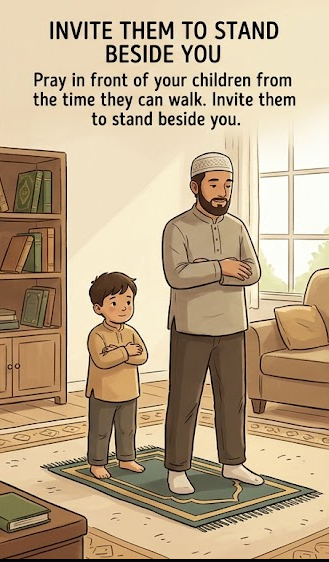
Children mirror what they see at home. When parents pray with consistency and calm — not anxiety or obligation — children absorb that attitude.
In our instructors’ experience at Buruj Academy, children who grow up watching parents pause everything for Salah rarely need to be convinced of its importance. They simply want to participate.
Pair Salah with short surah memorization so children have the tools they need to pray correctly. Our easy surahs of Quran to memorize guide and shortest surahs to memorize resource are practical starting points for parents building this foundation.
Buruj Academy’s Online Quran Classes for Kids course teaches children the surahs they need for Salah using age-appropriate methods, guided by Al-Azhar-trained instructors experienced in child pedagogy.
Help your child start learning the Quran with a FREE trial
3. Zakat Shows Children That Wealth Is a Trust, Not a Possession
Zakat is the obligatory annual giving of 2.5% of qualifying savings to those in need. While children are not financially obligated to pay Zakat before adulthood, teaching them its meaning and spirit from a young age builds generosity, empathy, and social awareness that lasts a lifetime.
The Quran pairs Salah and Zakat together repeatedly — a deliberate reminder that worship and community responsibility are inseparable.
وَأَقِيمُوا الصَّلَاةَ وَآتُوا الزَّكَاةَ
Wa aqīmū aṣ-ṣalāta wa ātū az-zakāh
“Establish prayer and give Zakat.” (Al-Baqarah 2:43)
This verse, which children can memorize easily, makes the connection between prayer and giving explicit and memorable.
Teaching Zakat to Children Through Practical Exercises
Abstract concepts become real when children act on them. Here are three age-appropriate approaches we recommend:
The three-jar system (ages 5–10)
Divide any money a child receives into three jars — spending, saving, and giving. The “giving” jar is their personal Zakat practice, donated together as a family to a cause they choose.
Read also: The Best Quranic Games for Kids
Eid al-Adha and Zakat al-Fitr (all ages)
Use these seasonal obligations as annual teaching moments. Explain why the family is giving, who it helps, and what Islam says about those in need.
Grocery giving (ages 6–12)
Let the child place non-perishable food items in a donation box themselves. Ownership of the action builds ownership of the value.
| Concept | Child-Friendly Explanation |
| What is Zakat? | Sharing a small part of our money with people who have less |
| Why do we give? | Because all wealth belongs to Allah — we are just taking care of it |
| Who receives it? | People who are poor, in debt, or struggling to meet basic needs |
| When does it happen? | Once a year when savings reach a certain amount (Nisab) |
Children who grow up practicing generosity do not struggle with it as adults. Zakat becomes a reflex, not a reluctant obligation.
Expand Your Islamic Knowledge
Join our structured online courses led by qualified instructors to deepen your understanding of the Deen.
Join a Free Trial Class4. Sawm During Ramadan Teaches Children Discipline, Gratitude, and Community
Sawm — fasting during the month of Ramadan — is one of the most emotionally rich pillars for children to experience. Even before they are old enough to fast fully, children feel the atmosphere of Ramadan: the pre-dawn Suhoor, the iftar table, the late-night Taraweeh prayers, the sense that the entire family is doing something sacred together. That emotional memory is itself a form of Islamic education.
Children are not obligated to fast until puberty, but introducing partial fasting — skipping a meal, fasting until Dhuhr, or fasting on weekends — between ages 8–12 is a widely practiced and encouraged approach among scholars and educators.
What Sawm Teaches Children Beyond Hunger
Fasting teaches the body to obey the soul — and for children, that lesson is profound. We see this consistently in families who enroll in Buruj Academy’s Islamic Studies for Kids course: children who fast even partially during Ramadan develop noticeably stronger self-regulation and awareness of Allah’s presence in daily life.
The first session is free in Buruj’s Islamic Studies Classes for Kids
Three core values Sawm develops in children:
- Gratitude: Hunger, even temporary, teaches children to appreciate food, water, and comfort they normally take for granted.
- Empathy: Feeling hungry — even briefly — connects children emotionally to those who go without daily.
- Self-control: Saying no to food when it is right in front of you builds willpower that transfers to every area of life.
How to Make Ramadan Memorable for Children in Western Households
Parents in the West often worry that their children will feel the isolation of fasting in a non-Muslim environment.
The answer is not to downplay Ramadan — it is to make home feel like a celebration. Decorate the house. Let children help prepare Suhoor. Make iftar a family event, not just a meal.
Pair Ramadan with Quran engagement. Our Quran activities for kids resource offers practical ideas to keep children connected to the Quran throughout the month.
5. Hajj Teaches Children That Muslims Are One Global Family Answering the Same Call
Hajj — the annual pilgrimage to Makkah — is obligatory once in a lifetime for every Muslim who is physically and financially able.
Children will not perform Hajj for many years, but teaching them about it early builds a deep connection to the global Muslim community (Ummah) and to the story of Ibrahim (AS) and his family, which sits at the heart of every Hajj ritual.
The Quran records the call of Ibrahim (AS) that established Hajj:
وَأَذِّن فِي النَّاسِ بِالْحَجِّ يَأْتُوكَ رِجَالًا
Wa adhdhin fī n-nāsi bil-ḥajji ya’tūka rijālā
“And proclaim to the people the Hajj; they will come to you on foot.” (Al-Hajj 22:27)
Reading this verse together and explaining that Muslims have been answering that call for over 1,400 years gives children a breathtaking sense of belonging to something ancient and universal.
Making Hajj Real for Children Who Have Never Seen Makkah
| Teaching Tool | What It Teaches |
| Watching Hajj footage together | Visual connection to the rituals and the Kaaba |
| Explaining each ritual’s story | Connects Tawaf, Sa’i, and Rami to Ibrahim (AS) and Hajar (AS) |
| Eid al-Adha as a Hajj lesson | Brings the sacrifice of Ibrahim (AS) into the home annually |
| Talking about the Ummah | Helps children understand they are part of 1.8 billion Muslims worldwide |
Connecting Hajj to Quran Learning at Home
Children who read Quran regularly encounter the themes of Hajj, Ibrahim (AS), and the Kaaba throughout the text. Investing in Quran literacy now means Hajj will always carry meaning, not just mystery.
Our Quran learning tools for kids and Quran facts for kids articles are useful resources for building that literacy at home.
Read also: Arabic Quiz for Kids
Discover the Buruj Academy Difference
Step into our virtual classrooms and see how our expert instructors make learning Quran and Arabic intuitive and clear. We focus on overcoming the specific hurdles non-native speakers face, building your confidence and connection with the Quran.
Give Your Child a Strong Islamic Foundation with Buruj Academy’s Expert Instructors
The five pillars are not just knowledge — they are a way of life that children absorb through consistent teaching, lived example, and structured learning.
Buruj Academy’s Islamic Studies Classes for Kids course covers the pillars, their meanings, and their practice in a structured, child-friendly curriculum delivered by Al-Azhar University graduates with 12+ years of experience teaching non-Arabic speakers globally.
Every class is a personalized 1-on-1 online session, flexible around your family’s schedule, taught by instructors trained in child pedagogy and Islamic studies.
Enroll your child in one of our specialized, kid-friendly tracks today:
- Online Quran Classes for Kids
- Tajweed Classes for Kids
- Hifz Classes for Kids
- Online Arabic Classes for Kids
- Quranic Arabic Course for Kids
- Noorani Qaida Course for Kids
- Islamic Studies Classes for Kids
Ready to watch your child grow in knowledge and character? Join the Buruj Academy family and book a free trial session for your child today!
Your child gets real learning — not just facts to memorize, but faith to live.
Book a free trial lesson today and let your child take their first structured step toward knowing and loving their deen.
Expand Your Islamic Knowledge
Join our structured online courses led by qualified instructors to deepen your understanding of the Deen.
Join a Free Trial ClassConclusion
The 5 pillars of Islam are your child’s first map of what it means to be Muslim — not rules imposed from outside, but acts of worship that shape how they see Allah, themselves, and the world around them. Shahada anchors their identity. Salah structures their day. Zakat opens their heart. Sawm builds their character. Hajj connects them to a global Ummah stretching back fourteen centuries.
Parents in the West do not need a madrasa to teach these pillars. They need consistency, intentionality, and the right support. Start where you are, with what you have — and build from there, Insha’Allah.
Frequently Asked Questions About the 5 Pillars of Islam for Kids
At What Age Should Children Start Learning the 5 Pillars of Islam?
Children can begin learning the five pillars as early as age 3–4 through simple repetition and imitation. By ages 6–8, parents can introduce meanings and stories behind each pillar. Formal practice of Salah is encouraged from age 7, following the guidance of the Prophet ﷺ recorded in Sunan Abi Dawud.
How Do I Explain Zakat to a Young Child in Simple Terms?
Tell your child that everything we own is a gift from Allah, and Zakat is our way of sharing that gift with people who are struggling. Even young children understand fairness — framing Zakat as “making sure others have enough too” connects the concept to values they already hold naturally.
Should Children Fast During Ramadan Before They Reach Puberty?
Children are not obligated to fast before puberty, but partial fasting — skipping one meal or fasting until Dhuhr — is encouraged for children aged 8–12 as a gradual preparation. The goal is to make fasting feel familiar and meaningful before it becomes obligatory, not to burden young children before they are ready.
How Can I Teach My Child About Hajj Without Traveling to Makkah?
Watch Hajj footage together during the Dhul-Hijjah season, explain the story of Ibrahim (AS) and Hajar (AS) behind each ritual, and use Eid al-Adha as an annual teaching moment. Children connect deeply to stories — when Hajj is taught through its human stories, the rituals carry meaning long before a child ever sets foot in Makkah.
What Is the Best Way to Help Children Memorize the 5 Pillars?
Use a simple visual — a hand with five fingers, each labeled with one pillar — and review it regularly. Pair each pillar with a short story, a Quranic verse, or a family practice so children connect names to meanings. Repetition through daily life is far more effective than drilling lists. Our best age to memorize Quran article also offers useful insights on how children’s memorization capacity develops over time.