 Arabic
| Key Takeaways |
| Arabic writing moves right to left, and children must master this directional habit before learning individual letter forms. |
| Arabic has 28 letters, each with up to four positional forms depending on its location within a word. |
| Kids learn Arabic writing fastest when letter introduction follows phonetic grouping, not alphabetical order. |
| Tracing exercises on dotted worksheets build muscle memory before children attempt freehand Arabic letter writing. |
| Consistent short daily practice sessions of 10–15 minutes outperform long irregular ones for young Arabic writers. |
Teaching a child to write Arabic feels daunting at first — a new script, a new direction, and letters that change shape depending on where they appear in a word.
But children’s brains are remarkably adaptable, and with the right sequence, Arabic handwriting becomes natural faster than most parents expect.
The key is structured, phonetically grounded progression: start with direction and posture, introduce letters in shape-similarity groups, and build from tracing to freehand writing gradually. This guide gives you exactly that sequence, step by step.
Table of Contents:
1. Teach the Right-to-Left Writing Direction Before Any Letters
Arabic writing moves from right to left across the page, and this directional habit must be established in a child’s muscle memory before any letters are introduced.
Children who skip this step consistently revert to left-to-right movement mid-word, creating serious confusion later.
Begin with simple directional exercises: draw horizontal lines starting from the right margin, trace arrows pointing rightward, and practice moving a pencil across the page from right to left repeatedly.
Just two or three minutes of this daily, over one week, is enough to reset the hand’s default direction.
Why Directionality Matters More Than Letter Shape at the Start
The writing direction in Arabic is not just a stylistic preference — it affects how letters connect, how words flow, and how children read their own handwriting back.
A child who writes individual letters correctly but drifts left to right will produce disconnected, unreadable text.
We recommend placing a small green dot at the right margin of every practice line as a visual cue for “start here.” This simple technique, used consistently in our sessions at Buruj Academy, reduces directional reversals significantly within the first two weeks.
2. Introduce the Arabic Alphabet Through Shape Families, Not Alphabetical Order
The Arabic alphabet contains 28 letters, but many share the same base shape and differ only in the number or placement of dots. Teaching letters in shape-family groups — rather than alphabetical order — reduces cognitive load dramatically for young learners.
| Shape Family | Letters | Distinguishing Feature |
| Tooth shapes | بـ، تـ، ثـ، نـ، يـ | Same base, different dots |
| Curve shapes | ج، ح، خ | Same hook base, different dots or none |
| Loop shapes | س، ش | Repeated loops, one dotted |
| Round shapes | ع، غ | Oval base with and without dot |
| Angular shapes | ك، ل | Distinct angular strokes |
This grouping method means a child who learns ب (ba) already understands the base form for ت (ta) and ث (tha) — they simply add dots. Progress accelerates visibly, and children feel confident rather than overwhelmed.
For a fuller foundation on the Arabic alphabet before beginning writing practice, our Arabic alphabet for kids guide covers letter recognition in detail, which pairs well with the writing steps here.
Buruj Academy’s Online Arabic Classes for Kids introduce letters in precisely this shape-grouped sequence, with qualified instructors who adapt the pace to each child’s age and learning capacity.
Book a FREE Arabic trial for your Child

3. Teach the Four Positional Forms of Each Letter Using Visual Color Coding
One of the most common points of confusion for young Arabic writers is that each letter can take up to four different forms: isolated, initial (beginning of a word), medial (middle of a word), and final (end of a word).
Teaching these forms systematically, with color as a visual anchor, makes the pattern visible and memorable.
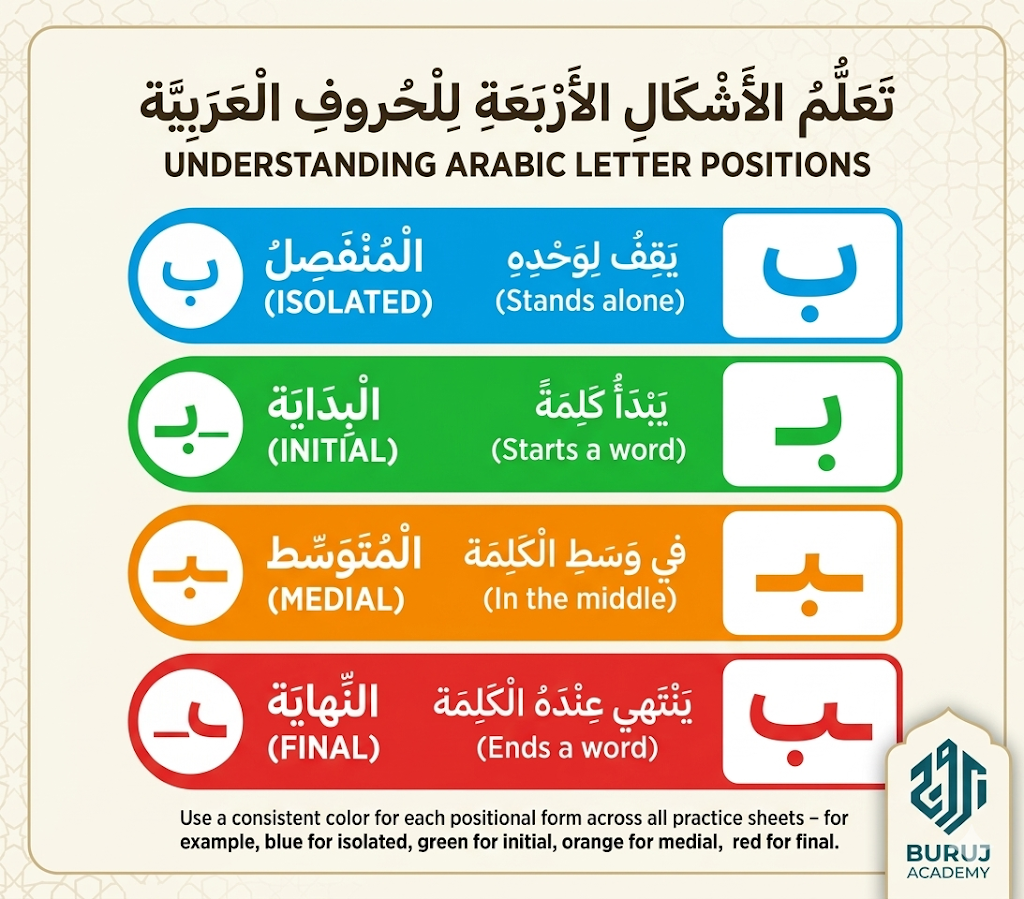
Children as young as five years old internalize positional awareness far more quickly through color association than through written labels alone.
How Connection Rules Govern Letter Position
Not all Arabic letters connect on both sides. Some letters — called non-connecting letters (حروف غير الواصلة) — only connect to the letter before them, never after.
These include و، ر، ز، د، ذ، أ. Teaching this rule early prevents the common mistake of forcing connections where none exist.
A helpful exercise: write a simple word like وَرَد (ward — rose) and show the child why no letter connects to the ones following و or ر. Seeing the rule in a real word makes it concrete rather than abstract.
4. Build Pencil Control Through Structured Arabic Tracing Worksheets
Before any child writes Arabic letters freehand, they need dedicated pencil-control practice through tracing. Arabic letters require specific strokes — curves, loops, descending tails, and connection lines — that differ substantially from Latin handwriting.
Good Arabic tracing worksheets should include: dotted letter outlines in correct stroke order, directional arrows showing where each stroke begins, and adequate spacing between practice lines for young hands.
Free downloadable worksheets are widely available and we address specifically how to use them effectively in our guide on how to learn Arabic for kids.
Master the Arabic Language
Join our expert-led courses and build a strong foundation in Classical and Modern Arabic.
Get Your Free TrialThe Correct Stroke Order for Arabic Letters Matters
Arabic letters are not drawn as single strokes from top to bottom. Many letters require a specific sequence — for example, ع (ain) begins with the upper curve, descends into the open lower portion, then adds the connecting tail.
Teaching incorrect stroke order at the tracing stage creates habits that become increasingly difficult to correct.
In our experience teaching children between the ages of five and ten, those who learn correct stroke order during tracing require significantly less correction once they transition to freehand writing. The investment at this stage pays forward.
Buruj Academy’s Learn Arabic Writing course teaches children the correct stroke order and letter connection rules that prevent the ingrained errors we see in students who learned writing informally without structured guidance.
Book your kid a free trial to start writing Arabic

5. Introduce Harakat (Short Vowel Marks) Alongside Letter Writing Practice
Arabic short vowels — fathah (فتحة)، kasrah (كسرة)، dammah (ضمة) — are diacritical marks written above or below letters. Children who learn to write letters without simultaneously learning harakat placement often struggle to read their own writing later.
| Vowel Mark | Arabic Name | Placement | Sound |
| َ | Fathah | Above the letter | “a” as in “cat” |
| ِ | Kasrah | Below the letter | “i” as in “bit” |
| ُ | Dammah | Above the letter | “u” as in “put” |
| ْ | Sukoon | Above the letter | No vowel sound |
Introduce harakat by writing simple three-letter words the child already knows phonetically — such as كَتَبَ (kataba — he wrote) or كِتَاب (kitab — book). Writing words with meaning accelerates retention compared to isolated letter practice.
Read also: How to Learn Arabic Grammar for Kids?
Discover the Buruj Academy Difference
Step into our virtual classrooms and see how our expert instructors make learning Quran and Arabic intuitive and clear. We focus on overcoming the specific hurdles non-native speakers face, building your confidence and connection with the Quran.
6. Move From Tracing to Freehand Writing Using Copy-Then-Cover Practice
The transition from tracing to freehand writing is where many children stall. The most effective bridging method is copy-then-cover: the child copies a letter or word while looking at the model, then covers the model and writes it again from memory, then checks their work.
This technique activates recall rather than mere reproduction, which builds genuine writing ability. It mirrors the same principle behind improving Arabic writing with dictation — a method that works for all ages but is particularly powerful for children because it adds an auditory layer to the visual-motor practice.
Freehand Writing Progression: Letters to Words to Sentences
Once freehand single letters are consistent, move to connected two-letter combinations, then three-letter words, then simple short sentences. The progression should feel gradual to the child — each stage revisited until fluent before moving forward.
For simple sentences that work well at this stage, our Arabic sentences for kids resource provides age-appropriate practice material that integrates naturally with freehand writing sessions.
How to Write in Arabic for Kids Online?
Learning how to write in Arabic for kids online has expanded significantly, with tablet-based apps and online class platforms offering structured, interactive handwriting practice. Digital tools work best as supplements to physical handwriting, not replacements.
Effective online Arabic writing tools for children should include: stroke-order animations showing the correct sequence, touch-screen tracing with haptic feedback, letter recognition games, and structured progression from isolated letters to connected words.
Apps that present letters randomly without phonetic or shape-family grouping are less effective for retention.
Buruj Academy’s Online Arabic Classes for Kids include live one-on-one instruction where qualified teachers observe a child’s handwriting in real time via shared screen or camera, providing immediate correction of stroke order and letter proportion. This live feedback element is something no app can replicate.
How to Write in Arabic for Kids Easy?
Making Arabic writing genuinely easy for kids comes down to sequencing and session length. Short, consistent, joyful sessions consistently outperform long, infrequent, pressured ones for children’s handwriting acquisition. Ten to fifteen minutes of focused daily practice is the target.
The easiest entry points into Arabic writing for young children are letters with simple, single-stroke forms: و، ر، ز، د are among the most manageable for small hands and build early confidence. Pairing these with words the child already knows — such as دار (dar — house) or ورد (ward — rose) — makes the writing feel purposeful from the first session.
Games That Make Arabic Writing Practice Feel Easy and Fun
Writing practice does not have to mean worksheets. Arabic letter sand tracing, magnetic letter boards, letter stamps with ink pads, and whiteboard practice all provide the same motor reinforcement with significantly more engagement for young children.
For more ideas on making Arabic learning engaging, our collection of top Arabic games for kids includes activities that pair naturally with writing development, including games that reinforce letter recognition and word building.
How to Write in Arabic for Kids Free?
High-quality free Arabic writing resources for children are genuinely available, and knowing where to find reliable ones saves parents considerable time. The primary criteria for evaluating free resources: correct stroke order, proper letter proportion, right-to-left directionality, and shape-grouped or phonetically organized letter introduction.
Reliable free resources include printable worksheets from established Islamic education sites, YouTube channels run by qualified Arabic teachers that show stroke order in real time, and PDF workbooks from accredited Arabic programs available for download.
Our blog on learning the Arabic alphabet for kids links to verified resources that meet these quality standards.
Free trials with qualified teachers offer the highest value of all: structured instruction, immediate feedback, and personalized pacing at no cost. Buruj Academy offers a free trial class for children’s Arabic writing — giving parents a direct experience of how structured online instruction differs from self-directed worksheet practice.
Help Your Child Master Arabic Writing with Buruj Academy’s Expert Kids’ Classes
Arabic writing is a lifelong skill, and the habits built in these early stages shape everything that follows — from Quran reading to formal Arabic study.
Buruj Academy’s Arabic writing course for children offers:
- Al-Azhar-trained instructors with 12+ years teaching non-native speakers
- Stroke-order-correct, shape-grouped letter progression
- The Buruj Method: Context-before-abstraction, Patience-before-performance
- Personalized 1-on-1 live sessions with real-time handwriting correction
- Flexible scheduling for families across all time zones
Book your child’s free trial today and see the difference structured instruction makes from the very first session.
Enroll your child in one of our specialized, kid-friendly tracks today:
- Online Quran Classes for Kids
- Tajweed Classes for Kids
- Hifz Classes for Kids
- Online Arabic Classes for Kids
- Quranic Arabic Course for Kids
- Noorani Qaida Course for Kids
- Islamic Studies Classes for Kids
Ready to watch your child grow in knowledge and character? Join the Buruj Academy family and book a free trial session for your child today!
Master the Arabic Language
Join our expert-led courses and build a strong foundation in Classical and Modern Arabic.
Get Your Free TrialConclusion
Teaching a child to write Arabic is ultimately about building confidence stroke by stroke. The right-to-left direction, the positional letter forms, the harakat placement — each element becomes manageable when introduced in the correct sequence and practiced daily in short, engaging sessions.
Children who learn Arabic writing through shape-grouped letters, proper stroke order, and consistent copy-cover recall develop handwriting that is both accurate and fluent. The foundation built here supports everything ahead: Quran reading, Arabic vocabulary, and a genuine connection to the language of the Quran.
Read also: Arabic Grammar for Kids
Frequently Asked Questions About How to Write in Arabic for Kids
At What Age Can a Child Start Learning to Write Arabic?
Most children are ready to begin Arabic letter tracing between ages four and five, when fine motor skills are sufficiently developed. Freehand writing typically begins around ages six to seven. Younger children benefit from pre-writing activities — tracing curves, loops, and lines — that build the pencil control Arabic handwriting requires before formal letter instruction begins.
How Long Does It Take a Child to Learn Arabic Writing?
With consistent daily practice of ten to fifteen minutes, most children aged five to eight recognize and trace all 28 Arabic letters within six to eight weeks. Connected freehand writing of simple words typically develops over three to four months of structured instruction. Progress varies with age, session consistency, and whether the child receives live teacher feedback or self-directs through worksheets alone.
Should Kids Learn Arabic Writing Before or After Arabic Reading?
Reading and writing Arabic develop best together, not sequentially. Introducing letter forms visually for reading, then reinforcing through writing, creates a stronger dual-channel memory trace. Children who read a letter and immediately write it retain both skills more durably than those who complete a full reading course before any writing practice begins.
What Is the Easiest Arabic Letter for Kids to Write First?
The letters و، ر، د، ز are consistently the easiest for young children due to their simple, largely single-stroke forms. Beginning with these builds early confidence before introducing more complex letters with loops, multiple dots, or connection tails. These letters also appear in common, meaningful words, which makes early writing practice feel purposeful and rewarding.
Is Online Arabic Writing Instruction Effective for Young Children?
Online instruction is highly effective when it includes live one-on-one sessions with a qualified teacher who can observe the child’s handwriting in real time. Apps and worksheet downloads provide useful supplementary practice but cannot replace immediate, personalized correction of stroke order and letter proportion that a live instructor provides during the critical early habit-formation stage.
Related Articles
Arabic