 Arabic
| Key Takeaways |
| Arabic has three short vowels (harakat), three long vowels, and double vowel forms called tanween. |
| Short vowels in Arabic are written as small diacritical marks above or below consonants, not as separate letters. |
| Long vowels in Arabic use the letters Alif, Waw, and Ya to extend vowel sounds to approximately double their length. |
| Arabic has six core vowel sounds total: Fatha, Kasra, Damma (short), and their long vowel counterparts. |
| Double vowels (tanween) appear only on indefinite nouns and add a nasal “n” sound to the final short vowel. |
Every Arabic learner reaches a moment where the text suddenly makes sense — and almost always, that moment comes when the vowels click. Without understanding Arabic vowels, even recognizing familiar words becomes guesswork.
Arabic uses a precise vowel system of short vowels, long vowels, and double vowels that together govern pronunciation, meaning, and grammatical function.
Table of Contents:
What Are the Vowels in Arabic?
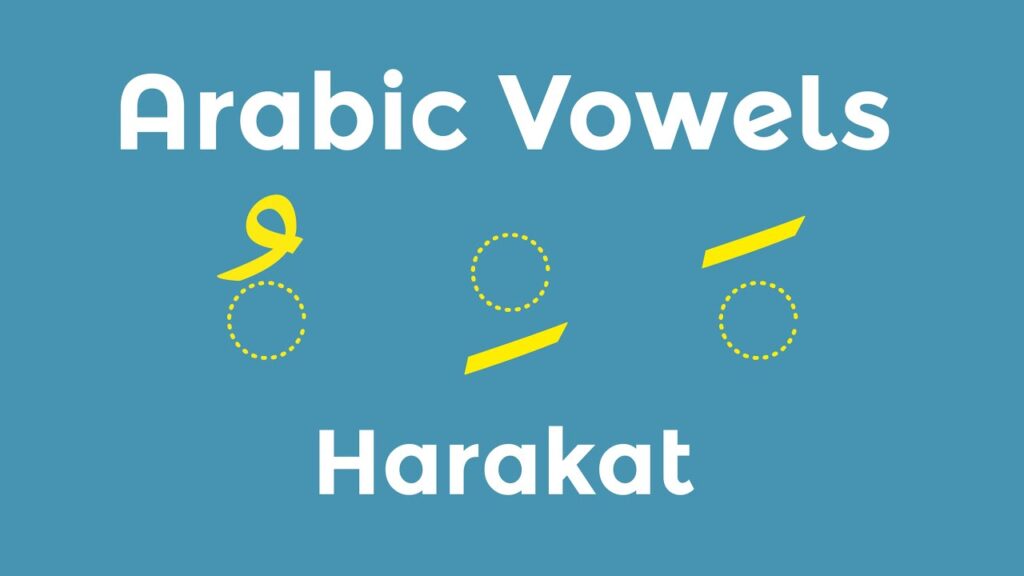
Arabic vowels are diacritical markers and specific letters that indicate how consonants are vocalized. Unlike English, where vowels are independent letters, short vowels in Arabic appear as small symbols written above or below consonant letters.
Long vowels use three specific letters — Alif (ا), Waw (و), and Ya (ي) — to stretch the vowel sound.
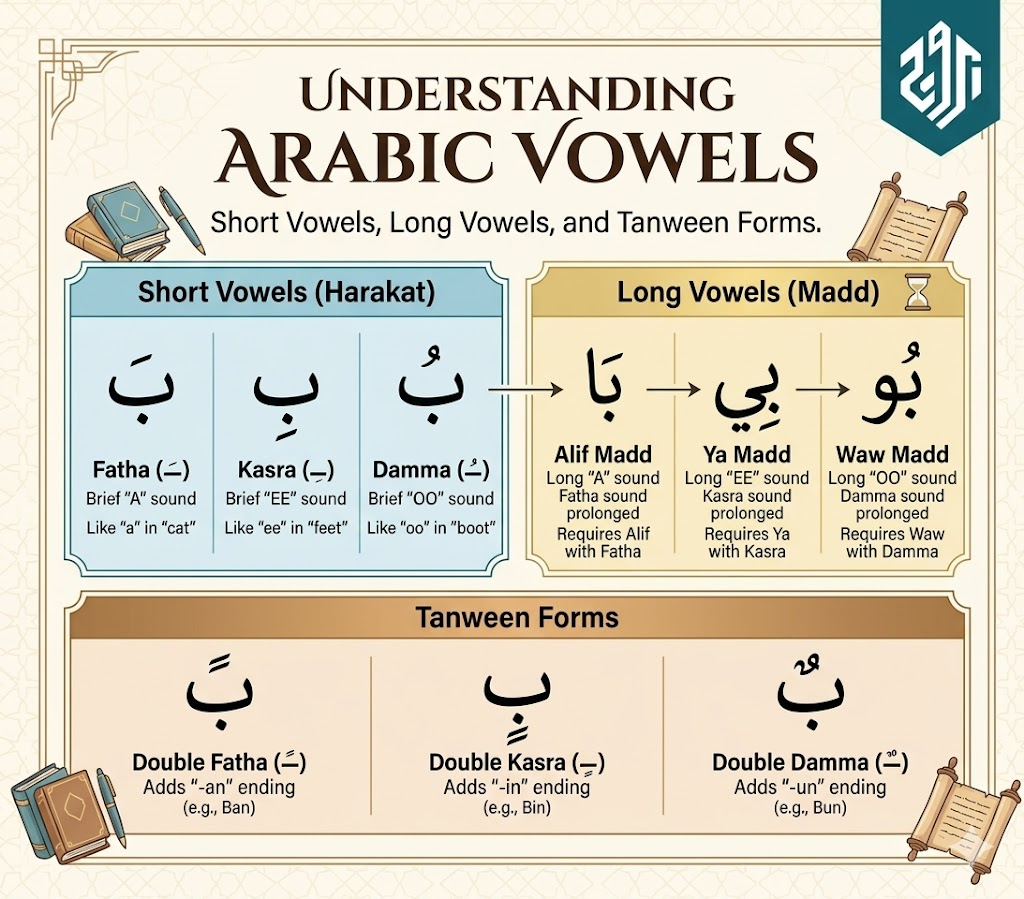
Arabic has three short vowels, three long vowels, and tanween forms (double short vowels on final letters).
Understanding each category separately, then as an interconnected system, is how students at Buruj Academy build genuine reading confidence rather than fragile pattern recognition.
Why Arabic Vowels Behave Differently from English Vowels
English vowels are full letters that appear within the word’s written skeleton. Arabic vowels — at least the short ones — are optional markers layered over a consonant framework.
This means most advanced Arabic texts, newspapers, and books omit short vowel markers entirely, leaving readers to infer pronunciation from context and grammatical knowledge.
Fully voweled texts, like the Quran and beginner learning materials, include all diacritical marks, making them the ideal starting point for new learners.
Learning Arabic vowels requires active practice, not passive reading. These structured exercises reflect the approach our instructors use with new students in Buruj Academy’s Online Arabic Classes.
Book your FREE Arabic trial online Arabic class at Buruj

What Are the 3 Short Vowels in Arabic?
The three short vowels in Arabic are Fatha (فَتْحَة), Kasra (كَسْرَة), and Damma (ضَمَّة). Each is written as a small symbol placed on a consonant letter, and each produces a distinct, short vowel sound that cannot be lengthened without changing the vowel type to a long vowel.
| Short Vowel | Arabic Name | Symbol Position | Sound | Example |
| Fatha | فَتْحَة | Above the letter | Short “a” as in “cat” | بَ = ba |
| Kasra | كَسْرَة | Below the letter | Short “i” as in “sit” | بِ = bi |
| Damma | ضَمَّة | Above the letter (curved) | Short “u” as in “put” | بُ = bu |
These three markers are the foundation of Arabic reading. In our experience at Buruj Academy, students who spend even two dedicated sessions mastering these three symbols reduce their reading errors by more than half — because almost every Arabic syllable is built around one of them.
How Do Short Vowels Change Word Meaning in Arabic?
Short vowels in Arabic are not decorative — they are grammatically and semantically functional.
The same consonant skeleton can produce entirely different words depending on which short vowel is applied. The root كَتَبَ (kataba, “he wrote”), كُتِبَ (kutiba, “it was written”), and كِتَاب (kitaab, “book”) all share the same three consonants.
Recognizing how vowels shift meaning is not optional knowledge — it is the difference between understanding Arabic and merely sounding it out.
For a deeper look at how Arabic grammar interacts with voweling, our guide on Arabic grammar for beginners provides an accessible foundation.
What Are the Long Vowels in Arabic?
The three long vowels in Arabic are Alif Madd (آ), Waw Madd (و), and Ya Madd (ي), each corresponding to the extended version of a short vowel.
A long vowel is approximately twice the length of its short counterpart — a distinction that is audible, meaningful, and in Tajweed, precisely measurable.
| Long Vowel | Corresponding Short Vowel | Letter Used | Sound | Example |
| Long “aa” | Fatha (a) | Alif (ا) | “a” held for two counts | كَانَ = kaana |
| Long “ii” | Kasra (i) | Ya (ي) | “ee” held for two counts | كَبِير = kabeer |
| Long “uu” | Damma (u) | Waw (و) | “oo” held for two counts | نُور = noor |
Read also: What Countries Speak Arabic?
How Short and Long Vowels Work Together in Arabic Words
A short vowel on the consonant before a long vowel letter signals that the long vowel begins there.
For example, in the word كِتَاب (kitaab, “book”), the Kasra on the Kaf is a short vowel, and the Alif following the Ta extends that syllable into a long “aa” sound. This interaction — short vowel triggers long vowel letter — is one of the most consistent patterns in Arabic phonetics.
Students in our Arabic for Beginners course practice identifying this pattern in real Quranic and MSA words from the very first week.
Begin learning Arabic at Buruj with a FREE trial lesson

What Are the 6 Vowels in Arabic?
When learners ask “what are the 6 vowels in Arabic,” they are referring to the three short vowels and their three long vowel counterparts — a clean pairing that forms the core of the Arabic vowel system.
| # | Vowel Type | Arabic Term | Sound Duration |
| 1 | Short “a” | Fatha | One count |
| 2 | Short “i” | Kasra | One count |
| 3 | Short “u” | Damma | One count |
| 4 | Long “aa” | Madd Alif | Two counts |
| 5 | Long “ii” | Madd Ya | Two counts |
| 6 | Long “uu” | Madd Waw | Two counts |
This six-vowel framework is where confident Arabic pronunciation is built. Learners who internalize this table — not just memorize it, but train their ears to hear the length difference — find that their Quranic recitation improves immediately.
Our Al-Azhar-trained instructors consistently emphasize auditory training before rule memorization, because the ear must lead the tongue.
Master the Arabic Language
Join our expert-led courses and build a strong foundation in Classical and Modern Arabic.
Get Your Free TrialCan I Learn Arabic Vowels Without Knowing the Alphabet First?
Learning Arabic vowels before the alphabet creates confusion, because vowel markers attach to consonant letters.
The correct sequence is: Arabic alphabet recognition first, then short vowel application, then long vowels, then Tanween and advanced markers.
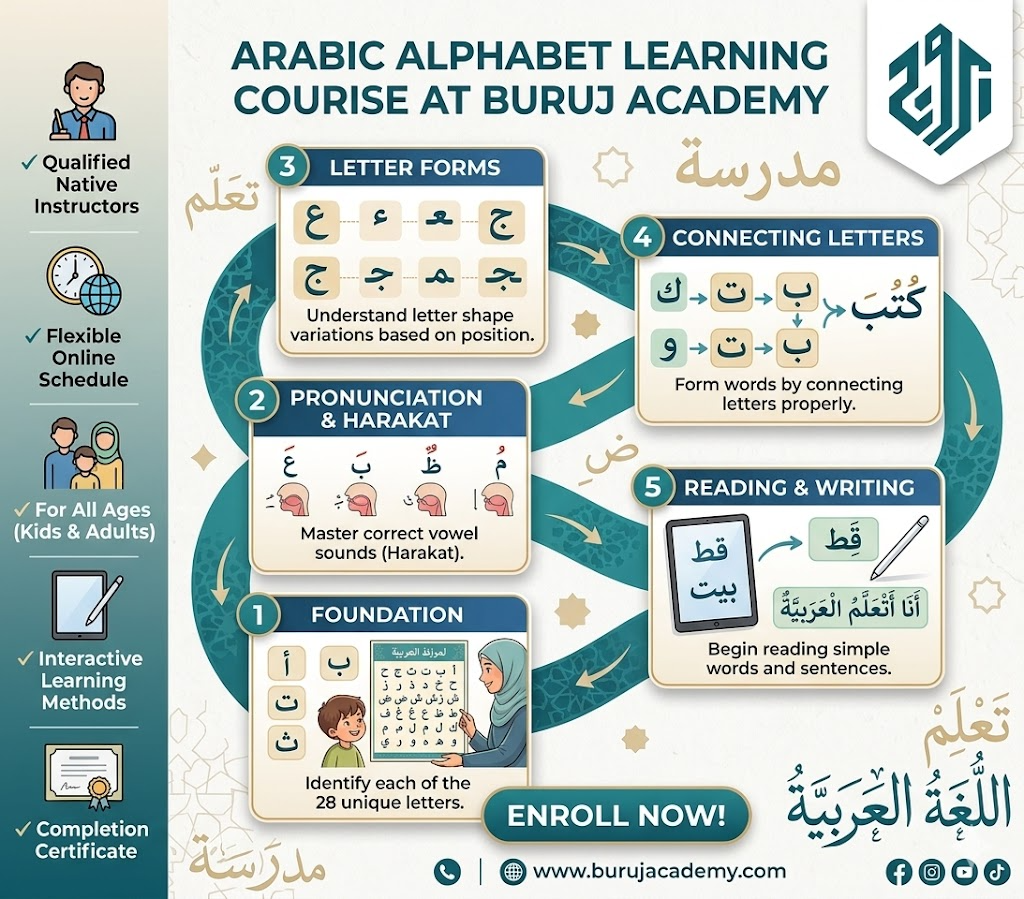
Our Arabic Alphabet Learning Course builds this sequence systematically for complete beginners before vowel training begins.
Get a free trial now in Buruj’s Alphabet course
What Are Double Vowels in Arabic (Tanween)?
Double vowels in Arabic, known as Tanween (تَنْوِين), are short vowels doubled at the end of indefinite nouns, producing an added “n” sound. There are three forms of Tanween, each corresponding to one of the three short vowels.
| Tanween Type | Symbol | Pronunciation | Example |
| Tanween Fath | ً (double fatha) | “-an” | كِتَابًا = kitaaban |
| Tanween Kasr | ٍ (double kasra) | “-in” | كِتَابٍ = kitaabin |
| Tanween Damm | ٌ (double damma) | “-un” | كِتَابٌ = kitaabun |
Tanween only appears on indefinite nouns — words without the definite article ال (al-). It signals grammatical case (nominative, accusative, genitive) and indefiniteness simultaneously.
In Tajweed, Tanween also triggers important rules including Ikhfa, Idgham, Iqlab, and Izhar when followed by specific letters. For a detailed breakdown of Tanween’s behavior in recitation, our dedicated article on Tanween in Arabic and Tajweed covers every rule with Quranic examples.
Discover the Buruj Academy Difference
Step into our virtual classrooms and see how our expert instructors make learning Quran and Arabic intuitive and clear. We focus on overcoming the specific hurdles non-native speakers face, building your confidence and connection with the Quran.
How Do Arabic Vowels Appear in the Quran?
The Quran is written with full vocalization — every short vowel, long vowel, Tanween, Sukoon, and Shaddah is marked. This makes the Quranic text the most accurate Arabic voweling guide available, and one of the primary reasons Islamic scholars developed this diacritical system in the first place.
A clear example of all vowel types appearing together:
بِسْمِ اللَّهِ الرَّحْمَٰنِ الرَّحِيمِ
Bismillāhir-Raḥmānir-Raḥīm
“In the name of Allah, the Entirely Merciful, the Especially Merciful.” (Al-Fatiha 1:1)
This single phrase contains Kasra (بِ), Sukoon (سْ), Shaddah with Fatha (لَّ), Madd Ya (حِيمِ), and Madd Alif (الرَّحْمَٰنِ) — a complete demonstration of the Arabic vowel system in eleven words.
Arabic Vowels and Consonants: Understanding the Difference
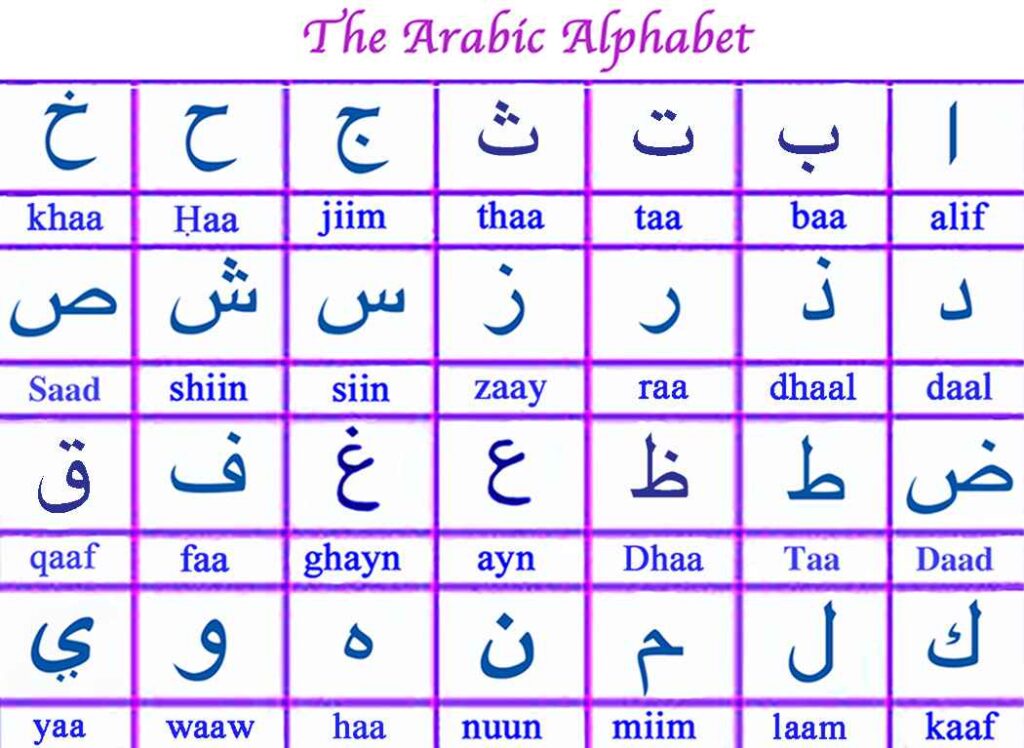
Arabic has 28 consonant letters in its alphabet. Vowels — both short and long — function as a separate layer added to those consonants. In unvoweled text, readers see only consonants and must supply vowels from linguistic knowledge.
In voweled text (like the Quran), both consonants and vowels are explicitly marked. This consonant-primary structure is why Arabic is classified as an abjad — a writing system built on consonants, not a full alphabet.
Understanding this distinction helps learners approach Arabic pronunciation with the correct mental model from the start.
Read also: Numbers in Arabic
Master Arabic Vowels with Buruj Academy’s Expert Instructors
Arabic vowels are the gateway to reading, understanding, and reciting Arabic correctly. Knowing the rules is the beginning — applying them fluently under expert correction is what builds lasting skill.
At Buruj Academy, our Online Arabic Classes are taught by Al-Azhar University graduates with 12+ years of experience teaching non-Arabic speakers worldwide.
Our Arabic for Beginners course builds vowel recognition systematically — short vowels first, long vowels second, Tanween and advanced markers third — using the Buruj Method’s context-before-abstraction approach.
Every session is 1-on-1, fully flexible, and guided by real-time instructor correction.
Book your free trial lesson today and start reading Arabic with confidence.
Begin your transformation today by choosing the path that fits your goals:
- Online Arabic Classes (General & Comprehensive)
- Arabic Course for Beginners
- Arabic Alphabet Learning Course
- Online Arabic Classes for Kids
- Arabic Classes for Adults
- Arabic Grammar Course (Nahw & Sarf)
- Intermediate Arabic Course (B1/B2)
- Arabic Speaking Course (Conversational Fluency)
- Arabic Reading Course (Literary Excellence)
- Learn Arabic Writing Course (Calligraphy & Composition)
Ready to speak with confidence? Join the global community at Buruj Academy and book your free placement interview today!
Master the Arabic Language
Join our expert-led courses and build a strong foundation in Classical and Modern Arabic.
Get Your Free TrialConclusion
Arabic vowels are not a complicated add-on to the language — they are the language’s heartbeat. Short vowels determine pronunciation syllable by syllable. Long vowels signal duration that changes word identity. Tanween marks grammatical case and indefiniteness simultaneously.
Together, they make Arabic one of the most phonetically precise writing systems in the world. Whether your goal is Quranic recitation, MSA reading, or conversational Arabic, investing time in these foundational vowel forms pays dividends at every stage of learning. Insha’Allah, this guide gives you a clear, structured starting point.
Frequently Asked Questions About Vowels in Arabic
How Many Vowels Does Arabic Have?
Arabic has six core vowels: three short (Fatha, Kasra, Damma) and three long (Madd Alif, Madd Waw, Madd Ya). When Tanween forms are included — Tanween Fath, Tanween Kasr, and Tanween Damm — the total vowel-related markers reach nine.
What Is the Difference Between Short and Long Vowels in Arabic?
Short vowels in Arabic are diacritical marks written on consonants and pronounced for one count. Long vowels are formed by a short vowel followed by Alif, Waw, or Ya, extending the sound to approximately two counts. This durational difference is phonemic — it changes word meaning and is mandatory in Tajweed recitation.
Do Arabic Words Always Show Vowels in Writing?
Fully voweled Arabic — including all short vowel marks — appears in the Quran, children’s books, and beginner learning materials. Most adult Arabic texts, newspapers, and books omit short vowel markers, showing only consonants and long vowel letters. Readers infer short vowels from grammatical context and vocabulary knowledge. This is why building a strong vowel foundation early is essential for reading unvoweled text correctly.
What Are Double Vowels in Arabic Used For?
Double vowels, or Tanween, appear exclusively on indefinite nouns and indicate grammatical case through their three forms: Tanween Damm (nominative, “-un”), Tanween Kasr (genitive, “-in”), and Tanween Fath (accusative, “-an”). They also trigger Tajweed rules — including Ikhfa and Idgham — when followed by certain consonants in connected recitation.