 Arabic
Finding the best program to learn Arabic is genuinely difficult — not because good options are rare, but because Arabic itself comes in multiple forms. Modern Standard Arabic (MSA), Quranic Arabic, and spoken dialects are distinct enough that choosing the wrong program for your goals can cost months of wasted effort.
The programs below are ranked and reviewed for non-Arabic speakers who want real results — whether that goal is reading the Quran, passing a professional exam, or holding a conversation.
Each entry reflects what the program actually delivers, including the honest downsides that most comparison lists skip.
Table of Contents:
1. Duolingo Arabic Program
Duolingo launched its Arabic course as a free, gamified introduction to MSA. Its mobile-first design, short lesson format, and streak system make it easy to build a daily habit — which is genuinely valuable in the early stages of language learning.
The app focuses primarily on reading and letter recognition rather than speaking. Its Arabic course contains roughly 50 lessons — a fraction of what Duolingo offers for Spanish or French.
Most learners who complete the full Duolingo Arabic course report that they cannot yet hold a basic conversation or read the Quran independently.
The gamification keeps motivation high in the short term, but the sentences used in exercises are often unrealistic, which does little to build functional language ability.
For complete beginners who need an accessible first step to recognize Arabic letters and basic vocabulary, Duolingo is genuinely useful — especially because it costs nothing. It is not, however, a standalone solution. Pairing it with a resource that addresses Arabic pronunciation is strongly advised from the outset.
Pros: Free (with ads); habit-building streak system; good for Arabic alphabet recognition; works on all devices; zero commitment required
Cons: Only ~50 Arabic lessons — far fewer than other languages; speaking and writing are not meaningfully developed; sentences are often artificial; no Quranic or Classical Arabic content; will not produce conversational ability on its own
2. Rosetta Stone Arabic App
Rosetta Stone has offered its structured immersion method for over 30 years. The Arabic course covers 12 units of MSA using a visual-audio matching system — learners see images, hear native speaker audio, and infer meaning without English translation or grammar explanations. The TruAccent speech recognition provides pronunciation feedback after each response.
The immersion approach works well for languages with clear audio-to-meaning mapping. Arabic’s complex grammar, however — including its root-and-pattern morphology and grammatical case system — is genuinely difficult to infer from pictures alone.
Most Arabic learners find that without explicit grammar explanations, Rosetta Stone produces recognition without comprehension. A 3-month subscription costs approximately $47.97, while a lifetime subscription to all 25 languages is currently priced at $199.
For our beginners’ guide to Modern Standard Arabic, we consistently note that MSA grammar requires explanation — not just exposure — for non-Arabic speakers to internalize sentence structure.
3. Buruj Academy’s Online Arabic Course
Buruj Academy is a specialist online Islamic education provider offering fully personalized Arabic instruction taught by Al-Azhar University graduates with 12+ years of experience teaching non-native speakers.
Unlike general language apps, Buruj Academy’s Online Arabic Classes are built around the Buruj Method — a context-before-abstraction approach that teaches Arabic through meaningful vocabulary and real sentence structures from day one, rather than isolated drills.
Book your FREE Arabic trial online Arabic class at Buruj
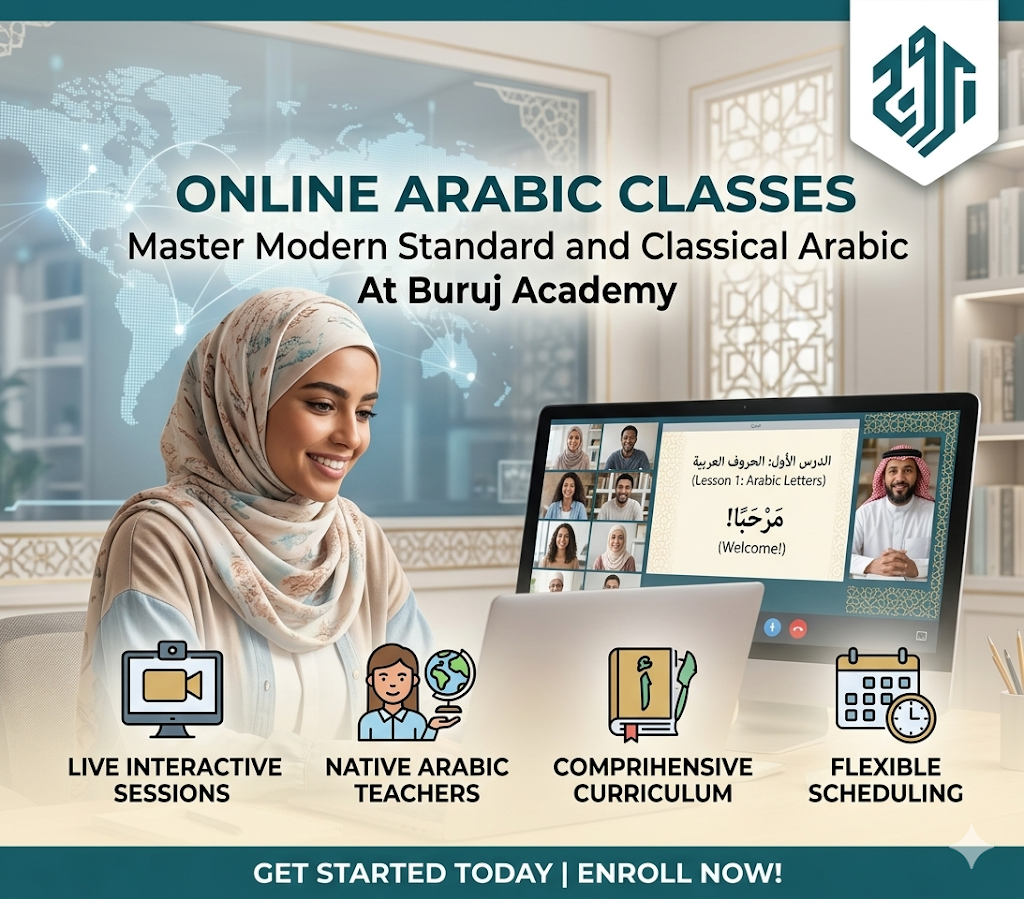
Every student receives a personalized learning plan matched to their current level, their specific goals (Quranic comprehension, MSA grammar, speaking fluency), and their schedule.
In our experience at Buruj Academy, the most common frustration among adult beginners is reaching week three of a generic app and realizing they cannot yet read a single Arabic word in the Quran.
Our structured Arabic for Beginners course resolves this directly — students begin connecting written Arabic to meaning within the first two sessions, because Al-Azhar-trained instructors sequence the curriculum around the student’s actual goal rather than a one-size-fits-all syllabus.
| Feature | Details |
| Instruction type | Live 1-on-1 with certified instructor |
| Methodology | Context-before-abstraction (Buruj Method) |
| Scheduling | Flexible 24/7 globally |
| Instructor qualification | Al-Azhar University graduates, 12+ years experience |
| Best for | Quranic Arabic, MSA grammar, speaking fluency |
Pros: Fully personalized; Ijazah-certified and Al-Azhar-trained instructors; real-time pronunciation correction; covers Quranic Arabic, MSA, grammar, speaking, reading, and writing; flexible scheduling for busy adults; free trial lesson available
Cons: Not a self-paced app — requires scheduling sessions; no gamified features for casual learners who prefer unstructured exploration
Begin learning Arabic at Buruj with a FREE trial lesson
4. AlifBee Is a Well-Structured MSA App
AlifBee is a dedicated Arabic learning app specializing in Modern Standard Arabic, designed to take learners from absolute zero through ten progressively challenging levels.
Its curriculum was built specifically for non-native speakers and covers reading, writing, listening, and speaking through interactive exercises, quizzes, and real-life dialogue scenarios.
What sets AlifBee apart from generic language apps is its commitment to short vowels (harakat) — a feature that most Arabic apps skip entirely despite being essential for anyone working toward Quranic reading.
The platform teaches over 6,500 words, roots, and sentences, all grounded in authentic cultural contexts.
A placement test assigns learners to the appropriate starting level, removing the guesswork that wastes time in the early stages. Understanding Arabic sentence structure becomes far more accessible when vocabulary is introduced through real sentences, as AlifBee consistently does.
Master the Arabic Language
Join our expert-led courses and build a strong foundation in Classical and Modern Arabic.
Get Your Free Trial5. iTalki App
iTalki is an online platform connecting over 10 million language learners with more than 30,000 professional teachers and community tutors across 150+ languages. For Arabic specifically, the platform lists over 400 Arabic tutors from across the Arab world, spanning every dialect and teaching style.
Lesson pricing starts from approximately $10 per hour for community tutors and $15–50+ per hour for certified professional teachers. A trial lesson system allows students to test multiple instructors before committing.
Learners who want to improve Arabic speaking skills through native speaker practice will find iTalki a practical and cost-effective tool — provided they bring their own learning goals and materials to sessions.
Pros: 400+ Arabic tutors; covers all dialects including Quranic and MSA; pay-per-lesson with no subscription required; trial lessons to find the right fit; 4.7-star Trustpilot rating; highly flexible scheduling globally
Cons: No curriculum — learners must bring their own structure and goals; quality varies dramatically between tutors; beginners often struggle without pedagogical scaffolding; finding the right instructor requires time; no progression tracking built into the platform
Read also: Best YouTube Channels to Learn Arabic
Discover the Buruj Academy Difference
Step into our virtual classrooms and see how our expert instructors make learning Quran and Arabic intuitive and clear. We focus on overcoming the specific hurdles non-native speakers face, building your confidence and connection with the Quran.
6. Rocket Arabic
Rocket Arabic is a one-time purchase course from Rocket Languages, covering Egyptian Arabic through over 120 hours of interactive audio lessons, language and culture lessons, and writing exercises.
For learners aiming to master Arabic vocabulary in Egyptian dialect specifically, Rocket Arabic provides structured, self-paced coverage that apps like Duolingo do not attempt.
The main limitations are scope and dialect specificity. Rocket Arabic currently offers only one beginner-to-intermediate level, and it teaches Egyptian dialect exclusively — meaning learners pursuing Quranic Arabic, MSA grammar, or any other regional dialect will need a different resource entirely.

7. Glossika Arabic Builds Spoken Fluency Through Sentence Repetition for Intermediate Learners
Glossika is a language learning platform built around a single, research-backed principle: fluency emerges from high-repetition exposure to complete sentences in context, not from memorizing isolated words or grammar rules.
Pros: Research-grounded spaced repetition method; high-quality native speaker recordings; covers MSA, Egyptian, and Moroccan Arabic; daily sessions take under 30 minutes; builds natural Arabic rhythm and spoken confidence; multi-language access with Pro plan
Cons: Not suitable for absolute beginners — requires prior vocabulary and letter knowledge; no Arabic alphabet instruction; no grammar explanations; no cultural context; higher price point than comparable apps; sessions can feel repetitive without supplementary resources

8. Pimsleur Arabic Is the Best Audio-Only Program
Pimsleur was developed by linguist Dr. Paul Pimsleur and uses spaced repetition within simulated conversations to build listening and speaking skills. Each lesson is approximately 25–30 minutes of audio, structured around responding to a native speaker in the context of a real dialogue.
The app includes a driving mode for hands-free learning during commutes, making it one of the few programs fully usable while doing other activities.
For learners who also want to improve Arabic writing through dictation, Pimsleur will need to be paired with a script-focused resource.
Pros: Hands-free audio format — ideal for commuting and multitasking; grammar explanations in English included; spaced repetition system for strong retention; multiple dialect options including MSA; proven method developed by an applied linguist
Cons: Minimal reading and writing instruction; limited content for advanced learners; not suitable for Quranic Arabic comprehension goals; relatively expensive for audio-only format; no significant interactive visual elements
Read also: Best Websites to Learn Arabic for Free
Start Learning Arabic Properly with Buruj Academy’s Expert-Led Online Arabic Course
The programs above each serve a specific type of learner well — but none of them replaces the impact of live instruction from a qualified teacher who understands where you are and knows exactly how to move you forward.
At Buruj Academy, our Al-Azhar University graduates and Ijazah-certified instructors teach through personalized 1-on-1 online sessions, with 24/7 flexible scheduling and goal-specific learning plans — whether you’re aiming for Quranic comprehension, MSA grammar, or Arabic speaking fluency.
The Buruj Method means you understand what you learn from day one, not after months of passive exposure.
Book your free trial lesson today and experience the difference expert-guided, personalized instruction makes.
Begin your transformation today by choosing the path that fits your goals:
- Online Arabic Classes (General & Comprehensive)
- Arabic Course for Beginners
- Arabic Alphabet Learning Course
- Online Arabic Classes for Kids
- Arabic Classes for Adults
- Arabic Grammar Course (Nahw & Sarf)
- Intermediate Arabic Course (B1/B2)
- Arabic Speaking Course (Conversational Fluency)
- Arabic Reading Course (Literary Excellence)
- Learn Arabic Writing Course (Calligraphy & Composition)
Ready to speak with confidence? Join the global community at Buruj Academy and book your free placement interview today!
Master the Arabic Language
Join our expert-led courses and build a strong foundation in Classical and Modern Arabic.
Get Your Free TrialConclusion
The best program to learn Arabic is ultimately the one that matches your specific goal — not simply the most popular or least expensive option. For casual exposure, free apps like Duolingo provide a low-stakes entry point.
For spoken fluency, audio-driven platforms like Pimsleur and Glossika build strong listening habits. For Quranic comprehension and serious MSA grammar, structured programs with explicit instruction — or live teaching from qualified instructors — are non-negotiable.
What consistent experience at Buruj Academy confirms is this: students who combine clear goals with expert-led, personalized instruction reach functional Arabic ability significantly faster than those cycling through self-paced apps alone. The right program corrects your mistakes in real time, sequences learning around your actual goals, and gives you the accountability that no app can replicate.
Frequently Asked Questions About the Best Programs to Learn Arabic
Which Arabic Program Is Best for Complete Beginners with No Prior Knowledge?
For complete beginners, Buruj Academy’s Arabic for Beginners course provides the most structured and personalized starting point — especially for Muslims who want Quranic Arabic. AlifBee and Duolingo are useful free or low-cost supplements, but neither delivers the real-time correction and personalized sequencing that beginners need most to avoid building bad habits early.
Is It Possible to Learn Arabic Effectively Using Only an App?
Apps like Duolingo, AlifBee, and Rosetta Stone are effective for building basic vocabulary and listening habits, but they consistently fall short of producing conversational fluency or Quranic reading ability on their own. Most Arabic language specialists recommend combining app-based self-study with live instruction from a qualified, credentialed teacher for any serious language goal.
What Is the Difference Between MSA and Quranic Arabic, and Which Should I Learn?
Modern Standard Arabic (MSA) is the formal written language used in media and academia. Quranic Arabic is Classical Arabic — the language of the Quran — which uses more complex grammatical structures and vocabulary that differ meaningfully from MSA. If your goal is Quran comprehension, choose a program explicitly designed for Quranic or Classical Arabic. Our Arabic Grammar course at Buruj Academy is specifically built to bridge this gap for non-Arabic speakers.
How Long Does It Take to Learn Arabic to a Conversational Level?
The US Foreign Service Institute classifies Arabic as a Category IV language — approximately 2,200 class hours to reach professional proficiency for English speakers. With daily dedicated study and quality 1-on-1 instruction, most non-Arabic speakers reach a functional conversational level within 12–18 months. Consistency and quality of instruction matter far more than total time invested.