 Arabic
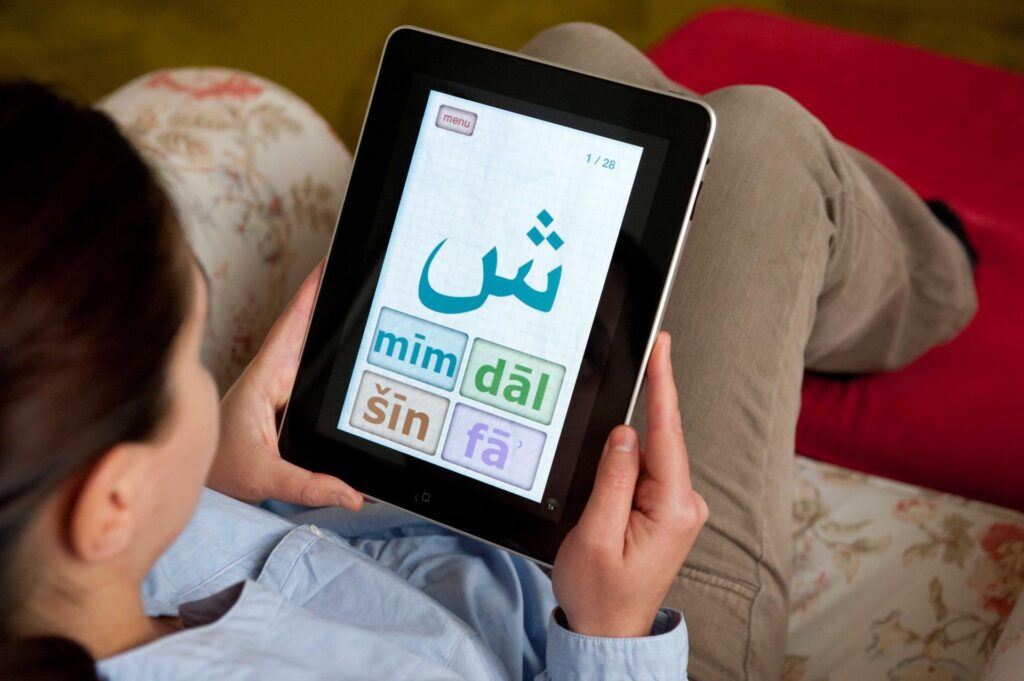
Finding a reliable Arabic learning app feels straightforward until you download three, lose interest in two, and can’t explain why the third stopped working for you. The sheer number of options obscures a simple truth: different apps serve completely different learning goals, and choosing the wrong one wastes months of effort.
The best app to learn Arabic depends entirely on what you need to accomplish. For absolute beginners building reading and script foundations, AlifBee leads the field. For speaking and listening on the go, Pimsleur remains the strongest audio-first option. For dialect variety under one subscription, Mango Languages is unmatched.
Table of Contents:
1. Duolingo App to Learn Arabic for Complete Beginners
Duolingo is the world’s most downloaded language app and offers a fully free Arabic course covering the Arabic script, basic vocabulary, and foundational sentence structures. It teaches Modern Standard Arabic (MSA) using short, gamified lessons that take five to fifteen minutes to complete, making it the easiest entry point for anyone starting from zero.
Pricing: Free with ads | Super Duolingo: ~$5/month (annual) or $12.99/month | Duolingo Max: ~$29.99/month
| Pros | Cons |
| Completely free core content | Teaches MSA only — no dialects |
| Gamified streaks build daily habits | Limited grammar explanation |
| Includes Arabic script from lesson one | Sentences are often impractical |
| Placement test available | Cannot produce conversational fluency alone |
| Works offline (paid tier) | Limited speaking practice in free version |
In our experience teaching Arabic at Buruj Academy, students who use Duolingo as a daily warm-up tool — rather than a primary course — retain motivation far better during the early weeks. The gamification works for building the habit of showing up, but it cannot replace structured instruction in grammar or pronunciation correction.
Best for: Absolute beginners needing a free, low-pressure way to start reading Arabic script and building basic vocabulary.

2. AlifBee App
AlifBee was designed specifically for MSA learners from absolute beginner through advanced levels. It covers all four skills — reading, writing, listening, and speaking — within a logically sequenced 10-level curriculum built by Arabic language specialists. Its placement test means you don’t waste time on material you already know.
Pricing: Free access to early lessons | Premium: ~$9–$15/month or ~$112/year
| Pros | Cons |
| Structured MSA curriculum from alphabet to advanced | No dialect-specific courses |
| Covers reading, writing, listening, and speaking | Some users report small text display issues |
| Teaches over 6,500 words, roots, and sentences | Full content requires paid subscription |
| Quality Pedagogy certification from Education Alliance Finland | Can feel academic rather than conversational |
| Placement test for accurate level placement | Less gamified than Duolingo |
AlifBee is among the most pedagogically rigorous apps available for non-native speakers seeking a formal foundation in written and spoken MSA.
For students in our Arabic for Beginners course, we often recommend AlifBee as a companion tool between live sessions — its structured vocabulary progressions complement instructor-led grammar work extremely well.
Best for: Learners who want a comprehensive, research-backed MSA app that builds literacy and speaking from day one.
Begin learning Arabic at Buruj with a FREE trial lesson
3. Pimsleur App
Pimsleur is one of the oldest and most research-validated language learning systems available. Its Arabic courses consist of 30-minute audio lessons built around spaced repetition, requiring you to actively speak responses aloud rather than passively listen.
It covers three Arabic varieties: Modern Standard Arabic, Egyptian Arabic, and Levantine Arabic.
Pricing: 7-day free trial | ~$19.99/month (all-access) or $14.99/month (single language) | Individual level purchase: ~$159.99
| Pros | Cons |
| Hands-free learning — ideal for commuting or driving | Minimal reading and writing instruction |
| Covers MSA, Egyptian, and Levantine varieties | Relatively expensive compared to alternatives |
| Strong pronunciation development through active speaking | Lessons can feel slow-paced for some |
| Proven spaced repetition methodology | No community or correction features |
| Offline access available | Does not explain grammar rules explicitly |
Pimsleur is especially valuable for learners whose primary goal is oral comprehension and pronunciation — two areas where most apps fall short.
For Muslims focusing on Quranic pronunciation accuracy, however, Pimsleur’s MSA track offers only a partial solution; Arabic pronunciation at the Quranic level requires tajweed-specific instruction that no audio app currently delivers.
Best for: Learners who spend time commuting, exercising, or driving and want to build speaking confidence without screen time.
4. Mango App
Mango Languages is the only mainstream language app that offers dedicated full courses in four distinct Arabic varieties: Modern Standard Arabic, Egyptian Arabic, Levantine Arabic, and Iraqi Arabic.
Its dialogue-centered lessons introduce all vocabulary in realistic conversational context rather than isolated word drills, and it uses minimal transliteration — training learners to engage with the Arabic script directly.
Pricing: 14-day free trial | Single language: $11.99/month or $9.99/month (annual) | All languages: $19.99/month or $16.67/month (annual) | Free via many public libraries
| Pros | Cons |
| Four Arabic dialect courses — unmatched variety | Does not teach the Arabic alphabet from scratch |
| Dialogue-centered vocabulary introduction | Grammar explanations lack depth |
| Minimal transliteration — encourages real script use | More expensive than Duolingo |
| Many libraries offer free access | Speaking practice is limited |
| Cultural context and grammar notes included | Leveling system less sophisticated than AlifBee |
We recommend Mango Languages to students who already know the Arabic alphabet and want to pursue a specific dialect for travel, family communication, or cultural connection.
Students in our Arabic Speaking course who supplement live sessions with Mango’s dialect dialogues demonstrate noticeably stronger informal comprehension within four to six weeks.
Best for: Learners who need dialect-specific Arabic (especially Egyptian, Levantine, or Iraqi) after establishing basic alphabet knowledge.
Book your free trial to start speaking Arabic fluently
Master the Arabic Language
Join our expert-led courses and build a strong foundation in Classical and Modern Arabic.
Get Your Free Trial5. Italki App
italki is not a self-study app in the traditional sense — it is a tutor marketplace connecting learners with Arabic-speaking community tutors and professional teachers for one-on-one video lessons.
It offers Arabic instruction in virtually any dialect, with tutors from Morocco, Egypt, Jordan, Lebanon, Iraq, and the Gulf region. Community tutors typically charge $5–$15 per hour; professional teachers range from $15–$40 per hour.
Pricing: Pay-per-lesson | Community tutors: ~$5–$15/hour | Professional teachers: ~$15–$40/hour | No subscription required
| Pros | Cons |
| Real human interaction — unmatched for speaking practice | No self-paced structured curriculum |
| Filter by dialect, country, and teaching style | Quality varies significantly by tutor |
| Any dialect available | Requires scheduling commitment |
| Community tutors very affordable | Not ideal as a standalone learning method |
| Writing correction feature available for free | No formal progress tracking |
italki works best as a speaking supplement layered on top of a structured app like AlifBee or Mango Languages.
Best for: Learners who have built foundational vocabulary and grammar and now need real conversation practice to activate their passive knowledge.
Read also: Best Resources to Learn Arabic
6. Memrise App
Memrise combines spaced repetition flashcard learning with short video clips of real native speakers using target vocabulary in natural settings.
This dual approach — hearing a word in an app drill and then seeing a native speaker use it casually — trains both recognition and authentic pronunciation simultaneously. Its Arabic vocabulary content focuses primarily on Egyptian Arabic and MSA.
Pricing: Free basic access | Pro: ~$8.99/month or ~$59.99/year
| Pros | Cons |
| Native speaker video clips for authentic pronunciation | Limited grammar instruction |
| Spaced repetition system proven for vocabulary retention | Arabic content less extensive than major languages |
| Engaging multimedia format | Not suitable as a standalone course |
| Affordable Pro pricing | Dialect coverage inconsistent |
| Good for reviewing and reinforcing vocabulary | Less structured than AlifBee |

Memrise works exceptionally well as a vocabulary reinforcement tool running alongside a structured grammar course.
We’ve observed that students who use it for ten minutes of daily vocabulary review alongside our Arabic Grammar course retain new words significantly faster than those relying on classroom sessions alone.
For a deeper look at vocabulary-building strategies, our guide on mastering Arabic vocabulary covers techniques that go well beyond what any app provides.
Best for: Learners at any level who want to accelerate vocabulary acquisition using native speaker multimedia content.
Understand the Arabic Grammar with Buruj’s free trial lesson
7. Glossika App
Glossika uses a mass sentence method — exposing learners to thousands of natural sentences through spaced repetition, dictation, and speaking exercises.
Its Arabic content covers Modern Standard Arabic. Unlike most apps, Glossika does not teach grammar rules explicitly; instead, it trains intuitive pattern recognition through sheer repetitive exposure to well-constructed sentences.
Pricing: 7-day free trial | Individual language: ~$16.99/month or ~$8.99/month (annual) | All languages: ~$30.99/month
| Pros | Cons |
| Extremely effective for building sentence-level fluency | No grammar explanations |
| Dictation and speaking exercises activate production skills | Overwhelming without foundational vocabulary first |
| Spaced repetition system is sophisticated | Not suitable for absolute beginners |
| Romanized option available for early learners | MSA only — no dialect options |
| Large sentence bank covers diverse real-life contexts | Expensive for single-language learners |
Best for: Intermediate to advanced learners who have core grammar knowledge and want to build automatic sentence production through disciplined repetition.
Discover the Buruj Academy Difference
Step into our virtual classrooms and see how our expert instructors make learning Quran and Arabic intuitive and clear. We focus on overcoming the specific hurdles non-native speakers face, building your confidence and connection with the Quran.
Read also: The Best Books to Learn Arabic for Non-Native Speakers
Start Learning Arabic Properly with Buruj Academy’s Expert-Led Online Classes
Apps are genuinely useful tools — but they cannot replace the structured correction, personalized pacing, and pedagogical depth that a qualified teacher provides.
At Buruj Academy, our Online Arabic Classes are taught by Al-Azhar University graduates with 12+ years of experience teaching non-native speakers globally.
Why students choose Buruj Academy:
- Al-Azhar-certified instructors and Ijazah holders with proven classroom expertise
- The Buruj Method: Context-before-abstraction — meaning you understand language in use before memorizing rules
- Personalized 1-on-1 sessions with flexible 24/7 scheduling
- Courses for every goal: Arabic for Beginners, Arabic Grammar course, Arabic Speaking course, and Arabic classes for kids
- Real-time pronunciation correction that no app can replicate
Book your free trial lesson today and experience the difference structured human instruction makes.
Master the Arabic Language
Join our expert-led courses and build a strong foundation in Classical and Modern Arabic.
Get Your Free TrialConclusion
Arabic apps have improved dramatically — but knowing which one to use, and when, makes the real difference. For beginners, AlifBee and Duolingo build the foundation. For dialect learners, Mango Languages stands apart. For speaking fluency, Pimsleur and italki fill the gap most apps leave open.
The pattern across all of them is consistent: apps accelerate vocabulary and listening, but they cannot replicate the precision of a qualified teacher catching your pronunciation errors and adjusting your grammar in real time.
Use apps to stay consistent — then invest in instruction to move forward with confidence.
Frequently Asked Questions About the Best Apps to Learn Arabic
What Is the Best Free App to Learn Arabic?
The best free app to learn Arabic is Duolingo for complete beginners who need script recognition and basic vocabulary at no cost. AlifBee also offers free access to early lessons with a more academically structured curriculum. For the best free option with dialect content, check whether your local library provides free Mango Languages access — many do.
Can You Become Fluent in Arabic Using Only an App?
No app can produce Arabic fluency on its own. Apps build vocabulary, reading recognition, and listening comprehension effectively, but reaching conversational fluency requires human interaction — specifically, real-time speaking practice with correction. Most researchers and language educators estimate that reaching basic conversational Arabic requires 6–12 months of daily consistent practice combining apps with live instruction.
Is Duolingo Arabic Good for Kids?
Duolingo’s Arabic course suits children aged 6 and above as a supplementary tool for building script recognition and basic vocabulary. Its gamified format keeps younger learners engaged. For structured Arabic learning tailored for children, our Arabic classes for kids provide age-appropriate instruction with instructors trained in child-specific pedagogy, which apps cannot replicate.