 Arabic
Finding the right starting point is the hardest part of learning Arabic — the resource landscape is vast, uneven, and rarely designed with Muslim English speakers in mind. Between apps promising fluency in 30 days and generic language platforms that ignore Quranic Arabic entirely, choosing poorly costs months of progress.
The best resources to learn Arabic depend entirely on your goal: Quranic comprehension, Modern Standard Arabic (MSA), conversational fluency, or all three.
Table of Contents:
1. Buruj Academy’s Online Arabic Classes Are the Most Structured Option for Learners
Buruj Academy is our first and strongest recommendation for non-Arabic speaking Muslims who want a learning experience designed around their actual goals — whether that’s understanding Quranic Arabic, building speaking confidence, or mastering grammar from the ground up.
Our Online Arabic Classes are taught by Al-Azhar University graduates with 12+ years of experience teaching non-native speakers globally.
Book your FREE Arabic trial online Arabic class at Buruj
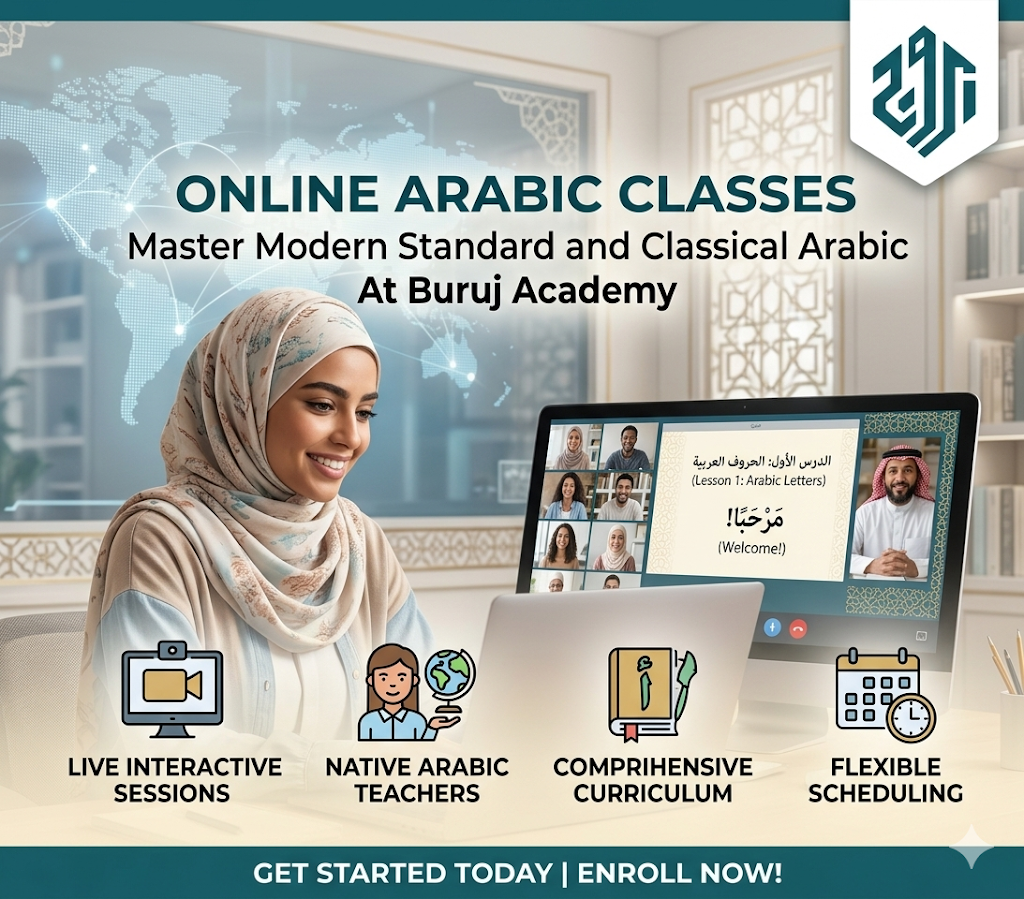
Unlike apps or generic platforms, every session is live, personalized, and 1-on-1 — so instruction adapts to your pronunciation gaps, your pace, and your specific goals from day one.
In our sessions at Buruj Academy, one of the most common observations we make is that beginners who struggle for months on apps make measurable breakthroughs within four to six weeks of structured instruction.
The reason is simple: apps cannot hear your mistakes. A qualified teacher corrects your makhraj in real time — no app replicates that.
| Your Goal | Recommended Course |
| Complete beginner | Arabic for Beginners course |
| Understand the Quran | Quranic Arabic Classes course |
| Build speaking fluency | Arabic Speaking course |
| Master Arabic grammar | Arabic Grammar course |
| Read Arabic script | Arabic Reading course |
The Buruj Method applies a context-before-abstraction approach — you encounter meaningful words and phrases before you dissect their grammar rules.
This mirrors how children acquire language naturally and dramatically reduces the frustration beginner adults experience when confronted with abstract grammatical tables on day one.
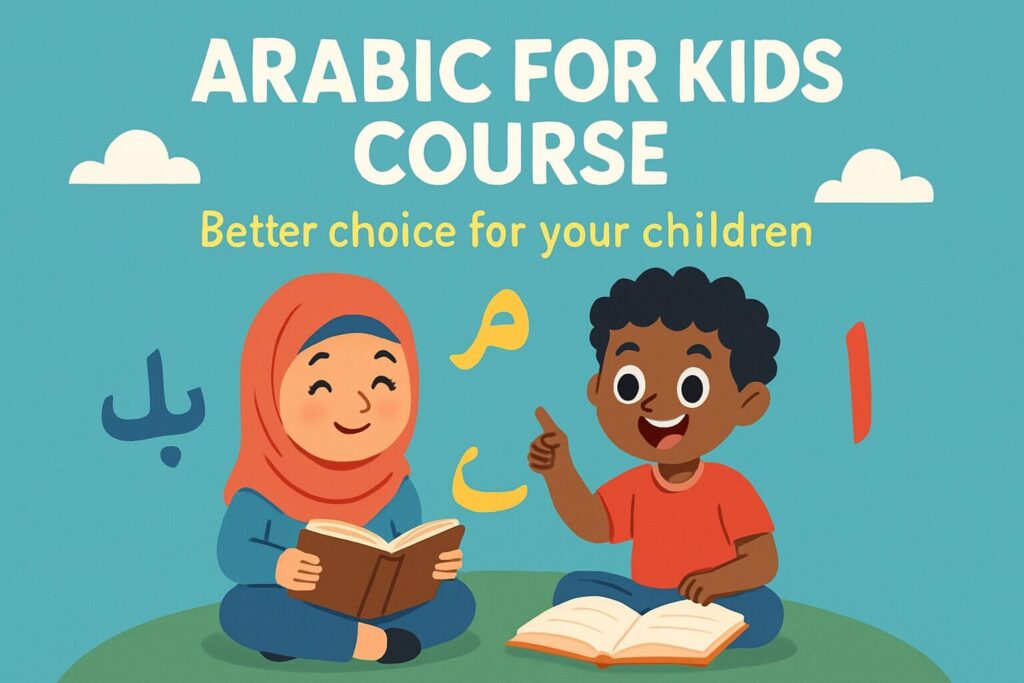
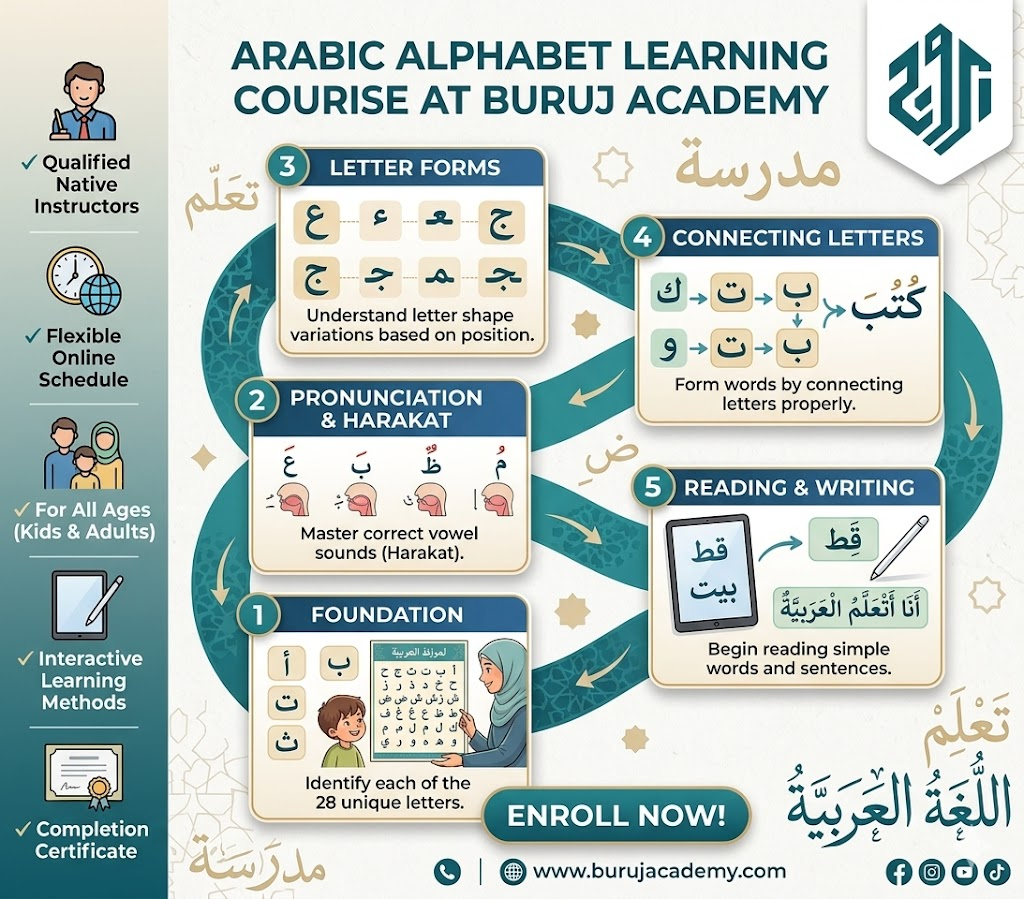
Buruj Academy also offers specialized tracks: the Arabic Alphabet Learning course for those starting from zero script knowledge, and the Online Arabic Classes for Kids course for parents building their children’s Arabic foundation early.
Book your free trial lesson and experience personalized instruction before committing.
2. Madinah Arabic Free Resources
Madinah Arabic is a free online platform built around the Arabic curriculum used at Madinah Islamic University in Saudi Arabia. It is one of the most respected free resources available for non-native learners focusing on Classical and Quranic Arabic.
The platform offers structured lessons on the Arabic alphabet, grammar, and vocabulary, with clickable audio on grammar tables — a simple but effective feature that builds correct pronunciation habits without a tutor.
For learners whose primary motivation is understanding the Quran rather than conversational fluency, Madinah Arabic covers the linguistic territory that matters most: i’rab (grammatical case endings), root-word patterns, and classical sentence construction.
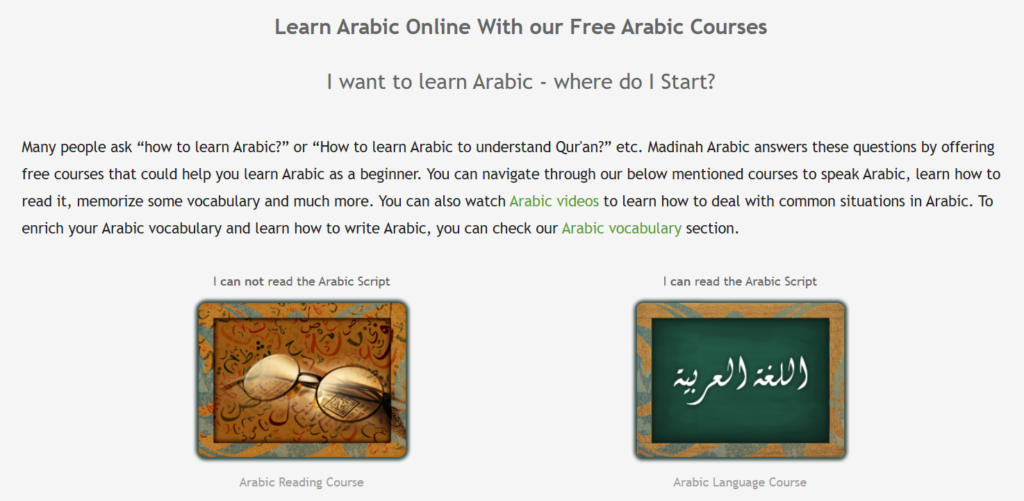
One important limitation to acknowledge: Madinah Arabic’s interface is dated, and the associated mobile apps have mixed reviews. We recommend using the desktop website directly rather than the app for the most reliable experience.
Madinah Arabic pairs well with Buruj Academy’s Quranic Arabic Classes course for learners who want to use the Madinah curriculum but benefit from live instructor guidance alongside it.
For a structured introduction to MSA grammar principles, our blog’s beginner’s guide to Modern Standard Arabic is a helpful companion resource.
Begin Understanding Quranic Arabic with a FREE Lesson
3. ArabicPod101 Provides Hundreds of Audio and Video Lessons for Self-Paced Learners
ArabicPod101 is a podcast-style language platform offering thousands of lessons across five proficiency levels — Absolute Beginner through Advanced — covering MSA, Egyptian, and Moroccan Arabic dialects.
The platform’s core format pairs two hosts discussing topics in Arabic, with transcripts, vocabulary lists, and lesson notes included. This makes it genuinely useful for auditory learners who want to absorb natural Arabic conversational patterns during commutes or passive listening sessions.
ArabicPod101 genuinely shines at the beginner-to-intermediate range. Advanced learners often find the content depth insufficient beyond a certain point.
One structural weakness: the platform does not always clearly label which dialect a lesson covers, which can confuse beginners trying to focus on a single variety.
For learners using ArabicPod101 to build vocabulary, pairing it with active practice is essential. Our guide on mastering Arabic vocabulary covers retention strategies that complement passive audio learning.
Read also: Why Learn Arabic?
4. italki Gives You Direct Access to Native Arabic Tutors Across All Dialects
italki is a tutor marketplace connecting language learners with over 400 Arabic teachers offering lessons in MSA, Egyptian, Levantine, Gulf, Moroccan, and other dialects — with per-lesson pricing ranging from approximately $5 to $70 depending on the instructor’s credentials and experience.
italki is not a course. It is a platform for finding a human teacher, which makes it fundamentally different from apps.
The quality of your learning depends entirely on which tutor you select — community tutors are cheaper but less formally qualified, while professional teachers offer structured progression at higher rates.
The platform’s key strength is flexibility and dialect access. If you need Gulf Arabic for professional reasons, or Egyptian Arabic for media consumption, you can find a specialist within minutes. italki also offers a community writing exercise feature where native speakers review your written Arabic — a useful free supplement for those working on script accuracy.
For learners who want to understand the principles of Arabic sentence construction before their first italki session, our Arabic sentence structure guide is an excellent primer.

Master the Arabic Language
Join our expert-led courses and build a strong foundation in Classical and Modern Arabic.
Get Your Free Trial5. Duolingo Arabic Builds Daily Habits for Complete Beginners
Duolingo Arabic is best understood as a habit-building tool rather than a complete Arabic education. Its gamified, streak-based system is genuinely effective at keeping beginners engaged through the early weeks of learning — a phase when dropout rates are highest.
Duolingo introduces Arabic script, basic vocabulary, and elementary sentence patterns in short, digestible sessions. It is the most accessible entry point available, and it is free. For Muslim learners who have never seen Arabic script before, Duolingo’s alphabet introduction provides a low-pressure first encounter with letter shapes and sounds.
The limitations become apparent quickly. Duolingo’s Arabic grammar instruction is shallow, its dialect coverage is non-existent, and it does not develop reading comprehension or speaking ability to any meaningful depth. Most serious learners outgrow it within three months.
Use Duolingo to establish a daily Arabic habit. Transition to structured instruction — through Buruj Academy’s Online Arabic Classes — once the Arabic alphabet feels familiar and you want to progress beyond survival vocabulary.
6. Pimsleur Arabic Trains Your Ear and Pronunciation Through Audio-Only Learning
Pimsleur Arabic is a research-backed audio program offering courses in MSA, Egyptian, and Eastern (Levantine) Arabic. Its method is built on spaced repetition of spoken phrases — listen, respond in the pause, then hear the correct answer — which develops strong listening recall and pronunciation habits.
Pimsleur is genuinely effective for building a spoken foundation quickly. Learners who commute, exercise, or have limited screen time find it particularly practical.
The claim that it delivers intermediate fluency in 30 days of 30-minute sessions is ambitious, but the method does build real pronunciation instincts that purely text-based resources cannot.
| Strength | Limitation |
| Strong pronunciation training | No script instruction |
| Spaced repetition built in | Limited grammar depth |
| Audio-only (flexible) | Fewer levels than other languages |
| MSA, Egyptian, Levantine available | No dialect beyond those three |
Pimsleur works best as a pronunciation supplement alongside a grammar-focused resource.
For learners concerned about correct Arabic pronunciation from the outset, our blog on Arabic pronunciation online covers the phonetic principles Pimsleur trains in spoken form.
7. YouTube Channels Offer Free Arabic Immersion When Used Strategically
YouTube is not a single resource — but approached strategically, it is one of the most powerful free Arabic immersion tools available. The key is selecting channels by goal rather than browsing randomly.
For MSA and Quranic Arabic: The Madinah Arabic YouTube channel offers free situational dialogues in Fusha. For grammar video supplements, the FC LangMedia channel covers classical grammatical structures with university-level explanations.
For speaking skills and dialect: Channels focused on Egyptian and Levantine Arabic provide natural exposure to how Arabic is actually spoken in daily life — a necessary complement to any formal MSA instruction.
For Arabic script and reading: Pair YouTube exposure with active reading practice. Our blog on how to improve Arabic speaking skills outlines how to transition from passive listening to active production — the gap where most self-studiers stall.
YouTube is most effective when combined with structured grammar instruction and live speaking practice, not as a standalone learning system.
Read also: The Best Apps to Learn Arabic
Discover the Buruj Academy Difference
Step into our virtual classrooms and see how our expert instructors make learning Quran and Arabic intuitive and clear. We focus on overcoming the specific hurdles non-native speakers face, building your confidence and connection with the Quran.
Start Your Arabic Learning with Buruj Academy’s Expert Instructors
Arabic is a profound and structured language — the right resource makes the difference between years of confusion and consistent, measurable progress.
Buruj Academy’s Online Arabic Classes offer everything self-study resources cannot: real-time correction, structured progression, and instruction from Al-Azhar University graduates with 12+ years teaching non-native speakers.
Our Buruj Method — context-before-abstraction, consistency-before-speed — ensures learners build genuine competence, not surface-level familiarity.
- Personalized 1-on-1 sessions tailored to your level and goals
- Flexible 24/7 scheduling for working professionals and parents
- Ijazah-certified instructors with verified credentials
- Specialized tracks from alphabet to advanced grammar
Book your free trial lesson today — no commitment required.
Begin your transformation today by choosing the path that fits your goals:
- Online Arabic Classes (General & Comprehensive)
- Arabic Course for Beginners
- Arabic Alphabet Learning Course
- Online Arabic Classes for Kids
- Arabic Classes for Adults
- Arabic Grammar Course (Nahw & Sarf)
- Intermediate Arabic Course (B1/B2)
- Arabic Speaking Course (Conversational Fluency)
- Arabic Reading Course (Literary Excellence)
- Learn Arabic Writing Course (Calligraphy & Composition)
Ready to speak with confidence? Join the global community at Buruj Academy and book your free placement interview today!
Master the Arabic Language
Join our expert-led courses and build a strong foundation in Classical and Modern Arabic.
Get Your Free TrialConclusion
The best resources to learn Arabic are the ones matched to your specific goal, your current level, and how you learn. Free tools like Madinah Arabic and YouTube have genuine value — but they cannot replace qualified instruction for learners serious about Quranic comprehension, grammatical accuracy, or speaking fluency.
Buruj Academy sits at the top of this list precisely because personalized instruction by Al-Azhar-trained teachers addresses what every app and self-study platform cannot: your specific errors, your specific pronunciation, and your specific pace. Begin with a free trial and experience the difference structured instruction makes.
Frequently Asked Questions About the Best Resources to Learn Arabic
Where Is the Best Place to Learn Arabic Online?
The best place to learn Arabic online is through a structured platform with qualified native-speaking instructors — like Buruj Academy’s Online Arabic Classes. Apps and free websites are useful supplements, but live 1-on-1 instruction with an Al-Azhar-certified teacher produces measurably faster progress, especially for Quranic Arabic and grammar accuracy.
Can I Learn Arabic for Free?
Yes — Madinah Arabic and Duolingo offer free Arabic instruction at beginner to intermediate levels. Free resources work best for building initial familiarity with the script and vocabulary. For consistent grammar progression and speaking ability, structured paid instruction accelerates results significantly.
How Long Does It Take to Learn Arabic?
The U.S. Foreign Service Institute estimates approximately 2,200 class hours for English speakers to reach professional Arabic proficiency. For conversational ability or Quranic reading competence, most learners reach functional goals within 12–24 months of consistent daily practice — faster with structured 1-on-1 instruction than self-study alone.
What Is the Best Resource to Learn Arabic Grammar Specifically?
For Arabic grammar, Madinah Arabic’s free structured curriculum is a strong foundation. Buruj Academy’s Arabic Grammar course provides the most guided path, with real-time explanation and correction from qualified instructors. Our Arabic grammar beginner’s guide is also a useful starting reference.