 Arabic
| Key Takeaways |
| Professionals with Arabic proficiency find opportunities in diplomacy, international development, translation, academic research, journalism, and the growing field of Islamic finance. |
| Arabic is the language of the Quran, and learning it allows Muslims to understand divine words directly without translation. |
| Arabic grammar is highly systematic, making it learnable for English speakers through structured, consistent daily practice. |
| Arabic trains analytical thinking in ways that benefit other academic disciplines. |
| Understanding Arabic significantly deepens Salah, transforming prayer from recitation into conscious conversation with Allah. |
Every Muslim recites Arabic daily — in Salah, in du’a, in Quran. But most do so without understanding a word. That gap between the tongue and the heart is exactly what learning Arabic closes, and it changes everything.
Arabic is not simply a foreign language. For Muslims, it is the language through which Allah chose to reveal His final message.
Whether you are a complete beginner or someone who has studied Islam for years, learning Arabic delivers spiritual, intellectual, and practical benefits that no translation can replicate.
Table of Contents:
1. Arabic Lets You Understand the Quran in the Words Allah Chose
The Quran was revealed in Arabic, and that choice was deliberate. Allah says:
إِنَّا أَنزَلْنَـٰهُ قُرْءَٰنًا عَرَبِيًّا لَّعَلَّكُمْ تَعْقِلُونَ
Innā anzalnāhu Qur’ānan ‘arabiyyan la’allakum ta’qilūn
“Indeed, We have sent it down as an Arabic Quran that you might understand.” (Yusuf 12:2)
The verse directly connects Arabic to ‘aql — rational comprehension — not merely recitation.
Every translation of the Quran is, by definition, an interpretation. Nuance is lost, connotation shifts, and the precise weight of Arabic words — words like taqwa, sabr, and rahmah — cannot be fully carried into English.
When you learn Arabic, you receive the Quran as it was sent.
At Buruj Academy, our Online Arabic Classes are built specifically around this goal — helping non-Arabic speakers access the Quran’s meaning through its original language, taught by Al-Azhar University graduates with 12+ years of experience.
Book your FREE Arabic trial online Arabic class at Buruj
2. Arabic Connects You to a Global Community of 400 Million Speakers
Arabic is spoken by approximately 400 million people across 22 countries as an official language, making it one of the six official languages of the United Nations.
For Muslims specifically, Classical Arabic (Fus’ha) serves as a shared register across all Arabic-speaking cultures, from Morocco to the Gulf.
A Muslim who learns Arabic can communicate with scholars, students, and communities across the entire Muslim world.
This is not an abstract benefit. When you travel to Makkah, Madinah, Cairo, or Istanbul, Arabic opens doors — in scholarship, in hospitality, and in worship — that remain firmly closed to those without it.
3. Arabic Builds Cognitive Skills That Benefit Every Area of Learning
Learning any second language strengthens executive function, working memory, and pattern recognition. Arabic specifically — with its root-pattern morphology and explicit grammatical case system (I’rab) — trains analytical thinking in ways that benefit other academic disciplines.
Children who learn Arabic demonstrate stronger phonemic awareness and linguistic flexibility.
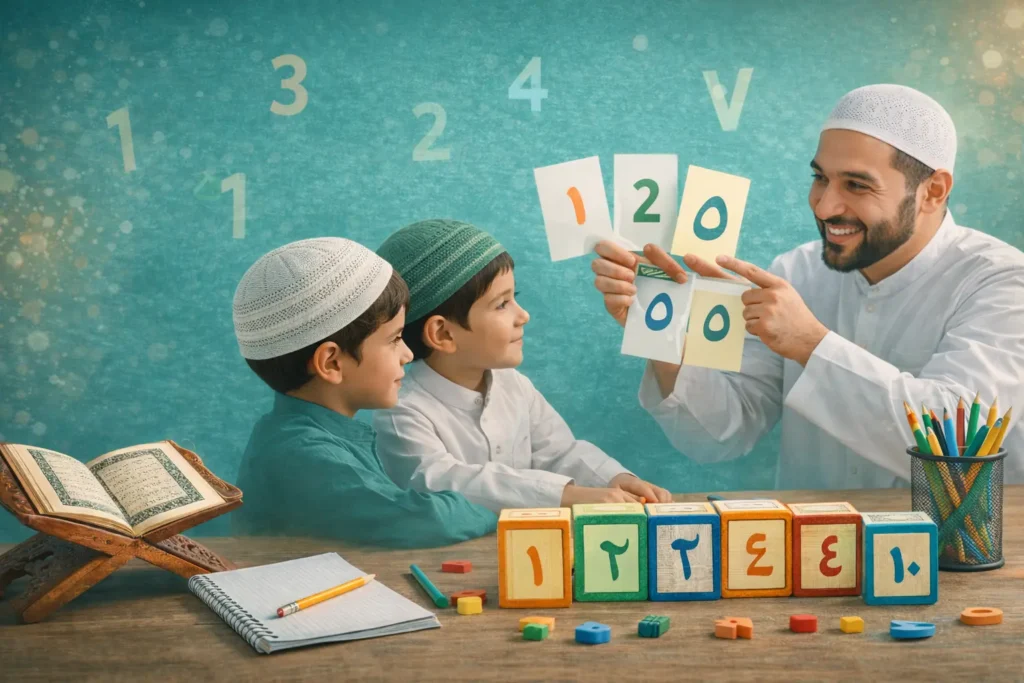
If you are considering Arabic for your children, our Online Arabic Classes for Kids use age-appropriate methods that build these cognitive foundations alongside Islamic vocabulary — a combination that serves them in Quran, in school, and in life.
Our blog’s guide to learning Arabic for kids outlines specifically what age-appropriate Arabic learning looks like at each stage.
Book a FREE Arabic trial for your Child
4. Arabic Opens Career and Professional Opportunities Worldwide
Beyond the spiritual dimension, Arabic is classified by the U.S. Foreign Service as one of the most strategically important languages globally.
Professionals with Arabic proficiency find opportunities in diplomacy, international development, translation, academic research, journalism, and the growing field of Islamic finance.
In the Gulf region specifically, Arabic proficiency is an asset in virtually every professional sector.
Developing your Arabic speaking skills and building a strong Arabic vocabulary foundation are practical steps that serve both your deen and your professional life simultaneously.
Book your free trial to start speaking Arabic fluently
5. Arabic Transforms Your Salah from Recitation into Conversation
Most non-Arabic speakers pray with sincere hearts but blank comprehension. Understanding Arabic changes that completely.
When you know that Ar-Rahman means “the Endlessly Merciful” and Al-Malik means “the Sovereign King,” Surah Al-Fatihah stops being a formula and becomes a direct address to Allah. That shift in consciousness is permanent.
In our sessions at Buruj Academy, students frequently describe the same experience: the first time they understood Al-Fatihah word by word, many were moved to tears. That is not sentiment — it is the natural result of language meeting worship.
Does Understanding Arabic Improve Khushu’ in Prayer?
Yes — and classical scholars consistently emphasized this connection. Ibn Al-Qayyim noted that understanding what one recites is among the foundations of khushu’ (concentration in prayer).
When your mind tracks meaning alongside recitation, distraction has far less room to enter.
Read also: How Hard Is It to Learn Arabic?
6. Arabic Gives You Direct Access to 1,400 Years of Islamic Scholarship
The overwhelming majority of classical Islamic scholarship — Tafsir, Fiqh, Usul, Hadith sciences, Arabic linguistics — was written in Arabic and has never been translated.
Scholars like Ibn Kathir, Al-Nawawi, Ibn Taymiyyah, and Al-Ghazali wrote in Arabic. Their works exist in translation only partially, and often imperfectly.
Learning Arabic means accessing this tradition as its authors intended — without the filter of a translator’s interpretation or the delay of waiting for a translation that may never come.
| Source Type | Available in English | Available in Arabic |
| Tafsir works | Partial (selected texts) | Thousands of volumes |
| Fiqh manuals | Limited selections | Complete across madhabs |
| Hadith commentaries | Small percentage | Extensive classical corpus |
| Arabic linguistics texts | Rare | Core of the tradition |
This table represents the real scope of what Arabic opens — not just better comprehension, but an entirely different level of access to Islamic knowledge.
Master the Arabic Language
Join our expert-led courses and build a strong foundation in Classical and Modern Arabic.
Get Your Free Trial7. Arabic Strengthens Your Tajweed and Quran Recitation Simultaneously
Tajweed rules — the precise science of Quranic pronunciation — are themselves taught, named, and explained in Arabic. Terms like Ikhfa, Idgham, Qalqalah, Tafkhim, and Tarqiq are not just labels.
Understanding their Arabic roots reveals what each rule actually does phonetically. Ikhfa (إخفاء) means concealment. Idgham (إدغام) means merging. Knowing this makes the rules intuitive, not arbitrary.
Our Al-Azhar-trained instructors at Buruj Academy teach Tajweed and Arabic as connected disciplines — because they are. Students who advance in Arabic consistently apply Tajweed rules with greater accuracy and understanding.
If you want to strengthen both together, our Noorani Qaida course provides the foundational vocabulary and pronunciation that feed directly into Tajweed proficiency.
Book your FREE trial lesson in the Noorani Qaida course
8. Arabic Is More Systematic Than Most Languages Non-Native Speakers Have Studied
A common fear among English speakers is that Arabic is impossibly complex. In reality, Arabic operates on one of the most logical grammatical systems in any language.
Nearly every Arabic word derives from a three-letter root (جذر, jithr), and patterns repeat consistently across vocabulary.
Once you learn that the root ك-ت-ب relates to writing, you can recognize kitab (book), kataba (he wrote), maktub (written), and maktabah (library) without learning each separately.
Our beginner’s guide to Modern Standard Arabic explains this root-pattern system in detail — and why it actually makes Arabic faster to learn than many expect.
Discover the Buruj Academy Difference
Step into our virtual classrooms and see how our expert instructors make learning Quran and Arabic intuitive and clear. We focus on overcoming the specific hurdles non-native speakers face, building your confidence and connection with the Quran.
How Does Arabic Grammar Compare to English Grammar for Beginners?
Arabic grammar is more explicit and rule-governed than English, which relies heavily on exceptions.
Arabic sentence structure follows consistent patterns, verb conjugations follow predictable forms, and the dual form (مثنى, muthanna) eliminates ambiguity English speakers navigate constantly.
With structured guidance through our Arabic Grammar course, English-speaking beginners typically establish core grammar patterns within three to four months of regular study.
Understand the Arabic Grammar with Buruj’s free trial lesson
9. Arabic Makes Du’a More Meaningful and Personal
Many Muslims memorize du’as phonetically without understanding their content. When you learn Arabic, du’as you have recited for years suddenly reveal their depth.
The du’a of Ibrahim (peace be upon him) in Surah Ibrahim, the du’as of the morning and evening adhkar, the supplications of the Prophet ﷺ — all of these carry layers of meaning that only Arabic reveals.
This is one of the most consistent observations we make at Buruj Academy: students who begin our Online Arabic Classes often report that their relationship with du’a changes before their relationship with Quran recitation does. That early emotional connection becomes the motivation to continue.
Read also: How Long Does It Take to Learn Arabic?
10. Arabic Deepens Your Understanding of Hadith and Prophetic Guidance
The Hadith literature — the recorded words and actions of the Prophet Muhammad ﷺ — was transmitted and preserved in Arabic.
While translations exist, the Arabic text of hadith often contains linguistic precision that translation flattens.
The Prophet ﷺ was known for jawami’ al-kalim — the ability to convey profound meaning in few words. That quality is a feature of Arabic itself.
Understanding Arabic allows you to engage with hadith through platforms like Sunnah.com not just in translation, but in the original Arabic — reading what was actually said, letter by letter, as the companions heard it.
11. Arabic Preserves Your Connection to Islamic Heritage Across Generations
Classical Arabic (Fus’ha) has remained essentially unchanged since the Quranic revelation.
This means that the Arabic you learn today is the same Arabic in which the Companions of the Prophet ﷺ communicated, in which Imam Al-Shafi’i wrote jurisprudence, and in which Ibn Kathir composed his Tafsir.
No other living language offers this degree of direct continuity with a 1,400-year tradition.
For Muslim families raising children in Western countries, teaching Arabic is an act of preserving identity across generations. It keeps children connected to their heritage, their faith, and a global community in a way that English — however useful — cannot replicate.
Should I Learn Arabic Even If I Am Not Fluent in Quran Recitation?
Yes — and the two pursuits are not sequential. You do not need to master Quran recitation before beginning Arabic, nor do you need to complete Arabic before starting Tajweed. These disciplines strengthen each other simultaneously.
Many students who begin with our Arabic Reading course find their Quran reading improves automatically as their letter recognition and phonetic awareness develop through Arabic study.
| Starting Point | Recommended First Step | Expected Crossover Benefit |
| Complete beginner | Arabic Alphabet + Noorani Qaida | Quran reading improves within weeks |
| Can recite but no understanding | Quranic Arabic vocabulary | Salah comprehension within months |
| Intermediate reciter | Arabic Grammar + Tafsir vocabulary | Deeper Quran engagement within one year |
| Advanced reciter | Classical Arabic texts | Access to full scholarly tradition |
Wherever you start, Arabic and Quran study reinforce each other at every stage.
Do You Have to Learn Arabic to Be a Muslim?
No — Arabic is not a condition of Islam. A person’s faith, sincerity, and practice are not measured by linguistic ability. Islam is a religion for all of humanity, and millions of sincere Muslims do not speak Arabic.
However, learning Arabic is strongly encouraged and carries immense reward, because it connects a believer more directly to the Quran, to Salah, and to Islamic scholarship.
The difference is between what is required and what is deeply beneficial — and Arabic sits firmly in the latter category.
Begin Your Arabic Learning with Buruj Academy’s Expert Instructors
The reasons to learn Arabic are clear — spiritually, intellectually, and practically. What matters now is starting with the right guidance.
Buruj Academy’s Online Arabic Classes are designed specifically for non-Arabic speakers, taught by Al-Azhar University graduates and Ijazah-certified instructors with 12+ years of experience.
Our Buruj Method — Context-before-abstraction, Consistency-before-speed — ensures you build real Arabic understanding, not just memorized phrases.
Every student receives personalized 1-on-1 sessions with flexible scheduling to suit any lifestyle.
Book your free trial lesson today and experience the difference structured, expert Arabic instruction makes from your very first class.
Begin your transformation today by choosing the path that fits your goals:
- Online Arabic Classes (General & Comprehensive)
- Arabic Course for Beginners
- Arabic Alphabet Learning Course
- Online Arabic Classes for Kids
- Arabic Classes for Adults
- Arabic Grammar Course (Nahw & Sarf)
- Intermediate Arabic Course (B1/B2)
- Arabic Speaking Course (Conversational Fluency)
- Arabic Reading Course (Literary Excellence)
- Learn Arabic Writing Course (Calligraphy & Composition)
Ready to speak with confidence? Join the global community at Buruj Academy and book your free placement interview today!
Master the Arabic Language
Join our expert-led courses and build a strong foundation in Classical and Modern Arabic.
Get Your Free TrialConclusion
Arabic is the language through which Allah revealed His final message, and learning it is one of the most spiritually transformative decisions a Muslim can make. It deepens Salah, enriches Quran recitation, opens centuries of scholarship, and connects believers to a global community of faith.
The question is never really why learn Arabic. The question is when to start — and the honest answer is always: now. With structured guidance and consistent practice, Arabic is genuinely within reach for any committed learner, at any age.
Frequently Asked Questions About Learning Arabic
Should I Learn Arabic as a Muslim Who Already Knows How to Read the Quran?
Yes — reading the Quran phonetically and understanding it are two separate skills. Knowing how to recite Arabic script does not mean you comprehend the meaning. Learning Arabic after Quran reading adds the crucial layer of understanding that turns recitation into worship with full conscious engagement, significantly deepening your connection to the text you already recite daily.
Do You Have to Learn Arabic to Be a Muslim?
No — Arabic fluency is not a requirement of Islamic faith or practice. Muslims worldwide practice sincerely without Arabic knowledge. However, learning Arabic is strongly recommended because it directly strengthens your relationship with the Quran, Salah, and the prophetic tradition. It transforms acts of worship from habitual to deeply understood, which Islamic scholarship consistently recognizes as spiritually valuable.
Should I Learn Arabic?
Yes — learning Arabic is one of the most rewarding decisions you can make for your future and understanding. Arabic connects you directly to the Quran, deepens your Salah, and opens access to Islamic scholarship that no translation fully captures. Even basic Arabic vocabulary transforms daily worship. The commitment required is real, but the spiritual and intellectual return is far greater than the effort invested.
What Is the Best Age to Start Learning Arabic?
There is no single best age — children acquire language more naturally, but adults learn more efficiently through structured grammar instruction. Children aged four to ten benefit from phonetic immersion and visual learning. Adults benefit from systematic grammar-first approaches that build on existing language knowledge. Buruj Academy tailors its methodology to each age group, making Arabic genuinely accessible from early childhood through adulthood.