 Arabic
| Key Takeaways |
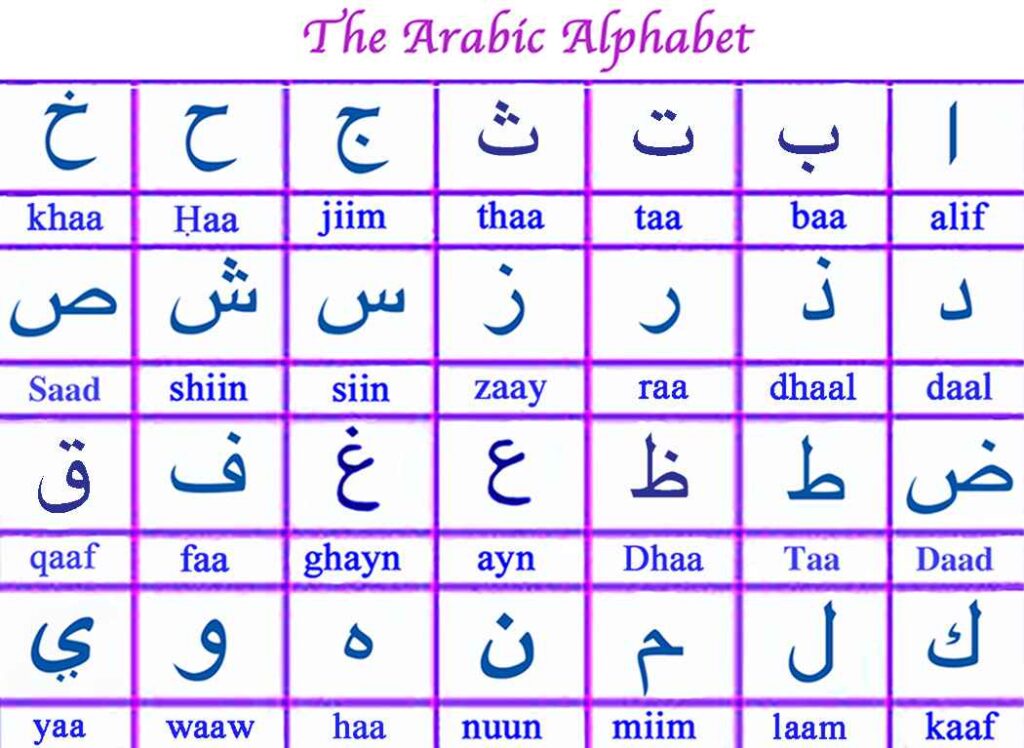
| The Arabic alphabet has 28 letters, each with up to four distinct written forms depending on position in a word. |
| Arabic letters are grouped into families sharing similar shapes, making recognition significantly faster for new learners. |
| Correct pronunciation of Arabic letters requires learning specific articulation points (makharij) from the throat, mouth, and lips. |
| Your learning purpose — Quran reading, speaking, or writing — determines which alphabet skills to prioritize from day one. |
| Consistent daily practice of 15–20 minutes produces measurable alphabet recognition within 2–3 weeks for most adult beginners. |
Learning the Arabic alphabet feels daunting at first — a completely unfamiliar script read right to left, with letters that change shape depending on where they appear. That challenge is real, and we see it in every new student who joins us.
The good news is that the Arabic alphabet is genuinely learnable in a structured way. With 28 letters organized into shape families, clear articulation rules, and a consistent writing system, most non-Arabic speakers can recognize all letters within three to four weeks of daily focused practice — provided they follow the right sequence.
Table of Contents:
1. Understand What the Arabic Alphabet Actually Is Before You Memorize Anything
The Arabic alphabet contains 28 letters, all of which are consonants. Arabic is an abjad — a consonant-based writing system where short vowels are indicated by small diacritical marks called harakat (حَرَكَات) placed above or below letters, rather than by separate vowel letters.
This distinction matters practically: when you read the Quran, harakat are fully written out, making it easier for beginners.
In everyday Arabic text — newspapers, signs, books — short vowels are usually omitted, which is why reading skill builds gradually.
Why Does Arabic Letter Position Change the Shape?
Each Arabic letter has up to four positional forms: isolated, initial (beginning of word), medial (middle of word), and final (end of word). This is not arbitrary — Arabic is a cursive script by nature, and letters connect to their neighbors on the right.
Knowing this from day one prevents the common beginner panic of seeing “different letters” that are actually the same letter in different positions.
| Position | Example with ب (Ba) | Function |
| Isolated | ب | Letter alone |
| Initial | بـ | Beginning of word |
| Medial | ـبـ | Middle of word |
| Final | ـب | End of word |
Six letters — و، ز، ر، ذ، د، ا — only connect to the letter on their right, never to the left. These are called non-connecting letters, and learning them early saves significant confusion later.
2. Learn Letters in Shape Families, Not Alphabetical Order
Memorizing all 28 letters in strict alphabetical order is one of the most common — and most inefficient — approaches we see from self-taught students. Arabic letters naturally cluster into shape families where the base form is shared and dots distinguish individual letters.
The Core Shape Families to Learn First
| Family Base Shape | Letters | Distinguishing Feature |
| ب base | ب / ت / ث | 1 dot below / 2 above / 3 above |
| ج base | ج / ح / خ | Dot below / no dot / dot above |
| د base | د / ذ | No dot / 1 dot above |
| ر base | ر / ز | No dot / 1 dot above |
| س base | س / ش | No dots / 3 dots above |
| ص base | ص / ض | No dot / 1 dot above |
| ط base | ط / ظ | No dot / 1 dot above |
| ع base | ع / غ | No dot / 1 dot above |
| ف base | ف / ق | 1 dot above / 2 dots above |
Start with the ب family — it covers three letters immediately, and the pattern of dot counting applies across the entire alphabet. This builds a recognition logic rather than brute memorization.
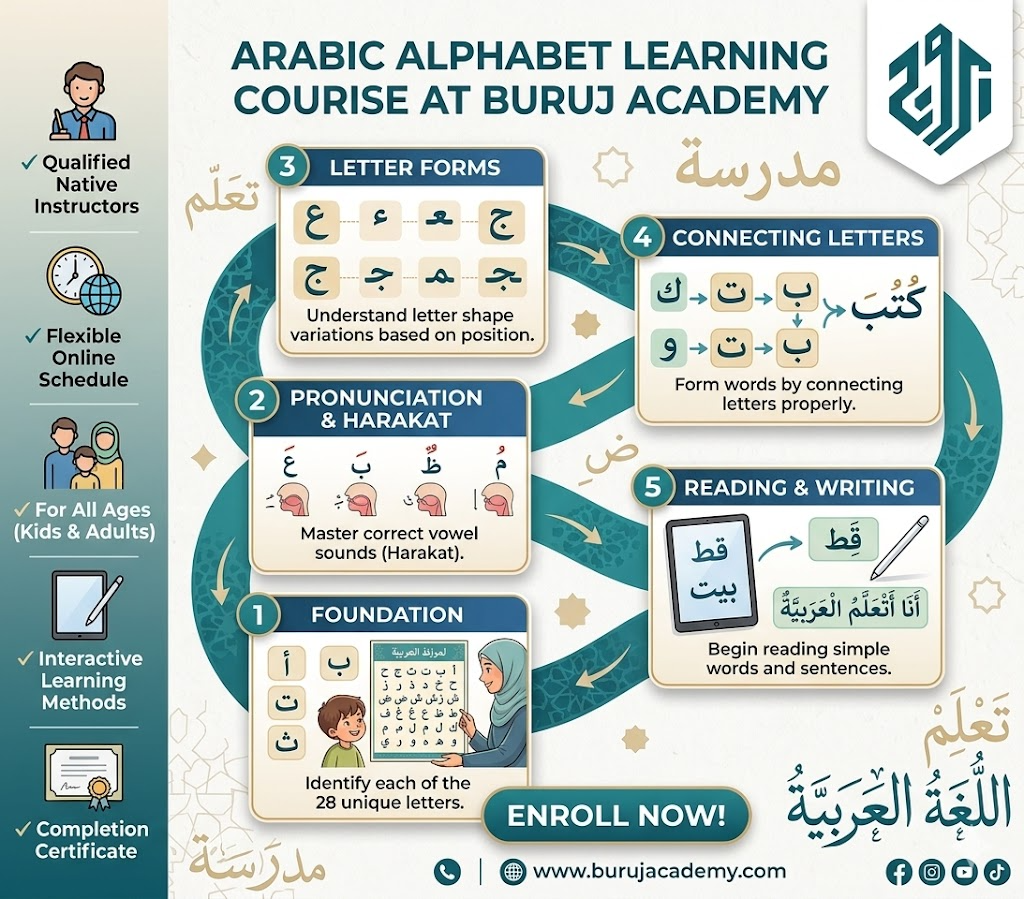
Buruj Academy’s Arabic Alphabet Learning Course uses shape-family grouping from lesson one, and the speed difference compared to alphabetical learning is significant. Students typically recognize all 28 letters 40–50% faster when grouped by form.
Get a free trial now in Buruj’s Alphabet course
3. Master the Sounds Before the Written Forms
A critical mistake in alphabet learning is treating Arabic letters as silent visual symbols to recognize and write — without connecting them to their actual sounds. Arabic pronunciation has articulation points (makharij al-huruf — مَخَارِج الْحُرُوف) that English simply does not have, and these must be trained early.
In our experience teaching beginners at Buruj Academy, students who learn to hear and produce sounds correctly in weeks one and two consistently outperform students who focus only on writing recognition in weeks three and four. Sound comes first. Shape follows.
The Letters That Require Extra Sound Training for English Speakers
These specific letters have no English equivalent and require active pronunciation training:
| Letter | Name | Sound Description |
| ع | Ayn | Deep constriction from mid-throat — no English equivalent |
| غ | Ghayn | Similar to French “r” — gargling quality from upper throat |
| ح | Ha | Forceful breath from mid-throat — deeper than English “h” |
| خ | Kha | Velar fricative — similar to Scottish “loch” |
| ق | Qaf | Deep uvular stop — “k” produced at the back of the throat |
| ص | Sad | Emphatic “s” — tongue pressed wider, voice darkened |
| ض | Dad | Heavy “d” — unique to Arabic among world languages |
| ظ | Dha | Emphatic “th” — tongue tip touches upper teeth with force |
For accurate pronunciation guidance, our Arabic pronunciation resources provide audio-supported breakdowns of each difficult sound.
Buruj Academy’s Arabic for Beginners course pairs every letter introduction with live instructor pronunciation modeling and real-time correction — because written descriptions of mouth position only go so far.
Begin learning Arabic at Buruj with a FREE trial lesson

4. Learn the Vowel System Alongside the Letters
Arabic short vowels — the harakat — are inseparable from reading, yet many alphabet courses delay them unnecessarily. We teach harakat from week one because a consonant without its vowel cannot be pronounced, and pronunciation is how memory sticks.
The Three Short Vowels Every Beginner Must Know
| Vowel Mark | Name | Sound | Example |
| ـَ | Fathah | Short “a” as in “cat” | بَ = “ba” |
| ـِ | Kasrah | Short “i” as in “bit” | بِ = “bi” |
| ـُ | Dammah | Short “u” as in “put” | بُ = “bu” |
Sukoon (ـْ) is a fourth marker indicating the letter carries no vowel — it is a “resting” consonant.
Shaddah (ـّ) doubles the letter, indicating a stressed or geminated consonant.
Understanding harakat immediately makes Quranic text readable because the Quran is fully vowelled. For students learning Arabic for Quran reading specifically, this step is not optional — it is the gateway to everything.
Read also: How to Learn Arabic?
Discover the Buruj Academy Difference
Step into our virtual classrooms and see how our expert instructors make learning Quran and Arabic intuitive and clear. We focus on overcoming the specific hurdles non-native speakers face, building your confidence and connection with the Quran.
5. Apply a Different Learning Sequence Based on Your Specific Purpose
Knowing why you are learning the Arabic alphabet determines which skills to develop first and which to build later. This is the step most general alphabet guides skip entirely.
A. If Your Purpose Is Quran Reading
Focus sequence: Sound accuracy → Letter recognition with harakat → Connecting letters into syllables → Quran-specific rules (Tajweed basics)
You need the full harakat system from the beginning. Prioritize correct articulation over writing speed.
Buruj Academy’s Arabic Reading Course follows exactly this sequence — letters with sounds, then syllables, then short words — before introducing any Tajweed terminology.
B. If Your Purpose Is Modern Standard Arabic (Speaking/Comprehension)
Focus sequence: Letter recognition → Basic vocabulary building → Sound patterns → Grammar exposure
For MSA learners, writing mastery is less urgent initially than building a recognition vocabulary. Our beginner’s guide to Modern Standard Arabic explains how alphabet learning feeds into grammar and sentence construction. Once reading fluency develops, our Arabic sentence structure guide provides the next structured step.
Master the Arabic Language
Join our expert-led courses and build a strong foundation in Classical and Modern Arabic.
Get Your Free TrialC. If Your Purpose Is Arabic Writing
Focus sequence: Letter isolated forms → Positional forms → Connecting rules → Handwriting practice with harakat
Writing Arabic requires understanding pen stroke direction and letter proportion. Arabic is written from right to left, and within each letter, specific stroke sequences apply.
Dictation practice — writing words read aloud — is one of the most effective consolidation tools. Our Arabic writing with dictation guide provides a structured method for this.
D. If You Are Learning with Children
Children benefit from visual association — pairing each letter with a picture of an Arabic word beginning with that sound. The letter ب (Ba) with a picture of a بَيْت (bayt — house), for example, creates dual memory anchoring.
Our Arabic for kids guide and Arabic sentences for kids resource extend this approach into first vocabulary building.
Buruj Academy’s Online Arabic Classes for Kids use structured visual association from lesson one, combined with short sessions of 20–25 minutes designed for children’s attention spans.
Book a FREE Arabic trial for your Child

6. Build Syllable Reading Before Attempting Full Words
After learning isolated letters and their sounds, the critical next step is syllable chaining — combining consonants with vowels into readable units before attempting complete words.
This step is skipped in many self-study approaches, creating a painful gap between “knowing” letters and actually reading.
The syllable structure in Arabic follows predictable patterns:
- V pattern (consonant): بَ، كِ، مُ — the most common beginner pattern
- VC pattern (consonant + vowel): كِتْ، بَيْ — introduces sukoon
- VCV pattern (consonant + vowel + vowel-less consonant): بَيْت — introduces sukoon
Practice every letter with all three harakat systematically: بَ / بِ / بُ — then move to the next letter. After completing all 28 letters with short vowels, introduce CVC syllables. This is the exact progression used in Noorani Qaida, which remains one of the most effective foundational reading tools for non-Arabic speakers.
7. Use Spaced Repetition to Lock Letters Into Long-Term Memory
Recognition of all 28 letters in isolation does not equal reading fluency. The brain needs repeated exposures at increasing intervals to transfer letter recognition from short-term to long-term memory. This is the science of spaced repetition, and it applies directly to alphabet learning.
A practical daily schedule for the first four weeks:
| Week | Daily Focus | Session Length |
| Week 1 | 6–7 letters per day, sound + isolated form | 15–20 minutes |
| Week 2 | Revise Week 1 letters + 6–7 new + positional forms | 20 minutes |
| Week 3 | All 28 letters + harakat + syllable chaining | 20–25 minutes |
| Week 4 | Short words + connected writing + self-testing | 25 minutes |
Consistent 15–20 minute sessions outperform occasional 60-minute sessions significantly.
Most adult learners who maintain this schedule recognize all 28 letters accurately by the end of week two. By week four, basic syllable reading is typically functional.
For grammar-focused learners who want to understand how letters build into words and sentences, our Arabic grammar guide for beginners provides the direct next step after alphabet fluency.
Read also: How Hard Is It to Learn Arabic?
8. Move from Letters to Words Using High-Frequency Quranic and Daily Vocabulary
The transition from letters to words is where motivation either accelerates or collapses. Students who practice only with artificial drill words lose momentum quickly.
Students who connect letters to meaningful words — especially words they already know from Salah — sustain momentum far longer.
High-Impact Starter Words That Use Letters Across Multiple Families
These words appear frequently in Salah and Quran, making them immediately meaningful:
| Arabic Word | Transliteration | Meaning | Letters Practiced |
| بِسْمِ | Bismi | In the name of | ب / س / م |
| اللَّهِ | Allah | God | ا / ل / ه |
| الرَّحْمَنِ | Al-Rahman | The Most Gracious | ر / ح / م / ن |
| كِتَاب | Kitab | Book | ك / ت / ا / ب |
| نُور | Nur | Light | ن / و / ر |
| قَلْب | Qalb | Heart | ق / ل / ب |
Reading بِسْمِ اللَّهِ الرَّحْمَنِ الرَّحِيمِ — the Basmala — in its vowelled Quranic form becomes a meaningful milestone that uses letters from eight different shape families. We encourage every student to set this as their first complete reading goal.
Master Arabic Alphabet with Buruj Academy’s Expert Instructors
Learning the Arabic alphabet correctly from the beginning makes everything that follows — Quran reading, grammar, speaking, and writing — significantly easier.
Buruj Academy offers a dedicated Arabic Alphabet Learning Course and Arabic for Beginners program taught by Al-Azhar University graduates with 12+ years of experience teaching non-native speakers.
Our Buruj Method builds sound accuracy before script recognition, ensuring students develop correct pronunciation habits from lesson one.
All sessions are personalized 1-on-1, scheduled 24/7 to fit your timezone, with real-time instructor correction. Book your free trial lesson today and begin with expert guidance from your very first letter.
Begin your transformation today by choosing the path that fits your goals:
- Online Arabic Classes (General & Comprehensive)
- Arabic Course for Beginners
- Arabic Alphabet Learning Course
- Online Arabic Classes for Kids
- Arabic Classes for Adults
- Arabic Grammar Course (Nahw & Sarf)
- Intermediate Arabic Course (B1/B2)
- Arabic Speaking Course (Conversational Fluency)
- Arabic Reading Course (Literary Excellence)
- Learn Arabic Writing Course (Calligraphy & Composition)
Ready to speak with confidence? Join the global community at Buruj Academy and book your free placement interview today!
Master the Arabic Language
Join our expert-led courses and build a strong foundation in Classical and Modern Arabic.
Get Your Free TrialConclusion
The Arabic alphabet is a precise, logical system — and learning it correctly from the start shapes everything that follows. By organizing letters into shape families, building sounds before shapes, and tailoring the sequence to your specific purpose — Quran reading, speaking, or writing — you give yourself a genuinely strong foundation rather than a fragile one built on rushed memorization.
Consistent daily practice, meaningful vocabulary from day one, and expert correction at key stages make the difference between recognizing letters and actually reading Arabic. The path is clear. The progress is real.
Frequently Asked Questions About How to Learn the Arabic Alphabet
How Long Does It Take to Learn the Arabic Alphabet?
Most adult beginners can recognize all 28 Arabic letters in their isolated forms within two to three weeks of 15–20 minutes of daily structured practice. Moving from letter recognition to basic connected reading typically takes an additional two to four weeks. Children may take slightly longer depending on age and session frequency, though visual learning methods often accelerate recognition significantly for younger learners.
Is the Arabic Alphabet Hard to Learn for English Speakers?
The Arabic alphabet is unfamiliar but not complex. Its 28 letters follow consistent sound-to-symbol rules, and the shape-family system means you are really learning 17–18 base shapes, not 28 entirely separate symbols. The genuine challenge is pronunciation — specific articulation points like ع (Ayn) and ح (Ha) require ear training alongside visual recognition. With a qualified instructor providing live correction, most English speakers overcome this within the first month.
Can I Learn the Arabic Alphabet Without a Teacher?
You can learn letter recognition independently using quality resources, but pronunciation accuracy almost always suffers without live correction. Arabic has sounds — particularly ع, غ, ح, خ, ق, and the emphatic consonants — that English speakers consistently mispronounce when self-studying. These errors become habitual quickly and are harder to correct later. A qualified teacher in the first four to six weeks is a significant advantage that protects the entire learning foundation.
What Is the Best Method for Teaching Children the Arabic Alphabet?
Children learn Arabic letters most effectively through visual association, short daily sessions of 15–25 minutes, and connecting each letter to a familiar Arabic word with a picture. Repetition through songs, tracing activities, and positive reinforcement builds recognition without overwhelming young learners. Sessions should introduce three to four letters maximum per lesson, with consistent daily review of previously learned letters before new ones are introduced.
Should I Learn Arabic Letters or Noorani Qaida First?
Noorani Qaida is itself an alphabet and foundational reading course — it teaches Arabic letters as its first stage. If your goal is Quran reading specifically, starting with Noorani Qaida gives you letters, sounds, harakat, and syllable reading in a single structured progression. If your goal is Modern Standard Arabic for speaking or grammar study, a dedicated alphabet course that immediately connects letters to MSA vocabulary is the more direct path.