 Quran
Quran
| Key Takeaways |
| Just 100 high-frequency Arabic words cover a large part of all word occurrences throughout the entire Quran. |
| Words like اللَّه (Allah), رَبّ (Rabb/Lord), and إِنَّ (Inna/Indeed) appear thousands of times across Quranic text. |
| Learning the most common Quranic words dramatically accelerates both comprehension and Hifz retention for non-Arabic speakers. |
| Pairing high-frequency word study with structured Quranic Arabic instruction produces the fastest path to Quran understanding. |
Millions of Muslims recite the Quran daily without understanding a single word they are reading. This gap between recitation and comprehension is one of the most common frustrations we hear from students when they first contact Buruj Academy — and it is entirely solvable.
The solution starts with a single, research-backed insight: a small core of high-frequency Arabic words accounts for the vast majority of everything the Quran says. Master these words, and the Quran begins speaking to you — not just through your lips.
Table of Contents:
What Are the Most Common Quranic Words?
The most common Quranic words are a set of high-frequency Arabic terms — particles, nouns, and verbs — that appear repeatedly across all 114 Surahs of the Quran. According to frequency analysis based on the Quranic corpus, the top 100 most frequent words account for a large part of total word occurrences in the entire Quran.
The Quran contains approximately 77,430 words in total, but the unique root-based vocabulary is far smaller.
Because Arabic is a root-based language, a single three-letter root generates dozens of related words.
High-frequency items cluster around foundational theological concepts: the names of Allah, descriptions of His attributes, human accountability, and divine guidance.
Why Does Frequency-Based Learning Matter for Non-Arabic Speakers?
Most non-Arabic speaking students approach Quranic Arabic by studying grammar rules first.
We see this pattern consistently in new students joining our Quranic Arabic Classes — they know what a فاعل (subject) is in theory, but they cannot recognize اللَّه as the subject of a sentence while reciting.
Frequency-based vocabulary reverses this. When you know the 100 most common words, you stop encountering blank spaces during recitation. Meaning starts attaching itself naturally to sound — which is precisely the foundation the Buruj Method builds on.
Begin Understanding Quranic Arabic with a FREE Lesson
A List of The Most Common Quranic Words
The following table presents the most commonly occurring words in the Quran, verified data from the Quranic Arabic Corpus .
Tier 1 for The Highest Frequency Quranic Lemmas
| Arabic Word | Transliteration | Primary Quranic Meaning | Part of Speech |
| مِن | min | From, Of | Preposition |
| ٱللَّه | Allāh | Allah (God) | Proper Noun |
| فِى | fī | In, Within | Preposition |
| إِنَّ | inna | Indeed, Verily | Accusative Particle |
| عَلَىٰ | ʿalā | On, Upon | Preposition |
| ٱلَّذِى | alladhī | Who, That which (relative) | Relative Pronoun |
| لَا | lā | No, Not | Negative Particle |
| مَا | mā | What, That which | Relative Pronoun |
| رَبّ | rabb | Lord, Sustainer | Noun |
| إِلَىٰ | ilā | To, Towards | Preposition |
| مَا | mā | Not (negation) | Negative Particle |
| مَن | man | Who, Whoever | Relative Pronoun |
| إِن | in | If | Conditional Particle |
| أَن | an | That (subordinating) | Subordinating Conjunction |
| إِلَّا | illā | Except, Unless | Restriction Particle |
| ذَٰلِك | dhālika | That (demonstrative) | Demonstrative Pronoun |
| عَن | ʿan | About, From, Away from | Preposition |
| أَرْض | arḍ | Earth, Land | Noun |
| قَد | qad | Indeed / Already | Particle of Certainty |
| إِذَا | idhā | When, If | Time Adverb |
| قَوْم | qawm | People, Nation | Noun |
| ءَايَة | āya | Sign, Verse | Noun |
| أَنَّ | anna | That (conjunction) | Accusative Particle |
| كُلّ | kull | Every, All | Noun |
| لَم | lam | Did not (past negation) | Negative Particle |
Tier 2 for Core Structural and Theological Vocabulary
| Arabic Word | Transliteration | Primary Quranic Meaning | Part of Speech |
| ثُمَّ | thumma | Then, Thereafter | Coordinating Conjunction |
| رَسُول | rasūl | Messenger | Noun |
| يَوْم | yawm | Day | Noun |
| عَذَاب | ʿadhāb | Punishment, Torment | Noun |
| هَٰذَا | hādhā | This | Demonstrative Pronoun |
| سَمَاء | samāʾ | Sky, Heaven | Noun |
| نَفْس | nafs | Soul, Self | Noun |
| شَىْء | shayʾ | Thing | Noun |
| أَوْ | aw | Or | Coordinating Conjunction |
| كِتَاب | kitāb | Book, Scripture | Noun |
| بَيْن | bayna | Between, Among | Location Adverb |
| حَقّ | ḥaqq | Truth, Right | Noun |
| نَاس | nās | People, Mankind | Noun |
| إِذ | idh | When (past reference) | Time Adverb |
| أُولَٰٓئِك | ulāʾika | Those (demonstrative) | Demonstrative Pronoun |
| قَبْل | qabl | Before | Noun/Adverb |
| مُؤْمِن | muʾmin | Believer | Noun |
| لَوْ | law | If (hypothetical) | Conditional Particle |
| سَبِيل | sabīl | Path, Way | Noun |
| أَمْر | amr | Command, Matter | Noun |
| عِند | ʿinda | At, Near, With | Location Adverb |
| مَع | maʿa | With, Together | Location Adverb |
| بَعْض | baʿḍ | Some, Part of | Noun |
| لَمَّا | lammā | When, As soon as | Time Adverb |
| أَيُّهَا | ayyuhā | O (vocative address) | Noun |
Buruj Academy’s Quran Classes for Beginners integrate high-frequency vocabulary from the very first lesson, building recognition before introducing formal grammar.
Our Al-Azhar-trained instructors teach words inside their Quranic sentence context — never as isolated items — ensuring that what students learn transfers immediately into real recitation.
Begin Learning Quran With a FREE Trial Lesson
Tier 3 for Essential Quranic Nouns and Particles
| Arabic Word | Transliteration | Primary Quranic Meaning | Part of Speech |
| خَيْر | khayr | Good, Better, Best | Noun |
| إِلَٰه | ilāh | God, Deity | Noun |
| نَار | nār | Fire, Hell | Noun |
| غَيْر | ghayr | Other than, Except | Noun |
| أَم | am | Or (disjunctive) | Coordinating Conjunction |
| مُوسَىٰ | Mūsā | Moses | Proper Noun |
| دُون | dūn | Besides, Other than | Noun |
| آخِر | ākhir | Last, Other, Hereafter | Noun |
| بَعْد | baʿda | After | Noun/Adverb |
| قَلْب | qalb | Heart | Noun |
| عَبْد | ʿabd | Servant, Slave | Noun |
| أَهْل | ahl | People of, Family | Noun |
| لَعَلَّ | laʿalla | Perhaps, So that | Accusative Particle |
| بَل | bal | Rather, On the contrary | Retraction Particle |
| يَد | yad | Hand | Noun |
| كَافِر | kāfirūn | Disbelievers | Noun |
| رَحْمَة | raḥma | Mercy | Noun |
| رَحِيم | raḥīm | Most Merciful | Adjective |
| أَجْر | ajr | Reward | Noun |
| ظَالِم | ẓālim | Wrongdoer, Oppressor | Noun |
| عِلْم | ʿilm | Knowledge | Noun |
| عَظِيم | ʿaẓīm | Great, Supreme | Adjective |
| لَن | lan | Will not (future negation) | Negative Particle |
| عَلِيم | ʿalīm | All-Knowing | Adjective |
| جَنَّة | janna | Paradise, Garden | Noun |
Read also: How Many Arabic Versions of the Quran Are There?
Tier 4 for High-Value Quranic Vocabulary
| Arabic Word | Transliteration | Primary Quranic Meaning | Part of Speech |
| حَتَّىٰ | ḥattā | Until, So that | Preposition |
| هَل | hal | (Question particle) | Interrogative Particle |
| دِين | dīn | Religion, Way of life, Judgment | Noun |
| قَوْل | qawl | Speech, Word, Saying | Noun |
| ذُو | dhū | Possessor of, One with | Noun |
| مَلَك | malak | Angel | Noun |
| مَثَل | mathal | Example, Parable | Noun |
| مَال | māl | Wealth, Property | Noun |
| وَلِىّ | walī | Guardian, Protector, Friend | Noun |
| هُدًى | hudā | Guidance | Noun |
| حَكِيم | ḥakīm | All-Wise | Adjective |
| فَضْل | faḍl | Grace, Bounty, Favor | Noun |
| صَلَوٰة | ṣalāh | Prayer | Noun |
| لَيْل | layl | Night | Noun |
| شَيْطَان | shayṭān | Satan, Devil | Proper Noun |
| كَيْف | kayfa | How | Interrogative Particle |
| أَصْحَاب | aṣḥāb | Companions, People of | Noun |
| إِن | in (neg.) | Not (negative emphasis) | Negative Particle |
| أَيُّهَا | ayyuhā | O you (vocative) | Noun |
| لَا | lā (prohib.) | Do not (prohibition) | Prohibition Particle |
| مَا | mā (interrog.) | What? (question) | Interrogative Particle |
| مَن | man (cond.) | Whoever (conditional) | Conditional Particle |
| يَوْم | yawm (adv.) | On the Day (time ref.) | Time Adverb |
| مَا | mā (sub.) | As long as, Whatever | Subordinating Conjunction |
| بَنَى | banyy | Sons of (term of address) | Noun |
100 Most Frequent Quranic Arabic Words PDF
The full 100 Most Frequent Quranic Arabic Words flashcard resource is publicly available at the PDF archive.
Excel in Your Quranic Studies
Join Buruj Academy and master the Quran with our structured, professional curriculum.
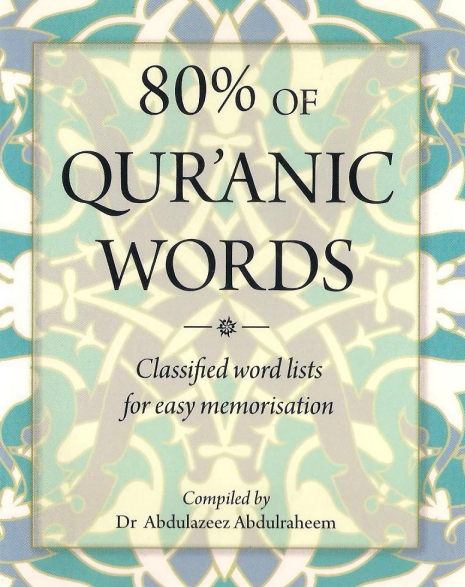
Book Your Free Trial80% of Quranic Words
The 80% claim is grounded in Zipf’s Law — a well-documented linguistic principle stating that a small percentage of words in any language account for the overwhelming majority of actual usage.
In Quranic Arabic, this effect is amplified because the Quran’s vocabulary deliberately repeats foundational theological concepts.
80 Percent Quranic Vocabulary PDF
The 80 Percent Quranic Vocabulary PDF demonstrates this with corpus-based frequency data: prepositions like مِن, فِي, and عَلَى alone appear collectively over 10,000 times.
Divine attributes like رَحِيم and عَلِيم recur across hundreds of verses.
When these high-frequency clusters are learned together, students begin recognizing complete phrases — not isolated words.
Which Category of Quranic Words Should You Learn First?
The most effective sequence for non-Arabic speaking Muslims is to begin with particles and prepositions, then move to divine attributes, then high-frequency nouns, and finally common verbs.
This ordering reflects how meaning is built in Arabic sentences — the grammatical connectors give you structure, the attributes give you theological comprehension, and the nouns and verbs fill in the content.
| Learning Priority | Word Category | Examples | Why First |
| 1st | Particles & Prepositions | مِن، فِي، عَلَى، إِنَّ، لَا | Appear in almost every verse; provide sentence structure |
| 2nd | Divine Attributes | رَحِيم، عَلِيم، حَكِيم، رَحْمَن | Anchor theological meaning throughout Quran |
| 3rd | Core Theological Nouns | رَبّ، يَوْم، نَفْس، حَقّ | Build conceptual vocabulary for Quranic themes |
| 4th | High-Frequency Verbs | قَالَ، كَانَ، آمَنَ، خَلَقَ | Enable understanding of Quranic narratives and commands |
In our sessions at Buruj Academy, students who follow this sequence consistently begin recognizing meaning in Surah Al-Fatiha within their first two lessons — often emotional moments for adults who have recited that Surah thousands of times without understanding it.
Read also: Top 9 Proven Quranic Miracles
Discover the Buruj Academy Difference
Step into our virtual classrooms and see how our expert instructors make learning Quran and Arabic intuitive and clear. We focus on overcoming the specific hurdles non-native speakers face, building your confidence and connection with the Quran.
How Does Learning Common Quranic Words Accelerate Hifz?
Vocabulary knowledge and memorization are deeply interconnected. When a student knows what they are memorizing, the words attach to meaning rather than floating as pure sound-patterns.
Neurolinguistic research consistently shows that meaningful content is retained far longer than phonetic strings — and we observe this difference clearly in our Online Hifz Classes for Adults.
Book Your Free Trial Lesson with Burruj’s Hifz Course for Adults

Students who arrive with even basic Quranic vocabulary knowledge progress through Hifz at a measurably faster pace.
They make fewer substitution errors — the most common Hifz mistake where a student replaces one word with a synonym — because they know what the word means and therefore notice when something sounds wrong.
If you want to understand the strategies our instructors use for retention, our guide on how to memorize Quran faster offers practical frameworks you can apply immediately.
How Do Common Quranic Words Connect to Tajweed Recitation?
Understanding vocabulary and mastering Tajweed are not separate pursuits — they reinforce each other. When a student knows that إِنَّ (Inna) is one of the most frequent words in the Quran, they pay closer attention to how the Shaddah on the Noon affects its pronunciation under Tajweed rules. Meaning motivates precision.
Several of the top 100 Quranic words are themselves key examples in Tajweed instruction. The word مِن (Min) is a classic Noon Sakinah case.
The word اللَّه (Allah) demonstrates the Tafkhim and Tarqiq rule for the Lam of the Majestic Name. Words like فِي (Fī) illustrate Madd Asli in context.
If you are building your Tajweed foundation alongside vocabulary study, our guide on Tajweed for beginners walks through the essential rules step by step. For students ready to go deeper into recitation quality, our Online Tajweed Classes provide structured, live instruction with Ijazah-certified teachers who correct pronunciation in real time.
Book Your FREE Trial Lesson to Begin Your Tajweed Journey

Start Understanding the Quran with Buruj Academy’s Quranic Arabic Course
Knowing the most common Quranic words is the single most efficient step toward Quran comprehension — and Buruj Academy’s expert team is ready to guide you through every stage of that process.
Our Quranic Arabic Classes are designed specifically for non-Arabic speaking Muslims who want to understand what they recite. Here is what makes our program distinctively effective:
- Al-Azhar University graduates with 12+ years teaching non-native speakers
- The Buruj Method: Context-before-abstraction — meaning first, grammar second
- Personalized 1-on-1 sessions adapted to your pace and schedule
- Flexible 24/7 scheduling for working professionals and busy parents
- Real-time correction and vocabulary mapping directly from Quranic text
- Proven progression from zero vocabulary to active comprehension
Book your free trial lesson today and begin understanding the Quran the way it was meant to be understood.
TBegin your journey of understanding by enrolling in a specialized track today:
- Quranic Arabic Classes (General & Immersive)
- Quranic Arabic Course for Kids (Interactive & Engaging)
- Quranic Arabic Course for Beginners (Foundation Building)
- Quranic Arabic Grammar Course (Syntax & Morphology)
Are you ready to understand what you recite? Join Buruj Academy today and book your free introductory session to begin your journey of discovery!
Excel in Your Quranic Studies
Join Buruj Academy and master the Quran with our structured, professional curriculum.
Book Your Free TrialConclusion
The gap between reciting the Quran and understanding it closes faster than most students expect — when the learning starts in the right place. The 100 most common Quranic words are that starting point: a small, learnable set of vocabulary that unlocks meaning across Quranic texts.
These words appear in every Salah, every Surah, and every page of the Quran. Learning them is not supplementary to Quran study — it is Quran study at its most foundational.
Whether your goal is deeper Salah connection, stronger Hifz retention, or full Quranic comprehension, this vocabulary is the common thread running through all of it. Begin with the top 20 words this week. Insha’Allah, the Quran will never sound the same again.
Frequently Asked Questions About the Most Common Quranic Words
How Many Unique Words Does the Quran Contain in Total?
The Quran contains approximately 77,430 total word occurrences, but when counted by unique root-based vocabulary, scholars estimate between 1,600 and 2,000 distinct roots. The high repetition of a small core vocabulary is precisely why frequency-based learning is so effective for Quranic comprehension among non-Arabic speakers.
Can I Learn Quranic Arabic Without Learning Classical Arabic Grammar First?
Yes — and for most non-Arabic speakers, starting with high-frequency vocabulary before formal grammar produces faster results. Understanding the 100 most common Quranic words gives you immediate recognition during recitation. Grammar study then provides the framework to understand why these words function as they do within sentences.
How Long Does It Take to Learn the 100 Most Common Quranic Words?
In our instructors’ experience, a motivated adult student spending 15 minutes daily on structured vocabulary practice can recognize all 100 words within 4–6 weeks. Students who combine flashcard practice with identifying words during daily Salah tend to reach confident recognition closer to the 4-week mark.
Do I Need to Know Arabic Script to Start Learning Quranic Vocabulary?
Learning Arabic script alongside vocabulary is strongly recommended — transliteration alone creates a dependency that slows long-term progress. Most students at Buruj Academy can recognize the Arabic script for the top 20 Quranic words within two to three structured sessions, because the words appear so frequently that repetition itself builds visual recognition quickly.