 Quran
Quran
| Key Takeaways |
| Quranic Arabic and Modern Standard Arabic share the same grammatical foundation but differ significantly in vocabulary, syntax, and function. |
| Quranic Arabic uses dense, classical vocabulary with layered meanings; MSA uses simplified, standardized terminology for everyday communication. |
| Full i’rab (case-ending pronunciation) is obligatory in Quranic recitation but is regularly dropped in spoken MSA contexts. |
| Quranic Arabic is inseparable from Tajweed rules governing sound production; MSA has no equivalent phonological requirement system. |
| Understanding both forms helps learners approach Quran comprehension and Arabic communication as related but distinct skill sets. |
Many students come to us asking one version of the same question: “If I learn Modern Arabic, will I understand the Quran?” The honest answer requires more than a yes or no.
Quranic Arabic and Modern Standard Arabic (MSA) are both branches of Classical Arabic — neither is a dialect, and neither is incorrect.
But they represent two distinct registers, separated by centuries of linguistic evolution, different purposes, and deeply different demands on the reader and listener.
Table of Contents:
1. Quranic Arabic and MSA Share the Same Grammatical Skeleton but Operate Differently in Practice
Quranic Arabic and Modern Standard Arabic are built on the same core grammar — the same verb conjugations, the same noun case system, the same root-based morphology.
What separates them is not the structure of the language but how that structure is used, which vocabulary fills it, and what each register demands from its reader.
This distinction matters enormously for learners. Many students study MSA for years and then open the Quran expecting fluency, only to find the vocabulary unfamiliar and the syntax dense in ways their textbook never prepared them for.
The grammar is recognizable; the experience is not. At Buruj Academy, our Quranic Arabic Classes are built specifically around this gap — training students in the classical register that the Quran actually uses, not just modern grammatical Arabic.
Begin Understanding Quranic Arabic with a FREE Lesson
2. The Vocabulary Gap Is the Most Immediate Difference Learners Notice
Quranic Arabic draws from a classical lexicon that is precise, dense, and deeply rooted in pre-Islamic and early Islamic Arabian culture. Words like ‘as’as (عَسْعَسَ — to approach or recede, referring to the night) or qaswarah (قَسْوَرَة — a lion or a powerful hunter) carry specific, layered meanings that no modern Arabic news broadcast would use.
MSA, by contrast, has actively trimmed this vocabulary. Arabic language academies — particularly in Cairo, Damascus, and Amman — have standardized the lexicon to eliminate words deemed too archaic for modern functional use.
In their place, thousands of new terms have entered through three main processes:
| Process | Method | Example |
| Arabization (Ta’rib) | Foreign words adapted phonologically | تِلفاز (tilfaz — television) |
| Derivation (Ishtiqaq) | New words from Arabic roots | طائرة (ta’irah — aircraft, from the root meaning “to fly”) |
| Semantic Shift | Old words given new meanings | سياسة (siyasah — originally “training horses,” now “politics”) |
The Quran contains none of these modern coinages. Every word in it belongs to the pre-modern Arabic lexicon, which is why a student who learns MSA can read an Arabic newspaper comfortably but may still struggle to understand the Quran without dedicated classical vocabulary study.
3. Quranic Arabic Uses Word Order for Theological Precision; MSA Prefers Directness
One of the most striking differences between the two registers is how they order words within a sentence. Quranic Arabic frequently departs from the default verb-subject-object pattern to achieve specific rhetorical and theological effects.
Consider the verse:
إِيَّاكَ نَعْبُدُ وَإِيَّاكَ نَسْتَعِينُ
Iyyaka na’budu wa iyyaka nasta’in
“It is You we worship and You we ask for help.” (Al-Fatiha 1:5)
The direct object “You” is fronted before the verb, producing grammatical exclusivity — we worship You alone, no other.
In standard MSA, the same idea would appear as نعبدك ونستعين بك — subject before object, straightforward, functional.
The exclusivity meaning is lost without the inversion. This syntactic technique — called taqdim wa ta’khir (fronting and deferral) — is a cornerstone of Quranic rhetorical structure and has no equivalent in modern journalistic Arabic.
MSA has also absorbed sentence patterns from European languages through translation.
The passive voice, compound noun phrases, and prepositional constructions that dominate modern Arabic media are heavily influenced by English and French syntactic models.
These structures are grammatically valid in Arabic but are stylistically foreign to the Quranic text.
4. Full I’rab Is Obligatory in Quranic Recitation but Regularly Dropped in MSA Speech
I’rab — the system of case-ending vowels that marks whether a noun is a subject (dammah), object (fathah), or possessive/prepositional (kasrah) — is one of Arabic’s most distinctive grammatical features.
In Quranic Arabic, producing these endings correctly is not optional. A reciter who drops case endings is making a recitation error, and in some scholarly positions, changing the i’rab of a word can alter meaning.
In MSA, especially spoken MSA — broadcasts, lectures, formal speeches — speakers routinely apply waqf (pause) rules even mid-sentence, effectively neutralizing case endings on most words.
This is widely accepted and does not affect comprehension in modern contexts. The sentence’s meaning is carried by word order and context rather than inflection.
| Feature | Quranic Arabic | Modern Standard Arabic |
| I’rab (case endings) | Obligatory — affects meaning and recitation validity | Optional in speech; fully used only in formal written texts |
| Sentence order | Flexible, used for rhetorical meaning | Predominantly subject-verb-object |
| Vocabulary | Pre-modern classical lexicon | Modernized, standardized, international terms included |
| Passive voice | Used sparingly, with specific purpose | Frequent, influenced by translation |
Read also: Why Is the Quran in Arabic?
5. Tajweed Rules Govern Quranic Arabic Sound Production with No MSA Equivalent
Quranic Arabic is not simply a written register — it is an oral tradition governed by a complete science of sound production called Tajweed.
The rules of Tajweed determine exactly how every letter must be articulated: the precise point of articulation in the mouth or throat (makhraj), the phonological properties of each sound (sifat), and the phonological interactions between letters when they appear in sequence.
Rules like Ikhfa, Idgham, Iqlab, and Ghunnah have no function outside Quranic recitation. They exist specifically to preserve the exact phonological form of the Quran as transmitted through an unbroken chain (sanad) from the Prophet Muhammad ﷺ.
MSA has no equivalent system. A native Arabic speaker who has never studied Tajweed may speak perfect modern Arabic and still recite the Quran incorrectly by Tajweed standards — because the sounds required are more precise than everyday Arabic demands.
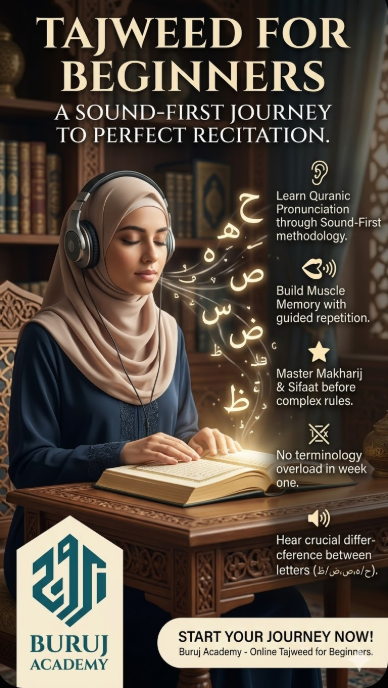
Our Tajweed for Beginners resource explains how this science is structured for students starting from zero.
For a deeper foundation in how Tajweed rules interact with Arabic sound production, the study of makharij al-huruf — the precise articulation points of Arabic letters — is where serious recitation training begins.
Students in our Tajweed for Beginners course frequently report the same experience: within weeks of learning correct articulation, their Salah feels qualitatively different. The Fatiha they have recited for years becomes something they feel — not merely recite.
Book Your FREE Trial Lesson to Begin Your Tajweed Journey
6. Semantic Density in Quranic Arabic Has No Modern Equivalent
A single Quranic word frequently carries multiple simultaneous layers of meaning — legal, spiritual, historical, and linguistic — all at once. This is not ambiguity; it is intentional semantic richness that classical Arabic scholars called wujuh (multiple valid dimensions of a word’s meaning).
The word taqwa (تَقْوَى) illustrates this clearly. In MSA and modern usage, it is typically translated as “piety” or “God-consciousness.”
In classical Quranic scholarship, it encompasses legal obligation, spiritual state, emotional awareness, behavioral restraint, and eschatological preparation simultaneously. No MSA equivalent carries all of those layers in one word.
This density is precisely why Tafsir — Quranic exegesis — exists as a dedicated science. Reading the Quran with grammatical Arabic competence does not automatically yield access to this semantic depth. It requires training in classical Arabic vocabulary and the interpretive tradition built around it.
Discover the Buruj Academy Difference
Step into our virtual classrooms and see how our expert instructors make learning Quran and Arabic intuitive and clear. We focus on overcoming the specific hurdles non-native speakers face, building your confidence and connection with the Quran.
7. The Writing System Is Identical but Reading Demands Are Different
Both Quranic Arabic and MSA use the same Arabic script. However, the Quran is written with full diacritical marks — harakat (short vowels: fathah, dammah, kasrah) and additional Tajweed symbols including sukoon, shadda, madd markers, and specialized stopping signs. These marks make the text fully vocalized.
Standard modern Arabic — in newspapers, books, and online content — is largely written without short vowels. Native readers fill in the correct vowels from context and familiarity.
For a learner, this means that competence in reading MSA texts does not automatically transfer to reading the Quran correctly.
The Quran is actually easier to decode at the word level because it is fully marked, but the sounds those marks demand — especially in Tajweed-compliant recitation — require specific phonological training.
Excel in Your Quranic Studies
Join Buruj Academy and master the Quran with our structured, professional curriculum.
Book Your Free TrialHere is the summary table section — ready to insert into the article body:
A Complete Chart of the Differences Between Quranic Arabic and Modern Standard Arabic
The following table consolidates every key difference covered in this article. Use it as a reference point when planning your Arabic or Quranic Arabic learning path.
| Area of Difference | Quranic Arabic | Modern Standard Arabic (MSA) | Example |
| Vocabulary | Classical, pre-modern lexicon; archaic and culturally rooted | Modernized, standardized; includes coined and borrowed terms | Quranic: قَسْوَرَة (qaswarah — lion/powerful hunter) vs. MSA: أَسَد (asad — lion) |
| Semantic Density | Single words carry simultaneous legal, spiritual, and historical meaning | Words carry one primary, functional meaning | Quranic تَقْوَى carries piety, legal obligation, spiritual state, and eschatological awareness simultaneously; MSA uses it to mean “piety” only |
| New Terminology | No coined or borrowed modern terms | Thousands of new terms via Arabization, derivation, and semantic shift | MSA: تِلفاز (tilfaz — television); طائرة (ta’irah — aircraft); سياسة (siyasah — politics, originally “training horses”) |
| Word Order (Syntax) | Flexible; inversion used for theological and rhetorical precision | Predominantly subject-verb-object; direct and functional | Quranic: إِيَّاكَ نَعْبُدُ (You alone we worship — object fronted for exclusivity) vs. MSA: نَعبُدُكَ (We worship You — standard order) |
| I’rab (Case Endings) | Obligatory in recitation; affects meaning and validity | Optional in speech; dropped routinely in broadcasts and lectures | Quranic recitation requires full dammah/fathah/kasrah endings; MSA speakers apply waqf (pause) endings mid-sentence without error |
| Phonology / Sound Rules | Governed by complete Tajweed science (makharij, sifat, Ghunnah, Madd, etc.) | No equivalent phonological rule system | Quranic: Noon sakinah before a ba’ requires Iqlab (conversion to meem with Ghunnah); MSA: no such rule applies |
| Writing & Vocalization | Fully vocalized with short vowels, Tajweed symbols, and stopping signs | Largely unvocalized; readers supply vowels from context | Quran: every word is marked with fathah, dammah, kasrah, sukoon, shadda, and madd markers; MSA newspaper text has none |
| Sentence Structure Influence | Purely classical Arabic rhetorical tradition | Influenced by English and French sentence patterns via translation | MSA passive constructions and compound noun phrases reflect European syntactic models absent from the Quranic text |
| Rhetorical Devices | Taqdim wa ta’khir, iltifat, ijaz, and other classical figures are structurally embedded | Rhetorical devices used occasionally but not structurally required | Quranic iltifat shifts from third to second person mid-passage for dramatic effect (e.g., Al-Fatiha moves from “He” to “You”) |
| Register & Purpose | Liturgical, legislative, literary — the preserved revelation | Journalistic, academic, diplomatic, educational | Quran: recited in Salah, studied in Tafsir; MSA: used in news broadcasts, official documents, school curricula |
| Tajweed Obligation | Recitation without Tajweed is considered a recitation deficiency | No recitation standard applies | A native Arabic speaker reciting the Quran without Tajweed training will still produce phonological errors by classical recitation standards |
| Root Overlap with Modern Arabic | High — Arabic’s root system is shared across both registers | High — same root system as Quranic Arabic | Root ك-ت-ب (k-t-b) produces كَتَبَ (kataba — he wrote) in both; Quranic usage adds rhetorical and legal dimensions MSA does not carry |
| Accessibility for Learners | Requires classical vocabulary study + Tajweed training + rhetorical awareness | Requires grammar + modern vocabulary; no Tajweed needed | An MSA learner can read an Arabic newspaper after intermediate study; Quranic comprehension requires an additional dedicated classical Arabic layer |
This table shows that the two registers share a grammatical skeleton but diverge in nearly every dimension of practical use. MSA knowledge accelerates the path toward Quranic Arabic — it does not replace it.
For students ready to bridge that gap directly, Buruj Academy’s Quranic Arabic for Beginners provide a structured, classical-first approach taught by Al-Azhar University graduates who specialize in exactly this transition.
Begin Understanding Quranic Arabic with a FREE Lesson
Read also: Which Arabic Dialect Should I Learn to Understand the Quran?
Deepen Your Quran Understanding with Buruj Academy’s Quranic Arabic Course
The difference between Quranic Arabic and MSA is not an obstacle — it is a map. Knowing where the two registers diverge tells you exactly what skills to build and in what order.
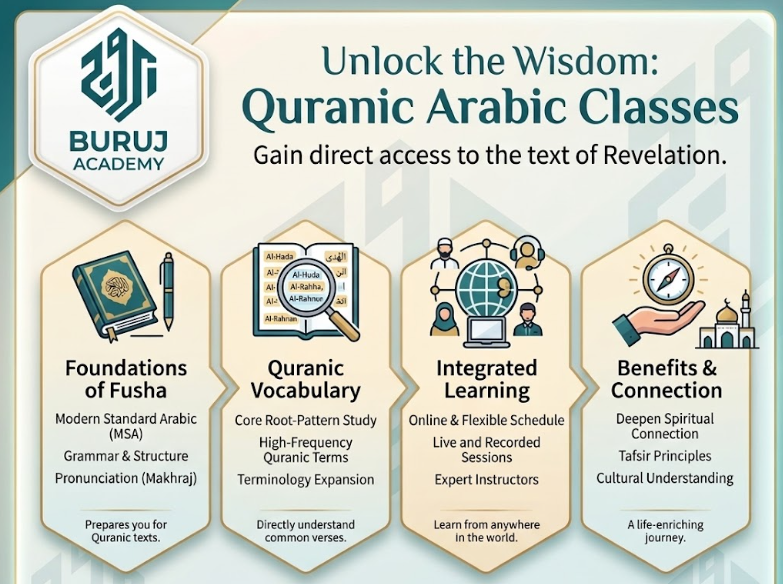
Buruj Academy’s Quranic Arabic Classes are taught by Al-Azhar University graduates specializing in classical Arabic linguistics, with 12+ years of experience teaching non-native speakers. We offer:
- Personalized 1-on-1 online sessions with flexible scheduling
- The Buruj Method: context before abstraction, meaning before memorization
- Dedicated tracks for the Quranic Arabic Grammar Course and for younger learners through the Quranic Arabic Course for Kids
- A free trial lesson to begin with no commitment
Excel in Your Quranic Studies
Join Buruj Academy and master the Quran with our structured, professional curriculum.
Book Your Free TrialConclusion
Quranic Arabic and Modern Standard Arabic are not two separate languages — they are two registers of the same language, separated by time, purpose, and the demands they place on their speakers. MSA evolved to serve communication; Quranic Arabic was preserved to carry revelation. Both deserve respect, and both reward serious study.
For any Muslim who wants to understand the Quran on its own terms — not through translation alone — investing in classical Arabic vocabulary, Tajweed-compliant phonology, and rhetorical awareness is not optional. It is the direct path to the text itself.
Frequently Asked Questions About the Difference Between Quranic Arabic and Modern Arabic
Can I Understand the Quran If I Already Speak Modern Arabic?
Spoken Modern Arabic (dialects) offers almost no direct comprehension of the Quran. MSA provides stronger grammatical foundations, but Quranic vocabulary, rhetorical structures, and semantic depth require dedicated classical Arabic study. Native MSA speakers still typically need specialized Quranic Arabic training to understand the Quran accurately without translation assistance.
Is Quranic Arabic Harder to Learn Than Modern Standard Arabic?
Quranic Arabic presents different challenges rather than simply greater difficulty. The vocabulary is more archaic, the syntax more rhetorical, and Tajweed adds a precise phonological layer. However, Quranic texts are fully vocalized, removing the vowel-guessing challenge that MSA reading requires. Most learners find both accessible with structured guidance from qualified instructors.
Do I Need to Learn MSA Before Studying Quranic Arabic?
No — MSA is not a prerequisite for Quranic Arabic. Many students begin directly with classical Quranic Arabic and develop the linguistic foundations they need from that starting point. MSA knowledge is helpful but not required, particularly for students whose primary goal is Quran comprehension rather than modern Arabic communication.
Why Does the Quran Use Word Orders That Seem Reversed in Modern Arabic?
Quranic Arabic uses flexible word order — especially fronting of objects or predicates — to produce specific rhetorical meanings, including emphasis, exclusivity, and contrast. These inversions are intentional and carry theological weight. Modern Arabic generally defaults to a more fixed word order influenced by practical clarity and, increasingly, by European sentence structures absorbed through translation.
What Is the Role of Tajweed in Distinguishing Quranic Arabic from MSA?
Tajweed is a complete science of phonological rules — covering articulation points, letter attributes, and sound interactions — that applies exclusively to Quranic recitation. MSA has no equivalent system. A person can speak grammatically perfect MSA and still recite the Quran incorrectly by Tajweed standards. Explore our guide to essential Tajweed rules for a structured introduction to this science.