 Tajweed

| Key Takeaways |
| Iqlab has exactly one letter — Baa (ب) — making it the simplest Noon Sakinah rule to identify in the Quran. |
| When Noon Sakinah or Tanwin precedes Baa, the Noon transforms into a concealed Meem with an obligatory Ghunnah of two counts. |
| Iqlab occurs both within a single word (e.g., أَنْبَأَ) and across two words (e.g., مِنْ بَعْدِ), with the same ruling applying in both cases. |
| In Uthmani Mushaf script, a small Meem (م) placed above the Noon Sakinah or Tanwin signals Iqlab — no guesswork required. |
| The Meem produced in Iqlab must be concealed (Ikhfa Shafawi), not fully pronounced — the lips must not press completely together. |
Knowing where to apply Iqlab transforms your recitation accuracy in ways that are immediately audible. It is one of the four rulings governing Noon Sakinah and Tanwin, and unlike Ikhfa or Idgham — which involve fifteen or six letters respectively — Iqlab concerns only a single letter.
Iqlab means converting the Noon Sakinah or Tanwin into a concealed Meem whenever Baa (ب) follows, while preserving a nasal resonance of two counts. Once you understand its definition, its single letter, and how it looks in the Quran, applying it consistently becomes straightforward Insha’Allah.
Table of Contents:
What Is Iqlab in Tajweed?
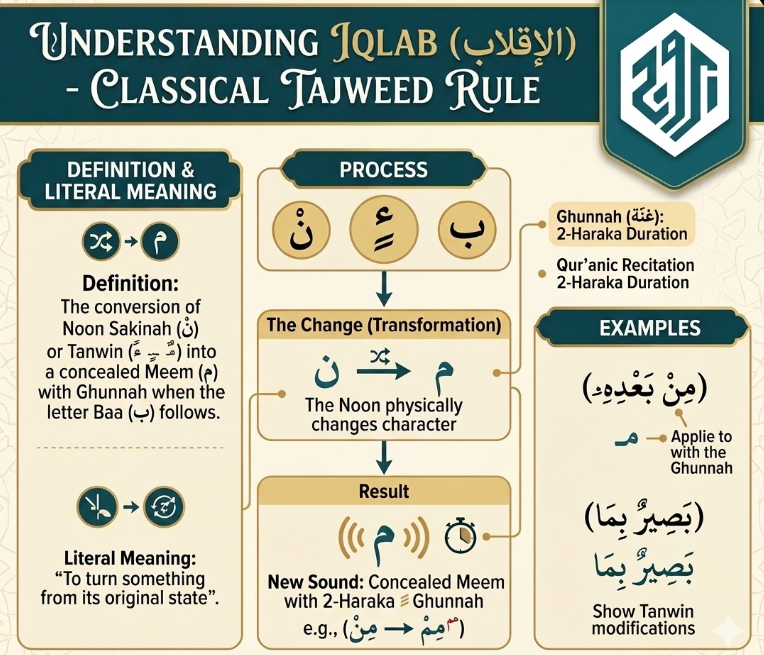
Iqlab (الإقلاب) is defined in classical Tajweed scholarship as the conversion of Noon Sakinah or Tanwin into a concealed Meem with Ghunnah when the letter Baa (ب) follows.
Iqlab Meaning in Arabic
The term itself means “to turn something from its original state” — which is precisely what occurs: the Noon does not disappear, nor does it assimilate; it physically changes character.
Why Does Iqlab Exist?
The reason scholars explain for this conversion is phonetic efficiency. Pronouncing a Noon directly before a Baa is naturally awkward because Noon is a nasal dental sound while Baa is a bilabial stop — the articulation points are far apart. The Meem shares the nasality of Noon and the bilabial point of Baa, making it the natural phonetic bridge between the two.
At Buruj Academy, our Ijazah-certified instructors teach students to understand the why before the what — because when a student grasps the phonetic logic behind Iqlab, they stop forgetting it mid-recitation. This insight comes from over 12 years of teaching non-Arabic speakers who initially try to force a Noon sound before Baa, creating an unnatural pause that disrupts recitation flow entirely.
Book a FREE trial session with one of Buruj’s Azhari Quran tutors

Read also: The 6 Throat Letters in Arabic: Pronunciation, Makharij, and Tajweed Rules
What Are the Iqlab Letters — And Why Is There Only One?
The iqlab letters consist of exactly one letter: Baa (ب). This is the only letter in the entire Arabic alphabet that triggers the Iqlab ruling. No other letter causes Noon Sakinah or Tanwin to transform into a Meem.
This singular status makes Iqlab arguably the easiest of the four Noon Sakinah rulings to identify. Compare the letter counts across all four rulings:
| Ruling | Letters Involved | Identification Difficulty |
| Izhar (Throat Letters) | 6 letters | Moderate |
| Idgham (Merging) | 6 letters | Moderate |
| Ikhfa (Concealment) | 15 letters | Higher |
| Iqlab (Conversion) | 1 letter (Baa only) | Simplest |
For students beginning their Tajweed for Beginners course, Iqlab is typically introduced early — precisely because its single-letter condition removes the memorization burden that comes with Ikhfa and Idgham.
Book Your FREE Trial Lesson to Begin Your Tajweed Journey

What Is the Iqlab Pronunciation?
The Iqlab pronunciation in practical recitation is a three-step physical process that must occur simultaneously. Understanding it as a sequence helps students build reliable muscle memory.
Step One — Convert the Noon into a Meem
The moment Noon Sakinah or Tanwin meets Baa, the Noon ceases to be pronounced as Noon. A Meem takes its place — but this Meem is not written in the standard script. It exists only in pronunciation (لفظاً لا خطاً — in sound, not in writing).
Step Two — Conceal the Meem Before the Baa
This Meem is not a fully articulated Meem. It undergoes Ikhfa Shafawi — a labial concealment where the lips approach but do not fully press together.
This is the most commonly misapplied aspect of Iqlab we observe at Buruj Academy. Students who learn Iqlab from written explanations alone often seal their lips completely, producing a fully pronounced Meem. That is technically incorrect — the sound is muffled, resonant, and nasal, not sharp.
Step Three — Sustain the Ghunnah for Two Counts
Throughout this conversion, a nasal resonance (Ghunnah) of two counts (two beats at the student’s natural recitation tempo) must be maintained. The Ghunnah is the acoustic signature of Iqlab — it is what distinguishes it from a plain Meem.
Excel in Your Quranic Studies
Join Buruj Academy and master the Quran with our structured, professional curriculum.
Book Your Free TrialHow Does Iqlab Apply with Noon Sakinah vs. Tanwin?
The iqlab rule applies in two distinct contexts — with Noon Sakinah and with Tanwin — and each has different positional possibilities.
| Context | Position | Example |
| Noon Sakinah | Within one word | أَنـبَتَتْ — the Noon of أَنـ before Baa |
| Noon Sakinah | Across two words | مِنْ بَعْدِ — Noon of مِنْ before Baa of بَعْدِ |
| Tanwin | Across two words only | سَمِيعٌ بَصِيرٌ — Tanwin Damm before Baa |
Tanwin cannot occur within a single word by grammatical definition — it is always a word-ending marker — so its Iqlab always spans two words. Noon Sakinah, however, can appear mid-word, making both positions possible.
One nuanced case worth noting: in Surah Al-‘Alaq (96:15), the word لَنَسْفَعاً contains what appears to be Tanwin but is technically a Noon of Emphasis (نون التوكيد). Classical Tajweed scholarship holds that this Noon takes the Iqlab ruling when followed by Baa — because functionally it behaves like Tanwin in this position. This is the kind of detail our Al-Azhar University graduates cover in depth during live recitation sessions.
Discover the Buruj Academy Difference
Step into our virtual classrooms and see how our expert instructors make learning Quran and Arabic intuitive and clear. We focus on overcoming the specific hurdles non-native speakers face, building your confidence and connection with the Quran.
Read also: Heavy and Light Letters in Tajweed: Tafkheem and Tarqeeq Fully Explained
Iqlab Examples Directly from the Quran
Recognizing iqlab examples in actual Quranic text builds the pattern recognition that makes the rule automatic. Here are verified examples across multiple Surahs:
مِنْ بَعْدِ
Min ba’di
“After”
(Noon Sakinah of مِنْ converts to concealed Meem before Baa — classic two-word Iqlab)
أَنـبَتَتْ
Ambatat
“It produced” — (Al-Baqarah 2:261)
(Noon Sakinah within a single word — the Noon of أَنـ converts before Baa)
وَاللّهُ بَصِيرٌ بِالْعِبَادِ
Wallahu Baseerun bil-‘ibaad
“And Allah is Seeing of His servants.” (Aal ‘Imran 3:15)
(Tanwin Damm on بَصِيرٌ converts before Baa — two-word Tanwin Iqlab)
وَاللّهُ عَلِيمٌ بِالظَّالِمِينَ
Wallahu ‘Aleemun bith-thalimeen
“And Allah is Knowing of the wrongdoers.” (Al-Baqarah 2:246)
(Tanwin on عَلِيمٌ before Baa — note the small Meem marker in the Uthmani Mushaf)
How Is Iqlab Marked in the Uthmani Mushaf?
One of the most practical Iqlab meaning Tajweed aids is the Mushaf notation system. The Uthmani script — used in standard printed Qurans worldwide — signals every Iqlab position visually, so readers are never left to guess.
For Noon Sakinah: A small Meem (م) appears directly above the Noon Sakinah. This small Meem is not part of the word’s spelling — it is purely a recitation instruction.
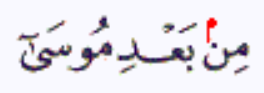
For Tanwin: The usual double diacritic is replaced by a single diacritic followed by a small Meem. For example, Tanwin Damm (ٌ) becomes a single Damm with a small Meem beside it.

Students who learn to recognize this small Meem marker progress significantly faster than those working from memory alone. In our Online Tajweed Classes at Buruj Academy, we train students to scan ahead for this marker before beginning a new page — creating a pre-reading habit that prevents Iqlab errors before they occur.
Book Your FREE Trial Lesson to Begin Your Tajweed Journey
Common Mistakes Non-Arabic Speakers Make with Iqlab
Understanding what is iqlab in tajweed academically does not automatically translate into correct application. These are the three most consistent errors we observe:
Mistake 1 — Pronouncing a Full Noon Before the Baa
Students who have not yet internalized the conversion instinctively try to say the Noon, then immediately say Baa. This produces a two-step sound (Noon + Baa) instead of the single converted Meem-Baa. It is the most common error in early recitation attempts.
Mistake 2 — Sealing the Lips Completely for the Meem
As mentioned, the converted Meem requires Ikhfa Shafawi — a partial, not complete, labial closure. Students who seal their lips fully produce a heavy, distinct Meem that is stronger than what Tajweed requires. If you can hear a clear “mmm” sound, the lips are too tight.
Mistake 3 — Dropping the Ghunnah Entirely
Some students focus so much on converting the Noon that they forget to sustain the nasal resonance for two counts. The Ghunnah is not optional — it is a defining characteristic of Iqlab. Without it, the recitation is technically deficient.
For a fuller understanding of how Ghunnah operates across Tajweed rulings, see our guide on Ghunnah and its rules — which covers nasal resonance requirements across all relevant positions.
Excel in Your Quranic Studies
Join Buruj Academy and master the Quran with our structured, professional curriculum.
Book Your Free TrialHow Iqlab Relates to Other Noon Sakinah Rules
Iqlab does not exist in isolation — it is one of four rulings that govern every occurrence of Noon Sakinah and Tanwin in the Quran. Knowing where Iqlab ends and other rules begin prevents confusion during recitation.
| Ruling | Trigger Letters | What Happens to Noon |
| Izhar | ء ه ع ح غ خ | Noon pronounced clearly |
| Idgham with Ghunnah | ي ن م و | Noon merges into next letter with nasality |
| Idgham without Ghunnah | ل ر | Noon merges silently |
| Ikhfa | 15 letters | Noon concealed with partial nasality |
| Iqlab | ب only | Noon converts to concealed Meem with Ghunnah |
For detailed coverage of Ikhfa — the most letter-intensive of these rulings — our article on the Ikhfa letters in Tajweed provides a complete breakdown. For Idgham, see our Idgham rules in Tajweed guide.
Understanding Iqlab within this framework helps students see the internal logic of Tajweed — a system designed entirely around natural Arabic phonetics. We also recommend reviewing our Tajweed rules essential guide for the complete picture of how these rulings interact.
Excel in Your Quranic Studies
Join Buruj Academy and master the Quran with our structured, professional curriculum.
Book Your Free TrialMaster Iqlab and All Tajweed Rules with Buruj Academy’s Expert Instructors
Iqlab’s single-letter condition makes it one of the most accessible Tajweed rulings — but correct application still requires trained ears and real-time correction that written guides cannot provide.
At Buruj Academy, our Online Tajweed Classes are taught by Ijazah-certified instructors and Al-Azhar University graduates with 12+ years of experience guiding non-Arabic speakers to accurate, confident recitation. Our Buruj Method trains your ear before introducing rules — so Iqlab becomes a reflex, not a memory test.
Join a supportive learning environment tailored to your pace and lifestyle. Start your journey toward excellence by enrolling in one of our specialized tracks:
- Online Tajweed Classes
- Tajweed Classes for Beginners
- Tajweed Classes for Adults
- Tajweed Classes for Sisters
- Tajweed Classes for Kids
- Advanced Tajweed Course
- Amli Tajweed Course (Practical Application)
Every session is 1-on-1, fully flexible, and designed around your pace and schedule. Book your free trial lesson today and let our instructors hear your recitation, identify your exact errors, and build a personalized Tajweed path for you.
Frequently Asked Questions About Iqlab Letters
How Many Letters Does Iqlab Have in Tajweed?
Iqlab has exactly one letter: Baa (ب). This makes it the only Noon Sakinah ruling governed by a single letter. Every other ruling — Izhar, Idgham, and Ikhfa — involves multiple letters. When you see Noon Sakinah or Tanwin followed by Baa anywhere in the Quran, Iqlab applies without exception.
What Is the Difference Between Iqlab and Ikhfa Shafawi?
Iqlab converts Noon Sakinah or Tanwin into a concealed Meem when Baa follows. Ikhfa Shafawi is a separate ruling that applies to Meem Sakinah specifically when it meets a Baa. The Meem produced in Iqlab then undergoes a form of concealment similar to Ikhfa Shafawi — but Iqlab and Ikhfa Shafawi are distinct rulings with different triggers. Explore Tajweed for beginners for a structured introduction to both.
Does Iqlab Apply Within a Single Word or Only Between Two Words?
Iqlab applies in both positions. Noon Sakinah within a single word — such as أَنـبَأَ — triggers Iqlab when the Baa immediately follows within that word. Tanwin, being a grammatical word-ending marker, only triggers Iqlab across two words. Both positions carry the same ruling: convert to concealed Meem with Ghunnah of two counts.
How Do I Recognize Iqlab When Reading the Mushaf?
The Uthmani Mushaf marks every Iqlab position with a small Meem (م) written above the Noon Sakinah or beside the Tanwin. This visual marker eliminates guesswork and serves as a reliable recitation aid. Training yourself to scan for this small Meem before beginning a recitation passage is one of the fastest ways to apply Iqlab consistently.
Is the Ghunnah in Iqlab the Same Length as in Idgham?
Yes — the Ghunnah in Iqlab is held for two counts (harakatayn), the same obligatory length as the Ghunnah in Idgham with Ghunnah. Both involve a nasal resonance of equal duration. The difference lies in what precedes the Ghunnah: in Iqlab, the Noon converts to a concealed Meem; in Idgham, the Noon merges into the following letter.
Related Articles
Tajweed