 Arabic

| Key Takeaways |
| Shaddah is a diacritical symbol placed above a letter to indicate it is doubled — one silent consonant followed by one voweled consonant. |
| In Tajweed, shaddah requires the voice to stop completely at the letter’s articulation point before releasing it with full vowel sound. |
| Noon and Meem with shaddah carry an obligatory ghunnah (nasal resonance) held for exactly two counts in Quranic recitation. |
| Shaddah combines with three vowels: fathah (َّ), dammah (ُّ), and kasrah (ِّ), each producing a distinct but equally doubled pronunciation. |
| Common errors include splitting the doubled letter into two audible syllables or under-pressing, which loses the shaddah’s characteristic weight. |
Reciting the Quran accurately depends on mastering small but powerful symbols — and few carry as much weight as the shaddah. Students who skip it or soften it unintentionally change the meaning of a word entirely.
The shaddah (ّ) is the Arabic diacritical mark that doubles a consonant, representing two identical letters merged into one stressed sound: the first silent, the second voweled. Mastering it is non-negotiable for correct Arabic pronunciation and valid Tajweed recitation.
Table of Contents:
What Does Shaddah Mean in Arabic?
Shaddah in Arabic literally means “intensity” or “stress,” and that definition describes its function precisely. It signals that the letter beneath it represents two consonants — one sukoon (vowel-less) immediately followed by the same letter carrying a vowel — merged through a process called idgham (assimilation).
The result is a single, forceful sound that demands full pressure at the letter’s articulation point (makhraj). Without that pressure, the letter loses its doubled value entirely.
The Shaddah Symbol
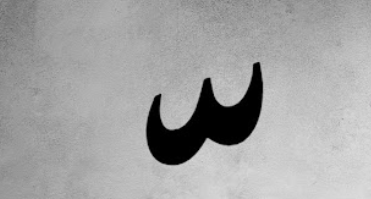
In written Arabic, the shaddah symbol (ّ) always sits above the letter. It combines with:
| Vowel | Symbol | Example Word | Meaning |
| Fathah | َّ | سَلَّمَ | He greeted / handed over |
| Dammah | ًّ | يُحِبُّ | He loves |
| Kasrah | ِّ | مُعَلِّم | Teacher |
Understanding the shaddah symbol is the first step — correct pronunciation is the second, and it requires proper instruction to develop.
Read also: Leen Letters in Arabic and in Tajweed
How Is Shaddah Pronounced in Arabic and English?
Shaddah pronunciation is where most non-Arabic speaking students struggle. The instinct is to either rush past it or artificially split it into two distinct syllables. Neither approach is correct.
To pronounce a letter with shaddah accurately, close the airflow completely at the letter’s makhraj, hold briefly, then release with the accompanying vowel sound.
Think of the English word “with that” spoken fast — the “th” naturally doubles. The doubled Arabic consonant works on the same principle but with deliberate, controlled pressure.
What Shaddah Sounds Like with Each Vowel
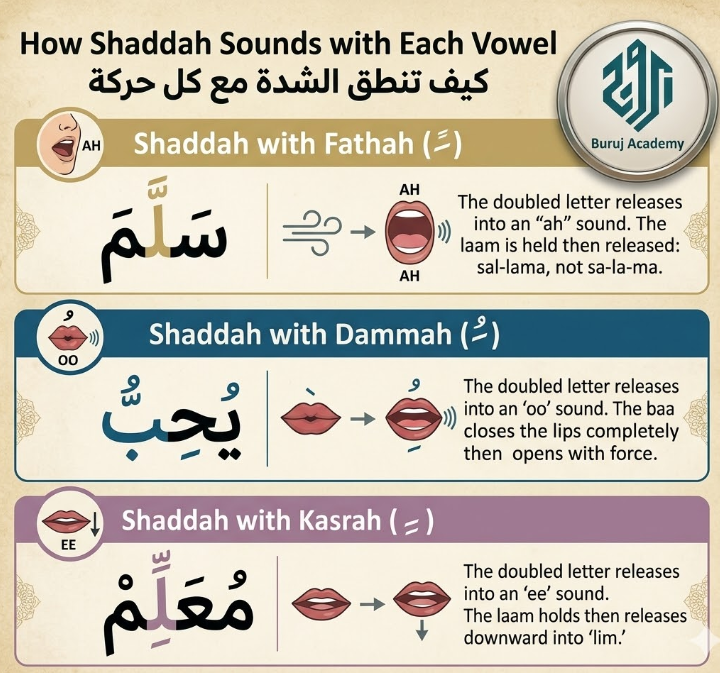
In our sessions at Buruj Academy, we consistently observe that students who learn shaddah pronunciation through sound imitation first — before studying the written rule — develop accurate muscle memory two to three times faster than those taught the rule-first approach. This is central to the Buruj Method: sound before rules.
Understand the Arabic Grammar with Buruj’s free trial lesson

What Is Shaddah in Tajweed?
In Tajweed, shaddah represents the merging of two identical consonants into a single doubled letter. The first of the two is vowel-less (sakin) and the second carries a vowel (mutaharrik) — and when they meet, the first assimilates completely into the second, producing one forcefully stressed sound at the makhraj.
This process is called idgham al-mithlain (إدغام المثلين) — the assimilation of two identical letters. The result is a letter that carries double the articulatory weight of a normal consonant: the makhraj closes fully for the silent first letter, then releases with force on the voweled second.
This is an important distinction for students to internalize: the shaddah symbol (ّ) is not simply an instruction to “press harder” on one letter. It represents two real consonants — one silent, one voweled — that have merged. Reciting it correctly means giving both their due weight within a single, held articulation.
For students deepening their understanding of how letter assimilation works across Tajweed rules, our guide on Tajweed for beginners provides the foundational framework.
Excel in Your Quranic Studies
Join Buruj Academy and master the Quran with our structured, professional curriculum.
Book Your Free TrialShaddah Rules for Noon and Meem: The Ghunnah Obligation
When the letters Noon (ن) or Meem (م) carry a shaddah, a specific and mandatory Tajweed rule activates: ghunnah (غُنَّة) — a nasal resonance held for exactly two counts (harakatayn).
This is not optional ornamentation. It is an obligatory Tajweed ruling confirmed by Tajweed scholars across all major recitation traditions.
| Letter | With Shaddah | Rule | Duration |
| Noon | نَّ / نِّ / نُّ | Ghunnah obligatory | 2 counts |
| Meem | مَّ / مِّ / مُّ | Ghunnah obligatory | 2 counts |
| All other letters | Any shaddah | Full doubling, no ghunnah | N/A |
The ghunnah for Noon and Meem with shaddah is considered the most complete (akmal) expression of ghunnah in the entire science of Tajweed — fuller than the ghunnah in Ikhfa or Idgham.
For a detailed study of how ghunnah functions across different Tajweed contexts, our article on ghunnah and its rules covers every ruling in depth.
Buruj Academy’s Online Tajweed Classes train students to produce the correct ghunnah duration from the first lesson — using audio modeling from Ijazah-certified instructors before introducing the written rule.
Book Your FREE Trial Lesson to Begin Your Tajweed Journey

Shaddah Examples in the Quran
The Quran contains hundreds of examples of shaddah across all letter types. Studying these examples in context is the most effective way to internalize correct pronunciation.
Noon and Meem with Shaddah (Ghunnah Required)
إِنَّ ٱللَّهَ كَانَ عَلِيمًا خَبِيرًا
Innallāha kāna ‘alīman khabīrā
“Indeed, Allah is ever Knowing and Acquainted [with all things].” (An-Nisa 4:35)
(The Noon in إِنَّ carries full shaddah with ghunnah — two counts of nasal resonance before releasing into the following laam.)
ثُمَّ كَانَ مِنَ ٱلَّذِينَ ءَامَنُوا۟
Thumma kāna minal-ladhīna āmanū
“And then being among those who believed.” (Al-Balad 90:17)
(The Meem in ثُمَّ requires full lip closure, ghunnah held two counts, then release into the following kaf.)
Shaddah with Fathah in the Quran
ٱلرَّحْمَٰنِ ٱلرَّحِيمِ
Ar-Raḥmāni ar-Raḥīm
“The Entirely Merciful, the Especially Merciful.” (Al-Fatihah 1:3)
(The Raa in ٱلرَّحْمَٰنِ carries shaddah with fathah — the tongue presses firmly to the articulation point of raa before releasing into the voweled sound.)
Shaddah with Dammah in the Quran
وَلَا تَحَاضُّونَ عَلَىٰ طَعَامِ الْمِسْكِينِ
Wa lā tuḥaddūnal-ṭa’ām
“And you do not encourage one another to feed the poor.” (Al-Fajr 89:18)
(The Daad in تَحَاضُّونَ requires complete lip closure — held — then released with the dammah.)
Shaddah at the End of a Word (Waqf Position)
When stopping (waqf) on a word ending in shaddah, the doubled consonant is held with full pressure but the vowel is dropped. In ٱلْحَقّ (Al-Haqq), stopping on the word means the Qaaf is doubled and held firmly — but the final dammah or fathah is not pronounced.
Discover the Buruj Academy Difference
Step into our virtual classrooms and see how our expert instructors make learning Quran and Arabic intuitive and clear. We focus on overcoming the specific hurdles non-native speakers face, building your confidence and connection with the Quran.
Read also: What Is Sukoon in Arabic and Tajweed?
Types of Shaddah in Arabic
Not every shaddah in the Quran originates the same way. Classical Arabic grammar and Tajweed scholarship distinguish between two types:
1. Original shaddah (أصلية)
The doubling is part of the word’s root structure. The shaddah exists in the word regardless of its grammatical context. Example: قَدَّمَ (qaddama — he presented) — the daal is doubled in the root itself.
2. Acquired shaddah (عارضة) through Idgham
This shaddah results when two adjacent letters of the same or similar type merge across word boundaries. The first letter (with sukoon) assimilates into the second, producing an audible shaddah.
Example: مِن رَّبِّهِمْ — the Noon of مِن assimilates into the Raa of رَّبِّهِمْ, producing a doubled Raa with shaddah. This is the rule of Idgham in Tajweed, which governs several letter combinations in the Quran.
| Shaddah Type | Origin | Example | Context |
| Original (أصلية) | Root of the word | قَدَّمَ | Always present in the word |
| Acquired via Idgham | Meeting of two letters | مِن رَّبِّهِمْ | Across word boundaries |
Common Shaddah Pronunciation Errors to Correct
In over twelve years of teaching non-Arabic speaking students at Buruj Academy, our Al-Azhar-trained instructors have identified three errors that appear with striking consistency — across all nationalities and age groups.
Error 1 — Splitting the shaddah into two audible syllables
Students pronounce إِنَّ as in-na (two separate syllables) instead of holding the Noon at its makhraj and releasing once. The correct production feels like one weighted sound, not two.
Error 2 — Under-pressing the makhraj
The letter is recognized as doubled but insufficient pressure is applied. The result is a soft, unconvincing doubled sound that loses the characteristic weight of the shaddah. This is especially common with labial letters like Baa and Meem.
Error 3 — Skipping ghunnah on Noon and Meem with shaddah
Students apply the doubling correctly but omit the two-count nasal resonance. In Tajweed, this is a substantive recitation error — the ghunnah is obligatory, not decorative.
Correcting these errors requires guided listening and real-time feedback — not self-study alone. Buruj Academy’s Tajweed for Beginners course targets exactly these foundational errors from the first session using the Buruj Method’s sound-first correction approach.
Book Your FREE Trial Lesson to Begin Your Tajweed Journey

The Semantic Weight of Shaddah in Quranic Arabic
Beyond pronunciation, the shaddah in Quranic Arabic frequently carries deliberate semantic emphasis. Classical Tafsir scholars note that the doubling of a letter in certain words reflects the intensity of the meaning being conveyed.
Consider لُجِّيٍّ (An-Nur 24:40) — describing the deep, layered darkness of an abyssal ocean. The shaddah on the Jeem intensifies the word’s meaning of extreme depth and heaviness. Similarly, صِرٍّ (Al-Imran 3:117) — describing a biting, destructive wind — uses the shaddah on the Raa to convey sharpness and severity.
This relationship between shaddah and intensified meaning reinforces why correct recitation matters. Softening a shaddah is not merely a pronunciation slip — it can diminish the expressive force the Quran intends at that precise word.
For students engaged in memorization, understanding these semantic layers deepens both retention and reverence. Our guidance on how to memorize the Quran faster explores how meaning-awareness strengthens long-term Hifz retention.
Excel in Your Quranic Studies
Join Buruj Academy and master the Quran with our structured, professional curriculum.
Book Your Free TrialMaster Shaddah Recitation with Buruj Academy’s Expert Instructors
Correct shaddah recitation requires more than knowing the rule — it requires trained hearing, precise makhraj control, and real-time correction from a qualified teacher.
Buruj Academy’s Online Tajweed Classes provide exactly that — personalized 1-on-1 sessions with Ijazah-certified instructors and Al-Azhar University graduates who have spent 12+ years training non-Arabic speaking students worldwide.
Our Buruj Method places sound accuracy before rule memorization, ensuring every student builds genuine recitation skill, not theoretical knowledge alone. Sessions are fully flexible with 24/7 scheduling.
Join a supportive learning environment tailored to your pace and lifestyle. Start your journey toward excellence by enrolling in one of our specialized tracks:
- Online Tajweed Classes
- Tajweed Classes for Beginners
- Tajweed Classes for Adults
- Tajweed Classes for Sisters
- Tajweed Classes for Kids
- Advanced Tajweed Course
- Amli Tajweed Course (Practical Application)
Book your free trial lesson today and recite with confidence, accuracy, and the weight your recitation deserves.
Frequently Asked Questions About Shaddah
What Is the Difference Between Shaddah and Sukoon?
Sukoon (ْ) marks a consonant with no vowel — it indicates the letter is silent and held briefly. Shaddah (ّ) marks a consonant that is doubled — representing two identical letters merged into one, with the first silent and the second voweled. Both affect how a letter is held, but shaddah always carries a following vowel sound.
Does Every Shaddah in the Quran Require Ghunnah?
No. Ghunnah (nasal resonance held for two counts) is required only when Noon (ن) or Meem (م) carries the shaddah. For all other letters — such as Raa, Laam, Qaaf, or Baa with shaddah — full doubling at the makhraj is required, but no ghunnah applies.
How Do I Know If a Shaddah Is Original or Comes from Idgham?
If the shaddah appears on a letter within a standalone word, it is original (أصلية) and part of the word’s root. If the shaddah appears on the first letter of a word following a compatible letter at the end of the previous word — particularly Noon sakinah or tanween — it is an acquired shaddah produced by Idgham. A qualified Tajweed teacher can train you to identify this quickly in live recitation.
Can I Learn Shaddah Pronunciation Without a Teacher?
You can learn the rule independently, but correct pronunciation requires guided correction. The three most common errors — splitting the sound, under-pressing the makhraj, and skipping ghunnah on Noon and Meem — are almost impossible to self-diagnose without an experienced teacher listening in real time. Even students with years of independent study often carry uncorrected shaddah habits. Starting with guided instruction from the beginning builds accurate habits that last.
Is Shaddah Found in Both Arabic Grammar and Tajweed?
Yes. In Arabic grammar, shaddah results from the merging of two identical consonants and affects word morphology and meaning. In Tajweed, shaddah is a recitation instruction requiring specific articulatory pressure, makhraj closure, and — for Noon and Meem — obligatory ghunnah. The two frameworks overlap but serve different purposes: grammar explains why the shaddah exists; Tajweed governs how it must be recited. Both are studied in Buruj Academy’s integrated Quran and Arabic programs. Explore how Tajweed rules interconnect through our complete Tajweed rules guide.