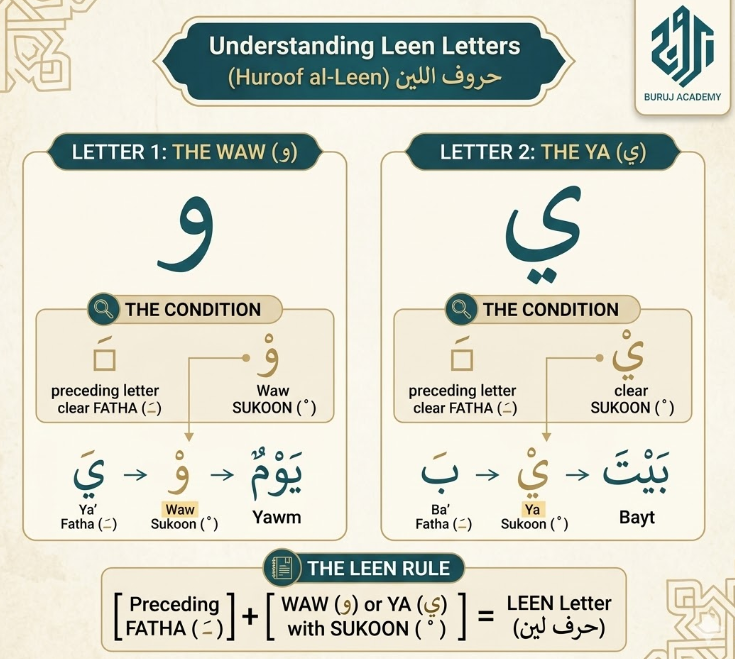
Leen letters are Waw and Ya when sukoon follows a fatha — found in words like خَوْف (khawf) and بَيْت (bayt).
Madd al-Leen applies only during waqf (pause); during wasl (continuation), leen letters are pronounced short without any elongation.
Leen letters differ from madd letters because the vowel before them is a fatha, not a matching vowel (damma or kasra).
Madd al-Leen is permissible at 2, 4, or 6 counts — like Madd al-‘Arid lil-Sukoon, all three lengths are valid.
Leen letters never appear at the beginning of a word and are distinct from the three standard madd letters (Alif, Waw, Ya).
Reciting the Quran with proper Tajweed means knowing not just the big rules, but the subtle ones that shape every word. Leen letters are among the most commonly mispronounced elements by non-Arabic speaking students — not because they are complicated, but because their rule changes entirely depending on whether you stop or continue.
Leen letters are the sukoon Waw (وْ) and sukoon Ya (يْ) when the letter before each carries a fatha. They produce a naturally soft, gliding sound — and when you pause on a word ending with one, a specific elongation rule called Madd al-Leen comes into effect.
Table of Contents:
What Are Leen Letters in Arabic Tajweed?
Leen letters (حروف اللين, Huroof al-Leen) are exactly two: the Waw (و) and the Ya (ي), both carrying sukoon, with a fatha on the letter immediately before them. This precise combination — fatha before sukoon Waw or Ya — is what defines a leen letter.
The word “leen” (لين) means softness or ease in Arabic. These letters earned their name because they exit the mouth with a natural, effortless glide — no tension on the tongue, no forceful articulation. In our sessions at Buruj Academy, we find that students actually produce leen sounds instinctively without realizing it — the challenge is learning when to extend them and when not to.
Leen letters appear in the middle or at the end of words. They never occur at the beginning of a word.
Are There 3 Soft Letters in Arabic?
A common question — especially among students encountering the term “3 soft letters in Arabic” — relates to whether the Alif belongs alongside Waw and Ya in this category. The answer requires a careful distinction.
In Arabic linguistics and spelling (imla’), the Alif is classified broadly as a soft or easy letter, and the three letters Alif (ا), Waw (و), and Ya (ي) are collectively called huroof al-‘illa (حروف العلة) — the weak or soft letters. In this grammatical context, yes, three soft letters exist in Arabic.
However, in Tajweed science specifically, the leen letters are only two: sukoon Waw and sukoon Ya preceded by fatha. The Alif is not classified as a leen letter in Tajweed because the Alif always carries sukoon by nature and always follows a fatha — making it a standard madd letter (Madd Tabii), not a leen letter. The Alif has no separate leen ruling; it belongs to the madd category without qualification.
Context
Soft Letters Count
Letters Included
Arabic linguistics / grammar
3
Alif (ا), Waw (و), Ya (ي)
Tajweed science (leen category)
2
Sukoon Waw + fatha before, Sukoon Ya + fatha before
Understanding this distinction prevents one of the most frequent conceptual errors we see in students joining Buruj Academy’s Tajweed for Beginners course — assuming the Alif carries a leen ruling and attempting to apply Madd al-Leen to madd Alif words incorrectly.
The name “leen” directly reflects the phonetic reality of these sounds. Classical Tajweed scholars named them huroof al-leen because they exit the articulation point with ease, softness, and no effort from the tongue — unlike emphatic or strong letters that require deliberate muscular control.
Some scholars also note a secondary reason: leen letters carry within them a trace of natural lengthening.
Even at their short, wasl pronunciation, the gliding quality of Waw and Ya gives them a faintly extended character compared to hard consonants. This natural softness is precisely why they receive the special elongation treatment during waqf.
Excel in Your Quranic Studies
Join Buruj Academy and master the Quran with our structured, professional curriculum.
What Is the Difference Between Leen Letters and Madd Letters?
Leen letters and madd letters are closely related but not the same, and confusing them is one of the most consistent errors we correct in our Online Tajweed Classes.
Feature
Leen Letters
Madd Letters
Letters
Waw (وْ) and Ya (يْ) only
Alif (ا), Waw (وْ), Ya (يْ)
Vowel Before
Fatha (open a-sound)
Matching vowel: damma before Waw, kasra before Ya, fatha before Alif
Natural Length
Short — no elongation at wasl
Elongated — minimum 2 counts
Example
خَوْف (khawf), بَيْت (bayt)
يَقُولُ (yaqool), قِيلَ (qeel), قَالَ (qaal)
Madd Rule Applied
Madd al-Leen (at waqf only)
Various madd categories (Tabii, Muttasil, etc.)
The governing distinction is the vowel before the letter. A damma before Waw gives you a madd letter. A fatha before Waw gives you a leen letter — same letter, entirely different rule.
Examples of Leen Letters in the Quran
The Quran contains hundreds of leen letter occurrences. Understanding them through real Quranic words — not abstract descriptions — is how the rule becomes permanent in a student’s memory.
“There will be no fear upon them, nor will they grieve.” (Al-Baqarah 2:38)
(The word خَوْفٌ contains a leen letter: Waw with sukoon, preceded by fatha on the Kha.)
2. Leen Letters with Ya (يْ)
The sukoon Ya preceded by fatha appears in: بَيْت (bayt — house), خَيْر (khayr — good), سَيْف (sayf — sword), عَيْن (‘ayn — eye), قَيْد (qayd — restriction).
A clear Quranic example:
إِنَّ أَوَّلَ بَيْتٍ وُضِعَ لِلنَّاسِ
Inna awwala baytin wudi’a lin-naas
“Indeed, the first House established for mankind…” (Aali ‘Imran 3:96)
(The word بَيْتٍ contains a leen letter: Ya with sukoon, preceded by fatha on the Ba.)
Discover the Buruj Academy Difference
Step into our virtual classrooms and see how our expert instructors make learning Quran and Arabic intuitive and clear. We focus on overcoming the specific hurdles non-native speakers face, building your confidence and connection with the Quran.
What Is Madd al-Leen and When Does It Apply?
Madd al-Leen (مد اللين) is the elongation of a leen letter that occurs specifically during waqf — when you pause on a word ending with a leen letter followed by a final consonant that becomes sukoon due to stopping.
The rule works this way: when the word ends with a leen letter followed by a consonant, and you pause on that word, the final consonant receives sukoon due to waqf. This waqf sukoon triggers the elongation of the leen letter before it — exactly as Madd al-‘Arid lil-Sukoon works. The three permissible lengths are 2 counts (qasr), 4 counts (tawassut), or 6 counts (isba’). All three are valid, and a reciter may choose any of them consistently.
During wasl — continuing without pause — no elongation applies. The leen letter is read at its natural, short sound, like any regular sukoon letter. This wasl-vs-waqf distinction is the entire practical application of the leen rule.
Recitation State
Rule for Leen Letters
Permitted Counts
Waqf (pausing)
Madd al-Leen applies
2, 4, or 6 counts
Wasl (continuing)
No madd — short natural sound
No elongation
In our experience teaching this rule at Buruj Academy, students who first learn it conceptually and then practice it on specific words — rather than trying to apply it while reading full pages — retain it much more reliably within two to three focused sessions.
How Do Leen Letters Relate to Other Tajweed Rules?
Leen letters do not exist in isolation — they connect directly to several other rules a Tajweed student will encounter. Recognizing these connections prevents confusion and deepens overall rule comprehension.
1. Madd al-Leen vs. Madd al-‘Arid lil-Sukoon
These two madd types are governed by the same length options (2, 4, or 6 counts) and both occur at waqf. The difference is what causes the elongation: in Madd al-‘Arid, a regular madd letter is followed by a consonant that receives waqf sukoon.
In Madd al-Leen, a leen letter (fatha + sukoon Waw/Ya) is followed by a consonant that receives waqf sukoon. Same mechanism, different triggering letter.
2. Leen Letters and the Rules of Waqf
Understanding Madd al-Leen requires solid knowledge of waqf (stopping) principles. If you have not yet studied when and how to stop correctly during recitation, we recommend working through our foundational guide on Tajweed for beginners before focusing on leen letter application.
3. Leen Letters and Qalqalah Letters
Students sometimes ask whether leen letters could overlap with Qalqalah letters. They cannot — Qalqalah applies to the five letters (ق ط ب ج د) when they carry sukoon, while leen applies only to Waw and Ya under specific vowel conditions. No letter belongs to both categories simultaneously.
Excel in Your Quranic Studies
Join Buruj Academy and master the Quran with our structured, professional curriculum.
Common Mistakes Non-Arabic Speakers Make with Leen Letters
After years of teaching non-Arabic speaking students at Buruj Academy, several recurring errors appear when students first encounter leen letters.
1. Elongating at wasl
The most frequent mistake is applying Madd al-Leen during wasl — extending خَوْف or بَيْت even while reading connected. The rule is exclusive to waqf. During wasl, leen letters receive zero elongation.
2. Confusing leen Waw with madd Waw
When students see a Waw with sukoon, they sometimes default to madd rules. The check is simple — look at the vowel before it. Fatha before sukoon Waw = leen. Damma before sukoon Waw = madd.
Treating all three madd lengths as mandatory choices
Some students assume they must apply all three options at different points. In practice, a reciter selects one length (2, 4, or 6) and maintains it consistently throughout a given recitation. Switching arbitrarily between lengths is incorrect.
Mispronouncing the glide itself
Some students harden the leen Waw into a full وَ sound or harden the leen Ya into a consonantal يَ. The leen sound is a soft glide — halfway between a vowel and a consonant — and that softness must be preserved. Proper training of the ear before the tongue is exactly why the Buruj Method prioritizes sound recognition in our Online Tajweed Classes.
How to Practice Leen Letters Effectively in Your Daily Recitation
Knowing the rule is the first step — building reliable, automatic application is the real goal. These focused practice strategies are what our Ijazah-certified instructors recommend for non-Arabic speaking students at every level.
Step 1 — Isolate leen words before reading full pages
Take a short list of leen words (خَوْف، بَيْت، يَوْم، خَيْر، سَوْف) and practice stopping on each one at all three lengths — 2, 4, and 6 counts — so your ear learns the difference before applying it in real recitation.
Step 2 — Read Juz ‘Amma and consciously mark leen occurrences
Juz ‘Amma (the 30th Juz) contains numerous accessible examples of leen letters in short, commonly recited surahs. Reading it with awareness of leen positions builds pattern recognition efficiently.
Step 3 — Practice wasl vs. waqf deliberately
Take a single ayah containing a leen letter mid-sentence (wasl context) and at the end (waqf context). Read it both ways until the difference in treatment becomes natural and effortless.
Step 4 — Work with a qualified instructor for real-time correction
Written rules cannot replace live auditory feedback. Our Al-Azhar-trained instructors in the Tajweed for Beginners course correct leen pronunciation errors in real time, which accelerates accurate habit formation considerably faster than self-study alone.
If you are building your foundational Quran reading skills alongside Tajweed, our guide on reading the Quran for the first time provides the ideal structural complement to this rule study.
Excel in Your Quranic Studies
Join Buruj Academy and master the Quran with our structured, professional curriculum.
Master Quranic Recitation with Buruj Academy’s Expert Tajweed Instructors
Leen letters are a precise, learnable rule — and with the right guidance, they become natural within weeks of consistent practice.
At Buruj Academy, our Online Tajweed Classes are taught by Al-Azhar University graduates and Ijazah-certified instructors with 12+ years of experience teaching non-Arabic speakers globally. Every lesson applies the Buruj Method: training your ear before introducing rules, ensuring you hear correct recitation before producing it yourself.
Our Tajweed for Beginners course builds leen letter mastery within a structured, step-by-step curriculum — with personalized 1-on-1 sessions, flexible scheduling, and real-time correction that self-study simply cannot replicate.
Join a supportive learning environment tailored to your pace and lifestyle. Start your journey toward excellence by enrolling in one of our specialized tracks:
Book your free trial lesson today at Buruj Academy and experience the difference of learning Tajweed from qualified instructors who have guided thousands of non-Arabic speakers to confident, accurate Quranic recitation — insha’Allah.
Frequently Asked Questions About Leen Letters
What Are the Two Leen Letters in Arabic Tajweed?
The two leen letters are Waw (و) and Ya (ي), each carrying sukoon, with a fatha on the letter immediately before them. Examples include خَوْف (khawf) for leen Waw and بَيْت (bayt) for leen Ya. These two letters are the only members of this category in classical Tajweed science.
What Is the Difference Between Leen Letters and Soft Letters in Arabic?
“Soft letters in Arabic” and “leen letters” refer to the same concept. The Arabic term “huroof al-leen” translates directly as “soft letters” or “letters of ease.” Both terms describe the sukoon Waw and Ya preceded by fatha, characterized by their effortless, gliding exit point compared to harder Arabic consonants.
Do Leen Letters Apply During Wasl (Continuation)?
No. Leen letters carry no elongation rule during wasl. When a word containing a leen letter is read in connected recitation without pausing, the leen Waw or Ya is pronounced at its natural, short sound like any regular sukoon letter. Madd al-Leen is exclusively a waqf (pause) rule.
How Many Counts Are Allowed for Madd al-Leen?
Madd al-Leen permits three valid lengths: 2 counts (qasr), 4 counts (tawassut), and 6 counts. All three are permissible according to mainstream Tajweed scholarship. A reciter should select one length and apply it consistently throughout their recitation session rather than alternating between them.
How Do I Find Leen Letters While Reading the Quran?
Look for a Waw or Ya carrying sukoon immediately after a letter with a fatha. If the letter before the sukoon Waw or Ya carries any other vowel — damma or kasra — it is a madd letter, not a leen letter. The fatha-before-sukoon-Waw/Ya combination is the single identifying marker for every leen letter occurrence.
Unlock Your Potential at Buruj Academy: Enroll Today and Elevate Your Knowledge!
Join Buruj Academy and embark on a transformative learning journey designed to expand your skills and understanding. Experience expert guidance, interactive courses, and a supportive community that empowers you to achieve academic excellence and personal growth. Start your path to success today!
 Tajweed